Sell My Car Hub

Selling a car for parts: one sale or part it out

To sell a car for parts, you either sell the whole car once to a business that takes it apart (a self-service yard, a full-service recycler or a scrap yard) or you pull the parts yourself and sell them one at a time. Either way, whoever takes the car or its shell will usually want the title, and the state record is closed or branded with a junk, salvage or dismantle filing. Our table shows who files that form in 34 states.

Last updated .

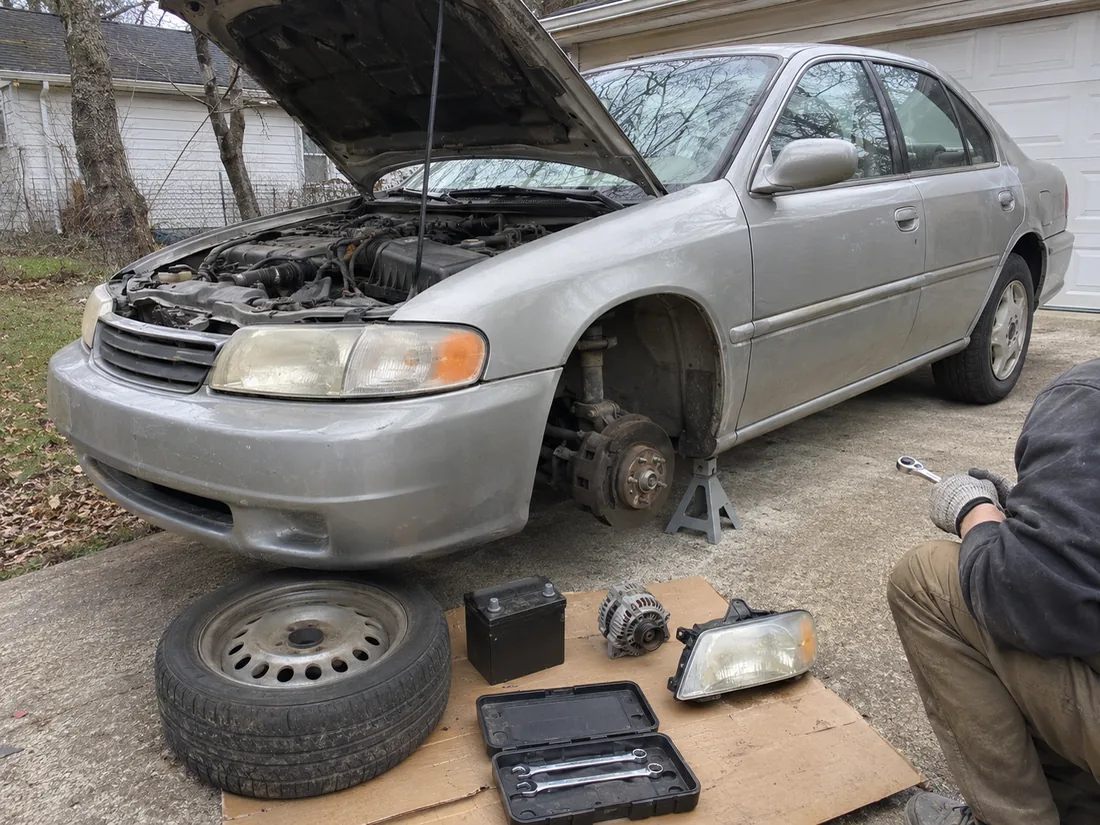
An older silver sedan in a driveway with its hood up and one front wheel off on a jack stand; the wheel, a battery, an alternator, a headlight and a wrench set lie on cardboard beside it while a person in work gloves crouches with a ratchet

Is it better to part out a car or sell it whole?

One sale. A buyer quotes the car as it sits, takes it away, collects the title and does the dismantling. Your work is the paperwork and emptying the car.

Parting out. You become a small parts seller, which takes:

What do used parts sell for? One public yardstick is the price list a self-service yard posts for parts its customers pull themselves. Pick-n-Pull posts one for each yard and says it works by “fixed pricing.” Each list gives one price per kind of part. These are the posted prices at two of its yards, read on November 26, 2026:

Used partOakland, CaliforniaFort Worth, Texas
Engine, complete$399.99$399.99
Automatic transmission$254.99$254.99
Door with hinges$99.99$87.99
Bumper, complete$82.99$96.99
Hood$77.99$77.99
Radiator$76.99$69.99
Headlight assembly$40.99$34.99
Alternator$37.99$32.99
Starter$34.99$30.99

Sources: Pick-n-Pull’s Oakland price list and Fort Worth price list. Several parts carry a core deposit on top; for a complete engine it is $64.99 at both yards. That is what a shopper pays for a part they remove with their own tools, so it is the competition a private seller faces for a common part, not what a seller is paid. A scarcer part can bring more, and a part nobody is looking for does not sell at all.

Get a number for the whole car before a bolt comes out. Ask for a free offer from our buying partner and set that figure against the weeks parting out would take. There is no charge and no obligation, and the offer stays open for a week.

Who buys cars for parts?

A licensed buyer asks for the title and your ID, and a federal reporting rule is one reason. 28 CFR 25.52 defines a junk automobile as one that “Is incapable of operating on public streets, roads, and highways” and “Has no value except as a source of parts or scrap,” and its note counts “pull- or pick-apart yards” and “scrap metal processors” as junk or salvage yards.

Under 28 CFR 25.56, read November 26, 2026, each such yard reports “on a monthly basis” every junk or salvage car “obtained in whole or in part,” with the VIN, “The date the automobile was obtained” and “The name of the individual or entity from whom the automobile was obtained.” The title is what proves that name belongs to the owner. The rule excuses anyone handling “less than five vehicles per year” of that kind, so parting out your own car does not make you a reporting yard.

Do I need a title to sell a car for parts?

Usually, yes. The car, or whatever is left of it, changes hands on the title or on a substitute your state allows. If the title is gone, start with the no-title junk guide and which states stop titling older cars. Some forms in the table cover the no-title case, each with limits:

Clear any loan first. Mississippi and Wisconsin both have you certify that no lien is outstanding; see selling a car with a loan.

What paperwork do I file when I sell a car for parts?

We publish a page on each of these forms, written from the agency’s PDF, and read every one to see who files it. Where the buyer files, ask for a copy: it is your record that the car left your hands.

StateFormWho files it, and what it does
AlabamaMVT 5-48 junk or parts-only noticeBuyer (recycler). Ends the title; ask for a copy
AlaskaForm 849 intent to dismantleOwner. Title, registration and plates go to the DMV
ArkansasForm 82 intent to dismantleOwner or buyer. Cancels the title
ArkansasParts-only title requestOwner. Title branded PARTS ONLY for good
CaliforniaREG 488C salvage or nonrepairableOwner or insurer. Nonrepairable: off California roads for good
ColoradoDR 2410 salvage or nonrepairableOwner (pages 1 to 3). Nonrepairable: parts or scrap only
FloridaHSMV 82363 salvage or destructionOwner or insurer. Destruction: never titled again
GeorgiaMV-1S salvage titleOwner. Salvage title, filed in Atlanta
HawaiiCS-L(MVR)202 junking statementOwner (Honolulu). Never titled or registered again
Idaho3312 salvage certificateOwner. Needed before a kept wreck is sold
IllinoisVSD 325 junk notificationBuyer (scrap processor). Proof it was destroyed; ask for a copy
IndianaSF 49891 salvage affidavitOwner. Owner requests the salvage brand
Iowa411123 junking certificateOwner. Ends the title; 14 days to fix a mistake
Iowa411403 restore a junked titleOwner. Undoes a junking made by mistake
KansasTR-13 salvage or non-repairableOwner. Non-repairable: never retitled for the road
KentuckyTC 96-351 junk a titleOwner. For a car to be crushed or used for parts
KentuckyTC 96-352 reactivate a titleOwner. Reopens a junked title; damage brings a salvage brand
MaineMVT-54 scrapped by recyclerBuyer (recycler); your ID copied. Scrap without a title; not for parts
MarylandVR-028 salvage certificateOwner. For a car sold as salvage
MassachusettsTTL108 junking or scrappingBuyer (company junking it). Ends the record
MichiganTR-12 salvage or scrap titleOwner, insurer or dealer. Scrap: never registered again
Mississippi78-031 cancel title for scrapYou sign; buyer mails it. Never titled again
Missouri5423 scrap bill of saleBuyer (scrap operator); you sign. Old, dead car without a title
MontanaMV206 salvage certificateOwner or insurer. Cars under 15 years; PDF withdrawn
NevadaVP 213 salvage or non-repairableOwner, insurer or wrecker. Non-repairable: crushed or parted out
New HampshireTDMV 24 salvage certificateOwner or insurer. Due 20 days after a total-loss payment
New JerseyOS/SS-61 salvage titleOwner. For a car that may be rebuilt
New JerseyOS/SS-61A junk titleOwner. $2.00; cannot be undone
Oregon735-229 salvage titleOwner or insurer. Ends the registration and plates
PennsylvaniaMV-6 nonrepairable or salvageOwner. Nonrepairable: never retitled
South CarolinaTI-014A disposal affidavitYou swear; recycler verifies. Old, dead car without a title
TennesseeRV-F1311801 salvage or non-repairableOwner. Free; non-repairable is parts or scrap
TexasVTR-441 salvage or nonrepairableOwner or insurer. Nonrepairable never returns to the road
TexasVTR-34-S copy of a salvage titleOwner or lienholder. Replaces a lost branded title
TexasVTR-71-2 authority to disposeOwner. No title; car can only be destroyed
TexasENF-SAL-221-NR disclosureBuyer signs before the sale. Buyer accepts it can never be registered
TexasVTR-203 junk bill of saleDealers and recyclers only. Not yours; sell on the title
UtahTC-802N branded-title noticeInsurer; owner signs. Owner has 10 days to get a branded title
VermontVT-017 rebuilt or salvage titleOwner. 15-day deadline; cars over 15 years exempt
VirginiaVSA 56 salvage certificateOwner. Sent to the branding work center
West VirginiaDMV-SV-1 salvage certificateOwner or insurer. Non-repairable: parts and scrap
WisconsinMV2459 junked vehicle bill of saleOwner. No title on hand; never titled again

Each form ends or changes the car’s record, and many end it for good. Arkansas’s dismantle notice and the Hawaii, Illinois, Iowa, Massachusetts, Mississippi, New Jersey junk, Texas demolisher and Wisconsin forms say the car is not titled again; Arkansas allows a 90-day claim of error, and Iowa a 14-day fix for a mistake or a bonded title once the car is 25 years old. The nonrepairable, scrap and destruction choices in California, Colorado, Florida, Kansas, Michigan, Pennsylvania, Tennessee, Texas and West Virginia are just as final. A salvage certificate still leaves a road back through repair and inspection.

So mind the order: a junk filing kills any market among rebuilders, and our Alaska page warns that a car already declared junk is worth less to a yard.

Five forms in the set are filed only by insurers, or by auctions and dealers handling insurance cars (Delaware MV215, Illinois VSD 929, Massachusetts TTL113, Pennsylvania MV-4IS, Rhode Island’s salvage affidavit); they are the insurer’s job and are left out. Texas VTR-203 stays in because yards hand it out: it is for dealers and recyclers, and a private seller signs over the title instead. States not in the table were not checked for this page; the rest of our state forms are in the forms library.

Which car parts have their own rules?

The catalytic converter. Two examples. California’s Vehicle Code 10852.5 lets a buyer take a used converter from an individual only with documentation such as “a certificate of title or registration that identifies the individual as the legal or registered owner,” with a VIN that “matches the vehicle identification number permanently marked on the catalytic converter.” A first offense costs the buyer $1,000. We read the section on the Legislature’s site on November 26, 2026; it was added by Senate Bill 1087 and took effect January 1, 2023.

Texas’s Occupations Code 1956.0321 has a seller give a metal recycler “the year, make, model, and vehicle identification number” of the car and “a copy of the certificate of title or other documentation” of ownership; otherwise the recycler “may not purchase” it. If yours is already gone, see selling a car without a catalytic converter and fix or sell after a converter theft.

Refrigerant. Under 40 CFR 82.155, the “final processor,” including “scrap recyclers and landfill operators,” must recover what is left in the air conditioning or “Verify using a signed statement or a contract” that it was recovered, with “the name and address of the person who recovered the refrigerant and the date.” If it all leaked out, the yard needs a signed statement saying so. Expect to be asked for one.

Oil and the battery. EPA’s used oil page says to “place it in a leak-proof can or container” and ask local shops, waste collectors or officials where to drop it off. Its battery page says to “Return lead-acid batteries to a battery retailer or local household hazardous waste collection program.”

What happens to the shell, and to a stripped car at home?

What remains is mostly metal, priced by weight. Ask the yard whether it takes a car with major parts missing and whether it tows, since a car with no wheels has to be lifted rather than rolled. Have the title and the refrigerant statement ready.

Until it goes, a half-stripped car can be a local problem. Texas is one example. Transportation Code 683.071 calls a car a “junked vehicle” if it is “wrecked, dismantled or partially dismantled, or discarded,” or inoperable for more than “30 consecutive days, if the vehicle is on private property,” with an expired plate or none. Section 683.072 makes one, “including a part of a junked vehicle,” a public nuisance if it is “visible at any time of the year from a public place or public right-of-way.” Under 683.073 that is a misdemeanor with a fine up to $200 and a removal order, and 683.0711 lets a city adopt “a more inclusive definition.” Other states and cities set their own rules.

How do you decide, and what comes after the sale?

Parting out can make sense with a garage or yard out of public view, the tools, the time and a model whose parts people look for. One sale is the better route without those, when the title needs work, or when the car is complete enough that someone may want it whole. Weigh a repair first with the fix-or-junk math and when repairs stop paying; see also selling a car that doesn’t run, selling a totaled car and state programs that pay to retire a car.

Once the car or shell is gone:

If parting out loses the argument, get a free offer from our buying partner on the whole car. A car that won’t start, or one with a title problem, can still be quoted. The tow costs nothing, and the driver pays by check after confirming the car matches what you described. Start to finish usually takes a few days. More options: how to get rid of an old car and our junk car page.

Common questions

What people ask about this

Will the yard report my name to the federal government?

A junk or salvage yard reports each such car monthly under 28 CFR 25.56, with the VIN, the date and the name of whoever it came from, unless its state already passes that data on.

Do I have to drain the refrigerant before a yard takes the car?

Ask the yard. Under 40 CFR 82.155 it must recover what is left or get a signed statement or contract that it was recovered, and tell suppliers it must be recovered before delivery. A leak caused by “cutting refrigerant lines” does not count as leaked out.

Can a car sold for parts ever be driven again?

A car on a salvage certificate can return after repair and inspection. A junk, scrap or nonrepairable record usually ends its road life for good.

Is a parts-only title the same as a junk title?

Not in Arkansas. Its parts-only title keeps an ownership document, branded PARTS ONLY forever; its dismantle notice cancels the title.

Rather just sell the car?

Get a cash offer for my car → Online · free · no obligation

Or send the details — we'll come to you

Tell us the car, which parts are still on it and whether the title is in your name, and we’ll call you back.

or call/text (877) 405-1808