If you want to sell your car to Pick-n-Pull, its website offers two routes: a junk-car quote priced on scrap and parts demand, and a Sell My Car quote that also weighs mileage. Both say they take cars that don’t run, both offer a free pickup (the junk route only inside its local towing zone), and both pay by check when you hand over the keys and title. Neither publishes a price list.
Last updated .
Yes. Pick-n-Pull is a chain of self-service used-parts yards, and it buys the cars that stock them. Its website runs two separate buying routes, each with its own phone line, and they don’t say quite the same things, so it helps to know which one you are reading:
Asked what types of vehicles it takes, the junk-car FAQ answers “all cars, trucks, vans and SUVs — any year, make or model (running or not).” The same page says that even after a fire or flood, “in most cases” it can buy the car, and that lost keys are fine as long as you have proof of ownership. It doesn’t take everything with an engine: asked about RVs, ATVs and motorcycles, it says “No, unfortunately we do not.”
Damage changes the price, not the answer. The Sell My Car FAQ says the company takes cars that need repairs, “such as an engine that doesn’t work,” and adds: “However, we pay more for cars with no front-end or major damage.” Neither page says anything about cars with parts already stripped off, so if yours is missing an engine, a transmission or its catalytic converter, say so when you ask for the quote. We read both pages on November 25, 2026.
Both routes use three steps: get an offer, schedule the tow, hand over the title and take a check. Here is each one in Pick-n-Pull’s own words, with the places where its two pages differ.
Payment is by check on both routes. The Sell My Car page puts it in one line: “You hand us the title and we’ll hand you the check.” Every payment answer on both pages names a check; the junk page’s “cash offer” is the name of the quote, and neither page mentions a bank transfer or a payment app.
Pick-n-Pull doesn’t publish a price list. None of the three pages we read on November 25, 2026 (the junk-car page, the Sell My Car page and the locations page) gives a dollar figure or a price per ton; the only way to get a number is to ask for a quote. What the company does publish is how it sets the number.
| What the price rests on | Cash For Junk Cars page | Sell My Car page |
|---|---|---|
| Inputs | “the year, demand for parts for that make or model, and the overall condition of the car or truck” | “the make, model, year, mileage, and condition of the vehicle,” plus “current market conditions” |
| Book values | “not based on a Kelly Blue Book value” | Not stated |
| New tires or a new radio | “won’t affect the cash offer” | Not stated |
| The base of the price | “Our prices are based on scrap metal prices” | Market conditions |
| Can the number change? | Offers “can change at any time until they are accepted and the required information has been provided” | The payout stays the same “as long as the vehicle we pick up matches the description you provided” |
So on the junk route, the price follows scrap metal and parts demand, and money you spent on the car recently won’t raise it. That makes the car’s weight and the scrap market the things to understand before you accept. Our guide to what a junk car is worth explains how yards value a car by weight, and the scrap steel price history shows how far that market moves.
For scale only: the Sell My Car page says the business buys 300,000 cars a year, and both pages say it has bought more than 6 million. Those are the company’s own figures, and they say nothing about what any one car brings. The practical step is to collect two numbers in the same week. If you have Pick-n-Pull’s quote, set a free offer from our buying partner beside it. It costs nothing, you aren’t obliged to take it, it stays open for a week, and the tow is free.
Start with the title. The junk-car FAQ says: “In most cases, we will only need the vehicle’s Certificate of Title, however, Some states may also require a bill of sale.” Beyond that, the two routes set different rules, and the Sell My Car route is the stricter one.
| Situation | Cash For Junk Cars page | Sell My Car page |
|---|---|---|
| Title not in your name | “In most cases, we can buy your junk car if the title was not issued in your name,” though some states may require a new title or other papers first | “Your name must also be listed as the owner on the car’s title.” |
| Loan still owed | Not stated | “you must first pay off any loan or lien on the vehicle” |
| Name changed since the title was issued | Proof of the name change and proof of identity, “in most cases” | Not stated |
| No title at all | “Every state has different rules and laws that apply,” and it asks you to call (866) 520-9750 | Not stated |
| Selling at a store | Title or registration, photo ID and the keys | Not stated |
Pick-n-Pull’s pages don’t name a single state when they talk about selling without a title, so there are no state rules of its own to report. The rules that apply are your state’s. Our guides on how to junk a car without a title and how to sell a car without a title cover the replacement-title and other routes. If your state wants a bill of sale too, bill of sale requirements by state says where.
One more thing to know before you call: the owner named on the title has to be at the pickup. If the car belongs to a relative, they need to be there, or the title needs to be put right first.
Its locations page, read on November 25, 2026, lists 48 Pick-n-Pull stores: 44 in 15 U.S. states and four in Canada (three in Alberta, one in British Columbia). California has the most, with 19. The other states are Arkansas, Georgia, Illinois, Indiana, Kansas, Missouri, Nevada, Ohio, Oregon, Rhode Island, Texas, Utah, Virginia and Washington. The same page lists nine Radius Recycling metal yards in Kentucky, Maine, Massachusetts, Oregon, Washington and British Columbia that “accept vehicles but do not sell parts.” The junk-car page gives a rounder number, “50 store locations across the U.S. and Canada,” so expect the count to move.
Two notes from that page are worth reading. Minors under 16 aren’t allowed in the stores. And “Pick-n-Pull is not affiliated with Pick-n-Pull San Antonio,” a separate business with the same name, so a quote from one is not a quote from the other.
On ownership, the site footer reads “Pick-n-Pull Auto and Truck Dismantlers, a subsidiary of Radius Recycling.” Radius itself changed hands in 2025. A press release filed with the SEC and dated July 10, 2025 says Toyota Tsusho America “today completed the acquisition of Radius Recycling, Inc.,” and that Radius’s network “includes 50 stores operating across the U.S. and Western Canada under its Pick-N-Pull brand.” Toyota Tsusho’s own release adds that “Radius has become a wholly owned subsidiary of Toyota Tsusho.” That release says Radius keeps its headquarters in Portland, Oregon, and its brand.
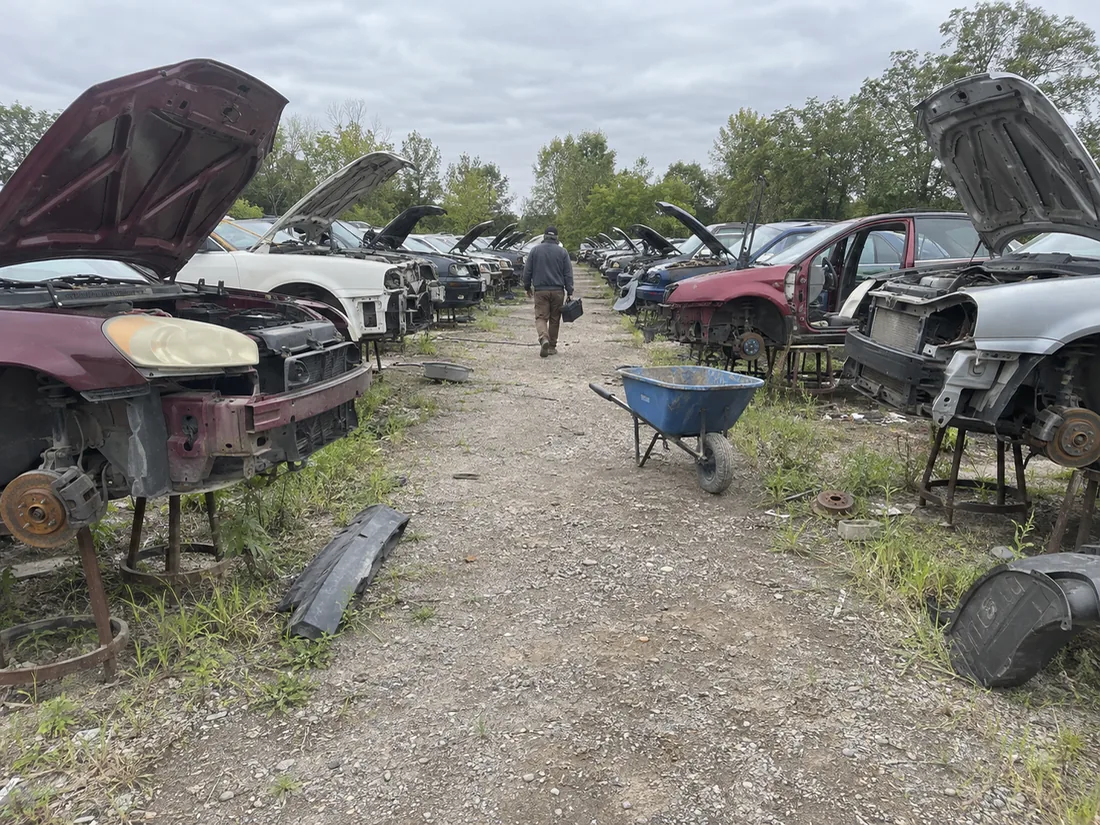
Treat the car as gone once it leaves. On the junk route it goes to a yard, and the junk-car FAQ is plain about the end of the line: the car “will be stripped of its parts, drained of all fluids, crushed and recycled as scrap metal.” Nothing left inside comes back.
Pick-n-Pull is one buyer, and its two routes are already two quotes. Its junk route prices the car on scrap and parts demand; the Sell My Car route asks about mileage too and works through partner locations. If your car still has life in it, asking both is free.
Another self-service chain buys the same kinds of cars: LKQ Pick Your Part. Our guide to selling your car to LKQ sets out its process from its own pages, so you can compare the steps side by side. If the car is fixable and you are on the fence, fix it or junk it runs through the trade-off.
And for a number from outside the yard business, get a free offer from our buying partner. Like Pick-n-Pull, it will quote a car that doesn’t run, and it also looks at cars with title problems. Towing costs you nothing. You are handed a check when the driver arrives and sees the car is as you described it, and the sale usually wraps up in a few days. Take whichever number is higher for your car.
Yes. Its junk-car FAQ says it buys cars, trucks, vans and SUVs of any year, make or model, running or not, and in most cases even after a fire or flood. It does not take RVs, ATVs or motorcycles.
It publishes no price list. Its junk-car page says the price rests on the year, demand for parts for that model, the car’s condition and scrap metal prices, not on Kelley Blue Book, and that new tires or a radio won’t raise it. You get a figure only by asking for a quote.
Within its local tow area, yes. The junk-car page calls the removal free “if it’s within our local towing zone,” and one FAQ answer simply says “Yes, it is free,” but no answer says what happens outside that zone, so ask when you get the quote.
By check. The driver checks that the car matches what you described and takes the keys and title, and you get the check. If you drive the car to a store, you are paid by check there.
It depends on your state. Pick-n-Pull’s junk-car FAQ says every state has different rules and asks you to call (866) 520-9750. Its Sell My Car route requires your name on the title and any loan paid off.
Radius Recycling, according to the site footer. Toyota Tsusho America completed its purchase of Radius on July 10, 2025, and Toyota Tsusho says Radius is now its wholly owned subsidiary.