Sell My Car Hub

Selling a non-runner: who takes a car that can't be driven, and what they pay

If your car doesn't run, you can still sell it as it sits: a non-runner has buyers, just fewer of them. Four kinds of buyer take a non-running car, and the right one for yours comes down to three numbers: what a shop quotes to fix it, what it would be worth running, and what someone will pay for it broken.

Last updated .

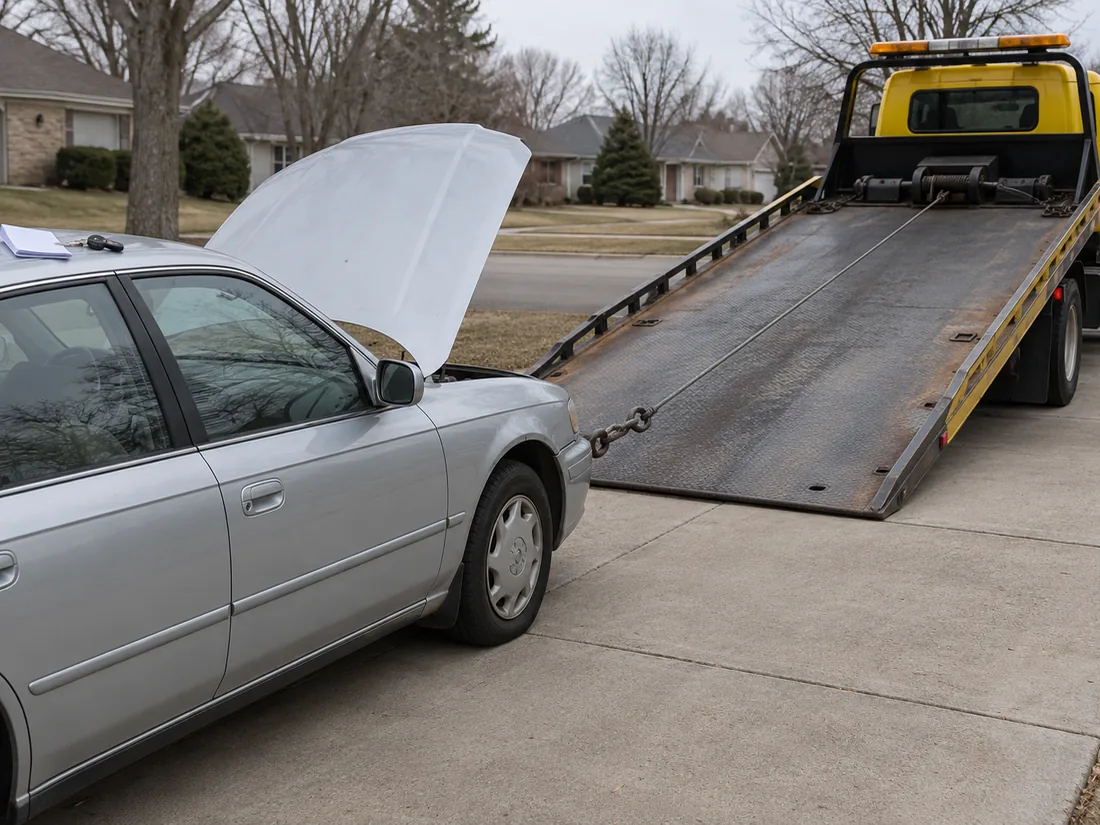
Silver sedan with its hood up on a suburban driveway, winch chain hooked to its front, as a yellow flatbed tow truck tilts its bed down to load it

Who takes a car that won't move, and how each sale works

Every buyer of a car that cannot move has two problems: judging it without a test drive, and getting it off your driveway. Here is how each solves both.

BuyerHow they judge the carHow it leavesHow you are paid
Instant-offer buyerAn online form: year, make, model, mileage, what is wrong. A driver checks the car against your description at pickup.The buyer arranges the pickup and pays for it, at a time you choose.A check from the driver for the online offer, if the car matches what you described.
Junk or scrap yardBy weight, plus the converter and any part with a resale market.Usually the yard's own truck. Ask whether the tow is inside the quote.By the yard's own rules; ask before you book.
Private buyerFrom your photos, the scan codes and a shop's written diagnosis.They bring a trailer or hire a tow.Whatever you agree, in writing, marked as is.
DealerAn appraisal, normally with a drive; phone first and ask whether the store takes a car that cannot move.By the store's own transporter, on its terms.Trade-in credit or a check; see selling to a dealership.

Charity is a fifth route, covered at the end. Here is what Peddle, the instant-offer buyer this site refers sellers to, publishes. Vehicles that are non-running or missing parts can still receive an offer. The offer is free and carries no obligation, and you have a week to accept it and schedule pickup. Peddle arranges and covers the cost of the pickup at a time that suits you, and the online offer is the amount paid at pickup, provided the driver finds the car as you described it. Payment is a check handed over at pickup, and the whole sale usually takes a few days. For a non-runner, two points matter most: any loan must be paid off first, and a missing title changes the offer rather than ending it, because Peddle says it has many buyers that buy cars without a title.

Which row pays most depends on the three numbers below. One pattern holds: a private buyer who can do the repair keeps the margin, so for a cheap, named fault he usually pays more than a scrap yard; what you give up is the tow, the as-is paperwork and the weeks of showing it. If you want the as-is number first, get a free offer on the car as it sits and hold it against the other two.

Diagnose it or sell it: the four faults behind most non-runners

You do not have to know what is wrong to sell the car. You do have to know in order to price it, because "it won't go" covers a battery and a transmission, and those repairs are more than ten times apart in cost. Our four repair guides each take one branch; read the one that matches what the car does when you turn the key.

Nothing, a click, or a slow crank. That is the battery, starter or alternator, the cheapest branch. Why won't my car start walks from the sound you hear to the multimeter numbers that settle it, and says when a jump is pointless.

It cranks and cranks but never catches. The engine is turning, so power is not the problem; fuel or spark is. Car cranks but won't start covers the codes to read first and what a fuel-pressure test measures.

It ran, then the engine failed. Knocking, a head gasket, overheating, a seized or blown engine. Selling a car with engine problems prices each of those and checks whether your engine's failure is a known one in NHTSA's complaint files.

It runs but won't move, or slips. Selling a car with a bad transmission separates a fluid problem from a worn gearbox and explains why a CVT fails differently.

In every branch: pay for a diagnosis, not a repair, until you have the other two numbers. A named fault on a shop's letterhead is worth money with every buyer in the table, because it turns "it won't go" into a cost they can look up.
Pricing a non-runner: repair quote, running value, as-is offer

Three numbers decide it, and none of them needs the car to move.

  1. The repair quote, in writing, for the named fault.
  2. The running value: what the same car sells for with nothing wrong. Our guide to what your car is worth covers the free pricing tools.
  3. The as-is offer: what a buyer pays for it broken, with no repair done.

A repair is worth doing only when it buys more value than it costs, and only if you keep the car long enough to use that value. If the running value minus the as-is offer is smaller than the quote, the repair loses money the day it is finished. Our fix-it-or-junk-it guide works the arithmetic; the four jobs below, RepairPal's national averages before tax, show why the branch matters.

RepairNational averageWhat it usually means for the sale
Battery replacement$456-$493Nearly always worth doing on a car that is otherwise sound; it turns a tow into a drive.
Starter replacement$565-$796Compare the quote with the gap between running and broken value, not with zero.
Fuel pump replacement$1,344-$1,513The first repair that can cost more than an older car is worth; get the as-is number first.
Transmission replacement$6,238-$6,764More than most non-runners are worth running; sell it broken unless the car is new enough to be worth far more fixed.

The floor under every offer is scrap: a car that cannot run still weighs the same, and what a junk car is worth shows how weight, the converter and distance set that floor, with scrap steel prices tracked by month. Before you pay for any repair over about a thousand dollars, see what the car is worth as it sits. The answer is free, and you have a week to decide.

Paperwork when the car can't be driven to a test

A car that cannot be driven changes four pieces of paperwork and leaves the rest alone.

The title. Every buyer in the table signs the car over on the title. For the instant-offer buyer a lapsed registration is "Not a problem!" while the title is current; expired registration by state says what the lapse costs you. A lost title narrows the field: yards and private buyers want it in hand, while the instant-offer buyer asks about it on the form and recalculates the offer. Selling a car without the title covers the replacement route and what to do while you wait.

A loan. "No, all liens and loans must be paid in full before we can buy your vehicle". A private buyer or a yard faces the same lien on the title; selling a car with a loan explains the payoff letter and who pays whom.

The inspection or smog test. In 45 states a private seller owes no test: the buyer takes the car for one after registering it, or there is none. Five states put a test on the seller before certain sales, and a car that cannot run cannot take one.

StateWhat the seller owes
CaliforniaA valid smog certification handed to the new owner, for most gasoline cars from 1976 and diesels from 1998. A car under four years old skips the test and the buyer pays a smog transfer fee.
ColoradoA fresh passing emissions certificate, if the car is past its first seven model years and the buyer lives in the emissions program area.
HawaiiNo emissions test, but a current safety inspection certificate goes to the buyer with the title, and the county records no transfer without it.
MarylandA Maryland Safety Inspection before a vehicle can be sold, titled or transferred, at a station licensed by the State Police; the certificate is valid for 90 days.
MissouriA Certificate of Inspection and Approval no more than 60 days old, unless the car is inside its first ten model years with under 150,000 miles; emissions too in the state's one emissions area.

In those five states, read your state's page before you sign; each names its own exemptions. The inspection rules by state table covers all 50 states, and emissions repair waivers by state shows what each emissions state makes a failing car spend before it stops asking.

Plates, the notice of sale and the bill of sale. Whether the plates stay on the car or come off with you is a state rule (license plates when selling), and so is the form that tells the state the car is gone (notice of sale by state, release of liability). For a car that leaves on a truck, write the bill of sale the way Washington's attorney general advises for any private sale: a description of the vehicle, the price, a statement that you hold clear title, and every promise made. Add that the car does not run and is sold as is. Our bill of sale guide has the rest.

The odometer. Federal law makes the person transferring a car give the buyer a written disclosure of the cumulative mileage, or a disclosure that the actual mileage is unknown if you know the reading is wrong, and bars a false statement in it. A car that has sat for a year still needs the line filled in. Cars of model year 2010 and older are exempt ten years after their model year, and 2011 and newer after twenty; odometer exemption by state shows how each title prints it.

What to disclose on an as-is sale

"As is" has a legal meaning and a limit. The FTC's Used Car Rule applies to dealers who sell, or offer for sale, more than five used vehicles in a 12-month period, and the "As Is" version of its window sticker means, in the Texas attorney general's words, that the vehicle does not have a warranty and the seller is under no obligation for repairs. A private sale sits outside that rule and outside most states' used-car lemon laws. New York's attorney general answers it directly: if you bought your car from a private individual, rather than from a professional dealer, the lemon law does not protect your purchase.

Massachusetts is the exception. Its used-vehicle statute reaches private sellers: a private seller "shall clearly disclose to any prospective buyer, before the sale is completed, all defects the seller knows of which impair the used motor vehicle's safety or substantially impair its use". A buyer who was not told can rescind within thirty days after the sale and recover what was paid, less fifteen cents for each mile driven. For a car that does not run, that means the fault goes in writing before money changes hands.

Everywhere else the limit on "as is" is the same: it does not cover a false statement, and the odometer law says so for mileage. So: say what the car does when the key turns, in the listing and on the bill of sale; hand over the shop's diagnosis or the scan codes; name any brand on the title (salvage and rebuilt titles carry their own disclosure rules in many states); and write "sold as is" with the known fault into the bill of sale.

Selling it for scrap: what the yard does with the VIN

A scrap sale is the simplest route and usually the lowest-paying, and it does one thing no other sale does: it puts the VIN on a federal register. Under the National Motor Vehicle Title Information System, junk and salvage yards "are required to report to NMVTIS an inventory of all junk or salvage automobiles obtained in whole or in part by that entity in the prior month regardless of the model year". The report carries the VIN, the date the yard got the car, the name of the person it got it from, and whether the car was crushed, disposed of, or offered for sale. Reporting has been monthly since 2009, with a few limited exceptions, among them yards handling fewer than five salvage vehicles a year.

Once a yard reports the car, its VIN is on record as junk or salvage, so sell to a yard when the car is going to be parts and metal, not when you expect anyone to drive it again. What the yard pays turns on weight, on whether the catalytic converter is still fitted (our converter guide explains why) and on how far the truck has to come.

Donating it instead

A charity pickup gets the car off the driveway and gives you a receipt, not a payment, and the IRS caps what the receipt is worth. If the claimed value is more than $500 and the charity sells the car, you can deduct the smaller of the gross proceeds from the sale or the car's fair market value, and you must get Form 1098-C, or an equivalent statement, from the charity within 30 days of the sale; without it you cannot deduct the gift. If the charity sells it for $500 or less, the deduction is the smaller of $500 or fair market value, and when the car's value is at least $250 you must hold a written statement from the charity acknowledging the donation. In every case the deduction counts only if you itemize. A deduction reduces taxable income; it is not money in your pocket. Run that number against the scrap offer before you choose.

Which big buyers take a car that doesn't run

The national buyers most people try first, and what each one says about a car that will not start or drive. Where the answer is no, the buyers earlier on this page are the ones to call.

What each big buyer’s own pages say about a car that doesn't run, as of 25 October 2026.
BuyerTakes it?Their rule
AutoNationnot statedFor a car that doesn't run: Its sell page says it makes offers on vehicles in all conditions, but every step it describes has the car brought to a store; it does not say whether it buys a car that doesn't run. Their page
AutotradernoFor a car that doesn't run: Private Seller Exchange only handles cars in running and safe operable condition. Their page
Carfaxcase-by-caseFor a car that doesn't run: Carfax doesn't buy cars; its junk-car guide says eligibility for a Sell My Car offer depends on the car's condition, and the dealer decides. Their page
CarGurusdepends on the dealerFor a car that doesn't run: Non-drivable condition is one of CarGurus’ listed reasons for no offer, and the seller must deliver the car to the dealer. Their page
CarMaxnot statedFor a car that doesn't run: CarMax's selling pages don't mention cars that don't run; its FAQ says it wants to make an offer on pretty much any car and sends cars that miss its lot standard to its wholesale auction. Their page
CarvananoFor a car that doesn't run: Carvana accepts a car only if it can safely drive it, and its sale appointment checks that the car is in safe driving condition. Their page
Drivewaycase-by-caseFor a car that doesn't run: Its list of cars it 'may not purchase' includes vehicles its valets cannot drive safely, and the valet test-drives the car at pickup. Their page
Edmundsnot statedFor a car that doesn't run: Edmunds’ pages don’t say whether a non-running car gets CarMax’s online offer; with no online offer CarMax requires an in-person appraisal. Their page
Kelley Blue Booknot statedFor a car that doesn't run: KBB's pages don't say; you deliver the car to a participating dealer, who may test drive it and makes the final call on condition. Their page
TrueCarnot statedFor a car that doesn't run: TrueCar's archived pages don't say; a Certified Dealer inspects the car and decides. Their page

Your state's paperwork for a car that leaves on a truck

The buyer sets the price; your state sets who signs, what happens to the plates and what you file after the truck pulls away. Pick yours.

Common questions

What people ask about this

Can I sell it without the title?

Often, yes, to the instant-offer buyer: Peddle's help center says it has many buyers that buy cars without a title, and its form recalculates the offer when you say the title is lost. Yards follow their own state's rules for older cars. Our guide to selling a car without the title covers the replacement route and what to do while you wait.

Who tows the car away, and who pays for it?

With an instant offer, the buyer arranges the pickup and covers its cost, at a time you choose. A scrap yard usually sends its own truck; ask whether the tow is already inside the quote. A private buyer has to bring a trailer or hire a tow, which is why private buyers for non-running cars are mostly people who fix cars or want parts.

Do I need a smog or safety inspection if the car can't be driven?

In 45 states, no: the test is the buyer's job at registration, or there is none. In California, Colorado, Hawaii, Maryland and Missouri the seller owes a test before certain sales, and a car that cannot run cannot pass one. Read your state's page for the exemptions, and tell any buyer who sends a truck what the car's inspection status is before pickup.

Do I have to tell the buyer what's wrong with it?

In Massachusetts, yes, by statute: a private seller must disclose every known defect that impairs safety or substantially impairs use, or the buyer can rescind within thirty days. Elsewhere there is usually no written duty, but as-is never covers a false statement, and the federal odometer disclosure has to be true. Write the fault on the bill of sale.

Is it worth fixing the car before I sell it?

Only if the repair buys more value than it costs. A battery averages $456 to $493 at RepairPal and usually turns a tow into a drive. A transmission averages $6,238 to $6,764, which is more than most older cars are worth running. Get the quote, the running value and an as-is offer, then compare.

What if I still owe money on the car?

The instant-offer buyer will not buy it until every lien and loan is paid in full, in its own words. A private buyer or yard faces the same lien on the title. Our guide to selling a car with a loan explains how a payoff is handled.

Rather just sell the car?

Get My Instant Offer → Online · free · no obligation

Or send the details — we'll come to you

Tell us the year, make and model, and what the car does when you turn the key, and we'll call you back.

or call/text (877) 405-1808