Sell My Car Hub

How to sell a lemon car, branded or just unreliable

Selling a lemon car means one of two things. A manufacturer buyback carries a title brand in many states; it follows the VIN, must be disclosed, and costs you at resale. A car that just keeps breaking can be sold as is, once you check whether a lemon-law claim or one more repair pays more.

Last updated .

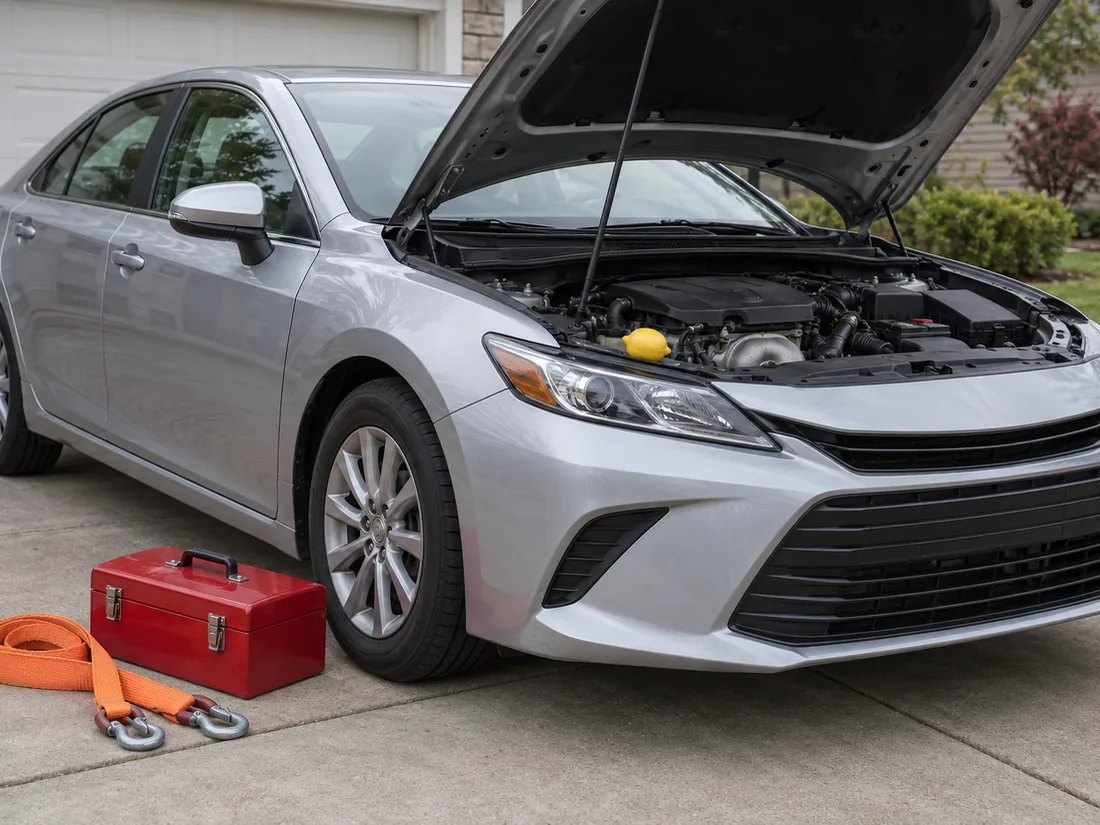
Silver sedan in a home driveway with the hood up, a lemon resting on the engine and a tow strap and toolbox on the ground

Which lemon you have: a buyback brand, or a car that keeps breaking

The word covers two cars that sell very differently.

Settle which one you own before you set a price. Read the brand line on the title (the next section shows eight states’ wording), then pull a vehicle history report. The Department of Justice says a report from the federal title system, NMVTIS, covers five indicators, and “Brand History” is one of them. It defines brands as “descriptive labels (applied by state motor vehicle titling agencies) regarding the status of a motor vehicle.” Every state’s brands feed the same record, so a brand from one state still shows after retitling in another. Our guide to vehicle history reports explains which part of that check is free and which is not.

If the car was bought back but the title shows nothing, keep reading: some states disclose on paper instead. A history report shows a brand only where some state applied one; the Department of Justice puts it as “NMVTIS keeps a history of brands that have been applied to the vehicle by any state.” In a paper-only state the disclosure statement and the repair orders are the proof.

What the brand says, in eight states

Each state writes its own brand and resale rule. These eight were checked against the statute or agency manual on October 24, 2026.

StateWhat the title showsWho must disclose at resaleSource
California“LEMON LAW BUYBACK” on title and registration (“WARRANTY RETURN” for cars reacquired before 1996), plus a decal on the left door frameThe manufacturer titles it in its own name with the notation; a reselling dealer collects a signed disclosure naming each defect and repair attemptDMV manual 2.040
FloridaTitle stamped “Manufacturer’s Buy Back”“A person may not knowingly sell, exchange, or transfer” one without written disclosure; the manufacturer warrants the fix for 1 year or 12,000 miles; a knowing sale without it is a second-degree misdemeanorF.S. 319.14; F.S. 681.114
IowaA designation that the car “was returned to the manufacturer,” on that title and every later one; REBUILT or SALVAGE may replace it“A person shall not knowingly” sell or transfer it unless “the nature of the nonconformity is clearly and conspicuously disclosed”Iowa Code 322G.12
Minnesota“Lemon law vehicle” on the title “and all subsequent certificates of title”The manufacturer: a separate all-capitals statement and its original warranty for 12 months or 12,000 milesMinn. Stat. 325F.665
New YorkThe statutory notice “conspicuously printed on the motor vehicle’s certificate of title”The manufacturer, its agent or a dealer, in a ten-point all-capitals written statementVTL 417-a
Ohio“BUYBACK: This vehicle was returned to the manufacturer because it may not have conformed to its warranty.” in black boldface on every titleThe manufacturer: an all-capitals statement listing each defect, plus 12 months or 12,000 miles of warranty, or the rest of the original if longer. A car bought back for a defect “likely to cause death or serious bodily injury” may not be sold, leased or operated in OhioORC 1345.76
PennsylvaniaA designation that the car “was repurchased under the provisions of this act”The all-capitals written notification and the original express warranty for 12 months or 12,000 miles after resaleAct 28 of 1984, section 10
Washington“A title brand indicating the motor vehicle was returned under this chapter”The manufacturer, its agent or a dealer with actual knowledge, before the first resale, with a window notice; a serious safety defect must be corrected and warranted firstRCW 19.118.061

Two things stand out. The brand is permanent: Minnesota, Iowa and Ohio each carry it to every later title. And in Florida and Iowa the duty to disclose falls on “a person,” which takes in a private seller; the other states aim it at the manufacturer, its agent or a dealer and leave private sellers to the rule below.

Whether a state brands at all is a state choice. When the Federal Trade Commission looked at the question in 1996, it counted “approximately 36 states and D.C.” with buyback disclosure laws, some branding the title and others using “other methods of getting the information to the consumer,” and it named “lemon laundering,” retitling a buyback in a state with weaker rules. The count is thirty years old; what has changed since is NMVTIS, which carries the brand history across state lines. California’s wording is on our California title brands page.

What you owe a buyer, and where that is written

Federal law reaches a lemon sale in three places, and none of them is a title brand.

A private seller sits outside the first of those. Kentucky’s attorney general tells buyers: “If you buy a used car from a private individual, the sale is not covered by the rule,” and “in most private sales, the car is sold ‘as is.’” It adds that a buyer who can prove “very specific misrepresentations” may have a fraud claim. Two state rules go further:

So a safe private sale of a buyback puts the brand and the original defect in the bill of sale, hands over the manufacturer’s disclosure statement and repair orders, and answers questions straight. The salvage version is in our guide to selling a salvage or rebuilt car.

Still under warranty? A claim usually pays more than any sale

If the car is still inside its lemon-law window and still broken, do not sell it yet. A buyer pays what the car is worth now; a lemon-law refund is built from what you paid.

No used-car buyer matches a refund built that way, which is why this page says claim first. The windows are short, and most run from the day the first owner took delivery, not from your purchase.

StateWindowWhat countsDeadlineSource
California18 months or 18,000 miles from delivery4 repairs for the same problem; 2 if it could cause death or serious injury; or more than 30 days out of service—California AG
FloridaThe 24-month “Lemon Law rights period” after original delivery3 repairs for the same problem, plus a final attempt after written notice to the manufacturer, with the problem still there; or 30 cumulative days out of serviceArbitration request no later than 60 days after the period endsF.S. ch. 681, 681.104
Illinois1 year or 12,000 miles from delivery4 repairs, or 30 business days out of serviceAny action within 18 months of original delivery; the maker’s dispute program comes first where one exists815 ILCS 380/3, /6
Minnesota2 years from delivery or the warranty term, whichever is earlier4 repairs, or 30 business days out of service—Minn. Stat. 325F.665
New York2 years or 18,000 miles4 repairs, or 30 calendar days out of service—GBL 198-a
Ohio1 year or 18,000 miles3 repairs for the same problem; 8 for any; 30 calendar days; or 1 attempt on a death-or-serious-injury defect—ORC 1345.73
Pennsylvania1 year, 12,000 miles or the warranty term, whichever is first3 repairs, or 30 calendar days out of service—Act 28, sections 4 and 6
Texas24 months or 24,000 miles4 repairs; 2 for a serious safety hazard; or 30 days out of serviceComplaint within 6 months after the earliest of warranty expiry, 24 months or 24,000 miles; $35 feeTxDMV
Washington2 years or 24,000 miles4 repairs; 2 for a serious safety defect; or 30 calendar daysArbitration request within 30 months of original deliveryRCW 19.118.021, .041, .090

Used cars are not always shut out: California’s attorney general says the law covers “used vehicles for which a manufacturer’s new car warranty is issued with the sale.” Once the window has closed, any warranty left is a selling point instead; see whether a car warranty transfers.

No claim left? Choose between one more repair and selling as is

Most people who search this phrase own the second lemon: out of warranty, clean title, a repair bill every few months. Nothing on the title needs disclosing; the question is money.

Two guides do that arithmetic. When to stop repairing an old car sorts the four kinds of repair that mean different things and the pattern that really says stop. Selling a car that has problems walks you to the number that settles most of these decisions. Close to scrap, fix it or junk it and what a junk car is worth give you the floor.

Three checks move that number before you decide:

  1. Look up open recalls by VIN; our guide to checking recalls before you sell shows where.
  2. Get the fault named. A scan report or written quote turns “it keeps breaking” into something a buyer can price, and protects you if the buyer later says you hid it.
  3. Find out whether any coverage passes to the next owner. It is worth money to a private buyer and nothing to a scrap buyer.

Disclosure for this car is the ordinary rule above: the truth when asked, the known faults in writing, and in Massachusetts the known defects whether the buyer asks or not.

When the repair quote is more than the car is worth running, an instant offer that describes the faults shows what it is worth as it sits. The offer is free, carries no obligation and stays open for a week, long enough to hold it against the quote and a private listing.

Who buys a lemon, and how the price gets set

Four kinds of buyer take these cars.

In honest order: a successful claim beats every buyer here. After that, a private buyer who accepts the brand pays more for a car that runs. The instant offer wins on a car that does not run, or when you want it gone without showing it; get an instant offer while the listing is up and take the higher number.

Where the paperwork differs: by state

The brand and the claim come from the state that titled the car. The signatures, the plates and the notice of sale come from the state where you sell it. Pick yours for who signs, what to remove and what to file afterwards.

Common questions

What people ask about this

Does a lemon-law buyback brand ever come off the title?

Not in the states that print it. Minnesota records “lemon law vehicle” on the title and all subsequent certificates of title, Iowa carries its designation to every later title and registration receipt, and Ohio prints its BUYBACK line on all certificates of title. Iowa is the one state here that lets a REBUILT or SALVAGE designation take the brand’s place. NMVTIS keeps the brand history as well, so retitling in another state does not clear it.

Can I sell a buyback privately without telling the buyer?

In Florida and Iowa, no: a person may not knowingly sell or transfer one without disclosing the nonconformity in writing, and Florida makes a knowing sale without it a second-degree misdemeanor. Massachusetts requires any non-dealer seller to disclose known defects that impair safety or substantially impair use. Elsewhere a private sale is usually as is, but the Kentucky attorney general’s warning holds everywhere: a buyer who can prove specific misrepresentations may have a fraud claim. Put the brand and the original defect in the bill of sale.

Is a car with a buyback brand safe to drive?

The resale rules assume the defect was fixed. Florida, Minnesota, Ohio and Pennsylvania make the manufacturer warrant the repair for 12 months or 12,000 miles on resale, Washington bars the manufacturer from reselling a car found to have a serious safety defect until the defect is corrected and warranted, and Ohio bars the sale, lease or operation of a car bought back for a defect likely to cause death or serious bodily injury. Read the disclosure statement for what the defect was, and check the VIN for open recalls.

Can I still file a lemon-law claim on a used car?

Sometimes. California’s attorney general says the law covers used vehicles for which a manufacturer’s new car warranty is issued with the sale. Most windows run from original delivery to the first owner, so a two-year-old car is usually past them: Texas requires a complaint within six months after the earliest of warranty expiry, 24 months or 24,000 miles, and Washington requires an arbitration request within 30 months of original delivery.

How much does a successful lemon-law claim return?

The purchase price, including collateral charges in Florida and Illinois, minus an allowance for the miles you drove. Florida’s offset is your miles multiplied by the base price and divided by 120,000. Pennsylvania caps the allowance at 10 cents a mile or 10 percent of the price, whichever is less. California lets you choose a refund over a replacement. Under the federal Magnuson-Moss Warranty Act a consumer who prevails may also recover attorneys’ fees based on actual time expended.

Will an instant-offer buyer take a branded or non-running lemon?

Yes, with conditions. Our partner buys cars as is regardless of title status, including salvage and rebuilt, and makes offers on cars that do not run. Any loan must be paid off first, and a lease has to be bought out before the sale. The offer is free and open for a week, and the amount quoted online is what is paid by check at pickup if the car matches your description.

Rather just sell the car?

Get My Instant Offer → Online · free · no obligation

Or send the details — we'll come to you

Send the year, make and model, a photo of the title’s brand line if it has one, and what the car keeps doing, and we’ll call you back.

or call/text (877) 405-1808