In most states you can sell a car with engine problems as it is, without fixing it first, and for a failed head gasket, a rod knock or a seized engine that is often the sensible move once you price the repair. To know which way your car goes, put a name on the failure, set the repair cost against what the car is worth running, and tell the buyer exactly what is wrong.
Last updated .
A buyer who hears “engine trouble” prices the worst case. A buyer who hears “failed head gasket, confirmed by a shop” prices that one repair. So your first job is a diagnosis in writing, not a repair. Here is what the common symptoms usually point to.
| What you notice | What it usually points to | Keep driving it? |
|---|---|---|
| White exhaust smoke, coolant level dropping, milky or frothy oil | Head gasket, or a cracked head or block | No. Coolant in the oil is likely to lead to major engine damage |
| A metallic, rhythmic knock from the engine | Worn connecting-rod bearings (rod knock) | No. It can end in engine failure and a stall |
| A pinging or rattling sound | Fuel igniting too early; sometimes fixed with higher-octane fuel if the manual calls for premium | Get it checked first; it may not be a failure at all |
| Temperature gauge in the red, steam from under the hood | Overheating: often a cooling-system part, sometimes the gasket | No. Pull over and switch off |
| The engine will not turn at all, with a good battery | A seized engine, or a starter fault | It cannot be driven |
If the check engine light is on, the stored code is part of the diagnosis: reading the code before you list the car costs little and tells the buyer what the fault is. If the engine only clicks and will not turn, rule out the battery and starter with the no-start checks before you call it seized.
Yes. In most states nothing makes you fix it first. A few states make the seller supply a passed inspection or certificate at the sale; inspection rules when selling, state by state shows which ones. What you must tell a buyer is covered further down. The real decision is whether the repair is worth paying for, and that starts with knowing what the repair is.
The signs. The head gasket seals the joint between the engine block and the cylinder head. When it fails, oil and coolant can meet. RepairPal's rule of thumb for diagnosis: if oil and coolant are found mixed, in the engine or in the cooling system, the gasket is often the cause. Jalopnik lists the other signs: overheating, oil or coolant leaking around the head and block, and white exhaust smoke or froth in the oil. How to check your engine oil shows what the dipstick reading means.
What the repair involves. The gasket sits under the cylinder head, so the head has to come off. RepairPal says parts of the engine are taken apart to inspect and clean the surfaces the gasket touches, that the job typically takes several days, and that it is not one to do yourself. The head itself can be part of the problem. Jalopnik explains that when a head warps where it meets the block, the seal can be compromised, that overheating is a prime contributor to warping, and that aluminum expands about twice as much as cast iron when it heats up. Some warped heads can be straightened or machined; others have to be replaced. Mechanics often tell the two metals apart with a magnet, which sticks to iron and not to aluminum. Ask whether your quote includes work on the head, or only the gasket.
What it costs. RepairPal puts the average head gasket replacement at $2,572 to $3,386. Labor is $1,669 to $2,449 of that, and parts are $903 to $937. Labor is most of the bill, so a cheap gasket set does not make this a cheap job. Subaru's 2.5-liter engines are a well-documented case: Jalopnik names the 2000–2009 Legacy and Outback, 1999–2010 Forester, 1999–2011 Impreza and 2003–2006 Baja, with failures typically between 120,000 and 150,000 miles and repairs of $1,200 to $2,500.
Skip the bottle of sealer. RepairPal calls additives that claim to reseal a head gasket from the coolant passages dangerous. A sealer that hides the symptoms for a test drive also does not change what you have to tell a buyer.
Fix or sell? Fixing makes sense when the leak was caught early, the engine was not driven hot for long, and the car is worth at least the repair bill more running than it is now. If it overheated hard or kept being driven with milky oil, treat the head gasket quote as the starting point, not the ceiling. That is usually the moment to sell it as it is.
People call an engine blown when something inside has failed for good: a spun bearing, a broken rod, a hole in the block. A seized engine is the extreme case, where the crankshaft will not turn at all. SlashGear’s guide to checking a junkyard engine says that if you cannot turn the crankshaft at all, the engine may be seized. The check is turning the crankshaft by hand with a ratchet and socket on the crankshaft pulley nut.
There are three routes to a working engine, and they are priced very differently. These are Kelley Blue Book’s figures:
| Route | Typical cost | Note |
|---|---|---|
| Professional rebuild of your engine | $3,500 to $6,000 | Usually the least expensive of the three |
| Remanufactured engine | $5,000 to $9,000 for a mainstream car | Add $1,200 to $1,500 or more to fit one bought separately |
| Engine replacement at a dealership | Close to $8,000 on average | A high-output engine can cost three or four times that |
A used engine pulled from a wrecked car is the other route people take. Its history is unknown, and no independent source we checked publishes a price range for it, so it is not in the table. If you go that way, the same SlashGear checks apply: the crankshaft should turn by hand, and milky or frothy oil usually means coolant has got in, which in most cases means head gasket damage.
Set those numbers against what your car is worth running. If the running value is not well above the cheapest route, the engine has written the car off in all but name, and selling it with the engine as it is keeps the replacement bill off your hands.
Not every knock means the engine is finished, so identify it before you price the car.
Do not keep driving on a true rod knock to get a few more weeks out of the car. A later Hyundai recall on the same engine family says bearing wear may result in the engine seizing, which the recall says increases the risk of a crash.
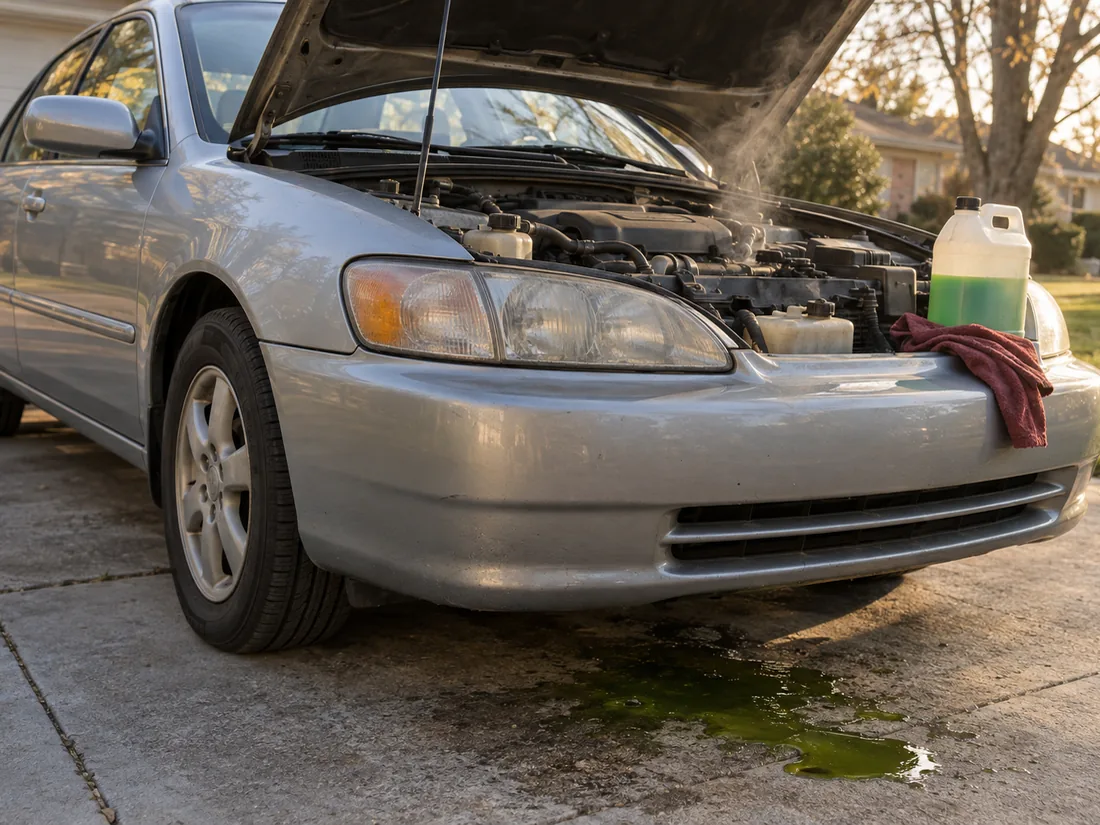
An overheat is a symptom, not a verdict. What you do in the first minutes decides whether it stays a small repair. AAA’s steps: pull over as soon as it is safe and shut off the engine. If traffic stops you pulling over straight away, turn off the air conditioning and turn on the heater to ease the load. Once you are stopped, leave the hood alone for around 20 minutes, and do not open the radiator cap: AAA warns that hot coolant can spray out and severely burn you, and that driving on risks further damage.
AAA also notes that an overheat usually means a cooling-system part needs repair. The expensive part is what the heat does next. According to SlashGear, an overheating incident can damage the head gasket and the cylinder head, and overheating is the most common cause of a cracked block, along with extreme cold.
Signs of a cracked block overlap with a head gasket: milky oil or oil in the coolant, thick white smoke or steam, overheating, and sweet-smelling coolant puddles under the car. A shop diagnosis tells them apart, and the difference matters for the price. SlashGear says a severely damaged block almost always needs a replacement or rebuild, and that most professionals recommend that over sealing products. A confirmed cracked block puts you in the blown-engine cost table above, not the head gasket one.
Owners report safety problems to NHTSA, and the agency publishes the complaints. It uses them to identify safety issues and to judge whether a safety-related defect trend exists. On September 25, 2026 we pulled every complaint NHTSA’s public complaints API returned for 16 model-years: engines that NHTSA recalls or independent sources tie to a known failure, plus two family sedans of the same era for comparison. We counted the complaints whose component list includes the engine, then counted words in those complaints’ written summaries (a knock count leaves out mentions of the knock sensor).
| Vehicle | Complaints on file | Filed under the engine | What the engine complaints mention most |
|---|---|---|---|
| Hyundai Sonata 2011–2013 | 6,841 | 2,360 (34.5%) | Stall 24%, knock 15%, seized 14%, head gasket under 1%. Median stated failure: 100,000 miles |
| Kia Optima 2011–2013 | 2,895 | 1,326 (45.8%) | Stall 23%, knock 15%, seized 14%. Median stated failure: 110,000 miles |
| Chevrolet Equinox 2011–2013 | 2,218 | 1,200 (54.1%) | Burning or using oil 37%, stall 23%, knock 5%. Median stated failure: about 94,000 miles |
| Subaru Forester 2003 and 2005, Outback 2005 and 2007, Legacy 2006 | 773 | 106 (13.7%) | Head gasket 24%, stall 12% |
| Toyota Camry 2012 (comparison) | 644 | 66 (10.2%) | Stall 18%, burning or using oil 11% |
| Honda Accord 2013 (comparison) | 1,421 | 186 (13.1%) | Burning or using oil 13%, stall 11% |
These are our counts from owner reports. They are not an NHTSA statistic and not confirmed defects, one complaint can mention several things, and the median mileage comes only from complaints that state one. Three things stand out.
What to do with this: if your car is on one of these lists, run the VIN through NHTSA’s recall search and ask a brand dealer about engine coverage before you sell it for its parts value. The VIN search does not show recalls more than 15 years old unless the maker offers more coverage. Selling a car with an open recall covers what an open recall means for the sale itself.
The quote alone does not answer it. Compare the repair with the gap between what the car is worth running and what it is worth with the failed engine. Our fix-or-junk guide sets out that method and why the old rules of thumb mislead. For the second number, what a non-running car is worth breaks down the floor under the price.
| Repair | Typical cost | Source |
|---|---|---|
| Head gasket, national average | $2,572 to $3,386 | RepairPal |
| Head gasket, Subaru 2.5-liter known years | $1,200 to $2,500 | Jalopnik |
| Engine rebuild | $3,500 to $6,000 | Kelley Blue Book |
| Remanufactured engine | $5,000 to $9,000, plus $1,200 to $1,500 or more to fit | Kelley Blue Book |
| Engine replacement at a dealership | Close to $8,000 | Kelley Blue Book |
A worked example: a $3,000 head gasket quote, near the middle of RepairPal’s range, only pays if the car is worth at least $3,000 more running than it is today. If the head then needs machining, that bar goes up.
State law draws a similar line for crash damage. Oklahoma’s statute makes a car from the last ten model years a salvage vehicle once repairs for safe operation would exceed 60% of its fair market value. Texas waits until repairs exceed the car’s whole pre-damage value. Every state’s total-loss line is on our threshold page. Those laws are written for damage from a crash, flood or similar event, not a worn engine, but they make a fair gauge: an engine quote at 60% or more of the car’s value is already past the point where Oklahoma would brand a damaged car salvage.
Selling a car with a bad engine is legal. The federal Used Car Rule requires car dealers to display a Buyers Guide on the used cars they sell. It does not reach you as a private seller. Kentucky’s attorney general spells out what that means: private sellers do not have to use the Buyers Guide, most private sales are “as is”, and without a written contract with specific repair provisions, a private seller has no further responsibility for the car.
That protection stops where a false statement starts. FindLaw’s summary is that a buyer in a private sale who suspects fraud or misrepresentation has legal rights, usually pursued in small claims court. Telling a buyer the engine is fine when you know it is not is the kind of statement that invites that claim. So:
The paperwork around the sale, such as the title, the plates and the notice of sale, differs by state. Your state’s selling rules are on our state pages. A car that should not be driven has to be towed to its buyer. Our team picks up and tows cars whatever is wrong with the engine, head gasket included, so the car does not have to run for the sale to happen.
Yes. It has to be towed, and it will be priced as a car that needs an engine, but it can be sold as it is. Before you call it seized, make sure it really will not turn: a click and no crank can also be a flat battery or a failed starter. If it is a Hyundai or Kia with the Theta II engine, run the VIN for recalls first, because NHTSA recalls on certain cars with those engines cover bearing wear that can seize the engine, with free inspection and replacement where needed.
Avoid it. Coolant in the oil stops both the cooling and the lubrication systems from working properly and, left alone, is likely to lead to major engine damage. AAA warns that driving an overheating car risks further damage. A tow keeps the car in the condition you described to the buyer.
No. RepairPal calls additives that claim to reseal a head gasket from the coolant passages dangerous. A sealer can also hide the symptoms during a test drive, and a buyer misled about a fault still has legal rights after an as-is private sale.
The FTC's Buyers Guide rule applies to dealers, not private sellers, and most private sales are as is. But a buyer who was misled about the car's condition has legal rights, usually in small claims court. The safe course is to describe the fault plainly in the listing and on the bill of sale. The details differ by state.
Yes, if it has the Theta II engine. NHTSA recalls covered certain 2011-2014 Sonata, 2013-2014 Santa Fe Sport, 2011-2014 Optima, 2012-2014 Sorento and 2011-2013 Sportage for engine bearing problems, with free inspection and engine or short-block replacement as needed. A later class settlement added a lifetime warranty for covered cars that received a knock-sensor software update. Run the VIN on NHTSA's recall search and ask a brand dealer about engine coverage before you price the car as scrap.
RepairPal's average is $2,572 to $3,386, of which $1,669 to $2,449 is labor. The quote can grow if the cylinder head turns out to be warped and needs machining or replacing, which is more likely after the engine has overheated.