A car that won't start is almost always one of three things: a battery that can't deliver, a starter that can't turn the engine, or an alternator that stopped charging the battery days ago. They feel similar from the driver's seat and they are not the same repair. The sound the car makes when you turn the key narrows it down in five seconds, a ten-dollar multimeter settles it, and the jump-start that fixes the first one does nothing for the other two. Here is the whole sequence, sourced to AAA and the battery makers rather than to guesswork.
Last updated .
Turn the key or press the button and pay attention to the first second. The sound is the diagnosis most of the time.
The three parts divide the job. The battery stores energy and delivers a burst to start the engine. The starter is the motor that burst drives. The alternator is belt-driven off the running engine and does the charging. AAA's winter guide draws the line: a car battery provides the power to start your car and run some accessories, but it doesn't provide continual power; that's the job of the alternator.
The headlight test. With the engine off, turn the headlights on and then try to start. If the lights are bright and stay bright while you hear a single click, the battery has power and the starter or its wiring is the suspect. If the lights are dim, or dim sharply when you turn the key, the battery cannot deliver and it is the battery or a bad connection at the terminals. Interstate adds a subtler version: if the headlights flicker within 60 seconds with the engine off, you may need a new battery; if the car is running and the headlights flicker at idle, that may be a sign of a bad alternator and a weak battery.
The alternator tell. A car that starts fine after a jump, drives, and is dead again the next morning is not telling you the battery is bad. Something is failing to recharge it, or something is draining it overnight. AAA's advice after any jump is to check your battery to ensure a bad battery wasn't the root cause. Optima's engineers go one step further and point at the belt: if the belt or a tensioner pulley is damaged or not functioning properly, it could negatively impact both the alternator and the battery, neither of which may have any problems of their own.
A basic multimeter set to DC volts, red lead on the positive post and black on the negative, replaces all of the guessing. Two things first. Fluke, the meter maker, says to turn off all accessories before taking a resting voltage measurement, and if the vehicle was recently running, turn on the headlights for about a minute to remove the surface charge. A battery that has just been charged reads high for a while and will lie to you.
Then read it against the makers' own thresholds:
Two checks before the cables come out, both from AAA's jump-start guide and both routinely skipped. First, check your vehicle's owner's manual, because some carmakers advise against jump-starting to protect the car's electronics from a power surge; several makers specify a dedicated jump post under the hood rather than the battery itself. Second, never try a jump-start if the battery's frozen, and if the battery has a charge-indicator eye that reads black or clear, it is completely discharged and should not be jumped or recharged. A frozen or bulging battery can rupture.
Then the order, as Interstate Batteries lays it out in its official jump-start procedure. Both cars off, in park or neutral, not touching each other.
Small things Interstate includes that matter: take off rings and watches before you lean over a battery, and look at the posts while you are there, because corrosion at the terminals is a common reason a good battery cannot deliver.
What happens after is where two authorities honestly disagree, and the disagreement is useful. AAA says to drive around for at least 30 minutes to allow the alternator to recharge the battery, which is fine for a battery that was merely low. Optima's engineers point out that alternators are designed to maintain batteries near a full state of charge, not recharge a deeply discharged battery, and asking one to do that can put tremendous strain on it. If the battery was flat rather than low, put it on a proper charger until it reads 12.6 volts or better, then have it load tested. A jump is a way home, not a repair.
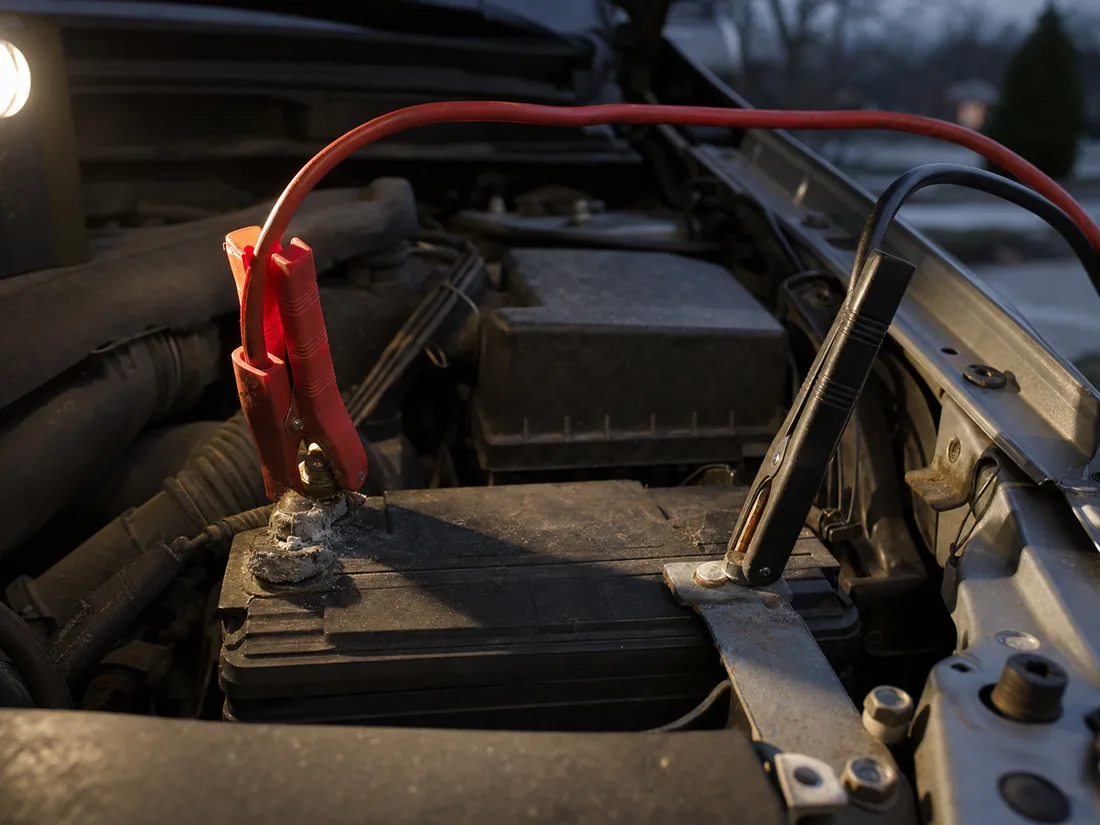
A jump with a healthy donor car that produces the same click, or nothing, means you have moved past the battery. Interstate's troubleshooting guide opens with exactly that: if you tried a jump-start and your car won't start, you're looking at a problem bigger than the car battery. In rough order of how cheap they are to check:
Replacing a battery without asking why it failed is how people buy two batteries in a year. The causes, from the makers:
On most cars this is a fifteen-minute job with one wrench, and the order matters for the same reason the jump-start order does. The car's body is the negative side of the circuit, so a wrench that touches the positive terminal and any bare metal at the same time is a dead short. Disconnect the negative clamp first, so that once it is off there is no complete circuit for a slipped wrench to close. Then the positive, then the hold-down bracket, then lift the battery straight out; they are heavier than they look. Installation is the reverse: battery in, bracket tight, positive on first, negative last. Clean the clamps and posts if there is any white or green crust, and snug the clamps so they cannot be twisted by hand.
Three cautions that apply to newer cars. Many now use an AGM battery, and an AGM should be replaced with an AGM; Interstate confirms it can be safely jump-started when done correctly but it charges differently and the car's charging system is set up for it. Some cars need the new battery registered to the body computer so the charging profile resets, which a shop does with a scan tool. And disconnecting the battery clears radio presets, window auto-up settings and sometimes the throttle position memory; the owner's manual lists what needs relearning.
A car that needs a jump to make the test drive is a car nobody buys at asking price. Buyers read a dead battery as a car that has been sitting and neglected, whatever the truth, and every other flaw they find afterwards gets weighed against that first impression. The good news is that this is the cheapest fix on the whole vehicle: a battery costs less than almost any other part that stops a car starting, and it is one of the few repairs a buyer will believe you did properly.
Be honest about which problem you actually have. A tired battery is a battery. A car that needs a jump every morning has an alternator, belt or drain problem, and swapping the battery to get it through a sale will strand the buyer within a week; most states expect a private seller to disclose a known defect, and this one is easy to prove. The selling a car with problems guide covers what disclosure looks like where you live. If the honest answer is that it needs a starter or alternator and you would rather not pay for it, the fix it or junk it and when to stop repairing a car guides are built for that decision, and a buyer who takes cars as they sit will price the work in rather than negotiate over it. While the hood is up, the brake noises and steering guides cover the other two things a buyer tests in the first minute.
Either, and the headlights tell you which. Turn them on and try to start. Bright lights that stay bright with a single click means the battery has power and the starter or its cable is the problem. Dim lights, or lights that drop sharply as you turn the key, mean the battery cannot deliver, or a terminal is loose or corroded. AAA lists a single click as a sign of either a faulty battery or a bad starter; the lights split them.
Engine off and rested, 12.6 to 12.8 volts is fully charged; VARTA says recharge if it drops below 12.4. Engine running, 13 to 15 volts means the alternator is charging; over 16 can damage the car. Turn the headlights on for a minute first if the car was just running, to burn off the surface charge that reads falsely high. Voltage shows charge, not health: a battery can read 12.7 and still fail a load test, which parts stores do for free.
Red to the dead battery's positive, red to the good battery's positive, black to the good battery's negative, and the last black clamp to bare metal on the dead car, not its battery, so the spark of the final connection happens away from any hydrogen the battery is venting. Start the good car, wait a minute, start the dead one, then remove the clamps in reverse. Check the owner's manual first, because some makers advise against jumping at the battery, and never jump a frozen battery.
The battery is not being recharged, or something is draining it overnight. Measure the voltage with the engine running: if it is not between 13 and 15 volts the alternator or its belt is the problem. If it is, look for a parasitic drain, which Fluke defines as more than 100 milliamps of draw after the car has gone to sleep. Also, a deeply discharged battery is not recharged by driving; alternators maintain charge, they do not restore it. Put it on a charger to 12.6 volts and load test it.
Yes. Interstate confirms an AGM battery can be safely jump-started when done correctly, using the same cable order. What matters more is afterwards: an AGM should be recharged on a charger with an AGM setting rather than left to the alternator, and if it needs replacing it should be replaced with another AGM, because the car's charging system is set up for it.
AAA says to have it tested once it is more than three to five years old; Interstate says a battery is at its best for three years. Heat shortens that more than cold does, even though cold is when the failure shows up. Short trips and long periods sitting shorten it too. The manufacture date is on the case.
If the battery is the actual problem, yes; it is the cheapest fix on the car and a buyer who has to jump-start the test drive will discount everything else. If the car needs a jump every morning, the battery is not the problem, and swapping it to get through a sale strands the buyer within a week. Most states expect a seller to disclose a known defect, and a charging fault is easy to prove. Fix the cause, or sell it as-is and say so.