Turning the wheel feels like one motion, but it travels through about eight parts to reach the tires, and every one of them is a joint that can wear. That's why steering goes vague gradually rather than all at once, and why the fix is almost never the steering wheel. Here is the chain in order, what each piece does, which ones wear first, and the free-play limits an inspector actually measures with a ruler.
Last updated .
Follow the motion and the system explains itself. The steering wheel sits on a steering column, a shaft inside the dashboard that usually telescopes and tilts and carries the collapsible section designed to shorten in a crash. Below the firewall the column hands off to an intermediate shaft, a short link with a universal joint at each end. It exists because the wheel and the steering gear are almost never in line with each other, and the U-joints let the shaft turn around the corner between them.
The intermediate shaft drives the steering gear, which is where rotation becomes side-to-side movement. From the gear, tie rods reach out to the steering knuckles, the castings that hold the front wheel bearings and hubs. Push one tie rod out and pull the other in, and the wheels swing together.
That is the whole system: wheel, column, intermediate shaft, gear, tie rods, knuckles. Everything else is either the power assist that makes it light, or the suspension parts the knuckles are mounted in. Count the joints, though: two in the intermediate shaft, one inside the gear, an inner and outer end on each tie rod. Eight or more wear points, each contributing a fraction of a degree of slack as it ages, and the driver feels the sum of them as one vague steering wheel.
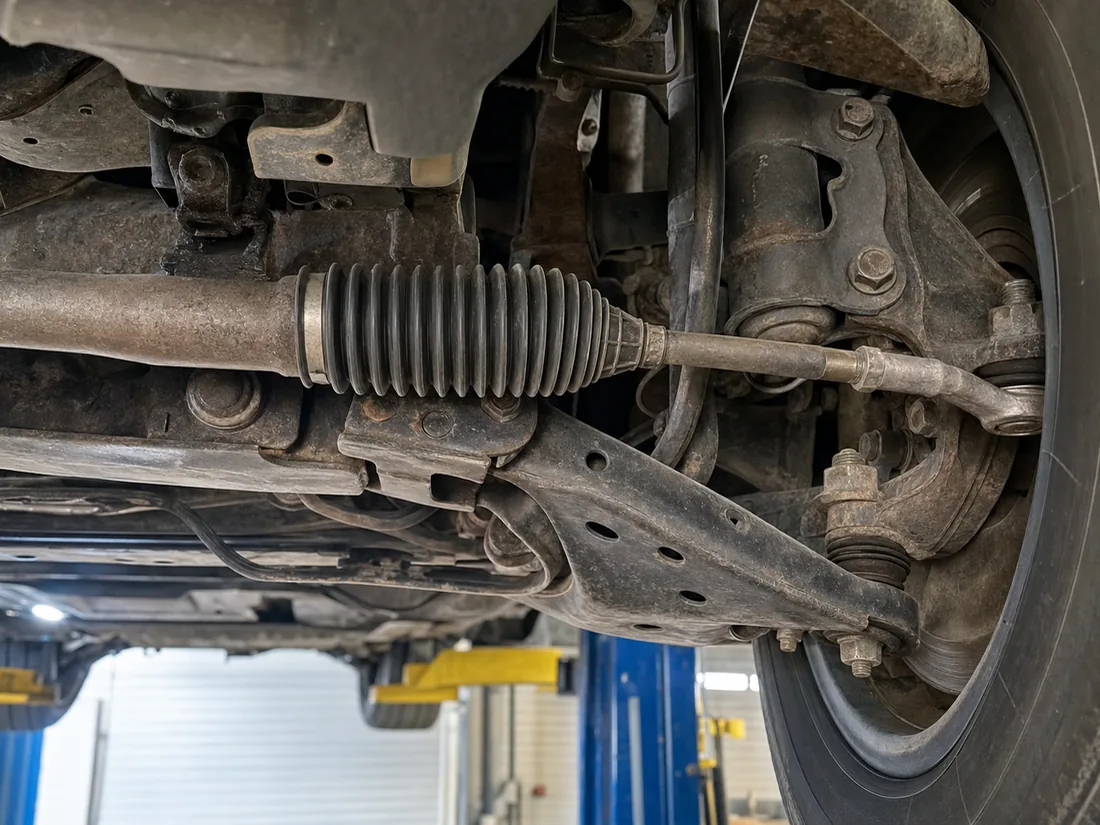
Rack and pinion is what almost every modern car uses. The intermediate shaft turns a small pinion gear, whose teeth mesh with a long toothed bar, the rack, running across the car inside a housing. Turn the pinion and the rack slides left or right. The tie rods bolt to the ends of the rack, so the movement goes straight to the wheels. It is simple, light, and has few joints, which is why it took over.
Older cars, body-on-frame trucks and many heavy vehicles use a recirculating ball gearbox instead. Inside a cast housing, a worm gear drives a nut riding on recirculating ball bearings, which moves a sector shaft. That shaft pokes out of the box and turns the pitman arm, which pushes a centre link (or drag link) across the car. An idler arm on the far side holds the other end of the centre link at the right height, and the tie rods hang off it. More parts, more joints, more places for play to develop, but it tolerates abuse and big loads better.
You can usually tell from underneath without any tools. A rack is a long tube crossing the car behind or ahead of the engine, with a rubber boot at each end. A recirculating ball setup has a cast iron box bolted to the frame rail with an arm coming out of the bottom of it. If you see a pitman arm and an idler arm, you have the second kind, and the idler arm is very often the part that has worn.
Neither gear type is easy to turn at parking speed on its own, so almost every car adds assistance. Hydraulic assist uses a belt-driven pump, a reservoir of fluid, high-pressure hoses and a valve in the steering gear that sends pressure to whichever side of a piston pushes the way you are turning. It is the older arrangement, and it announces its problems: a whine that rises with engine speed, heavy steering when cold, a puddle under the front of the car, or a reservoir that keeps needing topping up. Federal inspection rules for commercial vehicles are blunt about the last one, requiring simply that the power steering system shall have sufficient fluid in the reservoir.
Electric power steering (EPS) replaces all of that with a motor, either on the column or wrapped around the rack, and a controller reading a torque sensor at the wheel. There is no fluid, no belt and no pump, so there is nothing to leak and no whine. It is also why steering effort can change with speed, and why some cars go heavy and stay heavy when the system faults: the mechanical connection is still there, but the assist has switched itself off. That is a warning-light problem, not a linkage problem, and no amount of new tie rods will fix it.
The distinction matters for diagnosis. A noise or a leak points at hydraulics. A dashboard light and sudden heaviness points at electronics. Vagueness, wandering and clunks point at neither, and belong to the joints in the section below.
Loose steering is a symptom with a short list of causes, and the order below is roughly how often each one turns out to be responsible.
One diagnostic point worth knowing: play that you feel at the steering wheel with the car parked and the engine running usually lives in the gear or the shaft. Play you can only feel by grabbing the tyre and rocking it lives in the joints out at the wheel. That is exactly the distinction Pennsylvania's inspection procedure is built around, and it is quoted in full further down.
On the MacPherson strut suspension used by most front-wheel-drive cars, the strut is not just a shock absorber. It is a structural part of the steering axis: the wheel pivots about a line running from the lower ball joint up through the top of the strut. That means the upper strut mount has to let the whole strut rotate when you turn, and it contains a bearing to allow it.
When that bearing dries out or the rubber in the mount collapses, the strut binds as it tries to rotate. The symptoms read like steering faults rather than suspension faults: a creak or groan when turning at low speed, a notchy or catching feel, a wheel that does not want to self-centre after a corner, sometimes a clunk over bumps. Nothing in the steering linkage is worn, but the pivot the linkage acts on has stopped pivoting cleanly.
This is why a shop diagnosing vague or notchy steering will check strut mounts alongside tie rods, and why the two systems cannot really be separated on a strut-equipped car. Pennsylvania's inspection code treats them as neighbours too, rejecting a vehicle where ball joint movement is in excess of the manufacturer's specifications or the shock absorbers are missing, broken at the mounts, or leaking severely rather than slightly damp.
Steering is one of the few systems where the pass/fail line is a measurement rather than an opinion, and the states that inspect publish theirs. Pennsylvania's regulation, 67 Pa. Code § 175.80, rejects a passenger car if:
Federal rules for commercial vehicles, 49 CFR § 393.209, set the lash limits a different way and show how much difference power assist makes. On a wheel 16 inches or smaller the limit is 2 inches of lash for a manual system and 4¼ inches for a power system; expressed as rotation, that is 14 degrees manual against 30 degrees power. The same rule requires the steering wheel to be secure with no spokes cracked through or missing, the gear box to have no loose or missing mounting bolts or cracks, and the pitman arm not to be loose on the output shaft.
Not every state inspects steering, and several do not inspect anything at all. Which states check what, and who has to produce the certificate when a car changes hands, is laid out in the inspection rules when selling by state table.
Steering is the first thing a buyer evaluates, usually without meaning to. Thirty seconds out of the driveway they have felt whether the wheel is tight, whether the car tracks straight, and whether anything clunks. Vague steering does not read to a buyer as "needs tie rods, about an hour's labour"; it reads as an old car that has been neglected, and it discounts everything else they see afterwards.
That makes it one of the better pre-sale repairs on a car worth keeping. Tie rod ends are among the cheaper parts on a vehicle, an alignment afterwards is routine, and the difference in how the car drives is immediate and obvious on a test drive. A groaning strut mount is a bigger job and a harder call. Where a car is near the end of its life the arithmetic often runs the other way, and the fix it or junk it and when to stop repairing a car guides are built for that decision.
What you should not do is say nothing. If the car has play in the steering, most states expect a private seller to disclose a known defect, and a buyer who discovers it on the test drive will trust the rest of your description less. The selling a car with problems guide covers what disclosure looks like where you live. And if the honest answer is that it needs steering work you do not want to pay for, that is an ordinary car to sell as-is to a buyer who prices the repair in rather than negotiating over it. While you are listening to it, the brake noises guide covers the other set of sounds a buyer will be listening for.
In order from your hands outward: the steering wheel, the steering column, an intermediate shaft with a universal joint at each end, the steering gear (a rack and pinion on most modern cars, or a recirculating ball gearbox on older cars and trucks), the tie rods, and the steering knuckles that hold the front wheels. Recirculating ball systems add a pitman arm, a centre link and an idler arm between the gearbox and the tie rods.
Rack and pinion converts rotation directly into side-to-side movement: a small pinion gear meshes with a long toothed bar that the tie rods bolt to. It is lighter, simpler and used on almost all modern cars. A recirculating ball gearbox uses a worm gear and ball bearings to turn a sector shaft, which moves a pitman arm, a centre link and an idler arm before reaching the tie rods. It has more joints and more places to develop play, but handles heavy loads and rough use better, which is why trucks kept it longer.
Almost always a worn joint rather than the steering wheel or gear itself. Outer tie rod ends are the most common culprit, followed by inner tie rod ends behind a split rack boot, ball joints, and on older trucks the idler arm. A worn universal joint in the intermediate shaft gives a notchy, catching feel in the first few degrees instead. A useful split: play you feel at the wheel with the car parked usually lives in the gear or shaft, while play you can only find by rocking the tyre by hand lives out at the joints.
It depends on the state and on the wheel. Pennsylvania rejects a car when free play exceeds 2 inches on a steering wheel 16 inches or smaller, rising to 2 3/4 inches on a 22-inch wheel, and separately rejects any car with more than 1/4 inch of movement measured at the front or rear of a tyre. Federal commercial-vehicle rules allow 2 inches of lash on a manual system and 4 1/4 inches with power assist, or 14 degrees against 30 degrees of rotation.
Yes, on any car with MacPherson struts, which is most front-wheel-drive cars. The strut forms part of the steering axis, so the upper mount contains a bearing that lets the whole strut rotate when you steer. When that bearing dries out or the rubber collapses, the strut binds: you get creaking or groaning at low speed, a notchy feel, a wheel that will not self-centre, and sometimes a clunk. The steering linkage can be perfectly good while the pivot it works against has stopped turning cleanly.
A whine that rises and falls with engine speed points to a hydraulic system: a failing pump, a restriction, or low fluid, which is often a leak. Sudden heaviness with a warning light on a newer car usually means electric power steering has faulted and switched its assist off; the mechanical link is still there, which is why the car remains steerable but very heavy. The first is a plumbing problem, the second an electrical one, and neither has anything to do with worn tie rods.
Often yes, if the car is worth keeping. A buyer forms a judgement about the whole vehicle in the first thirty seconds of a test drive, and vague steering reads as neglect rather than as a specific, cheap repair. Tie rod ends plus an alignment are among the more cost-effective pre-sale jobs. On a car near the end of its life the sums usually go the other way, and selling as-is to a buyer who prices the work in is cleaner than paying for it yourself. Either way, disclose it.