Tire shopping is a spec-matching exercise dressed up as a brand choice. The door-jamb placard fixes the size, load index and speed rating; federal rules define every grade on the sidewall and the test behind it; and the price is mostly tier and size before any store gets involved. This guide takes those in order, from reading the placard to judging a 2026 quote, with every figure traced to the regulation, manufacturer or survey it came from.
Last updated .
Every car sold in the United States carries a Tire and Loading Information placard; 49 CFR 571.110 dictates its contents and puts it on the driver's side B-pillar or the rear edge of the driver's door. It lists the original tire and spare sizes, cold pressures, seating capacity, the maximum occupant-and-cargo weight and usually the load index and speed rating. NHTSA's buying advice is to stay with the original size or another size the vehicle manufacturer recommends. The rule also requires that the car's normal load put no more than 94 percent of the tire's load rating on each tire at the placard pressure, so a lower load index than specified is no bargain; it erases that margin. A size beginning with P is P-metric and one with no letter is Euro-metric; the Tire Industry Association warns that Euro-metric tires may carry different loads than the same numbers in P-metric, so match the load index, not just the size.
The characters after the size, 91V for example, are the service description. The load index codes the most weight one tire can carry at its rated pressure. Goodyear's table shows most passenger-car indexes fall between 75 and 100, and the everyday 91 works out to 615 kg, or 1,356 lb, in Pirelli's chart:
| Load index | Maximum load per tire |
|---|---|
| 82 | 1,047 lb |
| 87 | 1,201 lb |
| 91 | 1,356 lb |
| 98 | 1,653 lb |
| 104 | 1,984 lb |
| 110 | 2,337 lb |
| 120 | 3,086 lb |
Speed ratings are letters, and a Z in the size means anything over 149 mph. The common ratings, per Bridgestone and Michelin:
| Letter | Sustained speed |
|---|---|
| T | 118 mph |
| H | 130 mph |
| V | 149 mph |
| W | 168 mph |
| Y | 186 mph |
A higher load index is allowed but does not raise the vehicle's own load limit; a lower one never is. A higher speed rating is fine; a lower one is not recommended except on 3PMSF-marked winter or all-season tires, and then only if the car stays under the tire's rated speed. Bridgestone adds that all four tires should carry the same rating. Watch for XL: an extra-load tire out-carries a standard-load tire of the same size only when inflated higher, by roughly 0.4 bar, about 6 psi, in Continental's guidance. FMVSS 139 fixes the rest of the sidewall, including the DOT symbol and the maximum pressure, which is a ceiling, not a setting. The last four digits of the DOT string are the build week and year; our tread, pressure, rotation and replacement guide explains reading them and when age alone retires a tire. Check the date on the tires being fitted; warehouse years count as age.
The three grades molded near the shoulder come from the Uniform Tire Quality Grading rule, 49 CFR 575.104, and each is a real test.
Treadwear is a convoy test: candidate tires run alongside government course-monitoring tires around a roughly 400-mile loop near San Angelo, Texas, for 16 circuits, about 6,400 miles. Wear is projected against the monitoring tires in multiples of 20, so a 600 should outlast a 200 three to one on that course. The rule itself concedes that real-world wear can depart significantly from the projection, and the Tire Industry Association adds that the number is comparable only within one manufacturer's line, not brand to brand.
Traction is straight-line wet braking and nothing else. A trailer is towed at 40 mph over wetted asphalt and concrete pads, one wheel is locked, and the sliding friction coefficient is recorded against these boundaries:
| Grade | Asphalt coefficient | Concrete coefficient |
|---|---|---|
| AA | above 0.54 | above 0.38 |
| A | above 0.47 | above 0.35 |
| B | above 0.38 | above 0.26 |
| C | 0.38 or less | 0.26 or less |
The rule's own warning is that the grade ignores acceleration, cornering and hydroplaning, so AA is not automatically better in a wet bend. NHTSA's tally shows why the grade rarely separates two candidates: 77 percent are graded A and 15 percent AA, with only four tire lines at C.
Temperature is a laboratory endurance run: the tire is pressed against a 67.23-inch steel drum in 95°F air at 88 percent of its maximum load while the drum speed steps up every 30 minutes. Surviving 500 rpm earns a B, surviving 575 rpm an A, failing at 500 a C; on a drum that size those are about 100 and 115 mph. C is the federal minimum every passenger tire must already meet, and NHTSA's count is 62 percent A, 34 percent B and 4 percent C.
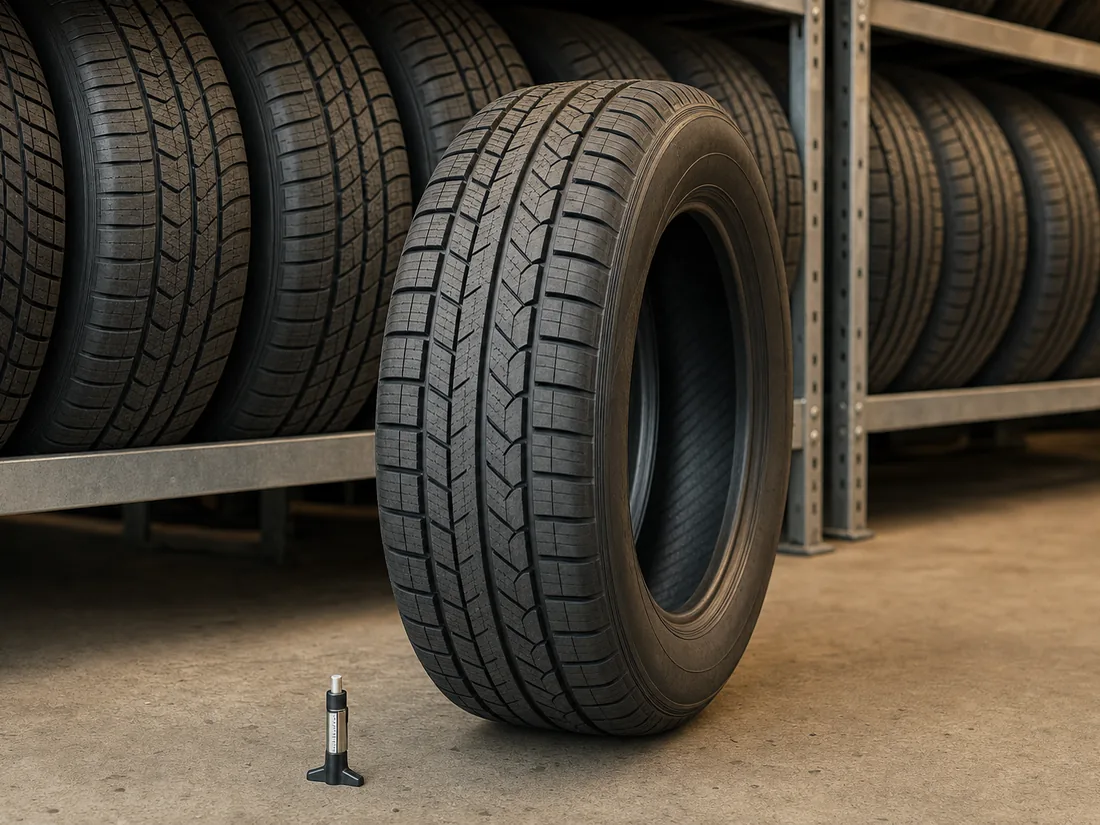
NHTSA's buying page sorts tires into four families: all-seasons handle a variety of conditions with some mud and snow capability; winter tires beat them in deep snow; summer tires are not built for temperatures below freezing or for snow and ice; and all-terrains, mostly on four-wheel-drive trucks, split the difference between pavement and dirt. The cutoff that matters is temperature, not the calendar: Nokian's guidance is that below about 45°F (7°C) an all-season compound hardens and loses responsiveness, which is when a winter tire earns its keep even on dry pavement.
Two snow markings look alike and are not. M+S is a claim about tread geometry; Continental states that the performance of M+S tires is neither defined nor measured. The three-peak mountain snowflake is a passed test: under FMVSS 139 a tire may wear the symbol only if it posts a traction index of at least 112 against the standard reference tire on medium-packed snow in the ASTM F1805 test. All-weather tires are all-seasons that pass it, the sensible pick for occasional snow.
Within all-season, the split is touring versus performance. Consumer Reports' category notes put it plainly: standard all-seasons offer year-round traction, long treadwear and a comfortable ride, while ultra-high-performance tires trade treadwear and ride comfort for handling. One more axis is printed nowhere on the tire: rolling resistance. The National Academies' study for Congress found it varies widely among replacement tires that are otherwise comparable, and that cutting it 10 percent buys a 1 to 2 percent gain in fuel economy; NHTSA's dynamometer test of 15 tire models (2009) measured about 1.1 percent per 10 percent reduction. On an EV that number is range, so ask for it.
Run-flats carry the car on a stiffened sidewall after a puncture. Michelin's Zero Pressure tires are rated for up to 50 miles at 50 mph, and Bridgestone's DriveGuard carries the same 50-mile, 50-mph rating. The trade-offs, per Michelin: a run-flat driven flat usually cannot be repaired, a working TPMS is essential because the tire will not look flat, the ride is firmer, and the tires cost more. Michelin also advises against fitting them to a car not originally equipped with them and against mixing them with conventional tires outside an emergency.
EV tires answer three facts Michelin lays out: EVs are heavier, instant torque wears the driven tires faster, and rolling resistance turns directly into range. Michelin's own answer to whether an EV needs EV-specific tires is not necessarily; any tire meeting the car's load, speed and size requirements will work. What you cannot skip is the load index, often XL on an EV. What you may want is the acoustic foam liner Michelin describes as the fix for cavity resonance.
OE-marked tires carry a code showing the tire was developed with the carmaker; Pirelli's table lists AO for Audi, a star for BMW, MO for Mercedes, N-numbers for Porsche and T0 for Tesla. The case for the marked version is that ABS, TPMS and other control systems are calibrated to the OE tire, and Michelin recommends replacing with the same approved marking where possible. The case against comes from Bridgestone's FAQ: OE tires are built to the carmaker's requirements, replacement tires for the performance and treadwear most drivers expect, and OE tires are generally excluded from mileage warranties; Michelin's excludes them from the 2018 model year onward. Buy the mark for a performance car; a commuter usually does better with the aftermarket version.
On a two-wheel-drive car, replacing in pairs is fine as long as the pair shares an axle and matches in size, load index, speed rating and, ideally, tread pattern; the companion guide covers why the fresh pair belongs on the rear. On all-wheel drive the arithmetic is unforgiving. Tire Rack's worked example: a new 225/45R17 at 10/32 inch of tread turns 835 times per mile, and the same tire worn to 8/32 turns 839, and that four-revolution gap is a constant strain on the center differential. The manufacturer tolerances quoted in the same article run from identical circumference to within 1/4 to 1/2 inch of circumference, 2/32 to 4/32 inch of tread depth, or 30 percent of remaining tread. Subaru's answer is to replace with the same tires as originally equipped.
Practically: on AWD, replace all four, or have a single new tire shaved to the depth of the other three. Keep a full-size spare in the rotation so it wears with the set.
A tire's price is set by tier, size and channel, in that order. Fitment Group's national survey of advertised prices, published in Modern Tire Dealer's 2025 Facts Issue, gives the 2024 spread by size and brand class:
| Size | Major brand | Low-cost brand | Overall average |
|---|---|---|---|
| 205/55R16 | $164.48 | $87.94 | $142.79 |
| 225/65R17 | $198.93 | $113.05 | $175.42 |
| 235/60R18 | $245.94 | $129.22 | $215.47 |
| 275/55R20 | $262.19 | $169.73 | $250.38 |
| LT265/70R17 | $286.25 | $186.01 | $266.21 |
| LT275/65R18 | $302.32 | $212.32 | $295.95 |
The same survey split one light-truck size, LT265/70R17, into retail tiers across nine regions, and the bands hold almost everywhere: opening-price tires ran about $175 to $203, value $233 to $246, better $268 to $280, best $287 to $308, and winter $239 to $269 (2024 advertised prices). Consumer Reports' survey of more than 24,000 members who bought tires between fall 2023 and fall 2024 put the median at $212 per tire, down from $223, with a median installation charge of $31 per tire. Since then, little has moved: Fitment Group told the trade press in June 2026 that retail prices held through the first half of 2026 while manufacturers announced increases of mostly 1 to 4 percent. Two line items sit outside the tire price. Most states add a per-tire fee at the register, roughly three dozen in USTMA's state-by-state summary (October 2024); California's is $1.75 per new tire (as of September 2026, unchanged since 2005). And mounting, balancing and disposal are separate charges unless the seller bundles them.
Channel matters less than people assume. In the Consumer Reports survey, 17 percent ordered online and had the tires shipped to a local store; 22 percent used independent shops, 17 percent Costco and 15 percent a dealership. Mail order works because of installer networks: under its 2025 program terms, Tire Rack ships free to more than 10,000 installers on orders over $50, each posting a fixed installation quote, fees included, before you commit.
Protection plans cover what the manufacturer excludes, road hazards included per Bridgestone's FAQ. Discount Tire's certificate, for example, covers a tire for up to three years, down to 3/32 inch of tread whatever the cause (as of September 2026), and Consumer Reports found members paid a median of $54 per set of four on all-season tires and $67 on all-terrain for such coverage. The manufacturer's warranty is free: Michelin covers replacement tires for defects for the life of the original tread or six years from purchase plus a mileage warranty by line; Bridgestone's replacement lines run up to five years, with a 90-day return window. Registration is what makes a recall reach you: under 49 CFR 574.8 an independent dealer must either hand you a form carrying the tire identification numbers or register the tires for you, free, within 30 days.
A fair quote: the tire matches or exceeds the placard's size, load index and speed rating; the date codes are recent; the price for four sits inside the band above for its tier; installation, disposal and the state fee are itemized; a set-of-four rebate has been checked, because Consumer Reports notes they reappear with great regularity; and you asked for a better price, since 63 percent of those who negotiated got one, saving a median $37 per tire. NHTSA's last item: have the new set balanced at fitting.
Tires are the one component a buyer inspects without tools, and they describe the owner as much as the car. Four matching tires of a known brand, in the placard's load index and speed rating, say the car was looked after by someone who read the door jamb. Two odd budget tires on one axle and a bald pair on the other say the opposite, and a buyer prices in the set plus a margin for whatever else was skipped. If you are selling soon, a matched set of value-tier tires in the correct spec removes the objection, while a wrong load index or one mismatched tire invites a discount larger than the tires cost. Keep the invoice and the registration confirmation; the next owner will want both.
Consumer Reports' survey of more than 24,000 members who bought tires between fall 2023 and fall 2024 put the median at $212 per tire plus a $31 median installation charge. Fitment Group's 2024 advertised-price data shows the spread: a 205/55R16 averaged about $164 from a major brand and $88 from a low-cost brand, while a light-truck LT275/65R18 averaged $302 versus $212. Prices held roughly flat through the first half of 2026.
Michelin's guidance is not to, with one exception: winter or all-season tires carrying the three-peak mountain snowflake symbol may be a step lower, provided you keep the car under the tire's rated speed. A higher rating is always acceptable. Bridgestone adds that all four tires should carry the same rating. Mixed ratings mean mixed construction front to rear, which changes the handling balance. The load index, by contrast, must never be lower than the placard figure.
Only within one manufacturer's line. The grade comes from a 6,400-mile convoy test on a course near San Angelo, Texas, expressed relative to government monitoring tires in multiples of 20. The regulation itself warns that real-world wear can depart significantly from the projection, and the Tire Industry Association says the number cannot be used to compare projected life across brands. Compare a 500 with a 700 from the same maker, not with a competitor's 600.
Usually, or close to it. A new tire at 10/32 inch and one worn to 8/32 differ by about four revolutions per mile in a 225/45R17, and that difference loads the center differential continuously. Manufacturer tolerances quoted by Tire Rack range from identical circumference to within 1/4 to 1/2 inch, or 2/32 to 4/32 inch of tread depth. Subaru's recommendation is to replace with the same tires as originally equipped. The alternative to four is having one new tire shaved to match.
It covers what the manufacturer's warranty excludes, which Bridgestone's FAQ lists as road hazards among other things. Discount Tire's certificate, for example, covers a tire for up to three years down to 3/32 inch of tread regardless of cause. Consumer Reports found members paid a median of $54 per set of four on all-season tires and $67 on all-terrain. On a premium set in an area with bad roads that is cheap insurance; on budget tires it can approach the price of a replacement.