Sell My Car Hub

Tire size calculator

Put in the size on your tires now and the size you are thinking of buying. The calculator works out how tall each one stands, how many times it turns in a mile, and what the speedometer will say once the new ones are fitted. Every figure comes from the size code alone, and the formulas are written out below so any of them can be checked by hand.

Last updated .

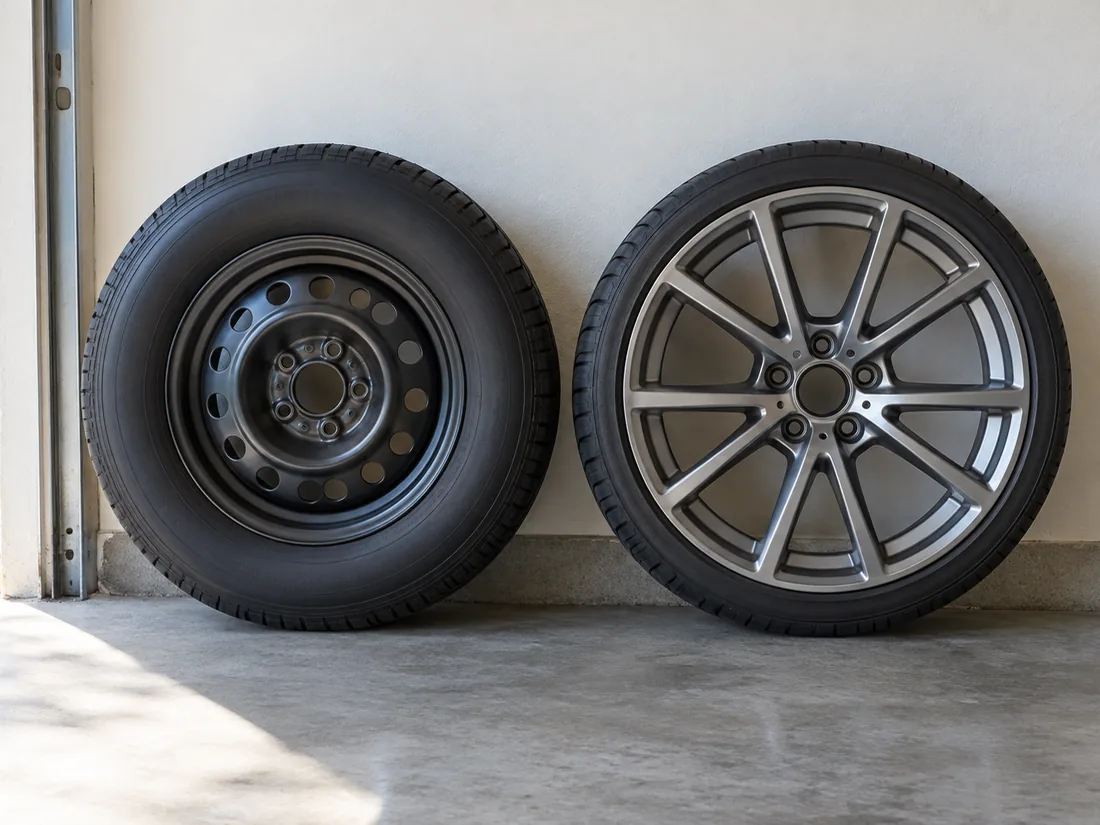
Two wheels leaning against a garage wall: a black steel wheel on a tire with a tall sidewall, and a larger silver multi-spoke alloy wheel on a low-profile tire, the two standing at almost the same height.
Calculator

Compare two tire sizes

From the tire's sidewall, or the placard on the driver's door jamb.
Metric like 245/40R18, light truck like LT285/75R16, or flotation like 33x12.50R17LT.

Enter two sizes and the comparison appears here: height, width, revolutions per mile, and what the speedometer reads once the second size is on.

Reading the size code

Take 225/45R17. The Tire Industry Association's sidewall guide reads it left to right: 225 is the approximate section width, the distance from one sidewall to the other; 45 is the aspect ratio, the sidewall's height as a percentage of that width; R means radial construction; and 17 is the diameter, in inches, of the rim the tire fits. Continental gives the width in millimeters. Whatever comes after the rim size, such as 91V, is the load index and speed rating, which describe what the tire can carry and how fast, not how big it is.

A letter in front names the tire type. The TIA lists P for passenger, LT for light truck, ST for trailer and T for a temporary spare, and says that no letter at all marks a Euro-metric tire, which may carry a different load than a P-metric one of the same size. The letter never enters the arithmetic here — 225, 45 and 17 mean the same thing whichever letter precedes them — but it is the reason a swap between types needs its load rating checked on its own. Bridgestone's manual makes the same point about P205/55R16 and 205/55R16: nearly identical codes, different load and inflation standards.

Some light-truck tires use an older style of code. In Kumho's tire glossary, 31x10.50R15LT reads as a 31-inch overall diameter, a 10.50-inch section width, radial construction and a 15-inch rim. The calculator accepts either style, so a metric truck size can be set against a flotation one.

The arithmetic, step by step

Six lines produce every number on this page. The sidewall appears twice in the diameter because there is one above the rim and one below it.

sidewall (mm) = width × aspect ratio ÷ 100overall diameter (in) = rim + 2 × sidewall ÷ 25.4circumference = π × overall diameterrevolutions per mile = 63,360 ÷ circumference (in)diameter change % = (new − old) ÷ old × 100speedometer shows = true speed × old diameter ÷ new diameter

Worked through for 225/45R17: 225 × 45 ÷ 100 = 101.25 mm of sidewall, which is 3.986 inches. Twice that is 7.972, and adding the 17-inch rim gives an overall diameter of 24.97 inches. One turn of the tire covers π × 24.97 = 78.45 inches of road. A mile is 5,280 feet, or 63,360 inches, so the tire turns 63,360 ÷ 78.45 = 807.6 times per mile.

The speedometer line assumes the gauge read true on the original size. It turns wheel rotations into speed using the circumference of that original tire, so a taller tire covers more road per turn than the gauge credits and the needle reads low; a shorter one reads high. Swap 225/45R17 for 225/40R18 and at a true 60 mph the speedometer shows 60 × 24.97 ÷ 25.09 = 59.7.
Plus sizing: a bigger wheel, the same height

Plus sizing means fitting a wheel an inch or more larger in diameter with a lower-profile tire, so the rubber gets thinner as the wheel gets bigger and the overall height stays close to where it was. Here is how that works out, and how it goes wrong, for a car that came on 225/45R17.

Figures computed from each size code. Changes over 3% are highlighted.

SizeSidewall (in)Diameter (in)Change vs 225/45R17Speedo at a true 60 mphRevs per mile
225/45R173.9924.97—60.0808
205/55R164.4424.88−0.38%60.2811
235/45R174.1625.33+1.42%59.2796
215/50R174.2325.46+1.97%58.8792
245/45R174.3425.68+2.84%58.3785
235/50R174.6326.25+5.12%57.1768
225/40R183.5425.09+0.46%59.7804
235/40R183.7025.40+1.72%59.0794
245/40R183.8625.72+2.98%58.3784
225/35R193.1025.20+0.91%59.5800
235/35R193.2425.48+2.02%58.8792
245/35R193.3825.75+3.12%58.2783

225/40R18 is the textbook plus-one: +0.46% on diameter. The trap is width. Because 40 and 45 are percentages of the width, a wider tire at the same ratio has a taller sidewall — 245/40R18 comes out +2.98%, right at the limit, and 245/35R19 goes past it at +3.12%. Staying on the same rim and stepping up in both width and ratio moves fastest of all: 235/50R17 is 5.12% taller.

Bridgestone's replacement-tire selection manual (a technical bulletin dated August 2006) says the overall diameter of a replacement tire should be within the vehicle manufacturer's tolerances and, if none are provided, within a guideline of plus or minus 3% of the tire specified on the vehicle's tire placard. Kumho's glossary gives the same 3% rule of thumb for plus sizing and says bigger variances can cause transmission problems and confuse brake-system computers.

Diameter is the first check, not the only one, and the same Bridgestone manual lists the others. The new size must carry at least the original tire's load at the recommended inflation pressure, with a speed rating no lower than the original; the wheel must fall within the rim-width range approved for the new size; and an acceptable diameter or load capacity does not mean the tire clears the body and chassis, which has to be checked on both axles. The load index and speed rating on the door-jamb placard are covered in how to choose tires for your car.

Light-truck sizes

Light-truck sizes run on the same arithmetic, but because their sidewalls are tall to begin with, a small change in the code moves the height a long way: on a truck that left the factory on LT265/75R16, one step up in width to LT285/75R16 adds 3.73% and puts the speedometer at 57.8 mph at a true 60.

LT265/75R16 against common alternatives. Flotation sizes use their stated diameter.

SizeSidewall (in)Diameter (in)Change vs LT265/75R16Speedo at a true 60 mphRevs per mile
LT265/75R167.8231.65—60.0637
LT265/70R177.3031.61−0.14%60.1638
LT275/70R177.5832.16+1.60%59.1627
LT285/70R177.8532.71+3.35%58.1617
LT285/75R168.4232.83+3.73%57.8614
LT305/70R168.4132.81+3.67%57.9615
31x10.50R15LT8.0031.00−2.05%61.3651
33x12.50R17LT8.0033.00+4.27%57.5611

Two things stand out. LT265/70R17 is nearly a perfect stand-in on height (−0.14%) for a truck moving to 17-inch wheels. And the flotation sizes' stated diameter makes them easy to compare: a 31x10.50R15LT is nominally −2.05% against the LT265/75R16, before any other check.

What changes when the height changes

Continental's tire-size guide says compatibility is set by a tire's outer dimensions — diameter, rolling circumference and width — and that when the combined wheel and tire diameter is not correctly matched there can be drastic differences in ride height and speedometer readings. Its example of fitting a much larger wheel lists the rest: a higher body, a slight increase in top speed, a speedometer that is no longer accurate, and slower acceleration.

The speedometer and odometer errors are pure arithmetic and the calculator prints both. On 245/40R18 in place of 225/45R17, every 1,000 miles the odometer logs is 1,029.8 real miles, which matters for service intervals and for anyone reading the mileage later.

A tire's height also changes over its life. Every 1/32 inch of tread that wears away comes off the top and the bottom, so the diameter falls by 1/16 inch. A tire that starts with 10/32 inch of tread and wears to 2/32 inch is 0.5 inch shorter at the end, 2.0% on a 225/45R17 — more than the whole difference between that size and 225/40R18. Where the 2/32 line comes from, and how to measure it, is in tires: tread, pressure, rotation and when to replace.

What these numbers can and cannot tell you

Every figure here is the nominal geometry of the size code. The TIA calls the width approximate and the aspect ratio a nominal height, so two brands' 225/45R17s can measure slightly differently, and a tire sitting under a car is not a perfect circle where it meets the road. Use the calculator to compare sizes with each other; for one particular tire's exact dimensions, the figures its maker lists for that model are the better source.

The ride, the steering feel and the noise of a lower-profile tire are not in the size code at all, and neither is whether a size is approved for your car. Your owner's manual and the door placard are where the approved sizes live.

A link to a specific comparison works: the address bar updates as you type, so copying it shares that exact pair of sizes.

Common questions

What people ask about tire sizes

How do I work out a tire's overall diameter from its size?

Multiply the width by the aspect ratio and divide by 100 to get the sidewall height in millimeters, convert that to inches by dividing by 25.4, double it (there is sidewall above and below the rim), and add the rim size. For 225/45R17 that is 225 × 45 ÷ 100 = 101.25 mm = 3.99 in, doubled to 7.97 in, plus 17 = 24.97 in.

How many revolutions per mile does a 225/45R17 turn?

About 807.6, from the nominal size: a mile is 63,360 inches, and a 24.97-inch tire covers 78.45 inches per turn. That figure is for a tire exactly at its nominal dimensions. A particular tire model can measure a little differently, because the width in a size code is an approximate figure and the aspect ratio a nominal one.

Will bigger tires make my speedometer wrong?

Yes, if the overall diameter goes up. The gauge was set for the original size, so a taller tire covers more road per turn than it credits, and it reads low. Going from 225/45R17 to 245/40R18, 2.98% taller, the speedometer shows about 58.3 mph at a true 60. A shorter tire does the opposite and reads high.

Is a 3% difference in tire diameter OK?

Three percent is the outer edge of the guideline Bridgestone's replacement-tire manual gives for when the vehicle maker publishes no tolerance, measured against the size on the door placard. The carmaker's own tolerance comes first where there is one, and the same manual says an acceptable diameter does not prove the tire clears the body and suspension.

Can I put 225/40R18 tires on a car that came with 225/45R17?

On diameter alone it is a close match: 25.09 in against 24.97 in, 0.46% taller, which would put the speedometer at about 59.7 mph at a true 60. You also need an 18-inch wheel with a rim width the tire is approved for, a load capacity at least equal to the original, and room for the tire in the wheel well.

What does LT mean at the start of a tire size?

Light truck. The Tire Industry Association lists LT alongside P for passenger, ST for trailer and T for a temporary spare; no letter at all marks a Euro-metric tire. The letter does not change the arithmetic, but Bridgestone's replacement manual notes that LT tires carry load range codes such as C, D and E with their own load and inflation tables, so a swap between tire types needs its load capacity checked separately.

Pricing tires for a car you'd rather sell?

Get My Instant Offer → Online · about 2 minutes · free

Or send the details — we'll come to you

Tell us the year, make and model. Worn tires do not have to be replaced before an offer, and pickup is free.

or call/text (877) 405-1808