Almost every number written about worn shock absorbers comes from a company that sells shock absorbers. This page separates the one figure that is written into federal regulation from the ones that are marketing, and says plainly which is which.
Last updated .
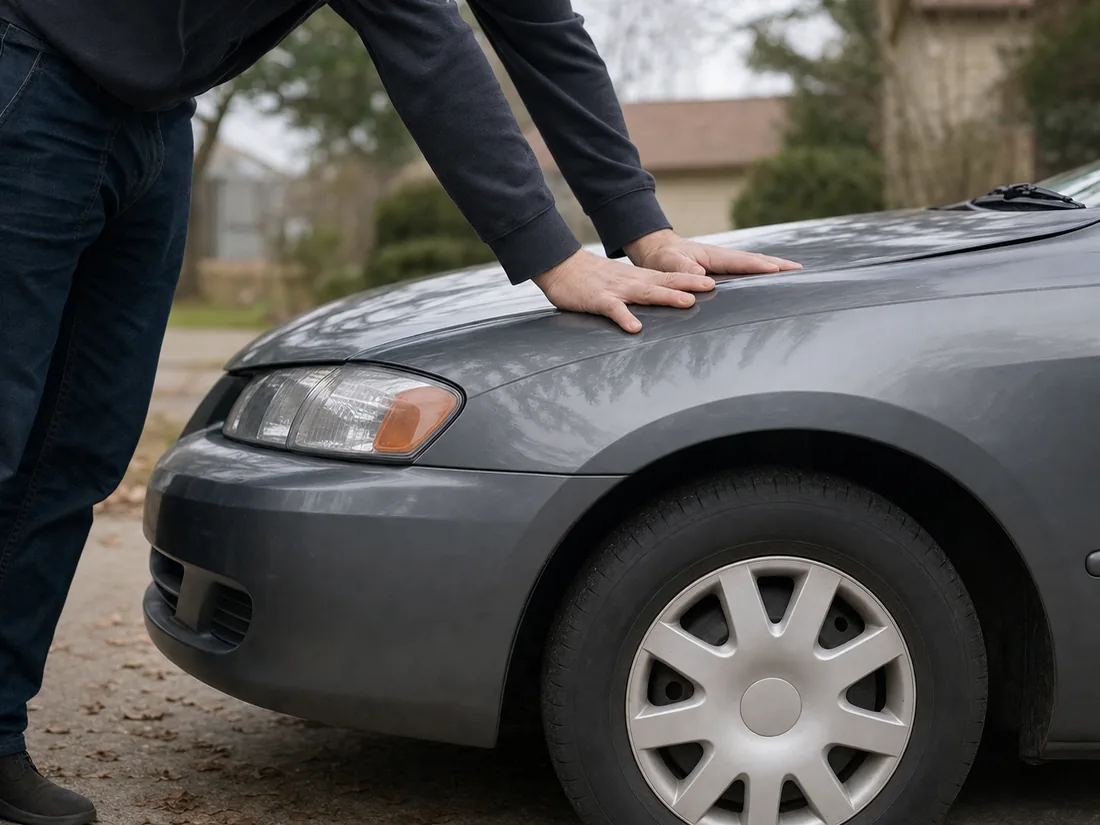
There is exactly one published pass mark for a worn shock absorber, and it is in federal regulation. The vehicle-in-use inspection standard says the shock absorber housing must show “no oil ... attributable to leakage by the seal, and the vehicle shall not continue free rocking motion for more than two cycles.” The procedure is the one you already know: on level ground, push down on one end of the car, let go, count how many times it rocks, then do the other end.
Two things about that rule matter and are almost never mentioned. It carries a citation line reading 1973, amended 1979, so it was written before gas-pressurised dampers became near-universal. And Part 570 is a model standard for state inspection programmes rather than a rule binding on you or your mechanic, covering vehicles of 10,000 lb gross weight or less. So when someone tells you the bounce test is “the official test,” that is the document they mean, and it is older than most cars on the road.
49 CFR 570.8 (eCFR).
Here is the awkward part. TÜV SÜD, a German technical inspection body with no dampers to sell, states that a simple visual check or a hand bounce test give no reliable results about how the dampers are actually working, and that the proper method is a shaker-plate rig that vibrates each wheel and measures the damping. Its 2024 wording was softer, calling such checks “only conditionally reliable”; by 2025 it had hardened to no reliable result at all.
Its inspection advice is worth repeating because it is about looking, not replacing: if a damper check is not already part of your service schedule, have one done by a specialist from about 80,000 km, roughly 50,000 miles, and about every 20,000 km after that.
Notably, Gabriel's own do-it-yourself advice does not mention the bounce test either. The only home check it offers is looking for physical damage and leaks.
TÜV Rheinland on shaker-plate testing; TÜV SÜD press releases of February 2024 and October 2025, read from Internet Archive captures because the live pages refuse automated requests.
The figure that circulates everywhere is Monroe's: a vehicle with 50%-worn shock absorbers, on an uneven surface at 80 km/h, needs an extra 2.6 metres to come to a full stop compared with the same vehicle on new shocks. The same page carries related claims: on a 40-metre roundabout, 50%-worn shocks lose stability 7 km/h earlier; on a 6 mm film of water, a front-wheel-drive car with worn shocks and new tyres aquaplanes at a 10% lower speed.
Now the part nobody quotes. The entire attribution for all of it is one footnote at the bottom of the page: “*TÜV test - Institute of Traffic Safety.” No year, no report number, no link. That is a manufacturer citing an unnamed test, and it should be read that way.
KYB publishes a different number that often gets confused with Monroe's: just one worn shock absorber can add up to 2 metres to stopping distance at 50 kph, about 30 mph. KYB cites nothing for it. And the independent bodies, the ones with nothing to sell, quantify nothing at all: TÜV SÜD says braking distance lengthens “under certain circumstances”, and Bilstein says it “can increase considerably.” Neither gives a figure.
The direction of all this is almost certainly right, and the mechanism is real: worn dampers let the tyre lose contact with the road, which is also why ABS, traction control and stability control degrade with them. Treat the decimal points with more suspicion than the conclusion.
Ask the makers when to replace dampers and you get numbers that do not survive comparison.
Monroe's European site says to have them inspected every 20,000 km and replaced every 80,000 km, introduced with “Experts recommend” and carrying an asterisk that resolves to a disclaimer that actual mileage may vary. Monroe's American site publishes the same article with the replacement mileage removed entirely, recommending only an annual inspection. Same company, same advice page, one number on one continent.
Monroe's own technician guidance treats 50,000 miles as a question to ask, not an interval to sell: has this vehicle been in service 50,000 miles or more? KYB recommends 80,000 km or 50,000 miles, always as an axle pair, citing no test. Gabriel recommends a check every 12 months or 12,000 miles and replacement at 50,000-mile intervals, hedged in the same sentence with “actual mileage intervals may vary.”
Even the wear arithmetic disagrees inside one company. Monroe's consumer page says dampers stroke about 1,750 cycles per mile, 21 million cycles per 12,000 miles. Tenneco's own technical training arm, Garage Gurus, says more than 2,200 cycles per kilometre and 176 million cycles by 80,000 km, roughly double. Both are the same corporate group.
The honest reading: there is no manufacturer-independent replacement mileage for shock absorbers, and where a company publishes one it is hedged, inconsistent between markets, or absent from its own technician-facing material. Inspect on a schedule; replace on evidence.
A film of oil on a damper body is the most common reason a perfectly good part gets replaced. Monroe draws the line explicitly. A minimal amount is weepage, it does not require replacement, and it happens because fluid clings to the rod and gets drawn past the seal. Replacement is required when most of the body appears wet and oily, or fluid is dripping off it, which is leakage.
Gabriel goes further and says dampers are designed to mist slightly, because that film lubricates the seal as the rod moves and protects the rod from corrosion.
So a damp-looking shock is normal. A wet, running, dripping one is finished. Note that the federal inspection rule quoted above is stricter than either manufacturer here, allowing no seal leakage at all, which is another sign of its age.
Three manufacturers publish symptom lists and they overlap heavily, which is the closest thing to consensus in this subject.
Two useful cautions from Gabriel. Dampers rarely fail outright; a shock can contain up to 40 precision parts and they degrade gradually, which is why owners adapt without noticing. And new dampers will not cure a vibration, because vibration comes from rotating parts in the wheels, tyres and driveline; if that is your complaint, this is not the repair.
Expect the car to feel firmer after new dampers are fitted. Gabriel explains it plainly: worn shocks ride softer, drivers adjust to that, and new ones return the car to how it originally rode.
Every manufacturer says to replace dampers as an axle pair, and the mechanism is worth understanding rather than taking on trust. A new damper has no internal wear; pair it with an old one and the damping across that axle becomes uneven. Tenneco's technical arm puts the consequence bluntly: the new unit becomes overloaded trying to control the rebound and compression the worn one is no longer handling, and replacing only one side voids the warranty claim.
There is a second, administrative reason. Monroe notes that in some countries a marked left-to-right difference in damper condition can fail a statutory roadworthiness test outright.
Worn dampers are one of the few faults a buyer detects in the first thirty seconds of a test drive, because the car floats over the first bump and dives at the first stop. They are also expensive enough that fitting four to a car you are selling rarely returns what it costs.
The straight play is to know the answer before they ask. Do the bounce test, look for a body that is wet rather than misted, and check the tyres for cupping. If the dampers are tired, say so and price accordingly; a buyer who discovers it on the drive assumes everything else was hidden too.
And if the shocks are the least of it, that is the car we buy as it stands.
It is the only test with a published pass mark: federal inspection rules say the car must not keep rocking for more than two cycles. But TÜV SÜD, an independent testing body, says a hand bounce test gives no reliable result about damping and that a shaker-plate rig is the proper method. Use it as a rough screen, not a verdict.
There is no manufacturer-independent figure. KYB says 80,000 km or 50,000 miles, Gabriel says 50,000 miles with the caveat that mileage varies, and Monroe publishes 80,000 km in Europe but no replacement mileage at all on its US site. Inspect on a schedule and replace on evidence.
Not necessarily. Monroe calls a minimal film weepage and says it does not require replacement, and Gabriel says dampers are designed to mist slightly because the film lubricates the seal. Replace when most of the body is wet and oily or fluid is dripping off it.
The direction is agreed and the mechanism is real, since a bouncing tyre loses contact with the road. The specific figures are weaker than they look: Monroe's 2.6 metres at 80 km/h rests on a single unnamed footnote, KYB's 2 metres cites nothing, and the independent testers publish no number at all.
Yes, per every manufacturer. A new damper paired with a worn one gives uneven damping across the axle, the new unit gets overloaded and wears early, replacing one side can void the warranty claim, and in some countries a marked left-right difference fails the roadworthiness test.