Sell My Car Hub

Brake noises and what they mean

Brakes talk in about five sounds, and most people hear all of them as the same worrying squeak. They aren't the same. One is nothing. One is a built-in alarm that gives you weeks of warning. One means the pad is gone and every mile is grinding the rotor away. Here is how to tell them apart by ear, what each one costs to ignore, and the actual measurements a state inspector uses to decide a brake has failed.

Last updated .

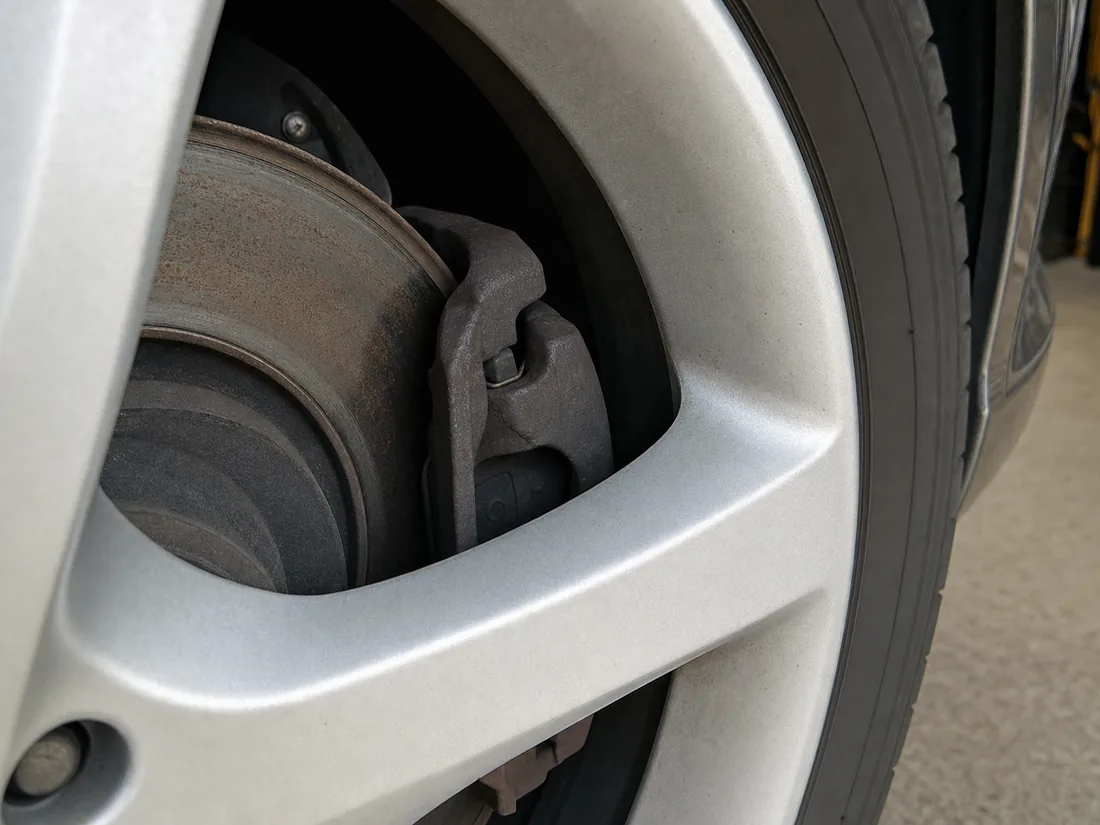
A disc brake rotor and caliper seen through the spokes of an alloy wheel on a parked sedan in a home garage - brake noises and what they mean

A squeak on the first few stops of the morning is usually nothing

Start with the one that scares people and shouldn't. A car that sat overnight, especially outside or after rain, often squeaks for the first two or three stops and then goes quiet. That is surface moisture and a film of light rust on the rotor face being scrubbed off by the pad. AAA's own service guidance says it plainly: noisy brakes can be benign when moisture accumulates on the pads and rotors and makes them temporarily squeak, particularly in the morning.

The test is whether it stops. Two or three normal stops should clear it. A squeak that is still there at the end of the drive, or that comes back every time you touch the pedal on a dry afternoon, is one of the noises below and deserves a look.

A high-pitched squeal on every stop is the wear indicator, or loose hardware

Most brake pads carry a small metal tab that does nothing until the friction material wears down to it. Then it touches the rotor and screams. PowerStop, one of the larger aftermarket pad makers, describes it as a mechanical wear indicator designed to produce an auditory signal when it's time for the pads to be changed. AAA calls them metallic wear indicators that squeak as the pads get thinner. It is a feature, not a fault, and it is the best warning you will get: the pad is low but it still has material on it, so you have time to book the job rather than a reason to stop driving.

The same squeal without the wear-indicator story usually comes from the hardware around the pad rather than the pad itself. PowerStop lists the usual suspects in the same article: spring-loaded hardware that has lost its tension, and insufficient lubrication on the pins that locate the pad in the caliper or on the pad's backing plate. A pad that can vibrate in its bracket sings. That is a cheap fix, clips and lubricant, and it is why a squeal that started right after a budget brake job is so common.

What to ask for: have the pad thickness measured, not guessed at. If the pads are at the indicator, replace them. If the pads are fine and the noise persists, the hardware and shims are the next thing to check, and they cost a fraction of what people fear when they hear the word brakes.

Grinding means the pad is gone and you are wearing the rotor

This is the one that should change your plans for the day. A low, harsh grinding that you feel through the pedal as much as hear is metal on metal: the friction material has worn through and the steel backing plate of the pad is being pressed straight into the rotor. AAA's description is exact: grinding noises likely mean your brake pads are completely worn out, allowing the metal backing of the brake pads to scrape against the metal rotors.

Two things happen at that point. Stopping distance goes up, because a steel plate is a poor friction surface. And the rotor, which would otherwise have outlived the pads, is being scored with every stop. That turns a pad job into a pad-and-rotor job. AAA's ballpark for a complete brake job, pads, rotors and calipers, is that it can easily set you back close to $1,000, against pads alone if you had caught the squeal a few weeks earlier. PowerStop's own advice on noise is that squeaks are not always cause for panic, but metal-on-metal grinding should be checked by a professional.

If it's grinding, drive it to the shop, not to work and then to the shop.

A click when you change direction is the pads shifting in their bracket

A single click or clack the first time you brake after reversing out of a space, or when you go from reverse to drive, is the pads moving. Most modern calipers sit on an anchor bracket and locate the pads with stainless steel clips that load them in one direction; change direction and the pad takes up the slack against the bracket with a click. PowerStop's explanation is that if you hear it right after new pads and rotors, it is most likely the hardware clips, which should be lubricated with a synthetic brake lubricant. Worn or missing clips do the same thing on an older car.

It is not a safety problem on its own. It is a loose-part noise, and the fix is clips and lubricant. Where it matters is the buyer's ear: a click on the first stop of a test drive reads as a mystery, and mysteries cost money at negotiation time. The same PowerStop article separates it from a clicking or popping that happens while turning, which is not the brakes at all and points at the driveline or suspension.

A pulse in the pedal or a shake in the wheel is an uneven rotor, and it is not "warped"

Brake pulsation feels like the pedal pushing back rhythmically as you slow, sometimes with a shudder through the steering wheel. Almost everyone calls this a warped rotor, and almost everyone is wrong about the mechanism. Rotors don't warp from heat in normal driving. What actually happens is disc thickness variation: the rotor is very slightly thicker in one spot than another, and the pad rides over the high spot on every rotation. PowerStop's technical article defines it as the variation between the thickest and the thinnest parts of the rotor as it rotates, and their companion piece states outright that contrary to popular belief, temperature does not cause the rotors to warp. The high spots are usually pad material, transferred unevenly onto the rotor face when the pad gets hot, with the resin in the pad acting as the glue.

AAA reads the same symptom from the driver's seat: if your steering wheel shakes when you are stopping, the surface of the rotors has become uneven, and a mechanic can tell you whether they can be resurfaced or need replacing. Two honest caveats. Worn suspension bushings can mimic it, because a loose suspension oscillates under braking, so a shop should confirm the rotor is the cause before selling you rotors. And whether resurfacing is even an option depends on how much metal is left, which is the number in the next section.

The numbers an inspector actually uses

Noise is a symptom. What decides whether a brake has failed is a measurement, and states that inspect brakes publish theirs. Pennsylvania's inspection regulation is the most specific of the ones that are easy to read, and its rejection thresholds for a passenger car are these, as of the current text of 67 Pa. Code § 175.80:

Those are one state's figures, and states differ on which components they check and how often. The inspection rules when selling by state table shows which states inspect at all and who has to produce the certificate. But the shape is the same everywhere: an inspector measures pad thickness and rotor thickness, and a shop quoting you rotors should be able to show you the stamped minimum and the reading that fell below it.

If you're about to sell the car

A brake noise changes the sale in a predictable way, and knowing which noise you have tells you how much. A morning squeak is nothing and needs no mention. A wear-indicator squeal is a known, priced job, and a buyer who hears it will either ask for it done or take it off the offer; the cost of pads is usually less than the discount a buyer will demand for an unknown noise. Grinding is different: it announces a pad-and-rotor job, it makes the test drive feel unsafe, and it is the kind of defect a buyer's own inspection will find in minutes with a flashlight through the wheel spokes.

Whether to fix it first is a cost question, not a moral one, and the answer depends on the car. On a car worth real money, a pad job before listing usually returns more than it costs. On a car at the bottom of its life, spending on brakes to sell it can be spending you never get back, and the fix-it-or-junk-it guide and the when to stop repairing guide are built for exactly that arithmetic. What you should not do is hide it. Most states expect a private seller to disclose known defects, and the selling a car with problems guide covers what disclosure looks like state by state. If the honest answer is that the car needs brakes and you don't want to pay for them, that is a normal car to sell as-is, and a buyer who takes cars as they sit will price the brakes in without a negotiation.
Common questions

What people ask about this

Why do my brakes squeak in the morning but stop after a few stops?

Moisture and a film of light rust form on the rotor face overnight, and the first few stops scrub it off. AAA's service guidance lists this as a benign, temporary squeak. If it clears within two or three stops and doesn't come back on a dry day, it needs nothing.

What is the metal tab that makes brakes squeal?

A wear indicator. It is a small metal tab on the pad that only touches the rotor once the friction material has worn down to it, and then it produces a high-pitched squeal on every stop. It is a deliberate warning that the pads are low, not a sign that the brakes have failed. Book the job; you have time.

Is it safe to drive with grinding brakes?

Not for any longer than it takes to get to a shop. Grinding means the friction material is gone and the pad's steel backing is pressing on the rotor. Stopping distance increases, and every stop scores the rotor, which turns a pad replacement into a pad-and-rotor replacement. Pennsylvania's inspection code fails a rotor scored deeper than .015 inch.

Are my rotors warped?

Probably not in the way the word suggests. Rotors don't warp from heat in normal driving. The pulse you feel is disc thickness variation: the rotor is fractionally thicker in one spot, usually from pad material deposited unevenly on its face, and the pad rides over that high spot every rotation. A shop measures the variation and checks the rotor against its stamped minimum thickness to decide between resurfacing and replacing.

Why do my brakes click when I go from reverse to drive?

The pads are shifting in the caliper bracket. Modern calipers hold the pads with stainless clips that load them in one direction; when the car changes direction the pad takes up the slack with a click. It is common right after a brake job when the clips weren't lubricated, and on older cars when the clips are worn. It is a hardware fix, not a safety failure.

How thin can brake pads be before they fail inspection?

It depends on the state, and many states don't inspect brakes at all. Pennsylvania's regulation rejects bonded linings thinner than 2/32 inch at the thinnest point, riveted linings less than 1/32 inch above the rivet head, and any disc thinner than the minimum stamped on it. Check your own state's rules; the inspection-by-state guide on this site lists which states inspect and when.

Should I fix the brakes before selling the car?

If the car is worth enough that a pad job is a small fraction of its value, usually yes, because a buyer will discount an unknown noise by more than the job costs. If the car is near the end of its life, spending on brakes to sell it can be money you never recover, and selling it as-is to a buyer who prices in the work is the cleaner route. Either way, disclose it.

Rather just sell the car?

Get My Instant Offer → Online · about 2 minutes · free

Or send the details — we'll come to you

Brakes grinding and not worth fixing? Tell us about the car. We buy them as they sit, brakes and all, and we come to you.

or call/text (877) 405-1808