Sell My Car Hub

Tires: how to check them, when to replace them, and how to change one

Tires are the only part of the car that touches the road, and they fail in ways that give warning if you look. Federal crash data puts tire-related deaths at several hundred a year, most of them from under-inflation and worn tread, both of which show up in a two-minute check. Here is everything on the sidewall and in the tread explained, with the numbers taken from NHTSA, the federal tire rule and the state inspection codes rather than from a tire shop's sales floor: how deep the tread has to be, what pressure to run and where that number lives, how often to rotate, how old is too old, and how to change one at the roadside without hurting yourself.

Last updated .
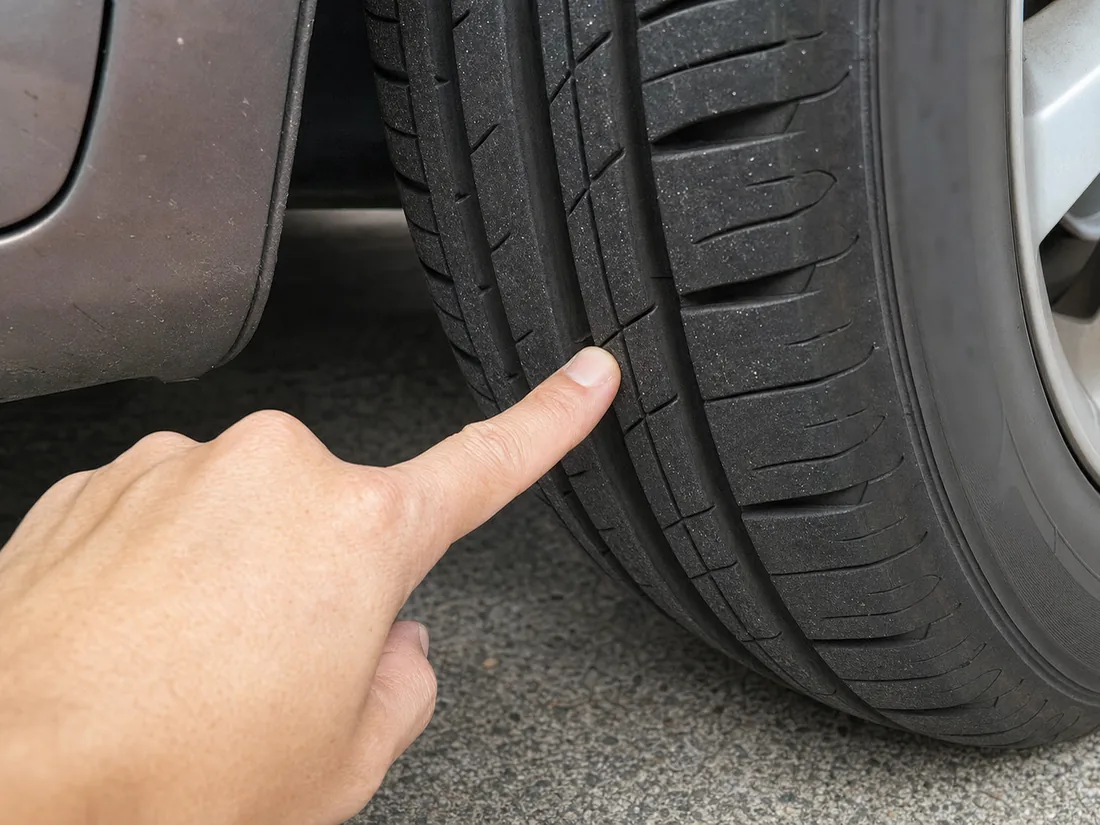
A fingertip resting in the tread groove of a car tire beside a raised wear bar, the tire on a car in a driveway - tires: tread depth, pressure and when to replace

Tread depth: the 2/32-inch line and the penny that measures it

Tread is what moves water out from under the tire; below a certain depth it cannot, and the car aquaplanes on a wet road at speeds that felt fine last month. The federal position is unambiguous. NHTSA's TireWise guidance: tires are not safe and should be replaced when the tread is worn down to 2/32 of an inch. State inspection codes use the same figure; Pennsylvania's rejects a car when a tire has two adjacent treads with less than 2/32-inch tread remaining at any point, and demands 4/32 on the front tires of anything over 10,000 pounds.

Three ways to read it, none needing a shop. The penny test: NHTSA's version is to place a penny in the tread with Lincoln's head upside down and facing you; if you can see the top of Lincoln's head, replace your tires. The top of the head sits about 2/32 above the coin's edge, which is why it works. Wear bars: every tire has built-in treadwear indicators, raised sections that run between the tread; when the tread is worn level with them, it's time to replace. A gauge: a few dollars at any parts store, and AAA notes the digital ones measure to the decimal inch or millimetre. Measure in several grooves and at both edges, because uneven wear across the tire is its own diagnosis: worn on both shoulders means chronic under-inflation, worn in the centre means over-inflation, worn on one edge means alignment.

Two caveats on the 2/32 figure. It is the legal floor, not the point at which wet grip is good; many drivers replace at 4/32, which is the depth AAA gives for the front winter tires it says to replace immediately, and a quarter with Washington's head down measures that. And NHTSA's advice is to check your tire's tread at least once a month when you're checking their pressure, which is the habit that catches a nail or a bulge before it becomes a blowout.

Pressure: the number is on the door, not on the tire

This is the single most common tire mistake, and NHTSA puts it in capitals: locate the recommended tire pressure on the Tire and Loading Information label on the driver's side door edge or post, or in the owner's manual; the correct pressure for your tire is what the vehicle manufacturer has listed, NOT what is listed on the tire itself. The number moulded into the sidewall is the tire's maximum, a ceiling for the tire on any car, not the setting for yours. Running it there gives a hard ride, a small contact patch and centre wear.

The pressure on the placard is a cold figure, and cold has a definition: NHTSA's is not driven on for at least three hours. Driving heats the air inside and raises the reading, which is why the federal rule for commercial vehicles requires that no motor vehicle be operated on a tire with a cold inflation pressure less than that specified for the load being carried, with a correction table for tires measured warm. If you have to top up a warm tire, NHTSA says to fill it to the placard number anyway and recheck cold later, because a slightly low warm reading is safer than driving with a significantly underinflated tire. Check all four and the spare; NHTSA's steps include the spare specifically, and a full-size spare that has sat for years is usually flat when you need it.

What correct pressure is worth, in NHTSA's own numbers: properly inflating your tires can save as much as 11 cents per gallon on fuel, yet only 19 percent of consumers properly inflate their tires, and properly inflated tires can extend the average life of a tire by 4,700 miles. AAA cites the Department of Energy for the same effect, up to 3 percent on fuel by inflating to the PSI listed on the frame of the driver's door. Pressure drops with temperature, roughly a pound for every ten degrees, so the first cold week of autumn is when every car on the street goes low at once.

The TPMS light: what it means, and what it doesn't

Every passenger car sold in the United States since the 2008 model year has a tire pressure monitoring system, and NHTSA's guidance is blunt about the symbol: when the TPMS symbol appears on your dashboard, it means at least one of your tires is significantly underinflated; inspect your tires and check the pressure as soon as possible. It is a late warning, not an early one; the threshold is well below the placard figure, so a lit TPMS light means a tire that is already badly low, and a dark one does not mean all four are right.

The pattern that confuses people is the light that comes and goes. NHTSA explains it: on cold mornings the symbol may illuminate for a short period and then turn off, caused by marginally low pressure that dips below the warning threshold overnight but rises to an acceptable level as the tires heat up. That is a tire a few pounds low, not a fault, and the fix is air. A light that flashes for a minute at start-up and then stays on is different: it means the system itself has a fault, usually a dead sensor battery, and the car has stopped monitoring. AAA lists the four triggers in its own guide: underinflated tires, an under- or over-inflated spare if it has a sensor, a temperature swing, and a sensor problem. Two kinds of system exist, and it matters after a tire change: direct systems have a sensor in each wheel that a shop must service, indirect ones read wheel speed through the ABS and need a reset from the dash after every inflation.

Rotation: 5,000 to 8,000 miles, and which cars cannot

Front tires steer and, on most cars, drive and carry the engine's weight, so they wear faster and differently. Rotation evens that out. NHTSA: if recommended by the vehicle manufacturer, rotate tires every 5,000 to 8,000 miles, or sooner if uneven wear appears. Bridgestone's own interval is the bottom of that range, as recommended by the vehicle manufacturer, or every 5,000 miles, and it adds a point worth knowing: rotating your tires may also be required to keep your tires covered under warranty. The easy way to remember it is to rotate at every oil change.

The pattern depends on the car. Front-wheel drive usually moves the fronts straight back and crosses the rears forward; rear-wheel drive the reverse; directional tires, marked with an arrow on the sidewall, can only swap front to back on the same side. And some cars cannot rotate at all: NHTSA notes that if your front and rear tires are different sizes, you may not be able to rotate your tires, which is the case on many performance and luxury cars with staggered fitments. Bridgestone's practical note is that rotation time is inspection time: a good opportunity to visually inspect them for damage, check their air pressure, have them rebalanced if you're noticing any vibration, and check their tread depth.

Reading the sidewall: size, ratings, and the date code

A size like P215/60R16 95H reads left to right: P for passenger car (LT is light truck); 215 is the width in millimetres; 60 is the aspect ratio, the sidewall height as a percentage of the width, and NHTSA notes that a number of 50 or lower indicates a short sidewall for improved steering response; R is radial construction; 16 is the wheel diameter in inches; 95 is the load index, a code for the weight each tire may carry; H is the speed rating. Replacement tires should match the size on the placard, because the speedometer, the ABS and the stability control are all calibrated to that rolling circumference.

Also on every passenger tire sold in the United States are three government grades. NHTSA's Uniform Tire Quality Grading puts treadwear, traction and temperature ratings on the sidewall of every passenger vehicle tire sold in the United States; treadwear is a relative number (a 400 should last twice as long as a 200 under the same test), traction is graded AA to C for wet braking, temperature A to C for heat resistance. Comparing two tires by those three grades is how to shop without reading a review.

The most useful string on the sidewall is the one nobody reads: the DOT Tire Identification Number. NHTSA's explanation: it begins with the letters DOT, indicating the tire meets all federal standards; the next two or three characters are the plant code; the last four numbers represent the week and year the tire was built, for example 3107 means the 31st week of 2007. That is the tire's birthday, and the next section is about why it matters. The full number is often on only one side of the tire, so if the outer sidewall shows a partial code, the date is on the inner one.

Age: when a tire with plenty of tread still needs replacing

Rubber degrades with time whether or not the tire rolls, and the failure it produces, tread separation at speed, is the dangerous kind. NHTSA's warning is that you cannot detect tire aging simply by looking at your tires, and that the people at risk are the ones who drive least: recreational vehicles, 15-passenger vans, collector cars, any other vehicles you don't drive regularly, or if your annual mileage is low, with heat and sun accelerating it, so that tire aging is a greater concern in the more southern parts of the Sun Belt states.

The number, as NHTSA states it: some vehicle and tire manufacturers recommend replacing tires that are six to 10 years old, regardless of treadwear. Michelin's own position, stated for its motorcycle tires, is the top of that range: all tires that have not been replaced after ten years should be changed, even if they appear to be in generally good condition and have not reached their tread wear limit. Check the owner's manual for the vehicle maker's figure, read the date code, and treat fine cracking in the sidewall or between the tread blocks as the visible end of the process.

The spare is the tire this catches most often. NHTSA: spare tires on all vehicles are prone to aging because they seldom get replaced; NHTSA recommends that if your vehicle comes equipped with a full-size spare tire, it not be used as a replacement for worn tires, except in emergencies. A fifteen-year-old spare with perfect tread is still a fifteen-year-old tire.

Damage, and what to do when a tire lets go at speed

The federal rule for commercial vehicles lists the conditions that take a tire off the road, and they apply just as well to a car: body ply or belt material exposed through the tread or sidewall, any tread or sidewall separation, a flat or an audible leak, or a cut to the extent that the ply or belt material is exposed. Add a bulge on the sidewall, which is the inner structure failing and the air pushing through, and a nail anywhere in the sidewall or the outer shoulder, which cannot be plugged safely. A nail in the centre of the tread can be repaired from the inside with a patch-plug; a sidewall cannot.

If one fails while driving, the instinct to brake hard is the wrong one. NHTSA's blowout procedure: do not panic; hold the steering wheel with both hands, maintain your vehicle speed if possible and if it's safe to do so, gradually release the accelerator, correct the steering as necessary to stabilise the vehicle, and once it has stabilised, continue to slow down and pull off the road where you judge it safe. Front and rear blowouts are handled the same way; NHTSA notes the only difference is that a front tire blowout you feel in the steering, a rear one in the seat or body of the vehicle.

Changing a flat at the roadside

Before anything, get the car somewhere flat and out of traffic, even if that means driving another hundred yards on the flat and ruining a tire that is already ruined. Hazard lights on, parking brake on, in Park or in gear. Find the spare, the jack and the wrench; on most cars they are under the boot floor, and the manual shows the jacking point for each corner, a reinforced notch in the sill that is the only place the jack should go.

  1. Loosen the wheel nuts a half-turn each while the wheel is still on the ground, in a star pattern. They are tight; stand on the wrench if you have to, but do not remove them yet. A wheel that spins on the jack cannot be loosened.
  2. Jack the car until the tire clears the ground by a couple of inches. Never put any part of yourself under a car held by a jack.
  3. Remove the nuts, then the wheel, and lay the flat under the sill beside the jack, so that if the car falls it lands on the wheel rather than the brake.
  4. Fit the spare, thread the nuts on by hand, and snug them in a star pattern. Lower the car until the tire touches the ground, then tighten the nuts firmly in the same pattern, then lower fully and remove the jack.
  5. Check the spare's pressure at the first opportunity. NHTSA's advice is to check the spare every time you check the others, and it is almost always low.

A compact temporary spare carries its own limits printed on its sidewall, typically a speed and a distance, and it is a way to a tire shop, not a tire. If the car has no spare at all, which is increasingly common, the sealant-and-compressor kit in the boot handles a tread puncture only; a sidewall cut or a blowout means a tow. Have the wheel nuts checked with a torque wrench when the proper tire goes back on; a roadside wrench cannot tell you whether they are tight enough or too tight.

Winter tires, and mixing tires

All-season tires are a compromise, and in real snow the compromise shows. NHTSA's own buying guidance is that winter tires are more effective than all-season tires in deep snow, and summer tires are not designed to operate in temperatures below freezing. The difference is the rubber compound as much as the tread: winter rubber stays soft below about 45°F where all-season rubber hardens and loses grip. AAA's winter guidance puts a shorter tread floor on them, if your front winter tires have reached less than 4/32 inch of tread depth or your back tires are at 2/32 inch, replace them immediately, and notes that many states don't always allow studded tires, so check your local laws.

Whatever the season, fit tires in matched sets, or at least matched pairs on an axle. Mixing tread patterns or wear levels across an axle makes the car pull under braking; mixing them front to rear on an all-wheel-drive car can damage the centre differential, and the manual usually says so. If only two are being replaced, the convention is that the new pair goes on the rear, because a car that loses grip at the rear spins where one that loses it at the front merely understeers.

If you're about to sell the car

Tires are the first thing a buyer can see without opening anything, and they read them in two ways: as a cost, since four tires is one of the larger bills a used car can present, and as a character reference, since bald or mismatched tires say the car was run on the cheap. A buyer who knows the trick will also read the date codes, and four different dates tells its own story.

Whether to replace before selling is arithmetic. On a car worth real money, a matched set of mid-range tires often returns more than it costs, because it removes the buyer's largest visible objection and lets the rest of the car be judged on its merits. On a car at the bottom of its value, it rarely does, and the honest route is to price the tires in and say so; a set at 3/32 with a bulge on one is a fact a buyer will find on the first walk-around, and most states expect a private seller to mention a known defect they were asked about. The selling a car with problems guide walks through what has to be declared where you live, and the fix it or junk it guide is the calculator for whether a set of tires is money you'll see again. If the car has other problems as well, a buyer who deals in cars as they stand will price the tires in with everything else, and the brake, battery and fluids guides cover the rest of what they look at in the first five minutes.

Common questions

What people ask about this

How do I know if my tires need replacing?

Three checks. Tread: below 2/32 of an inch, which is NHTSA's line and the state inspection floor, the tire is done; a penny with Lincoln's head down shows the top of his head at that depth, and the wear bars moulded into the grooves sit level with the tread at the same point. Damage: any bulge, any cut showing cord, any separation, or a nail in the sidewall. Age: NHTSA says some makers recommend replacement at six to ten years regardless of tread; read the last four digits of the DOT code for the week and year.

What pressure should my tires be?

The number on the label on the driver's door edge or post, or in the manual, never the number on the tire. The sidewall figure is the tire's maximum, not the setting for your car. Check it cold, which NHTSA defines as not driven for at least three hours, and check the spare too. NHTSA's figures: only 19 percent of drivers keep tires properly inflated, and doing so saves up to 11 cents a gallon and adds about 4,700 miles of tire life.

Why does my tire pressure light come on in the morning and go off later?

One or more tires is a few pounds low. Cold air contracts overnight, the pressure dips under the warning threshold, and driving warms it back above. NHTSA describes exactly this pattern. It is not a fault; it is a tire that wants air. A light that flashes for a minute at start-up and then stays lit is different: the monitoring system itself has failed, usually a sensor battery.

How often should I rotate my tires?

NHTSA says every 5,000 to 8,000 miles if the manufacturer recommends rotation, or sooner if uneven wear shows; Bridgestone's interval is every 5,000 and it notes rotation may be a warranty condition. Every oil change is the easy way to remember it. Cars with different sizes front and rear cannot rotate front to back, and directional tires can only swap on the same side.

How do I read the date on a tire?

Find the DOT code on the sidewall; it may be complete on only one side. The last four digits are the week and year of manufacture: NHTSA's example is 3107 for the 31st week of 2007. Tires made before 2000 used a three-digit code and are past any reasonable age anyway.

Can I drive on a bulging tire?

No. A sidewall bulge is the internal structure failing and the air pushing through the weakened spot; it is the stage before a blowout. Replace the tire, and if it bulged after a pothole, have the wheel checked for damage too. Fit the spare to get to the shop. The same applies to a cut that shows cord and to any separation of the tread from the casing.

What should I do if a tire blows out while driving?

Don't brake hard and don't lift off suddenly. NHTSA's procedure: both hands on the wheel, hold your speed for a moment if it's safe, ease off the accelerator gradually, steer to keep the car straight, and only once it is stable, slow down and pull off where it's safe. A front blowout you feel in the steering, a rear one in the seat; the response is the same for both.

Rather just sell the car?

Get My Instant Offer → Online · about 2 minutes · free

Or send the details — we'll come to you

Four bald tires and a car that isn't worth four new ones? Tell us about it. We make offers on cars as they are, and we collect.

or call/text (877) 405-1808