A car runs on seven fluids, and a five-minute look under the hood once a month catches most of the ways it fails expensively. None of the checks needs a tool. Every one has a rule that people get wrong, usually about colour, temperature or which fluid goes where, and a couple of those mistakes destroy a transmission or a brake system outright. Here is each fluid: where it lives, how to read it, what the manufacturers and the federal standard say about it, and when it needs changing rather than topping up.
Last updated .
Coolant circulates between the engine and the radiator, carrying heat away, and it also stops the water in the system from freezing in winter and corroding the metal year-round. It lives in a translucent reservoir with two moulded lines, and the check is a glance: the level should sit between them when the engine is cold. Prestone's own procedure for topping up is blunt about the one rule that matters: remove the pressure cap with the engine cold, and fill the tank to the cold line. A hot cooling system is under pressure and the coolant is well past boiling; opening it sprays scalding liquid. AAA's overheating guide opens with the same warning, an overheated engine can burn you, and adds the rule for the road: once your car overheats you can't keep driving; you could cause further damage to the vehicle. Pull over, switch off, and wait.
Level matters in both directions. Prestone: low coolant means less heat transfer, which risks the engine overheating; too much coolant also risks damage, because coolant needs room to expand. Top up with the type the maker specifies, premixed 50/50 or concentrate mixed with distilled water, never tap water, which brings minerals into the system. Colour is a type, not a condition. Coolants come in orange, pink, green, yellow, blue and purple because different chemistries suit different engines, and Prestone's own selector matches them by make and year; mixing chemistries can turn the coolant to a gel that blocks passages. If you do not know which one is in the car, the reservoir cap or the manual says, and a universal coolant labelled compatible with all is the safe top-up.
When to change it: modern coolants last a long time, but AAA notes that coolants can get contaminated with dust, dirt and other environmental components, and Prestone describes the result: dirty coolant is no longer effective, which means corrosion, rust and damage happen more rapidly, along with reduced flow and the risk of clogging. Rusty-brown coolant, or a sludge in the reservoir, means a flush rather than a top-up. The interval is in the manual and is usually measured in years; a cheap tester or test strip from a parts store reads the freeze protection and the acidity in a few seconds.
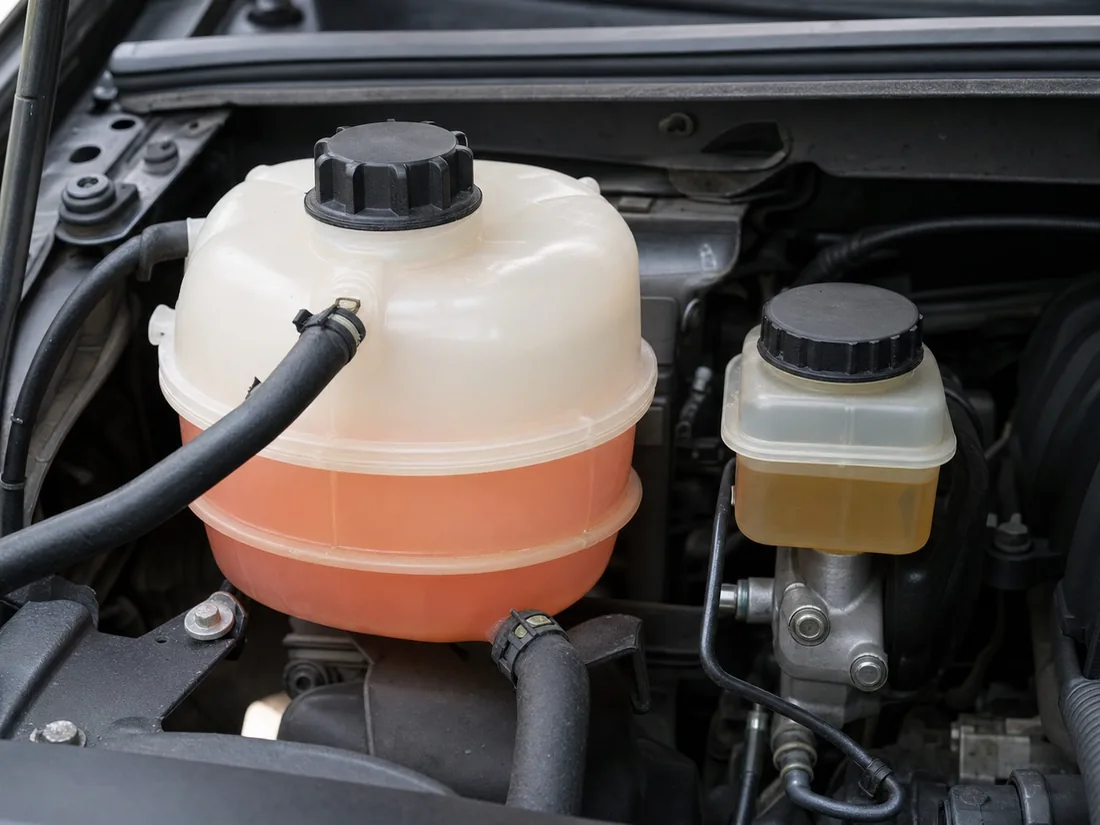
Brake fluid transmits your foot's pressure to the wheels, which is why it is the only fluid here with its own federal safety standard. The purpose of that standard, in its own words, is to reduce failures in the hydraulic braking systems of motor vehicles which may occur because of the manufacture or use of improper or contaminated fluid. The grades on the bottle, DOT 3, DOT 4 and DOT 5.1, are defined by that standard mainly through boiling points; for DOT 3 the minimums it sets are 205°C for fresh fluid and 140°C once the fluid has absorbed moisture, with DOT 4 and 5.1 held to higher figures. That second number is the whole story of brake fluid.
Because brake fluid is hygroscopic: it pulls water out of the air. Motul's technical guide explains what follows: even sealed systems allow small amounts of moisture through hoses, seals and servicing; as moisture increases, the boiling point drops, vapour bubbles can form, and brake pedal feel softens. Hard braking heats the fluid; wet fluid boils; the bubbles compress where the fluid would not; the pedal goes to the floor. The same moisture causes internal corrosion in brake lines, calipers and master cylinders. None of this shows on the dashboard. It shows the first time you need the brakes at the bottom of a long hill.
Checking it: the reservoir sits on the master cylinder at the back of the engine bay on the driver's side, with min and max lines. Fresh fluid is clear to pale amber; dark brown or black fluid is old and wet. A level that has slowly dropped over months usually is not a leak: as the brake pads wear, the caliper pistons sit further out and the fluid follows them into the calipers, so a low reservoir with no puddle is often a pad-wear reading. A level that dropped suddenly is a leak, and the car should not be driven. Changing it: Motul's summary of the industry position is that most manufacturers recommend replacing brake fluid every two years or according to the service schedule, regardless of mileage, because the clock on moisture runs whether the car moves or not. Replacing it means bleeding: opening the bleed valve at each wheel in the order the manual gives, usually starting furthest from the master cylinder, while a helper presses the pedal, until clean fluid comes through with no bubbles, keeping the reservoir topped the whole time so air never enters at the top. Use the DOT grade on the reservoir cap. Do not put DOT 5 in a car that specifies DOT 3 or 4; the standard treats DOT 5 silicone fluid as a separate class because it does not mix with the others.
Automatic transmission fluid lubricates, cools, and does the hydraulic work of shifting. AAA's technicians describe it as the lubricant that keeps the transmission's moving parts cool, clean and protected, and note the stakes: repairing a transmission can easily cost thousands of dollars, and most problems can be avoided with regular maintenance.
Checking it is the one fluid check that varies by car. Where there is a dipstick, AAA says you can check the level in much the same way as you check the oil, in many but not all vehicles; see your owner's manual for instructions, and the difference from oil is usually that the engine must be running and warm, in park or neutral, because the fluid level changes with temperature and the pump has to be circulating it. Read the level against the hot marks, and read the fluid: new fluid is bright red or pink and nearly odourless; brown fluid with a burnt smell has been overheated and the transmission should be looked at. Many newer cars have no dipstick at all. AAA is direct about what that means: "lifetime" fluid really means there is no easy dipstick access; it doesn't mean they're actually maintenance-free. On those cars the level is checked at a fill plug on a lift, which is a shop job.
Changing it: the range is wide. AAA: the guidelines for most vehicles recommend draining and replacing the transmission fluid every 30,000 to 150,000 miles, and its repair-centre guidance puts a professional flush at anywhere from 30,000 to 50,000 miles, with vehicles driven under harsh conditions, like a work truck or a car that does a lot of stop-and-go driving, possibly needing it more often. Two warnings from the same AAA experts belong in bold. One: a transmission unit can become irreparably damaged if the wrong fluid is used; the manual names the specification and there is no universal substitute. Two: if a transmission is already slipping or damaged, a fluid change won't repair worn components; have the system properly diagnosed before assuming a fluid change will help. A red puddle under the car is transmission fluid, and Prestone's advice is the obvious one: if your transmission is having trouble shifting, or you see red fluid puddling around your car, check the level right away.
If the car has hydraulic power steering, a small reservoir near the belt side of the engine holds the fluid the pump pushes to the steering gear; many newer cars have electric assist and no fluid at all, which the steering guide explains. The reservoir has cold and hot marks, or a dipstick in the cap, and the check is a glance with the engine off. The symptom of a low level is a whine or groan when you turn the wheel at parking speed, loudest when cold, and heavier steering. Use the fluid the cap or manual names; some cars specify automatic transmission fluid here, others a dedicated hydraulic fluid, and they are not interchangeable. A level that keeps dropping is a leak at a hose or the rack, and Prestone's leak guide notes the knock-on effect, since a healthy system prolongs the life of the belts and reduces strain on bushings and bearings. Power-steering fluid rarely appears on a service schedule, but it darkens and picks up debris like any hydraulic fluid; if it is black, a drain and refill is cheap insurance for a pump that is not.
Oil gets its own page here, engine oil: how to check it, how often to change it, and the 3,000-mile myth, because it is the fluid with the most folklore attached. The short version for a monthly check: engine off and level, wait a few minutes, wipe, reinsert, read between the marks; dark is normal, dark and gritty is not, milky means coolant is getting in; and the interval is the manual's or the oil-life monitor's, not the sticker's.
The least important fluid until the moment it is the most important. The reservoir is large, usually blue-capped, and it is the one fluid you fill rather than check. The mistake is seasonal: Prestone's winter guidance is that most regular blue washer fluids may work fine in the summer, but in cold weather they can freeze, smear on your windshield and block your view, and worse, a frozen reservoir can crack. Winter fluids are rated to well below zero; Prestone's de-icer version, for example, is formulated to work in temperatures as low as -25°F. Plain water in the reservoir freezes at 32°F and grows algae in summer. Fill it with the season's fluid and forget it.
Rear-wheel-drive cars, trucks and anything with all-wheel drive have gear oil in the differential, and four-wheel-drive vehicles have a transfer case with its own. They have no dipstick and no reservoir; the level is checked at a fill plug underneath, so it is a job for a lift or a set of ramps, and it is on the manual's schedule at long intervals, often 30,000 to 60,000 miles or longer, shorter for towing. The reason to know it exists is the sound it makes when neglected: a whine from the rear axle that rises with road speed rather than engine speed. If the car tows, or goes through deep water, the interval shortens, and a milky look at the plug means water got in.
Once a month, cold engine, level ground, five minutes: oil on the dipstick, coolant against the reservoir line, brake fluid against its line and its colour, power-steering fluid if the car has it, washer fluid topped. Transmission fluid on the schedule the manual gives, warm and running if it has a dipstick. Differential and transfer case at the service interval. Look under the car where it usually parks: a puddle's colour names the fluid. Red or pink is transmission or power-steering fluid, green, orange or pink and sweet-smelling is coolant, clear-to-amber and slippery near a wheel is brake fluid, and dark brown is engine oil.
A buyer who knows cars does this routine on the test-drive car in the first two minutes, and it tells them more than the service history does. Milky oil, brown brake fluid, a rusty coolant reservoir or burnt-smelling transmission fluid each say the car was not looked after, and each discounts everything else. Topping up before a sale is honest and cheap. What is not honest is masking: fresh red transmission fluid over a slipping gearbox, or a coolant top-up on an engine that is losing it somewhere. A known defect is something most states require a private seller to declare; the selling a car with problems guide explains how that works in yours, and the when to stop repairing a car guide is for the case where the transmission is the problem and the arithmetic no longer works. Someone who purchases cars with known faults builds the fluid into the price and doesn't haggle. The two other things they check in those first minutes, the battery and the brakes, have their own guides: why won't my car start and brake noises and what they mean.
Engine cold, look at the translucent reservoir: the level should sit between the two moulded lines. Never open the pressure cap on a hot engine; the system is pressurised and the coolant is past boiling. Top up with the type the cap or manual specifies, premixed or concentrate mixed with distilled water. Low risks overheating; overfull risks damage because coolant needs room to expand. Colour is the chemistry type, not the condition; rusty-brown or sludgy coolant needs a flush.
Because it absorbs water from the air, even in a sealed system, and water lowers its boiling point. The federal standard defines DOT 3 by that: at least 205 degrees C fresh, but only 140 degrees C once wet. Hard braking heats the fluid, wet fluid boils, the bubbles compress, and the pedal goes soft or to the floor. Moisture also corrodes the lines and calipers from inside. Motul summarises the makers' position as replacement every two years regardless of mileage.
Bright red or pink and nearly odourless when new. Brown fluid with a burnt smell has been overheated and the transmission should be inspected. Check it the way the manual says, usually with the engine warm and running in park or neutral if the car has a dipstick. Cars with no dipstick are not maintenance-free; AAA's point is that "lifetime" fluid means there is no easy access, and the level is checked at a fill plug on a lift.
Only if the manual says the specification it meets is acceptable. AAA's technicians warn that a transmission can be irreparably damaged by the wrong fluid. The manual names the exact specification; buy that, whatever the brand. And a fluid change will not fix a transmission that is already slipping; have it diagnosed first rather than spending on fluid.
Usually. A whine or groan at parking speed, loudest when cold, with heavier steering, is the classic low-fluid symptom on hydraulic power steering. Check the reservoir against its marks with the engine off and top up with the fluid the cap names; some cars specify ATF, others a dedicated fluid, and they don't interchange. A level that keeps dropping is a leak at a hose or the rack. Cars with electric power steering have no fluid to check.
Red or pink is transmission or power-steering fluid. Green, orange or pink with a sweet smell is coolant. Clear to amber and slippery, near a wheel, is brake fluid, and the car should not be driven until it is found. Dark brown or black is engine oil. Plain water under the front on a hot day is condensation from the air conditioning and is normal.
Yes, and a buyer who knows cars will check every one in the first two minutes anyway. What you should not do is use a top-up to hide a problem: fresh transmission fluid over a slipping gearbox or coolant poured into an engine that is losing it. In most states a seller has to declare a defect they know about, and those two are easy to find on a test drive. Top up honestly, say what you know, or sell it as-is to someone who prices the work in.