Spark plugs are among the cheapest parts in the ignition system and the ones most often replaced for the wrong reason. A worn set does produce a misfire, a rough idle and a long crank, but so does a dying coil, a leaking injector or a timing fault, and the plug gets changed first because it is easy. Here is what a plug does, how long each electrode material lasts by the makers' own numbers, what the carmakers' schedules say, how to read a used plug so it tells you which fault you have, the gap and torque figures a driveway job depends on, and what a shop charges when you would rather not.
Last updated .
A spark plug is two electrodes held a fraction of a millimeter apart inside the combustion chamber, with a ceramic insulator stopping the coil's voltage from taking a shorter route. NGK's primer states the job in a sentence: ignite the air-fuel mixture under any operating condition. It adds the condition the rest of this page hangs on: the ignition system has to supply enough voltage to spark across the plug gap. Every symptom of a worn plug, and most coil failures blamed on plugs, come back to that requirement.
Two things to unlearn. A “copper” plug has no copper electrodes. NGK is blunt that copper is too soft and melts too easily to be an electrode; a standard plug fires from a nickel alloy, and the copper is a core that carries heat away, one that NGK's iridium and platinum plugs share. And the heat range number says nothing about the spark; it describes how fast the insulator nose sheds heat, and NGK puts the working window at about 500°C to 800°C at the firing tip. Cooler than that, carbon piles up; hotter, the tip can light the mixture before the spark does. Use the heat range the carmaker specified.
Every spark carries off a little metal. Denso puts the wear on a standard nickel plug at roughly 0.10 to 0.15 mm for every 10,000 km driven. A hundred thousand kilometers of that opens the gap by a millimeter or more, and because the voltage a plug needs rises as the gap grows, the coil eventually cannot keep up. Platinum and iridium erode far more slowly, which also allows a much thinner center electrode that fires more easily.
Denso publishes replacement intervals by electrode material:
| Electrode material | Denso's stated interval | In miles, roughly |
|---|---|---|
| Nickel (“copper”) | 30,000 to 45,000 km | 19,000 to 28,000 |
| Platinum | about 70,000 km on Denso's European page; 100,000 km on its global site | 43,000 to 62,000 |
| Double platinum | more than 80,000 km | 50,000 and up |
| Iridium | 60,000 to 120,000 km, depending on the electrode design | 37,000 to 75,000 |
Two footnotes matter more than the table. Not every iridium plug is a long-life plug: Denso warns that some iridium plugs are rated for only 20,000 km, so read the rated life, not the metal. And the intervals are economic, not physical: Denso defines physical life as the distance until misfire begins, and warns that misfire can damage the catalytic converter. Bosch frames its platinum line the same way, as up to twice the service life of a standard plug rather than a mileage. The maker's number is a ceiling; the carmaker's schedule is what binds.
Plug makers describe what a plug can do. The carmaker's schedule says when to change it in that engine, and two engines in one showroom can be three intervals apart. Toyota's 2025 Crown guide puts spark plugs for the turbocharged T24A-FTS engine at 40,000, 80,000 and 120,000 miles, while the non-turbo A25A-FXS engine in the same car gets its first set at 120,000. The 2023 Tundra, also turbocharged, gets plugs every 40,000 miles too, and carries a footnote that spark plug service is required under the Emissions Control Warranty. Both guides add: install new plugs of the same type as originally equipped.
| Vehicle and engine | Plug replacement | Source |
|---|---|---|
| 2025 Toyota Crown, T24A-FTS (turbo) | 40,000, 80,000 and 120,000 miles | Toyota Warranty & Maintenance Guide |
| 2025 Toyota Crown, A25A-FXS | 120,000 miles | Same guide |
| 2023 Toyota Tundra | 40,000, 80,000 and 120,000 miles, or every 48 months | Toyota Warranty & Maintenance Guide |
| 2022 Honda Accord | When the Maintenance Minder shows sub-item 4 | Honda Maintenance Minder |
Honda prints no mileage at all. Its Maintenance Minder works out service from engine operating conditions and shows code 4 when plugs are due, which the 2022 Accord guide defines as replace spark plugs and inspect valve clearance. The federal floor on how short a carmaker may set the interval is covered in the cranks-but-won’t-start guide, which is also where to go if the engine turns over and never fires.
Worn and fouled plugs produce the same symptoms, because the failure is the same: the spark stops lighting the mixture reliably. Autolite's list runs misfire, check-engine light, rough idle, trouble starting, weak acceleration and poor fuel economy. Denso ties rounded electrodes and a wide gap to poor starting and acceleration and names the cause as a plug past its service life.
Behind all four is one line from Denso: required voltage rises with distance driven. It climbs fastest in the first 4,000 km or so, as a new electrode's sharp edge rounds off, then more slowly as the gap opens. Cold, rich, low-speed running adds to the demand, so the symptoms show up on winter mornings first.
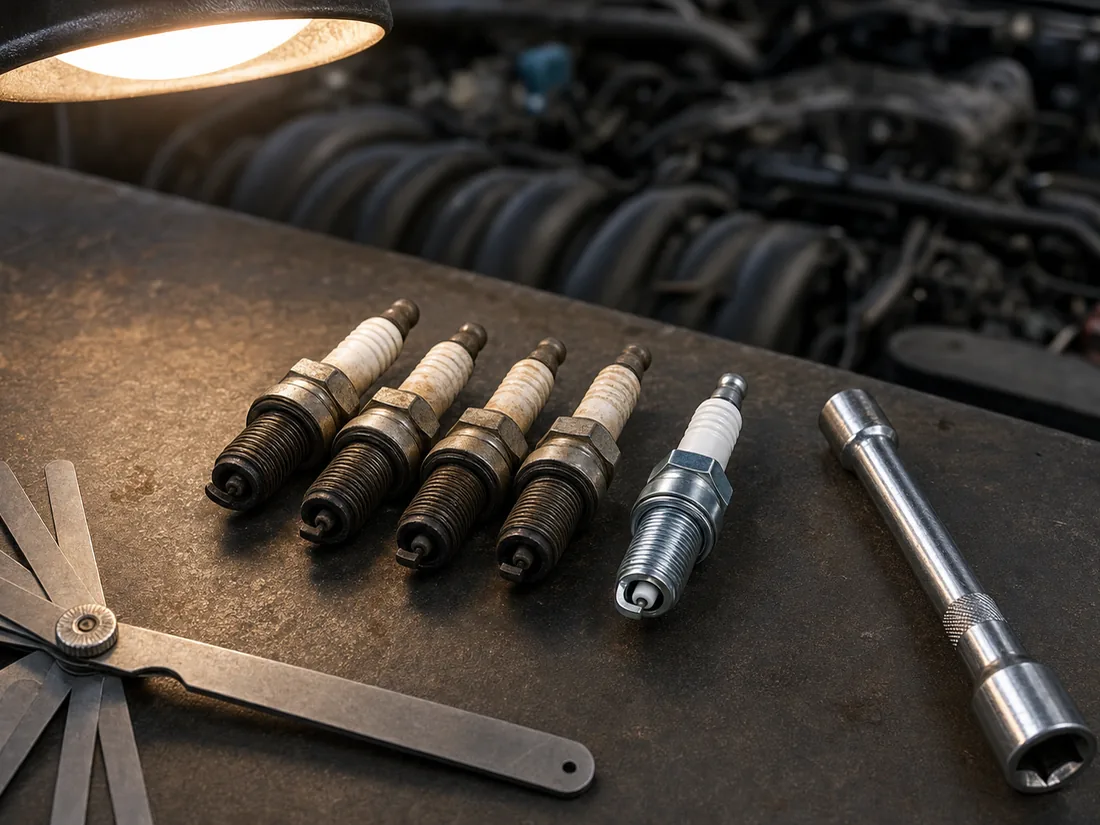
NGK calls plugs a window into the engine. Keep them in cylinder order: one odd plug points at one cylinder's problem; a matching set points at fuel, timing or plain age.
| What you see | What it means | Whose fault |
|---|---|---|
| Light tan or gray insulator, slight electrode wear | Normal, optimum temperature, engine in good condition | Nobody's. Replace on schedule. |
| Dry, soft black soot on insulator and electrodes | Carbon fouling; Denso lists poor starting, misfire and weak acceleration as the results | Short trips, a rich mixture or late injection timing, or a plug that runs too cold. Rarely the plug itself. |
| Black, wet, oily deposits | Oil fouling | Piston rings, cylinder or valve guides. New plugs will foul again. |
| Insulator scorched chalk-white, electrodes eroding fast | Overheating | Wrong tightening, a cooling problem or ignition timing too early, or a plug that runs too hot (Denso's page says “heat range too low”; in its numbering a low heat range is the hot type) |
| Both electrodes rounded, gap visibly wide | Worn out | Past its service life. The one case where the plug is the whole answer. |
| Tan ring on the insulator above the hex | Corona stain | Nothing. NGK says it is normal and not a broken seal. |
The sooty row is the one that gets misdiagnosed. NGK lists the causes of dark deposits as a rich condition, a cold plug, a vacuum leak, low compression, retarded timing or too large a gap. Only the last one is the plug; fresh plugs in a cylinder with a dribbling injector will look like the old ones inside a month.
Gap. Plugs arrive pre-gapped from the factory, though NGK says to check it against the vehicle spec, and its rules for fine-wire plugs are strict. Measure with a round wire or pin gauge, move only the ground electrode, never pry against the center electrode, and stay within 0.008 inch of the preset gap.
Torque. NGK calls torque one of the most critical aspects of installation, because the seat is how the plug dumps heat into the head. Loose, the tip overheats and can trigger pre-ignition; too tight, the shell stretches and threads crack. Its values for common gasket-seat sizes:
| Thread size (gasket seat) | Cast iron head | Aluminum head |
|---|---|---|
| 14 mm | 18.0 to 25.3 lb-ft | 18.0 to 21.6 lb-ft |
| 12 mm | 10.8 to 18.0 lb-ft | 10.8 to 14.5 lb-ft |
| 10 mm | 7.2 to 10.8 lb-ft | 7.2 to 8.7 lb-ft |
Without a torque wrench, NGK's turn-angle method is finger-tight until the gasket touches, then one-half to two-thirds of a turn; a tapered-seat plug gets about a sixteenth of a turn. Work on a cold engine, because metal expands when hot and threads get damaged, and skip the anti-seize. NGK's plated threads go in dry, and it warns that lubricant can alter the effective torque by up to 20 percent, which is how a correctly set wrench overtightens a plug.
The job. Autolite's tool list is a spark plug socket of the right size, a ratchet and extensions, a gap gauge and dielectric grease; add a torque wrench. Then, on a cold engine and one cylinder at a time so nothing goes back in the wrong place:
Do every cylinder; Autolite says replace plugs as a complete set.
On most modern engines each cylinder has its own coil sitting on the plug, what NGK calls a coil-on-plug or pencil coil, which feeds a single spark plug and needs as many coils as there are cylinders. NGK's advice on misfire codes is that it is a mistake to view the coil in isolation.
Plugs kill coils. As the gap grows the coil must build more voltage to fire it; NGK says a worn plug strains the whole ignition system, and Denso says running worn plugs stresses the ignition coil and can shorten its life. High voltage also hunts for shortcuts, and NGK names flash-over, a spark finding a path outside the plug, as a leading cause of early coil death. A new coil on the old plugs is on the same road.
Coils also fail by themselves, mostly from heat, which NGK says melts insulation and weakens windings until the coil shorts internally. Three ways to tell which part is guilty before buying either:
Autolite's summary is the honest one: not every symptom is the plugs; rule out coils, the fuel system and sensors. One cylinder misfiring with a good plug and a coil that passed the swap test is an injector or a mechanical problem. Every cylinder misfiring at once is rarely plugs; that is fuel pressure, timing or a sensor.
Because plugs on a modern engine sit under a cover and beneath the coils, labor is most of the bill. RepairPal's national estimate, as of September 2026, is $288 to $399 for a spark plug replacement, of which labor is $184 to $270 and parts $104 to $129. The spread is mostly access and cylinder count: the same source puts a Toyota Corolla at $185 to $259 and a Ford F-150 at $299 to $391. On a transverse V6 with the rear bank against the firewall, the shop price starts to look fair.
The plug interval is one of the few maintenance items a buyer can check against the schedule, and on a turbo engine at 80,000 miles it is a $300 to $400 question. A receipt with the date, mileage and part number answers it. A live misfire code is a different conversation, because a buyer prices a coil, an injector and a catalytic converter into the offer whether or not the fix is a plug. If the car is worth the job, do the plugs, clear the code and drive long enough to prove it stays gone. If it isn't, sell it as it sits and say so; a misfire does not hide on a test drive.
Use the carmaker's schedule, not the box the plugs came in. Toyota's 2025 Crown guide calls for plugs at 40,000, 80,000 and 120,000 miles on its turbocharged engine and at 120,000 on the non-turbo one; Honda's Maintenance Minder shows code 4 when the engine's operating history says they are due. Denso's own material intervals run from about 30,000 km for nickel plugs to as much as 120,000 km for long-life iridium.
RepairPal's national estimate, as of September 2026, is $288 to $399, with labor at $184 to $270 and parts at $104 to $129. A Toyota Corolla runs $185 to $259 and a Ford F-150 $299 to $391 on the same source. The difference is access: on newer engines the shop has to remove the engine cover and every ignition coil before it reaches a plug, and a V6 with a rear bank against the firewall takes longest.
Check, but rarely adjust. NGK ships plugs pre-gapped and says the gap may still need confirming for the vehicle. On fine-wire iridium or platinum plugs, measure with a round wire or pin gauge, bend only the ground electrode, never pry against the center electrode, and stay within 0.008 inch of the factory setting. If a new plug is far outside the spec, it is the wrong part number, and adjusting it is the wrong fix.
Not on modern plated plugs. NGK's threads carry a plating that acts as its own release agent, and the company warns that anti-seize works as a lubricant and can shift the effective torque by up to 20 percent, so a wrench set correctly still overtightens the plug and can stretch the shell or break threads. Autolite gives the same instruction. Install dry, on a cold engine, into a clean plug well, to the published torque.
Read the code first: a coil-circuit code such as P0351 means the computer never saw that coil fire, which is a coil or wiring fault. For a plain misfire code, swap the suspect cylinder's coil with a neighbor and clear the code. If the misfire follows the coil, replace the coil; if it stays on the cylinder, look at the plug, then the injector and compression. Replace plugs when you replace a coil, since a worn gap is what overworked the coil.