Every number on this page comes from one place: fueleconomy.gov, the site the Department of Energy and the EPA run together, administered by Oak Ridge National Laboratory. Where it gives a range, the range is quoted. Where it gives no figure, none is invented here.
Last updated .
The fuel-economy label on a new car shows three figures for a gasoline vehicle: City, Highway and Combined miles per gallon. Combined is the big one, and it is not an average of the other two. The EPA weights City at 55 percent and Highway at 45 percent to produce it, on the reasoning that most driving is the slower kind. Plug-in and electric cars carry MPGe instead, miles per gallon of gasoline-equivalent, so they can sit on the same scale.
The trap is that miles per gallon does not scale the way it feels. The EPA's own label guidance works the example: moving from a 10 mpg vehicle to a 15 mpg vehicle saves about 33 gallons over 1,000 miles, while the same five-point jump from 30 to 35 mpg saves only about 5. The agency calls this the MPG illusion, and it is why the label also prints an annual fuel cost and why fleets think in gallons per 100 miles. A gain of a few mpg on a thirsty car is worth far more fuel than the same gain on a frugal one.
Learn more about the fuel economy label (fueleconomy.gov, DOE/EPA).
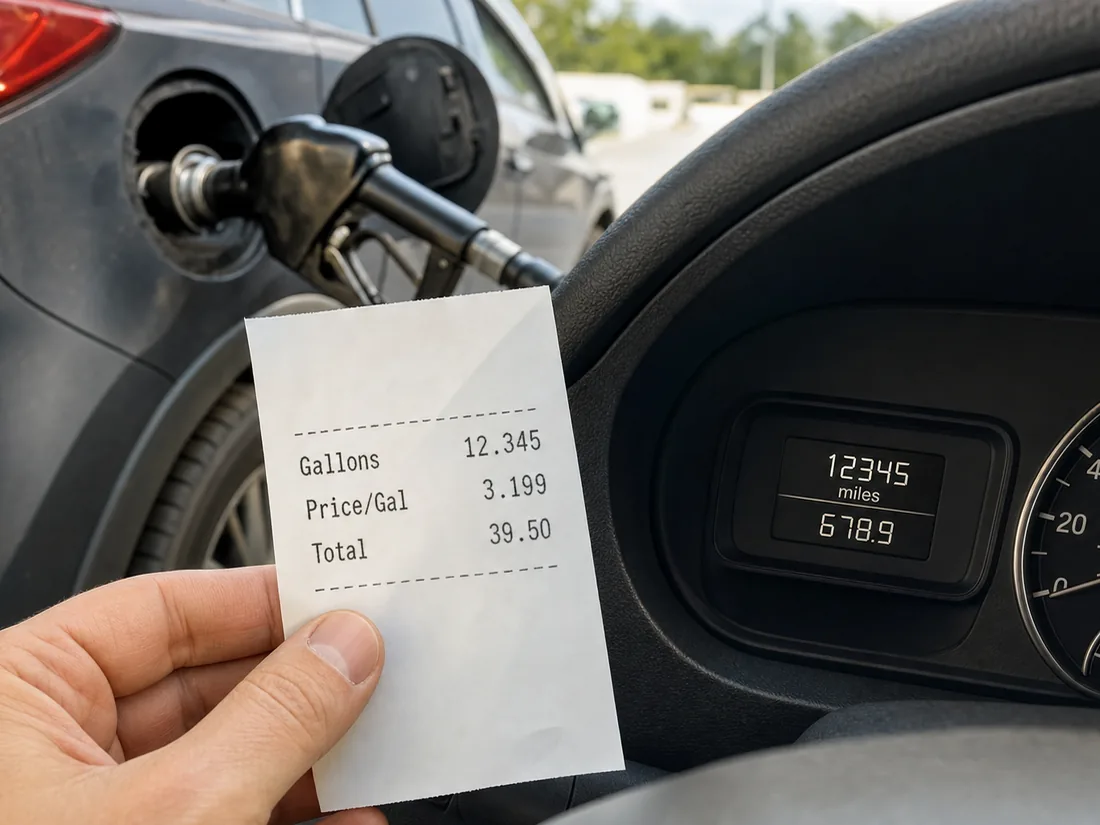
The sticker is a laboratory test. Your number is whatever your car does with you in it, and the only honest way to learn it is the fill-to-fill method.
One tank is a guess; three or four in a row is a number you can trust, because pump shut-offs vary and one tank of highway looks nothing like one tank of school runs. If your figure sits well under the label, that is not proof something is broken. The DOE's list of things that move fuel economy runs from driving style and speed to cargo, weather, fuel blend, tire pressure, and the age of the car, and most of them are on this page.
Many factors affect MPG (fueleconomy.gov).
Nothing else on this page comes close. The DOE puts the cost of aggressive driving, meaning hard acceleration, speeding and hard braking, at roughly 15 to 30 percent of your mileage at highway speeds and 10 to 40 percent in stop-and-go traffic. That is the difference between a car that meets its sticker and one that misses it by a third, with no mechanical change at all.
Speed by itself carries a price the agency states plainly: each 5 mph over 50 mph costs about as much as paying an extra 29 cents a gallon, at the fuel price used in its example. Most vehicles reach their best economy at a particular speed and lose it quickly above 50. Cruise control on the highway holds a steady speed and in most cases saves fuel for that reason alone.
Idling is the pure loss. An idling engine burns a quarter to a half gallon an hour depending on engine size and whether the air conditioning is running, and it is covering zero miles while it does it. The DOE's cold-weather page says the same thing from the other direction: warming the car up before you drive lowers your fuel economy, because idling gets 0 miles per gallon.
Driving more efficiently (fueleconomy.gov).
An extra 100 pounds in the car reduces mileage by about 1 percent, and the DOE notes the effect is proportional to the vehicle's own weight, so a small car feels a loaded trunk more than a truck does. That is the golf clubs, the emergency kit that grew, the case of water that never got unloaded.
Roof cargo is worse than its weight suggests because it changes the shape of the car. Hauling anything on the roof raises aerodynamic drag, and the agency's engineering page explains why drag matters so much: at highway speeds a large share of the fuel burned goes to pushing air out of the way. The same page quantifies rolling resistance, the other invisible load: a 5 to 7 percent reduction in it improves fuel efficiency by about 1 percent, which is the reason low-rolling-resistance tires exist and why the pressure section below matters.
Take the roof box off between trips. Empty the trunk of what does not need to ride along. It costs nothing and it is measurable.
Where the energy goes (fueleconomy.gov).
Keeping tires at the pressure on the door placard improves mileage by 0.6 percent on average and up to 3 percent in some cases. The more useful figure is the rate: mileage falls about 0.2 percent for every 1 psi that the average pressure across all four tires drops. A set running 8 psi low, which is common after a cold snap, is giving away over a percent and a half on every tank, along with tread life and braking. Our tires guide covers where the right pressure is printed and why the sidewall number is the wrong one.
Oil grade is the other quiet one. Using the manufacturer's recommended grade of motor oil improves mileage by 1 to 2 percent; the DOE's example is that 10W-30 in an engine designed for 5W-30 costs that much, and 5W-30 in an engine built for 5W-20 costs 1 to 1.5 percent. The grade is printed on the oil cap. Our engine oil guide walks through reading it.
Keeping your vehicle in shape (fueleconomy.gov).
Most gasoline sold in the United States contains up to 10 percent ethanol, and the DOE states that E10 lowers fuel economy by 3 to 4 percent compared with pure gasoline, because ethanol carries less energy per gallon. Winter-blend gasoline has slightly less energy than summer blend, about 1.7 percent by the agency's figure, which is part of why the same car does worse in January.
Cold is the larger effect. In the DOE's testing a conventional gasoline car's city mileage is roughly 15 percent lower at 20°F than at 77°F, and can drop as much as 24 percent on short trips of three or four miles, because the engine spends the whole trip warming up. Hybrids lose more, 30 to 34 percent under those conditions, and electric vehicles can lose roughly 39 percent in mixed driving with 41 percent less range, most of it to cabin heat.
Heat has its own tax. Running the air conditioner on its maximum setting can cut mileage by roughly 5 to 25 percent compared with leaving it off. At low speeds, open windows cost less than the compressor; at highway speeds the drag of open windows grows and the air conditioner becomes the cheaper choice.
Fuel economy in cold weather and factors that affect MPG (fueleconomy.gov).
Add the sourced figures up honestly and the picture is lopsided. Tire pressure, oil grade and a lighter trunk are each worth a percent or two, and they are worth doing because they cost nothing and they compound over a year of tanks. Driving style is worth ten to forty. A driver who stops racing to red lights and holds 65 instead of 75 will see more change in one tank than every maintenance item on this page combined.
The DOE's own note on in-car feedback displays makes the same point from the data: the average driver who uses one improves fuel economy by about 3 percent, and drivers who use it deliberately to save fuel improve by about 10. The instrument was never the limit. The habit was.
Fuel economy is one of the few things a buyer can check in a minute and argue about for an hour, so have the number ready. Three or four fill-to-fill readings written on the receipts are worth more than the sticker, because they are your car, your roads, this year. If the figure is under the label, the reasons above are the honest explanation, and a set of tires at the placard pressure and a clean trunk will move it before the test drive.
If the car is old enough that the mileage is the least of its problems, that is a different conversation, and it is the one we are for.
The sticker is a standardised test. The DOE lists driving style, speed, cargo, roof loads, cold weather, short trips, ethanol blend, tire pressure and air-conditioning use as things that lower real-world mileage below it, and aggressive driving alone accounts for 15 to 30 percent at highway speeds.
No. The DOE's cold-weather guidance says warming up before you drive lowers your fuel economy, because an idling engine is burning a quarter to a half gallon an hour while covering zero miles. Drive gently for the first few minutes instead.
About 0.2 percent of mileage for every 1 psi the average pressure of all four tires runs low, and 0.6 percent on average, up to 3 percent, when they are brought back to the placard figure. It is small per tank and it runs on every mile.
This page cites only figures fueleconomy.gov publishes, and it does not publish a mileage gain for premium in an engine that does not require it. Use the grade your owner's manual specifies.
Fill to the pump's first click, reset the trip odometer, drive, refill to the first click, and divide the miles by the gallons on the receipt. Do it over three or four tanks before treating the result as your number.