On September 16, 2026, regular averaged $3.75 a gallon in Indiana and $6.04 in California by AAA's count, and the two stations you pass on the way home rarely agree with each other. Almost none of that is random. It is taxes, wholesale zones, rent, card fees and the day of the week, and each piece can be worked. Here is what actually moves the number on the sign, what the price apps can and cannot tell you, where the club and grocery discounts come from, and whether the cheap stuff is any worse for the engine.
Last updated .
Start with what a gallon is made of. In 2025, by the Energy Information Administration's accounting, crude oil was 51.4 percent of the pump price, refining 14.3 percent, taxes 16.6 percent, and distribution and marketing 17.8 percent (EIA's breakdown of the retail price). The first two are identical across a metro area on any given morning; the spread between stations lives in the last two.
That means rent, wages, card fees and margin. EIA says stations close together can carry different rent, traffic patterns and sources of supply, that the number of nearby competitors matters, and that prices run highest where stations are scarce (why prices differ by location).
The piece most drivers never hear about is zone pricing. Suppliers set the wholesale price a station pays according to where it sits, and each supplier draws its own map. A Connecticut legislative report quotes a Mobil executive describing 46 price zones in that one small state, drawn around competition, taxes, traffic patterns, even rivers and highways; the FTC called zones rough outlines of local competition (Connecticut OLR report on zone pricing). So two stations may not even pay the same wholesale price.
The retail markup on top of all that is thin: NACS, the convenience store trade group, puts it at roughly 35 to 40 cents a gallon over the past five years, before card fees and overhead (NACS on who makes money selling gas).
Every price app runs on user reports, and each says so in its help pages.
The routine: check GasBuddy or Waze for the neighborhood spread, then read the timestamp on the cheap one. A price reported six hours ago in a week when the market moved 16 cents, as the national average did in the week ending September 14, 2026 (EIA weekly retail prices), is a guess; a price two apps agree on is real.
The cheapest gallon in most metros is not at a gas station at all. Costco's warehouse pumps sell its Kirkland Signature gasoline, take Visa or PIN debit, and place a hold of up to $150 on the card while you fill (Costco gas station FAQs). Sam's Club describes its pumps as members-only access and pricing, with Plus members earning 5 percent back in Sam's Cash on gas bought anywhere with the club's Mastercard (Sam's Club fuel center page). Neither club promises a fixed discount; the price is whatever the sign says, and it is usually the lowest number the apps show for miles.
Grocery points work differently: the discount is yours only at the pump and only once. Kroger's program, renamed from Fuel Points to Points in June 2026, gives one point per dollar spent and takes 10 cents a gallon off for every 100 points redeemed, up to $1 a gallon (Kroger rewards announcement), on a maximum of 35 gallons per fill (Kroger fill-up promotion terms). A dollar off 35 gallons is $35, which is why people bring the second car. The same points can now go to groceries at a dollar per 100, so pick the use worth more.
Two cautions: a loyalty discount only helps if the base price is competitive, so check the sign against the neighborhood first; and the fastest way to earn points is usually a store credit card, which is no reason to carry a balance.
The cash price is real money to the station. NACS reports credit card fees on gasoline ran 8.4 cents a gallon in 2023, the latest year published (NACS), a big slice of the margin. Federal law protects a merchant's right to discount for cash, check or debit, and bars card networks from stopping it (15 U.S.C. 1693o-2(b)(2)(A)). A station posting a cash price is passing along a cost it would otherwise eat; one with a single price has built the card fee into what cash customers pay too. And because GasBuddy files cash pricing as an amenity, a station that looks 10 cents dearer than its neighbor may match it at the cash pump.
Timing is worth about the same. GasBuddy's February 2026 analysis of a year of daily statewide prices found Sunday the cheapest day in most states, Wednesday through Friday the most expensive, and a gap of 4 to 9 cents a gallon between the best and worst weekday (GasBuddy's best-day study). That is the whole national effect: not worth a detour, but worth filling up after Sunday errands instead of Thursday morning.
The exception is bigger. Prices cycle in Ohio, Michigan and Indiana, in Florida and Texas, and along stretches of the West Coast: stations jump together, then undercut each other for days until the next jump. GasBuddy puts the peak-to-bottom spread in those markets at 15 to 45 cents or more and says the best window usually opens five to seven days after a jump (same study). If the sign went up 20 cents overnight in one of those states, buy a quarter tank and wait.
The fear that discount fuel is bad fuel is mostly wrong, and the line is a licensing program called Top Tier. The EPA has required a minimum detergent level in all gasoline since 1996; in 2004 a group of automakers set a higher standard, and a licensed retailer must meet it at every station and in every octane grade (Top Tier program description). Octane has nothing to do with it. Regular at a Top Tier station carries the full additive package; premium at a non-Top Tier station does not.
AAA tested the difference in 2016. After 4,000 miles of simulated driving, the engine run on Top Tier gasoline averaged 19 times fewer intake valve deposits than on non-Top Tier fuel, and AAA's review of the research put the long-term cost of low-additive gasoline at 2 to 4 percent in fuel economy plus drivability problems (AAA fuel quality fact sheet). Over a year of price tracking, Top Tier brands averaged only three cents more per gallon, and existing deposits could largely be cleaned up by switching brands.
So the question is licensed versus not. The U.S. Top Tier list ran to about 78 brands in September 2026 and includes Costco's Kirkland Signature, QuikTrip, Holiday and Meijer Express alongside Shell, Exxon, Chevron, BP, Marathon, Sunoco, Valero and ARCO (Top Tier licensed gasoline brands). Sam's Club, Kroger, Wawa, Sheetz, Buc-ee's, Circle K, Speedway and Murphy USA did not appear, and Top Tier's rule is that a brand not on the list is not Top Tier (Top Tier on identifying licensed brands). The list changes, so check it before writing a station off. If the engine idles rough when cold or hesitates, AAA's advice is a few tanks of Top Tier fuel before anything more expensive.
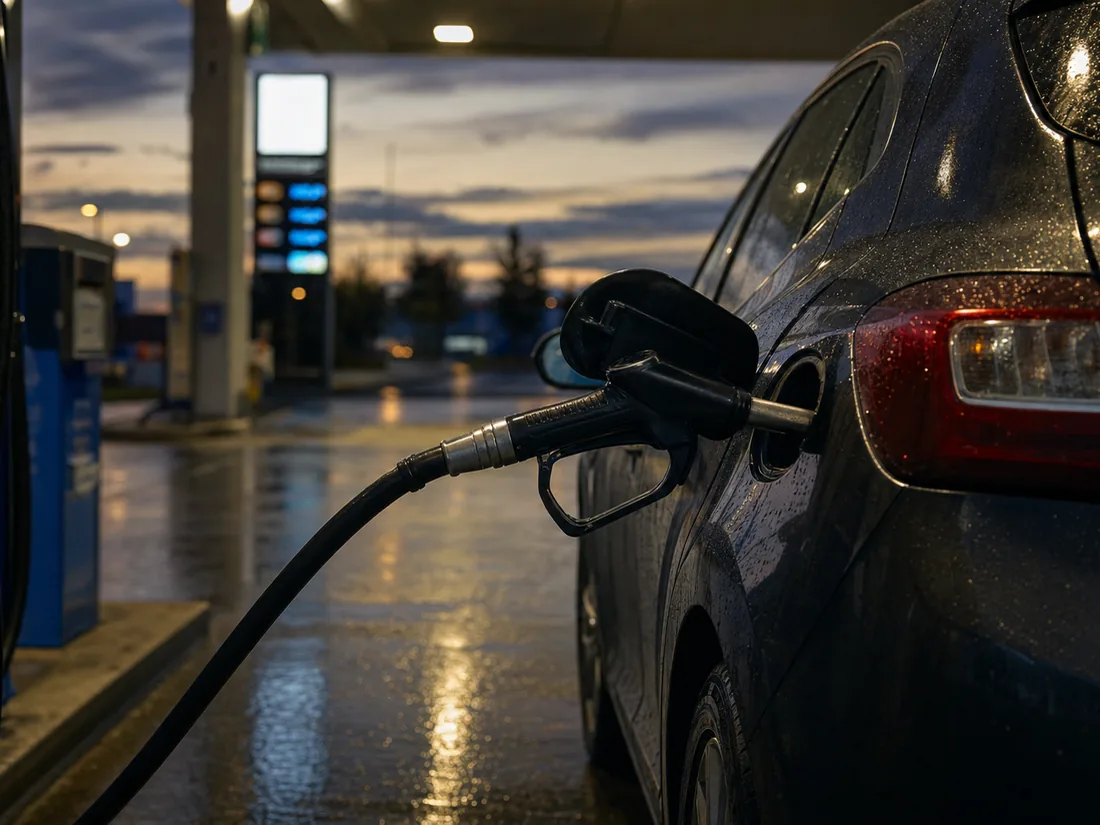
The federal tax is 18.4 cents a gallon, unchanged since October 1993 (EIA). Everything above that is the state, which varies by a factor of eight. EIA's table, current to July 1, 2026, puts the average state load at about 33.8 cents (EIA federal and state motor fuel taxes):
| State | State taxes and fees, cents per gallon | With the federal 18.4 cents |
|---|---|---|
| California | 73.6 | 92.0 |
| Illinois | 71.7 | 90.1 |
| Indiana | 64.5 | 82.9 |
| Washington | 60.2 | 78.6 |
| Pennsylvania | 58.7 | 77.1 |
| Louisiana | 20.9 | 39.3 |
| Texas | 20.0 | 38.4 |
| Oklahoma | 20.0 | 38.4 |
| Arizona | 19.0 | 37.4 |
| New Mexico | 18.9 | 37.3 |
| Hawaii | 18.5 | 36.9 |
| Alaska | 9.0 | 27.4 |
Rates exclude county and local add-ons. Nineteen states raised gasoline taxes between the start of 2025 and the start of 2026 and seven lowered them (EIA, February 2026), so the numbers drift every January and July.
Where this pays is at a state line. Illinois to Missouri is a 41.7-cent difference in tax alone; California to Arizona is 54.6 cents; Washington to Idaho is 27.2 cents. If your commute or road trip crosses one of those lines, fill up on the low-tax side.
But look at Indiana. It has the third-highest tax load in the table and, on September 16, 2026, the lowest average pump price in the country at $3.75, while California was highest at $6.04 (AAA state averages). Indiana sits in the Midwest supply region, where EIA's average that week was $4.09 against $5.47 on the West Coast (EIA regional prices). Refinery proximity, pipeline access and a crowded retail market outweighed 64 cents of tax. Tax explains why a state is expensive, not where in it to buy.
Federal data has the average licensed driver covering 13,735 miles in 2024 (FHWA, Our Nation's Highways), and the average short-wheelbase light-duty vehicle burning 447 gallons a year at 24.7 mpg (FHWA Table VM-1, 2023). At 447 gallons, each tactic on this page is worth roughly:
| Tactic | Per gallon | Per year at 447 gallons |
|---|---|---|
| Buying Sunday instead of midweek | 4–9¢ | $18–$40 |
| Paying cash at a station that discounts it | up to 8.4¢ | up to $38 |
| Timing the cycle in a price-cycling state | 15–45¢ | $67–$201 |
| Dropping premium in a car that calls for regular | about $1.00 | about $446 |
| Grocery points at the maximum discount | $1.00, once per 35 gallons | $35 per fill |
At 24.7 mpg and $4.32 regular, a five-mile detour each way burns about $1.75 in gas, more than a 9-cent saving on a 12-gallon fill. The rules that hold up: buy on the cheap side of a state line, favor Top Tier stations that are already cheap, use the club pump if you carry the card, skip premium your manual does not ask for, and fill up when the app timestamp and the day of the week agree. Driving style and tire pressure are a larger lever, covered in our guide to measuring and improving gas mileage.
Fuel cost follows the car when you sell it. A buyer weighing two used cars will ask what grade each takes, and a premium-required engine now carries a dollar-a-gallon surcharge that shows up in the offer. If the fuel line has grown larger than the car's value, or the engine has picked up the rough cold idle AAA associates with deposits, selling it as it sits starts to make more sense than another tank.
Not because it is cheap. What matters is whether the brand is licensed under Top Tier, the automaker detergent standard that applies to every grade at a licensed station. In AAA's 2016 lab test, Top Tier fuel left 19 times fewer intake valve deposits after 4,000 miles, and Top Tier brands cost only about three cents a gallon more on average. Costco's Kirkland Signature and QuikTrip are on the list; check the current list for the station you use.
None of them reads the pump; all rely on user reports or a database built from them. GasBuddy says its prices come mainly from volunteer spotters and asks them to post pre-discount sign prices; Waze says user-updated prices may not match the sign and that it does not verify the data. Treat any price as a claim with a timestamp, and trust a number two apps agree on over a low outlier reported hours ago.
Offering a lower price for cash is legal across the United States; federal law bars card networks from stopping a merchant from discounting for cash, check or debit. Stations do it because card fees on gasoline averaged 8.4 cents a gallon in 2023 by NACS data, a large share of a typical retail margin. A station that posts one price for everyone has built that fee into what cash customers pay as well.
Sunday in most states, according to GasBuddy's February 2026 analysis of a year of daily statewide averages, with Wednesday through Friday the most expensive. The national gap is 4 to 9 cents a gallon. In price-cycling states such as Michigan, Ohio, Indiana, Florida and Texas, the better rule is to wait five to seven days after a visible jump, when the spread between peak and bottom can reach 15 to 45 cents.
As of July 1, 2026, EIA's table shows California highest at about 73.6 cents a gallon in state taxes and fees, followed by Illinois at 71.7 and Indiana at 64.5; Alaska is lowest at 9.0 cents, then Hawaii, New Mexico and Arizona under 20 cents. Add the federal 18.4 cents to each. A high tax does not guarantee a high pump price: Indiana had the lowest state average in the country in mid-September 2026.