Oil is the one maintenance item every driver has heard a rule about, and the rule most people know is wrong. The 3,000-mile oil change is a leftover from older engines and older oils; most cars built this century go two to five times that, and the number that applies to your car is printed in its manual, not on a windscreen sticker. Here is how to check the level and read what you see, what the intervals really are and who says so, how to do the change yourself if you want to, and how to get rid of the old oil without poisoning a million gallons of water.
Last updated .
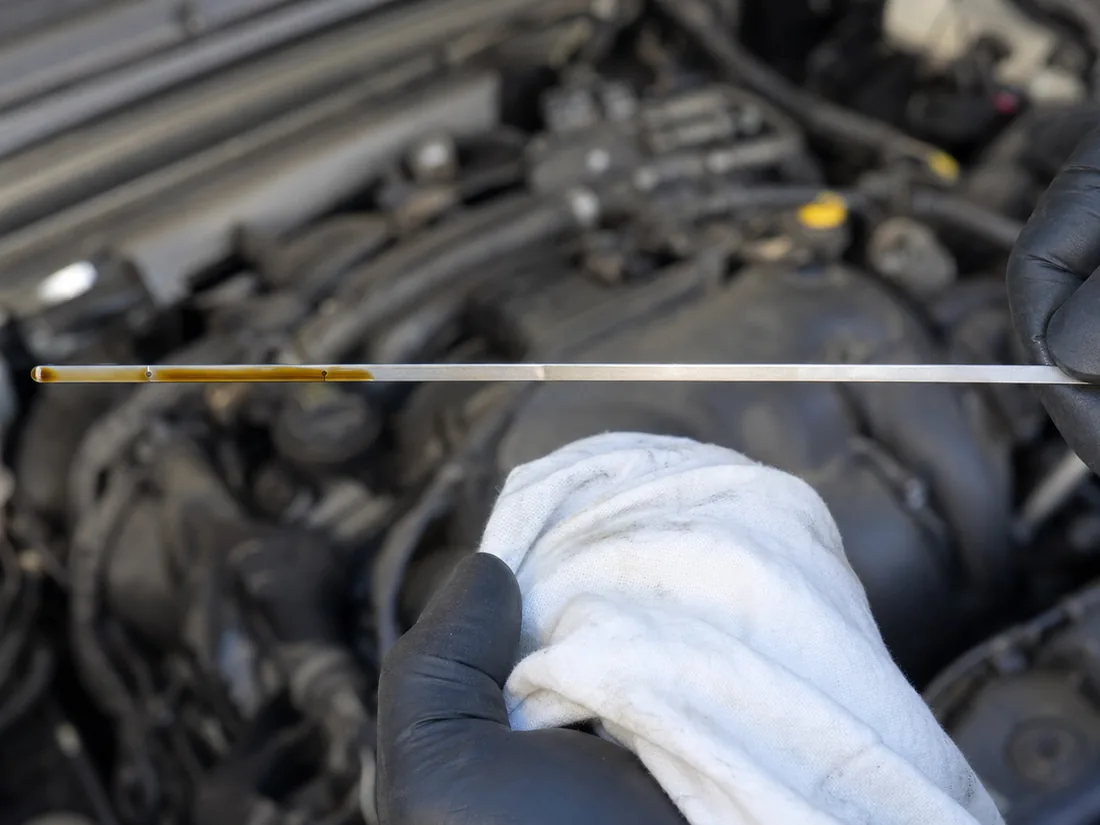
Checking oil takes two minutes and needs no tools, and it is worth doing monthly on any car, because a low level does more damage faster than old oil does. AAA's experts lay out the procedure: the engine should be off for at least two to three minutes and the car parked on level ground; open the hood, remove the dipstick, wipe it clean with a rag, reinsert it fully and remove it again. That second pull is the reading. The oil level should be between the two markers on the stick. Below the lower mark, add oil of the grade on the filler cap or in the manual, a little at a time, rechecking as you go; the distance between the marks is usually about a quart. Above the upper mark is also a problem, because overfilled oil gets whipped into foam by the crankshaft and stops lubricating properly.
Then look at what is on the stick. Colour is the thing everyone reads wrong. AAA is direct about it: many drivers incorrectly consider a change in oil colour as conclusive evidence that their car needs an oil change. Oil is designed to darken; it is carrying away combustion by-products, which is its job. The distinction that matters, again from AAA, is texture: if the oil is dark and gritty, it is picking up dirt and other particles, which prevents it from doing its job properly. Two other readings are warnings rather than wear. Oil that looks milky or like coffee with cream has coolant in it, which usually means a head gasket; stop driving and have it looked at. Oil that smells of petrol and reads high on the stick is being diluted by fuel, common on cars that only ever do short trips. Some newer cars have no dipstick at all and report the level on the dashboard; the manual says how to bring the reading up.
The 3,000-mile rule was true once. It dates from engines with looser tolerances running conventional oils without today's detergents and additive packages, and it was kept alive long past its time by quick-lube marketing and the sticker in the corner of the windscreen. It was widespread enough that California's recycling agency ran a public campaign against it; CalRecycle's used-oil programme still lists its "3000 Mile Myth" public service announcement from 2008, because unnecessary changes produce unnecessary waste oil.
What applies now, from AAA's auto-repair guidance: older cars require an oil change every 3,000 miles, most engines manufactured today can go up to 7,500 miles, and cars that use synthetic oil usually don't require a change for up to 15,000 miles. AAA's Josh Sens, writing for members in 2024, puts the advice in one line: don't rely on the familiar "three months or every 3,000 miles" adage; check your owner's manual for an accurate time frame, with a AAA technician noting that some new vehicles only require a change every 10,000 miles. The three things that shift the number, per AAA, are the car's age, the type of oil, and the local climate; the manual usually gives a shorter "severe service" interval for short trips, towing, dust and extreme heat or cold, and a surprising number of ordinary commutes qualify as severe service.
If the car has an oil-life monitor, that is the number. AAA: most new models have an oil-life monitoring system designed to automatically determine when an oil change is needed, and after an oil change, make sure the mechanic resets it. The monitor calculates from actual driving, not from a calendar, and an unreset monitor is why some cars demand a change two weeks after having one.
What happens if you push past the interval is not subtle. AAA describes the sequence: the oil starts to deteriorate, gets thicker, and eventually loses its ability to maintain a consistent viscosity, turning into a black sludge that can coat parts of the engine and clog oil passageways. Sludge is what a skipped-oil-change engine dies of, and it is not reversible with a late change.
The grade is printed on the oil filler cap or in the manual as something like 5W-30 or 0W-20. The first number is cold-flow (the W is for winter), the second is viscosity at operating temperature; those grades are defined by SAE J300, the viscosity classification the industry uses. Use the grade the maker specifies. A thicker oil is not "better protection" in a modern engine designed around thin oil and tight clearances; it starves the top end on cold starts.
The other mark to look for on the bottle is the American Petroleum Institute's certification. API runs the Engine Oil Licensing and Certification System, and its licensed oils carry the round "donut" showing the service category and viscosity grade and, where the oil meets the current fuel-economy standard, the "starburst". API tests licensed oils bought off the shelf and compares them with the formulations on file, so the mark is checked, not self-declared. A bottle with the grade your manual names and the API mark is the right oil, whatever the brand.
Synthetic against conventional is a smaller question than the marketing suggests. Synthetic holds its viscosity longer and resists sludge better, which is why it carries the longer intervals above, and most cars built in the last decade specify it. If the manual says synthetic, use synthetic. If it does not, conventional oil changed on the manual's interval protects the engine just as well; it simply needs changing sooner.
An oil change is the most common job people do at home, and it is safe if the car is held up properly and the old oil is caught. You need the right amount of the right oil (the manual states capacity, usually four to six quarts), a filter that matches the car, a drain pan, a wrench for the drain plug, a filter wrench, gloves, and either ramps or a jack with jack stands. A jack alone is not a support; a car has to sit on stands or ramps before anyone goes under it.
Two things worth doing while you are there. Look at the old oil in the pan: metallic glitter or a milky look is a reason to have the engine checked. And check the engine air filter, covered next, because it is a two-minute job with the hood already open.
The engine air filter sits in a plastic box on top of or beside the engine, held by clips or a few screws, and it is the easiest part on the car to inspect: open the box, lift it out, hold it up to the light. If you cannot see light through the pleats, or it is packed with leaves and insects, replace it. Fram, which makes them, says most manufacturers urge a change every 12,000 miles, though certain factors can reduce that, dust and unpaved roads being the main ones.
The symptoms of a clogged one, in Fram's list, are the check engine light on the dashboard, reduced fuel economy, and sluggish acceleration, the last more common in older vehicles. The mechanism is simple: the engine is unable to pull in enough outside air for efficient combustion. A new filter costs a fraction of a tank of fuel and installs in the time it takes to undo the clips; there is no reason to pay a shop to do it, and no reason to let a quick-lube upsell you one you have just checked.
This is the part of a home oil change that people get wrong, and the scale of the harm is worth knowing. The EPA's consumer guidance states it plainly: used oil from one oil change can contaminate one million gallons of fresh water, a year's supply for 50 people. CalRecycle gives the same figure the other way round: one gallon of used oil can foul a million gallons of drinking water, and oil poured down a drain or onto the ground works its way into ground and surface water.
The procedure is not hard. The EPA says to take care not to spill any when you collect it, place it in a leak-proof container, and contact local automobile maintenance facilities, waste collectors or government waste officials to find out where you can drop it off; the jug the new oil came in is the usual container, and most parts stores and many quick-lube shops take used oil free. Drain and recycle the used oil filter as well; the same collection points usually take it. Do not mix the oil with anything else, including brake fluid, coolant or solvents, because a contaminated batch cannot be re-refined and the whole container becomes hazardous waste. California, for the record, has certified over 3,000 collection centres that take used oil from the public and pay a recycling incentive; other states have equivalents, usually listed by the state environmental agency.
Oil is the first thing a careful buyer checks, and they check it the way this page describes: pull the dipstick, look at the level, look at the colour, smell it. A level below the marks says the car has not been looked after, whatever the service history claims. Milky oil ends the sale. Dark oil on its own means nothing to a buyer who knows cars and everything to one who doesn't, so a fresh change before listing is one of the cheapest ways to make the engine bay look cared for; it is also honest, because it is what the car needed anyway.
What a fresh oil change does not do is fix an engine that burns or leaks it. A car that needs a quart every few hundred miles, or leaves a spot on the driveway, has a problem the oil change will hide for a week and the buyer will find in a month, and in most states a private seller is obliged to disclose it. The selling a car with problems guide sets out the rule for each state. If the honest answer is that the engine is tired, the when to stop repairing a car guide is built for that decision, and a buyer who specialises in cars with faults simply factors it into the offer. While the hood is open, the car won't start guide covers the battery check a buyer does next, and the brake noises guide covers what they listen for on the test drive.
Engine off for at least two or three minutes, car on level ground. Pull the dipstick, wipe it, push it fully back in, pull it again and read: the level should be between the two marks. If it is below the lower mark, add the grade printed on the filler cap a little at a time. Do it monthly; a low level damages an engine faster than old oil does.
No. Oil darkens in normal use because carrying away combustion by-products is its job, and AAA specifically warns against reading colour as proof a change is due. The warning sign is texture: dark and gritty means it is carrying dirt. Milky or creamy oil means coolant is getting in, which is a head-gasket problem, not an oil problem.
Whatever the owner's manual or the oil-life monitor says, not the windscreen sticker. AAA's guidance: older cars every 3,000 miles, most modern engines up to 7,500, synthetic oil up to 15,000, with some new cars specifying 10,000. Short trips, towing, dust and extreme temperatures put you on the manual's shorter severe-service interval, and a lot of ordinary driving counts as severe.
Older engines and older oils without modern additives, kept alive by quick-lube marketing. It was common enough that California's recycling agency ran a public campaign called the "3000 Mile Myth" in 2008, because needless changes create needless waste oil. It is not the interval for any car built this century unless its manual says so.
It is the American Petroleum Institute's certification mark, showing the oil's service category and viscosity grade. API licenses oils under its Engine Oil Licensing and Certification System and tests licensed oils bought off the shelf against the formulations on file. A bottle in the grade your manual specifies carrying the API mark is the right oil regardless of brand.
Yes. It needs the right oil and filter, a drain pan, a wrench, and the car held up on ramps or jack stands, never on a jack alone. Warm the engine, drain the plug, swap the filter with a film of oil on its gasket, refit the plug, fill to half a quart short of capacity, run it, check for leaks, then top up on the dipstick and reset the oil-life monitor.
Pour it into a leak-proof container, usually the jug the new oil came in, and take it to a parts store, quick-lube or municipal collection point; most take it free, and they take the used filter too. Never down a drain or onto the ground: the EPA says one oil change's worth can contaminate a million gallons of water. Do not mix it with coolant, brake fluid or anything else, or it becomes hazardous waste nobody will accept.