How much is a junk car worth?
Nobody is buying your car. They are buying four things — weight, the converter, the distance to the yard and how hard it is to load — and this is what each one is currently worth.
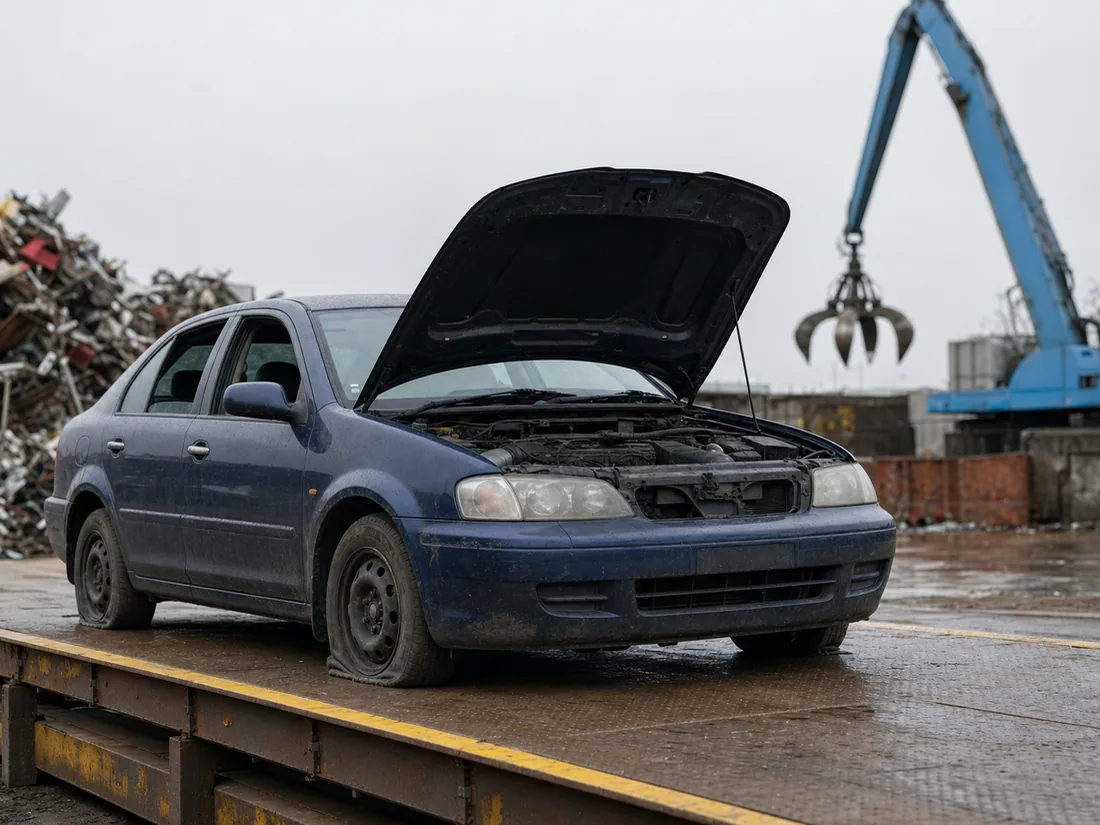
The short version
- 4things the offer is actually made of
- 77%rhodium’s fall, 2021 to 2024
- 31%scrap steel below its 2022 peak
- $0what an index can tell you per ton
An offer on a car that does not run feels arbitrary in a way that an offer on a working car does not. There is no mileage to argue about, no service history, no comparable listings. A number appears, and there is no obvious way to tell whether it is fair.
It is not arbitrary. Nobody is buying your car — they are buying four things, and the number is those four things added up and then reduced by what it costs to come and get it. Once you can see the four, you can tell a real offer from a low one in about a minute, which is the whole point of this page.
What this page will not do is tell you what your car is worth in dollars, and it is worth saying why up front. The public data on scrap prices is an index, not a price. It can show you where the market sits against its own history, honestly and precisely. It cannot be multiplied by your car’s weight to produce a number, and any site that appears to do that is generating a figure, not reading one.
1. Weight, because the floor under every offer is metal
The bottom of the market is scrap steel, and scrap steel is bought by mass. That is the floor under every junk offer: whatever else is true of the car, it is so many pounds of shreddable metal, and two otherwise identical wrecks that differ by half a ton do not fetch the same price.
This is why a dead pickup is worth meaningfully more than a dead subcompact even though neither one moves. It is also why the number on your door-jamb sticker is the one figure about your car that a scrap buyer genuinely cares about — we pulled the actual distribution and what has happened to it over the decades in average car weight by year and class.
Two adjustments come off the top of that mass. Fuel, fluids and tyres are not steel and cost money to handle. And a car stripped of major components — engine and transmission gone, doors gone — is lighter than the sticker says, which the buyer will discover on the weighbridge whether or not it came up on the phone.
2. The converter, which is the only part with a commodity market of its own
One part on an ordinary car is worth more per pound than anything else on it by a wide margin, and it is bolted to the exhaust. Catalytic converters contain platinum, palladium and rhodium. USGS puts the scale of it plainly: “The leading domestic use for PGMs was in catalytic converters to decrease harmful emissions from automobiles.”. — the leading domestic use of these metals is not jewellery or electronics. It is the part under your car.
And the recycling stream is genuinely enormous: “About 140,000 kilograms of palladium and platinum were recovered globally from new and old scrap in 2025, including about 50,000 kilograms of palladium and 8,600 kilograms of platinum recovered from automobile catalytic converters in the United States.”. Fifty tonnes of palladium a year, recovered in the United States alone, from cars like yours reaching the end of the line.
Here is the part that explains why converter money is not what it was. These metals had an extraordinary run and then gave most of it back:
| Metal | 2021 | 2024 | 2025e |
|---|---|---|---|
| Rhodium | $20,254.10 | $4,660.44 | $5,800 |
| Palladium | $2,419.18 | $994.90 | $1,100 |
| Platinum | $1,094.31 | $960.70 | $1,200 |
| Iridium | $5,158.40 | $4,810.40 | $4,400 |
| Ruthenium | $576.12 | $451.02 | $690 |
Rhodium fell 77 percent between 2021 and 2024. Palladium fell 59 percent over the same three years. If you heard in 2021 that converters were worth a small fortune, you heard something that was true at the time and has not been true since.
The story does not end there, and the honest version is more interesting than the collapse. Prices turned back up: USGS reports that “The estimated annual average price in 2025 increased by 53% for ruthenium, by 25% for platinum, by 24% for rhodium, and by 11% for palladium compared with the average prices in 2024.”. Platinum in particular never really crashed — it is +10 percent against 2021, while rhodium is still nowhere near where it was. So the converter on your car is worth materially less than it would have been at the peak, and somewhat more than it would have been two years ago. Which of those metals is in it depends on what the car is: USGS notes that “About 25% of palladium can routinely be substituted for platinum in diesel catalytic converters; the proportion can be as much as 50% in some applications.”.
Two practical points follow. First, an offer generally assumes the converter is still attached. If yours has already been stolen or removed, say so when you get the quote: the buyer will find out on collection either way, and the number will change at the worst possible moment.
Second, do not cut it off and sell it separately. Federal law makes it unlawful “for any person knowingly to remove or render inoperative any such device or element of design after such sale and delivery to the ultimate purchaser”. — that is the Clean Air Act tampering prohibition, and note that it reaches any person knowingly doing it, the owner of the car included, rather than only repair shops. States have been adding their own restrictions on who may buy a detached converter, so that is worth checking where you are before assuming the part is yours to sell. The straightforward route is to leave it on the car and let a licensed recycler deal with it.
3. Distance, because somebody has to physically come and get it
This is the lever sellers underestimate most, and it is pure arithmetic. A non-running car moves by truck. That truck costs money per mile in both directions, and it is a real cost subtracted from a small number, not a rounding error. The same car can be worth a fair sum twenty minutes from a shredder and close to nothing three hours from one.
It is also why quotes for identical cars vary so much between buyers. They are not disagreeing about the car. They are quoting different distances to different yards, and a buyer with a facility near you can pay more for exactly the same metal than one who has to send a truck across two counties. Getting more than one offer matters more on a junk car than on a running one, because the spread between buyers is driven by geography rather than by judgment.
4. Whether it rolls, steers and is all there
The last lever is about the cost of loading. A car that rolls in a straight line and steers can be winched onto a flatbed by one person in a few minutes. A car with seized brakes, missing wheels or no steering needs different equipment and sometimes a second person, and that difference in labour comes straight off the offer.
Completeness works the same way. Wheels, glass, seats and the drivetrain all have either resale or scrap value; a car that has already been picked over is worth less than its weight suggests. So is a car that cannot be reached — behind a locked gate, up a narrow drive, boxed in by other vehicles. When you get a quote, describing the access honestly is not generosity, it is the difference between the quoted number and the number you actually get.
And one piece of paper sits underneath all four: whether you can prove the car is yours. A junk buyer is buying a vehicle, not a heap, and in most states cannot lawfully take it without a title or the state’s substitute for one. If yours is missing, that is the first problem to solve, not the last — selling a car without a title sets out the routes state by state.
Where the scrap market actually is right now
The floor under the whole calculation moves, and it is publicly measurable. The BLS producer price index for iron and steel scrap — series WPU1012, monthly since 1947 — stood at 588.9 in July 2026. Against its own history that is:
- 31 percent below the April 2022 peak of 859.2, which was the highest reading in the series’ entire post-war run.
- 42 percent above its 2019 average of 413.3 — the last full year before the pandemic distorted every commodity market there is.
So: well off the boom, and still comfortably above where the market sat the last time things were normal. That is a genuinely useful thing for a seller to know, because it says the current moment is neither the windfall of 2022 nor the trough people assume followed it.
Now the caveat that matters more than the numbers. WPU1012 is an index on a 1982=100 base, not a price. It measures how prices have moved, not what they are. It cannot be converted into dollars per ton, and it cannot be multiplied by your car’s kerb weight to produce what your car is worth. Any calculator that seems to do that is inventing the conversion. The full series, charted, is on the scrap steel price history page, with the same warning attached.
What the four levers cannot tell you
They cannot tell you whether the car is genuinely finished. This is worth a moment’s thought before you accept any junk offer, because the four levers above price a car as raw material and completely ignore the possibility that it is worth more as a car. A vehicle with an expensive but ordinary fault — a dead battery pack, a failed transmission, a blown head gasket on an otherwise sound body — is often worth more to a buyer who wants it running than to one who wants it shredded. The test is not whether it currently moves. It is whether what is wrong with it costs less to fix than the difference in price.
If the answer is that it really is finished, the four levers are the whole story, and the best thing you can do is describe all four accurately to two or three buyers and take the highest number. If you are not sure, it costs nothing to find out what someone would pay for it as a car first.
Citing this page. The metal prices are USGS’s, from the 2026 Mineral Commodity Summaries, on the price basis USGS names in its own footnote. The scrap figures are computed from BLS series WPU1012 and are index comparisons, not dollar values — please carry that distinction if you quote them.
Sources
- USGS Mineral Commodity Summaries 2026 — Platinum-Group Metals — Prices per troy ounce, converter recycling volumes and the 2025 price turn
- BLS producer price index, iron and steel scrap (WPU1012) — Monthly since 1947; an index on a 1982=100 base, not a dollar price
- 42 U.S.C. 7522(a)(3)(A) — Clean Air Act prohibited acts — The tampering prohibition, which reaches owners and not only repair shops