Can you sell a car without a catalytic converter?
Almost every page on this question says the sale breaks federal law. It does not, and the EPA says so in writing. Here is what the Clean Air Act actually prohibits, and where the real restriction lives.
Last updated .
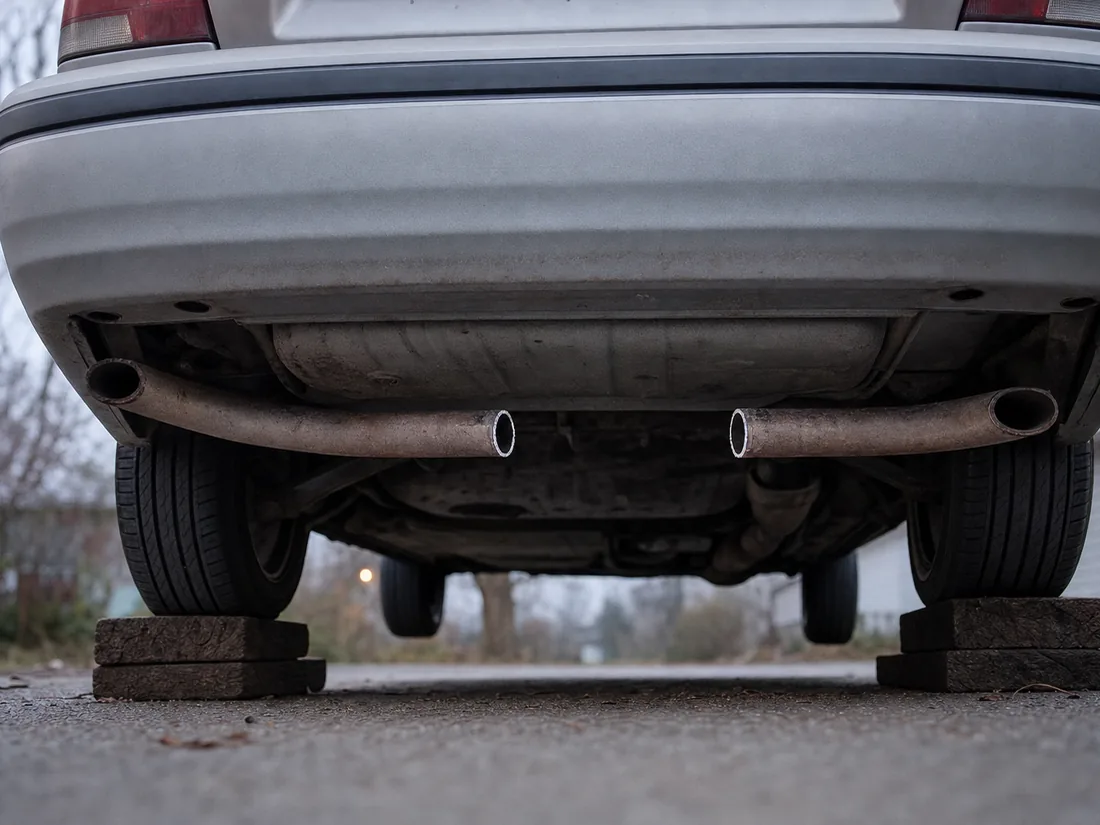
Somebody cut the converter out of your exhaust while the car sat outside. The car still starts. It is loud enough that the neighbours know, it may run badly, and in a state with tailpipe testing it will not pass. Now you want it gone, and every page you have found tells you the same thing: selling a car without its catalytic converter is a federal crime.
That is wrong, and the agency that enforces the law says so in plain words. The Environmental Protection Agency publishes a tampering page with a list of questions on it. One of them is the exact question you are asking — I didn’t tamper with the vehicle, but can I sell it? — and the answer begins: “Sales and operation of used tampered vehicles are not covered by the CAA.”
What the Clean Air Act actually prohibits
The confusion is understandable, because there is a serious federal prohibition here and it sits one sentence away from your situation. The tampering provision, at 42 U.S.C. § 7522(a)(3)(A), makes it unlawful “for any person knowingly to remove or render inoperative any such device or element of design after such sale and delivery to the ultimate purchaser.”
Read the verbs. Remove. Render inoperative. The prohibited act is the cutting. The person who took a saw to your exhaust at two in the morning committed that act. You, standing on the driveway the next morning looking at the gap, did not.
Nothing in that subsection prohibits selling the car afterwards. There is exactly one paragraph in the whole of § 7522(a) that prohibits selling a vehicle, and it opens by naming who it binds: “for any manufacturer of a new motor vehicle or new motor vehicle engine.” Unless you build cars, it is not about you.
The statute prices your position, and it is the cheap one
If you want a measure of how differently the law treats a private owner from the trade, read the penalty section. 42 U.S.C. § 7524(a) sets the fine for the same act of removal at two different levels: “any manufacturer or dealer who violates section 7522(a)(3)(A) … shall be subject to a civil penalty of not more than $25,000. Any person other than a manufacturer or dealer who violates section 7522(a)(3)(A) … shall be subject to a civil penalty of not more than $2,500.”
Ten to one, for identical conduct, decided entirely by whether you are in the business. EPA describes its own enforcement in the same terms, noting that “dealers can be fined over $5,000 per tampered vehicle.” The per-vehicle exposure is the dealer’s. That asymmetry runs through this entire subject and it is why advice written about dealerships — which is most of what ranks — reads as far more alarming than your position warrants.
The two things EPA says next, which matter
The sentence quoted at the top does not stop there, and a page that quoted only the convenient half would be doing to you what the rest of the internet already has. EPA continues that the Act “does prohibit the sale of defeat devices and at least one federal court, in a recent citizen suit, interpreted the prohibitions against selling defeat devices to extend to the sale of a vehicle with a defeat device,” and that many states have laws prohibiting dealers from selling tampered vehicles.
Take those in turn. The defeat-device prohibition, at § 7522(a)(3)(B), reaches a person who manufactures, sells or installs “any part or component … where a principal effect of the part or component is to bypass, defeat, or render inoperative” an emissions control. That is aimed at the trade in delete kits and straight pipes. A missing part is not a part; a court reading it to cover a whole vehicle was addressing a vehicle fitted with a device, not one with a hole where a component used to be. It is a real caveat and you should know it exists, but it is a long way from a theft victim selling a damaged car.
The second point is the one that will actually affect you, and it is not federal at all.
Your state is where the real restriction lives
Federal law leaves your sale alone. States frequently do not — and they disagree with each other so completely that no single national answer is honest. We read eleven states’ codes for this page, and they fall into three shapes.
Some ban the sale and then name your way out. California is the clearest. Its Vehicle Code has two relevant subsections and the difference between them is the whole lesson: subsection (a) of § 24007 binds dealers, and subsection (b)(1) binds everybody: “no person shall sell, or offer or deliver for sale, to the ultimate purchaser … a new or used motor vehicle … which is not in compliance with that part and the rules and regulations of the State Air Resources Board, unless the vehicle is sold to a dealer or sold for the purpose of being legally wrecked or dismantled.” The private sale is closed — and the legislature itself, in the final clause, names the two routes that stay open. That is not a loophole somebody found; it is the exception the statute was written with. Florida and Georgia do the same thing in their own words.
Some ban the sale and name nothing. Pennsylvania, New Jersey and Texas prohibit it flatly, with no dealer or dismantler carve-out written anywhere in the provision. Pennsylvania’s is the bluntest sentence we read in any state: no person shall knowingly sell or operate a vehicle whose emission control system has been disabled, changed or altered from its original design specifications. If you are in one of those three, the rule as written does not care who is buying.
And some do not restrict the sale at all. New York, Illinois and Washington prohibit the removal and stop there. Their emissions duty lands on the owner, or on the buyer at registration, after the money has changed hands. Washington has no test to fail in the first place — its inspection programme expired at the start of 2020.
| State | The sale rule binds | The way out | What it says, and where |
|---|---|---|---|
| California | Any person | Sale to a dealer, or for legal wrecking or dismantling — named in the statute itself. | Subsection (a) binds dealers; subsection (b) binds everyone. The smog certificate is also the seller’s duty here, not the buyer’s. Veh. Code § 24007(b)(1) |
| Florida | Any person | Sale, reassignment or trade to a licensed dealer, and separately “sales of motor vehicles for salvage purposes only.” | The statute names the catalytic converter first on its list of covered devices, and requires the seller to certify in writing that they did not tamper with it. Florida runs no emissions inspection at all. Fla. Stat. § 316.2935(1) |
| Georgia | Any person, in 13 metro counties | Sold for salvage or for parts — but only if the car is towed or hauled rather than driven, and the purpose is written on the bill of sale. | Georgia’s inspection is built around this exact part: its tampering check is defined as whether the original converter has been removed or modified. Ga. Comp. R. & Regs. r. 391-3-20-.18 |
| Colorado | Any seller, in the program area | Dealer-to-dealer wholesale, or a car that is inoperable or cannot be tested — the latter only with written notice to the buyer on a state form. | There is no dismantler exception. A car missing only its converter usually still drives, which makes the inoperable route a poor fit. C.R.S. § 42-4-310 |
| Texas | Any person, statewide | None written into the rule. | One step less verified than the rest of this table. Texas’s own rule viewer is now a JavaScript portal that serves navigation to every request, so the text linked here is EPA’s federally approved Texas plan, which carries the same prohibition under the rule’s former number. 30 Tex. Admin. Code § 114.20(c) |
| Pennsylvania | Any person | None, beyond replacing the part in kind. | The sharpest wording of any state read: no person shall knowingly sell a vehicle whose emission control system has been disabled, changed or altered — and on its face it is not limited to the inspection counties. 75 Pa.C.S. § 4531(c) |
| New Jersey | Any person | None. The rule’s only exclusions are diesel-only vehicles, motorcycles and electric cars. | The rule states in terms that it applies to any person, and lists the sale itself as a prohibited act alongside the removal. N.J.A.C. 7:27-15.7(a)3 |
| Arizona | Dealers only | Not needed — a private seller is not barred from selling. | The bite is at registration instead: the car cannot be registered in the Phoenix or Tucson areas until it passes. A dealer, by contrast, may not even deliver one first, and pays for the repairs. A.R.S. § 49-542 |
| New York | Nobody — no sale rule | Not needed. | New York prohibits the removal and stops there. The only pre-delivery inspection duty in the code falls on registered dealers. Veh. & Traf. Law § 375(28-a) |
| Illinois | Nobody — no sale rule | Not needed. | The whole emissions law puts the duty on the owner, and the Secretary of State enforces it by refusing to transfer a registration — which lands on the buyer, after the sale. 625 ILCS 5/ch. 13C |
| Washington | Nobody — no sale rule | Not needed. | Washington asks dealers to hand over a disclaimer and nothing more. Its emissions inspection programme expired on 1 January 2020, so there is no test to fail. RCW 70A.25.110 |
Ten states beyond California, each read from that state's own code, register or agency publication in this session. Where a state is absent from this table nobody read it, and the page says so rather than guessing. Texas carries a caveat of its own, set out in its row.
Two things to take from that table. The first is that the shape of the rule matters far more than whether your state “has emissions testing” — Florida has no inspection programme at all and still bars the sale, while Arizona tests hard and leaves private sellers alone. The second is that where the exception exists, it describes a licensed buyer or a dismantler, which is to say the route a cash-offer buyer already uses. In the states with no exception, that route is not privileged either; there, the honest position is that the rule as written reaches your sale, and the practical answer is replacing the converter or being plain with the buyer about what is missing.
Thirty-nine states are not in that table because nobody read them for this page, and we would rather say so than guess. If yours is missing, its own vehicle code or air-quality rules are where the answer lives, and the words to look for are whether the prohibition says dealer or says person.
If you are replacing it rather than selling
One more piece of the federal text is worth having, because people who have just been robbed sometimes worry that even the repair puts them on the wrong side of the law. It does not. The closing text of § 7522(a) says no action referred to in the tampering paragraph is a prohibited act “if (i) the action is for the purpose of repair or replacement of the device or element.” Fitting a new converter is expressly not tampering. What the replacement part has to be — and in California, whether it carries an Air Resources Board executive order number — is a state question, and the shop doing the work will know it better than any web page.
Where this leaves you
You did not break a federal law by having your car vandalised, and you will not break one by selling it. What you are facing is narrower and more practical than the internet told you: in a state with tailpipe testing the car cannot pass, in a state with a rule like California’s the private sale is closed, and in every state a private buyer who understands what is missing will price it accordingly or walk. The routes that stay open are the ones the California statute names out loud — a dealer, or a buyer who takes the car for dismantling.
Whichever way you go, say plainly and in writing that the converter is missing. It is the single fact that most changes what the car is worth, a buyer will discover it within a minute of looking underneath, and a sale where the other side finds it afterwards is the kind that comes back.