Total-loss thresholds, all fifty states, read from the law itself
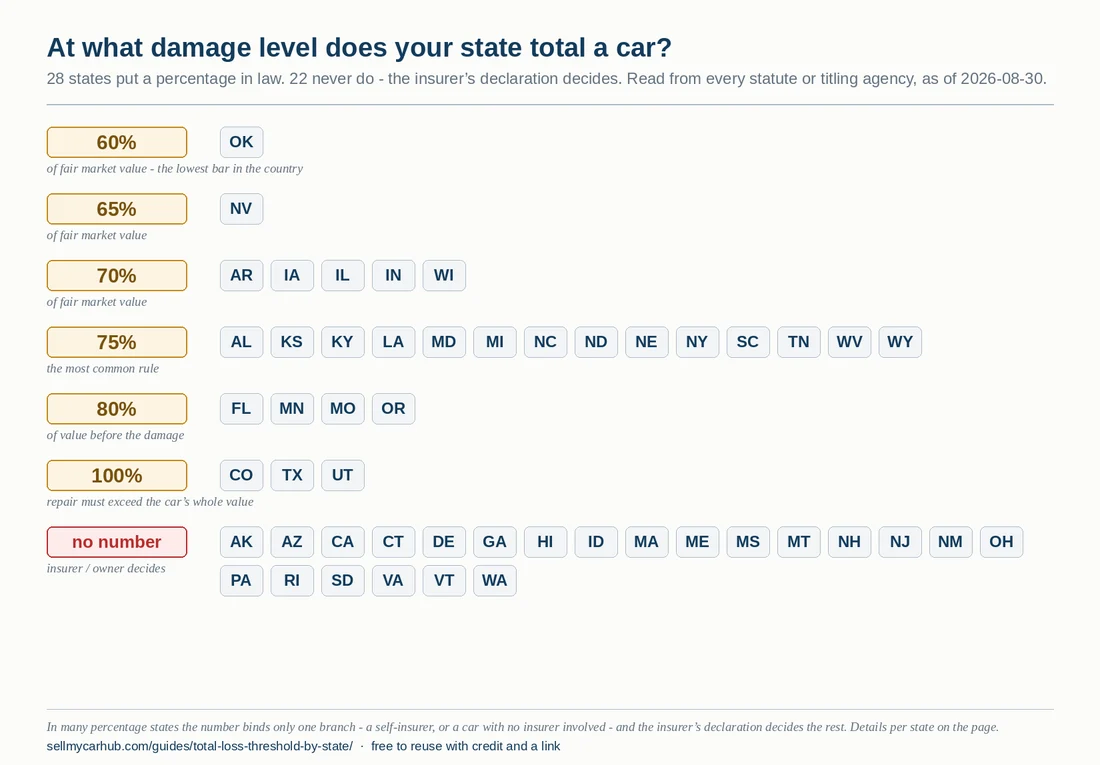
At what damage level is a car legally totaled? There is no national answer: 28 states put a percentage in law — from 60% in Oklahoma to 100% in Colorado, Texas and Utah — and 22 states never name a number at all. Every row below was read from the state’s own statute or titling agency, quoted verbatim, with the source linked.
Last updated .
The answer, before the table
There is no national number. 28 states put a percentage in law — and it runs from Oklahoma’s 60% to a full 100% in Colorado, Texas and Utah, where the repair has to cost more than the whole car was worth. The other 22 states publish no percentage at all: the trigger is the insurance company’s own declaration, or the owner’s, that the car is “uneconomical to repair.” California, the largest car market in the country, is in the no-number column.
And the number, where it exists, usually decides less than it appears to. In Florida, Illinois, Minnesota, Missouri, Oregon and Wyoming the percentage binds only one branch of the statute — a self-insured company, or a car with no insurer involved — while an ordinary insured claim is totalled by the settlement itself, at whatever damage level the insurer settles. That distinction is missing from nearly every table on this subject, which is a fair sign the tables were copied from each other rather than from the statutes.
How to read the threshold
Three shapes appear in the law, and they are not interchangeable:
A percentage. Repair cost against some value of the car — and which value varies. Kentucky and Nebraska measure retail value; Kansas, Iowa and Arkansas fair market or average retail value; North Dakota and Louisiana name the NADA guide in the statute itself; Michigan uses the pre-damage cash value. Pennsylvania stands alone in comparing the repair bill to the value of the repaired car.
A formula. Virginia’s title law runs a true total-loss formula: the car is salvage when repair cost exceeds its cash value minus its salvage value — and Idaho and Washington write the same subtraction into their “uneconomical to repair” tests.
A declaration. In 22 states the statute never states a number. The insurer’s total-loss decision — in several states the owner’s own — is the whole trigger, and the title consequence follows the settlement.
| State | Threshold | Who or what decides | Authority |
|---|---|---|---|
| Alabama | 75% | A settlement AND the number, together | Ala. Code s. 32-8-87 (as administered; DOR FAQ quoted) ↗ |
| Alaska | — | The insurer-surrender rules in the administrative code | 2 AAC 92.170 and 2 AAC 92.190 (as described by the DMV's own page) ↗ |
| Arizona | — | Owner or insurer judgment - “uneconomical to repair” | A.R.S. s. 28-2091(T)(3) ↗ |
| Arkansas | 70% | The number itself - the duty attaches when damage crosses it | Ark. Code Ann. s. 27-14-2301 (as quoted on the DFA's own form) ↗ |
| California | — | Owner or insurer judgment - “uneconomical to repair” | CVC 544 ↗ |
| Colorado | 100% | Insurer declaration, or repair cost past the whole value | C.R.S. s. 42-6-102(17) ↗ |
| Connecticut | — | The insurer’s declaration | Conn. Gen. Stat. s. 14-16c regime (as administered; DMV publication quoted) ↗ |
| Delaware | — | The total-loss settlement itself | 21 Del. C. s. 2512(a)-(b) ↗ |
| Florida | 80% | Insurer settlement; the number binds only the uninsured branch | Fla. Stat. s. 319.30(3)(a) ↗ |
| Georgia | — | Two damaged major components, or the settlement | O.C.G.A. s. 40-3-2(11) ↗ |
| Hawaii | — | The insurer’s declaration | HRS ch. 286 regime (HRS 286-48 salvage certificates; as administered by the counties) ↗ |
| Idaho | — | Owner or insurer judgment - “uneconomical to repair” | Idaho Code s. 49-123(2)(o) ↗ |
| Illinois | 70% | Insurer settlement; the number binds only the self-insured branch | 625 ILCS 5/3-117.1(b) ↗ |
| Indiana | 70% | Insurer settlement; the number binds only the self-insured branch | IC 9-22-3-3(a) ↗ |
| Iowa | 70% | The number itself - the duty attaches when damage crosses it | Iowa Code s. 321.52(4)(e) ↗ |
| Kansas | 75% | The number itself - the duty attaches when damage crosses it | K.S.A. 8-197(b)(2) ↗ |
| Kentucky | 75% | The number itself - the duty attaches when damage crosses it | KRS 186A.520(1)(a) ↗ |
| Louisiana | 75% | The number itself - the duty attaches when damage crosses it | La. R.S. 32:702(14) ↗ |
| Maine | — | Insurer or owner declaration | 29-A M.R.S. s. 602(13) ↗ |
| Maryland | 75% | Insurer settlement, or the number | Md. Code, Transp. s. 11-152 ↗ |
| Massachusetts | — | Owner or insurer judgment - “uneconomical to repair” | Mass. Gen. Laws ch. 90D, s. 1 ↗ |
| Michigan | 75% | The number itself - the duty attaches when damage crosses it | MCL 257.217c (as cited by the manual; late model at MCL 257.24b) ↗ |
| Minnesota | 80% | Insurer acquisition; the number binds only self-insured owners | Minn. Stat. s. 168A.151, subd. 1(f) ↗ |
| Mississippi | — | The insurer acquiring the car on a total-loss claim | Miss. Code Ann. s. 63-21-33 regime (as stated by the DPS; junked titles at s. 63-21-39) ↗ |
| Missouri | 80% | Insurer declaration; the number binds only the uninsured branch | RSMo s. 301.010(55) ↗ |
| Montana | — | The insurer’s determination | MCA 61-3-211(1) ↗ |
| Nebraska | 75% | The number itself - the duty attaches when damage crosses it | Neb. Rev. Stat. s. 60-171(7) ↗ |
| Nevada | 65% | The number itself - the duty attaches when damage crosses it | NRS 487.790 ↗ |
| New Hampshire | — | The insurer’s declaration | N.H. RSA 261:22, II ↗ |
| New Jersey | — | Owner or insurer judgment - “uneconomical to repair” | not cited on the agency page; the N.J.S.A. salvage-title sections were not reachable from this container ↗ |
| New Mexico | — | The total-loss settlement itself | NMSA 1978, s. 66-1-4.16(C) (named by NMAC 18.19.3.50(B)); mechanics at NMSA 66-3-4 ↗ |
| New York | 75% | Insurer acquisition, or the number | N.Y. Veh. & Traf. Law s. 429 regime (as administered; agency pages quoted) ↗ |
| North Carolina | 75% | The number itself - the duty attaches when damage crosses it | N.C. Gen. Stat. s. 20-4.01(33)(d) ↗ |
| North Dakota | 75% | The number itself - the duty attaches when damage crosses it | N.D.C.C. s. 39-05-20.2(1) ↗ |
| Ohio | — | The insurer’s declaration | Ohio Rev. Code s. 4505.11(C)(1) ↗ |
| Oklahoma | 60% | The number itself - the duty attaches when damage crosses it | 47 O.S. s. 1105(A)(1) ↗ |
| Oregon | 80% | Insurer declaration; the number binds only the uninsured branch | ORS 801.527 ↗ |
| Pennsylvania | — | Repair cost vs the REPAIRED car’s value | 75 Pa.C.S. s. 102 (as restated in PennDOT's fact sheet) ↗ |
| Rhode Island | — | The insurer’s declaration | R.I. Gen. Laws ss. 31-46-1(a), 31-46-1.1 ↗ |
| South Carolina | 75% | The number itself - the duty attaches when damage crosses it | S.C. Code s. 56-19-480(G) ↗ |
| South Dakota | — | The insurer’s declaration | SDCL s. 32-3-51.19 ↗ |
| Tennessee | 75% | The number itself - the duty attaches when damage crosses it | Tenn. Code Ann. s. 55-3-201 et seq. (as cited on the DOR form) ↗ |
| Texas | 100% | The number itself - the duty attaches when damage crosses it | Tex. Transp. Code s. 501.091 (as the manual's s. 1.1 cites) ↗ |
| Utah | 100% | The number itself - the duty attaches when damage crosses it | Utah Code s. 41-1a-1001(8) ↗ |
| Vermont | — | The insurer’s declaration | 23 V.S.A. s. 2001(13)-(14) ↗ |
| Virginia | — | Repair cost vs value minus salvage (a total-loss formula) | Va. Code s. 46.2-1600 ↗ |
| Washington | — | Owner or insurer judgment - “uneconomical to repair” | RCW 46.04.514 ↗ |
| West Virginia | 75% | The number itself - the duty attaches when damage crosses it | W. Va. Code s. 17A-4-10(a) ↗ |
| Wisconsin | 70% | The number itself - the duty attaches when damage crosses it | Wis. Stat. s. 342.065(1g) ↗ |
| Wyoming | 75% | Insurer declaration; the number runs the no-insurer branch | W.S. 31-2-106(a)(v) ↗ |
The table compresses; the quotes below do not. Each state’s entry carries the operative sentence verbatim from the statute or the agency’s own document, with the source linked, because a threshold paraphrased is a threshold you cannot check.
The carve-outs the summaries drop
The percentage is the headline; the exceptions decide real cases. These are all in the quoted text below, and almost none of them survive into the tables this page replaces:
Kentucky excludes a deployed airbag — the cost of parts and labor to reinstall an airbag system is left out of the 75% computation, so a deployed airbag alone cannot total a car there. Oklahoma counts only structural damage: repair costs toward its 60% include nothing but the suspension, motor, transmission, frame or unibody and designated structural components — and the definition only reaches vehicles in their first ten model years. North Dakota excludes glass and hail damage from its 75% entirely; Kansas sets aside exterior cosmetic windstorm and hail damage; Louisiana routes 75%-level cosmetic hail damage to a separate hail brand instead of salvage; Texas excludes a paid hail claim from salvage altogether, and Colorado excludes hail and theft by name. Arkansas totals any car submerged above the dashboard, whatever the repair bill. Nevada’s repair cost excludes paint, towing and manufacturer-spec electronics. South Carolina exempts cars worth $2,000 or less (and antiques) from its rule; South Dakota’s definition stops at ten model years old and 16,000 lbs; Michigan runs two tiers — salvage at 75–91% of pre-damage value, scrap at 91% and up, and a scrap-titled car can never return to the road. West Virginia writes a “cosmetic total loss” escape into the same section that sets its 75%.
Every state, in its own words
Alabama · 75%
Ala. Code s. 32-8-87 (as administered; DOR FAQ quoted) — fair retail value prior to damage, per nationally recognized compilations including automated databases. ↗
“A salvage vehicle (total loss) occurs when an insurance company or any other person pays or makes other monetary settlement to a person when a vehicle is damaged and the damage to the vehicle is greater than or equal to 75 percent of the fair retail value of the vehicle prior to damage as set forth in a current edition of a nationally recognized compilation of retail values, including automated data bases.”
Alabama's trigger is conjunctive - a SETTLEMENT PLUS damage at 75% or more - so damage alone, with no payout, does not make an Alabama salvage vehicle by this definition. The agency is the Department of Revenue.
The Code of Alabama's official text is gated; the quote is the Department of Revenue's own FAQ. The statute's own text still deserves a direct read when a public route exists.
Selling the car once it is declared a loss: how to sell a car in Alabama.
Alaska
2 AAC 92.170 and 2 AAC 92.190 (as described by the DMV's own page) — junk-brand and insurer-surrender regime under the administrative code - no statutory percentage. ↗
“Starting 08/01/2025 changes to 2 AAC 92.190 the department is now able to issue a "Salvage" title to a vehicle that has a current Junk brand that has not yet been reconstructed. This Salvage title is intended to allow a vehicle owner to provide a more substantial ownership document for surrender to an insurance company under 2 AAC 92.170 or a salvage company, to retrieve the vehicle from impound, or to otherwise demonstrate ownership.”
Alaska's regime is the youngest in the study - a stand-alone Salvage title only exists since August 1, 2025; before that a totaled car went straight to a Junk brand. The mechanics live in the administrative code (2 AAC 92.170 insurer surrender, 2 AAC 92.190 branding), not in a statutory percentage.
akleg.gov's statute and AAC browsers are JS-only from this container; the quote is the Alaska DMV's own page naming the AAC sections. The regulations' text still deserves a direct read when a route exists.
Selling the car once it is declared a loss: how to sell a car in Alaska.
Arizona
A.R.S. s. 28-2091(T)(3) — whoever holds the loss decides - no statutory percentage. ↗
“"Salvage vehicle" means a vehicle, other than a nonrepairable vehicle, of a type that is subject to the issuance of a certificate of title and registration pursuant to this chapter and that has been stolen, wrecked, destroyed, flood or water damaged or otherwise damaged to the extent that the owner, leasing company, financial institution or insurance company considers it uneconomical to repair the vehicle.”
No percentage anywhere in the definition - "considers it uneconomical to repair" puts the call with the owner, lessor, lender or insurer. A separate "nonrepairable vehicle" category covers cars with no usable components that the owner irreversibly designates as scrap.
Selling the car once it is declared a loss: how to sell a car in Arizona.
Arkansas · 70%
Ark. Code Ann. s. 27-14-2301 (as quoted on the DFA's own form) — average retail value per a Commissioner-approved pricing guide; above-dashboard water damage totals regardless of cost. ↗
“Pursuant to Arkansas Code 27-14-2301, "salvage vehicle" means a motor vehicle that has sustained physical damage equal to or exceeding seventy percent (70%) of its average retail value, or water damage to the extent that the motor vehicle was submerged to any level above the dashboard.”
Water above the dashboard is salvage at ANY dollar amount. The agency's declaration form adds the exemptions: motorcycles, motor-driven cycles, trucks of 10,000 lbs or more unladen, and vehicles more than seven model years old. Two agency documents state the same definition (the insurer-declaration form and DFA rule 2007-8).
Selling the car once it is declared a loss: how to sell a car in Arkansas.
California
CVC 544 — uneconomical to repair - no statutory percentage. ↗
“"Total loss salvage vehicle" means either of the following: (a) A vehicle, other than a nonrepairable vehicle, of a type subject to registration that has been wrecked, destroyed, or damaged, to the extent that the owner, leasing company, financial institution, or the insurance company that insured or is responsible for repair of the vehicle, considers it uneconomical to repair the vehicle and because of this, the vehicle is not repaired by or for the person who owned the vehicle at the time of the event resulting in damage. (b) A vehicle that was determined to be uneconomical to repair, for which a total loss payment has been made by an insurer, whether or not the vehicle is subsequently repaired, if prior to or upon making the payment to the claimant, the insurer obtains the agreement of the claimant to the amount of the total loss settlement, and informs the client that, pursuant to subdivision (a) or (b) of Section 11515, the total loss settlement must be reported to the Department of Motor Vehicles, which will issue a salvage certificate for the vehicle.”
No percentage - "considers it uneconomical to repair" is the whole test, and branch (b) makes an insurer's agreed total-loss payment itself the trigger, reportable to the DMV under CVC 11515. Connects to the branded-titles reference: the resulting Salvaged brand is permanent, and California has no rebuilt brand (data/brands/california.json).
Selling the car once it is declared a loss: how to sell a car in California.
Colorado · 100%
C.R.S. s. 42-6-102(17) — retail fair market value immediately prior to the damage - repair must EXCEED it (or any total-loss determination). ↗
“"Salvage vehicle" means: (A) A flood-damaged vehicle; (B) A vehicle branded as a salvage vehicle by another state; or (C) A vehicle that is damaged by collision, fire, flood, accident, trespass, or other occurrence, excluding hail damage or theft, to the extent that the vehicle is determined to be a total loss by the insurer or other person acting on behalf of the owner or that the cost of repairing the vehicle to a roadworthy condition and for legal operation on the highways exceeds the vehicle's retail fair market value immediately prior to the damage, as determined by the person who owns the vehicle at the time of the occurrence or by the insurer or other person acting on behalf of the owner.”
Hail damage and theft are excluded by name, flood damage and out-of-state brands are automatic, and off-highway vehicles are outside the definition. Subsection (b) fixes the valuation evidence: industry price guides, dealer quotations, computerized valuation services, newspaper advertisements, and certified appraisals.
Selling the car once it is declared a loss: how to sell a car in Colorado.
Connecticut
Conn. Gen. Stat. s. 14-16c regime (as administered; DMV publication quoted) — insurer total-loss declaration, regulated by the Insurance Department - no percentage in the DMV's materials. ↗
“Insurance companies have the authority to declare a motor vehicle a "total loss," but they are subject to regulation by the State of Connecticut Insurance Department. If your insurance company has determined that your motor vehicle is a "total loss," or the word "Salvage" has been stamped on the title, it is illegal to operate your motor vehicle upon any road in Connecticut.”
The DMV's page adds the permanent tier: a title branded "salvage parts only", "salvage unrebuildable" or "salvage unrepairable" can never be registered or re-titled under any circumstances. Rebuilt vehicles need the $88 salvage inspection and arrive on a flatbed - no wheel may touch the ground.
cga.ct.gov fails TLS from this container and the proxy fetch route returns 503, so the quote is the DMV's B-256 information sheet (Rev. 9-2024). CGS 14-16c's own text still deserves a direct read when a route exists.
Selling the car once it is declared a loss: how to sell a car in Connecticut.
Delaware
21 Del. C. s. 2512(a)-(b) — total loss insurance settlement - no statutory percentage. ↗
“Except as provided under subsection (g) of this section, when a registered or unregistered motor vehicle, for which a title has been issued by the Department, is transferred as salvage as a result of a total loss insurance settlement, the insurance company or its authorized agent shall send the certificate of title of the vehicle to the Department within 30 days from the date of settlement. Upon receipt of the certificate of title and appropriate fee, the Department shall issue a salvage certificate.”
The settlement itself is the trigger; Delaware's title law never states a damage percentage. Subsection (b): an owner who keeps the car as "owner retained salvage" must get the salvage certificate before the insurer may pay the settlement - the same ordering rule Florida states for plates and insurance.
Selling the car once it is declared a loss: how to sell a car in Delaware.
Florida · 80%
Fla. Stat. s. 319.30(3)(a) — cost of replacing with like kind and quality (uninsured branch only). ↗
“a motor vehicle or mobile home is a “total loss”: a. When an insurance company pays the vehicle owner to replace the wrecked or damaged vehicle with one of like kind and quality or when an insurance company pays the owner upon the theft of the motor vehicle or mobile home; or b. When an uninsured motor vehicle or mobile home is wrecked or damaged and the cost, at the time of loss, of repairing or rebuilding the vehicle is 80 percent or more of the cost to the owner of replacing the wrecked or damaged motor vehicle or mobile home with one of like kind and quality.”
The 80% figure applies ONLY to uninsured vehicles. Insured = insurer settlement/theft payout, no percentage. s.319.30(3)(a)2 adds the escape: not a total loss if insurer and owner agree to repair rather than replace - unless repair cost to the insurer exceeds 100% of replacement cost (statute continues).
Selling the car once it is declared a loss: how to sell a car in Florida.
Georgia
O.C.G.A. s. 40-3-2(11) — replacement of two or more major component parts, or an insurer's paid total loss claim - no percentage. ↗
“Official Code of Georgia Annotated s. 40-3-2(11) defines a "salvage motor vehicle," in part, as a vehicle damaged to "the extent that its restoration to an operable condition would require the replacement of two or more major component parts;" or a vehicle for "which an insurance company has paid a total loss claim."”
Georgia counts PARTS, not dollars: two or more major component parts needing replacement makes salvage regardless of cost ratios. The agency is the Department of Revenue, not a DMV, and its inspection statute (40-3-37, hosted on dor.georgia.gov) brands the title "rebuilt" and physically affixes the word to the door post when two or more major components were replaced.
O.C.G.A. official text is LexisNexis-gated; the quote is the Georgia Attorney General's own quotation of s. 40-3-2(11) (Official Opinion 97-24, which flags itself as quoting 'in part'), and dor.georgia.gov's salvage/rebuilt pages state the same two-branch test. The full current statutory text still deserves a direct read if a public route appears.
Selling the car once it is declared a loss: how to sell a car in Georgia.
Hawaii
HRS ch. 286 regime (HRS 286-48 salvage certificates; as administered by the counties) — insurer total-loss declaration or owner's sale as salvage - no percentage in the agency's materials. ↗
“Once a vehicle is declared a total loss by an insurance company, or sold by an owner as salvage, it cannot be issued a standard title or registration in Hawaii.”
Hawaii titles are administered by the counties; the quote is from the City and County of Honolulu's titling agency. The road back requires repair at a state-certified Salvage Repair Dealer (list kept by the DCCA Motor Vehicle Repair Industry Board), a certificate of repair, and a VIN and safety inspection before a rebuilt title issues.
capitol.hawaii.gov blocks both curl and the proxy fetch route from this container, so HRS 286-2/286-48's own text was not readable; the quote is the county titling agency's page. The statute still deserves a direct read when a route exists.
Selling the car once it is declared a loss: how to sell a car in Hawaii.
Idaho
Idaho Code s. 49-123(2)(o) — cost of parts and labor MINUS salvage value vs. repair economics; any insurer total-loss settlement. ↗
“Salvage vehicle or vessel. Any vehicle or vessel for which a salvage certificate of title, salvage bill of sale or other documentation has been issued showing evidence that the vehicle or vessel has been declared salvage or which has been damaged to the extent that the owner, or an insurer, or other person acting on behalf of the owner, determines that the cost of parts and labor minus the salvage value makes it uneconomical to repair or rebuild. When an insurance company has paid money or has made other monetary settlement as compensation for a total loss of any vehicle or vessel, such vehicle shall be considered to be a salvage vehicle or vessel.”
No percentage; the determination subtracts salvage value from repair cost, and any insurer total-loss settlement makes the vehicle salvage automatically. The definition sits inside the statute's definition of "Vehicle" itself - item (o) of subsection (2) - which is why citation tables routinely miscite it.
Selling the car once it is declared a loss: how to sell a car in Idaho.
Illinois · 70%
625 ILCS 5/3-117.1(b) — fair market value without the damage, repair cost including labor (self-insured branch only). ↗
“When a vehicle of a self-insured company is to be sold in the State of Illinois and has sustained damaged by collision, fire, theft, rust corrosion, or other means so that the self-insured company determines the vehicle to be a total loss, or if the cost of repairing the damage, including labor, would be greater than 70% of its fair market value without that damage, the vehicle shall be considered salvage.”
The insured route is settlement-based, no percentage: "When an insurance company makes a payment of damages on a total loss claim for a vehicle ... the vehicle shall be considered to be salvage" - with two owner-retention escapes (hail damage not affecting operational safety; any vehicle 9 model years or older, by agreement) and a theft carve-out (no salvage certificate on an unrecovered-theft payout unless the car turns up damaged enough to have totaled). The verbatim statute reads "has sustained damaged" - the grammar slip is the statute's own.
Selling the car once it is declared a loss: how to sell a car in Illinois.
Indiana · 70%
IC 9-22-3-3(a) — fair market value immediately before the damage (self-insurer / post-damage acquirer branch only). ↗
“A certificate of salvage title is required for a vehicle that is manufactured within the last seven (7) model years and meets any of the following criteria: (1) An insurance company has determined that it is economically impractical to repair the wrecked, destroyed, or damaged vehicle and has made an agreed settlement with the insured or claimant. (2) If the owner of the vehicle: (A) is a business that insures its own vehicles; or (B) acquired the vehicle after the vehicle was wrecked, destroyed, or damaged; the cost of repairing the wrecked, destroyed, or damaged vehicle exceeds seventy percent (70%) of the fair market value immediately before the vehicle was wrecked, destroyed, or damaged. (3) The vehicle is a flood damaged vehicle.”
Only vehicles within the last seven model years. The insurer route is "economically impractical" plus an agreed settlement - no percentage; the 70% test binds only self-insuring businesses and people who bought the car already damaged. Flood damage triggers salvage title outright. Secretary of State Form 55974 states the same rule in plain words. Source is the official 2022 Indiana Code edition PDF on in.gov; the section's amendment history ends at P.L.198-2016.
Selling the car once it is declared a loss: how to sell a car in Indiana.
Iowa · 70%
Iowa Code s. 321.52(4)(e) — fair market value before the damage, per department rules. ↗
“For purposes of this subsection, "wrecked or salvage vehicle" means a damaged motor vehicle subject to registration for which the cost of repair exceeds seventy percent of the fair market value of the vehicle, as determined in accordance with rules adopted by the department, before the vehicle became damaged.”
Iowa's definition sits inside the salvage-certificate subsection (321.52(4)) rather than a general definitions section, and delegates the fair-market-value method to DOT rules.
Selling the car once it is declared a loss: how to sell a car in Iowa.
Kansas · 75%
K.S.A. 8-197(b)(2) — fair market value immediately preceding the damage (late model vehicles), windstorm/hail cosmetic damage excluded. ↗
“"Salvage vehicle" means: (A) Any motor vehicle, other than a late model vehicle, which is of a type required to be registered in this state, but which cannot be registered because it has been wrecked or damaged to the extent that: The equipment required by state statute on any such vehicle used on the highways of this state is not present or is not in good condition or proper adjustment, as prescribed by state statute or any rules and regulations adopted pursuant thereto, or such vehicle is in an inoperable condition or a condition that would render the operation thereof on the highways of this state a hazard to the public safety; and in either event, such vehicle would require substantial repairs to rebuild or restore such vehicle to a condition which will permit the registration thereof; (B) a late model vehicle which is of a type required to be registered in this state and which has been wrecked or damaged to the extent that the total cost of repair is 75% or more of the fair market value of the motor vehicle immediately preceding the time it was wrecked or damaged and such condition was not merely exterior cosmetic damage to such vehicle as a result of windstorm or hail; (C) a motor vehicle, which is of a type required to be registered in this state that the insurer determines is a total loss and for which the insurer takes title;”
Three routes: older vehicles by inoperability, late model vehicles (model year plus six preceding years, s. 8-197(b)(6)) at 75% of fair market value with a windstorm/hail cosmetic-damage exception, or any vehicle the insurer totals AND takes title to. The ksrevisor.org filename trap from the pending note is resolved: 8-197 lives at chapters/ch08/008_001_0097.html.
Selling the car once it is declared a loss: how to sell a car in Kansas.
Kentucky · 75%
KRS 186A.520(1)(a) — retail value per a nationally accepted valuation guide (KRS 304.20-110); airbag reinstallation excluded. ↗
“A vehicle that has been wrecked, destroyed, or damaged, to the extent that the total estimated or actual cost of parts and labor to rebuild or reconstruct the vehicle to its preaccident condition and for legal operation on the roads or highways, not including the cost of parts and labor to reinstall a deployed airbag system, exceeds seventy-five percent (75%) of the retail value of the vehicle, as prescribed by a nationally accepted used car valuation guide or tool identified under KRS 304.20-110.”
Kentucky is the only state captured that EXCLUDES the cost of reinstalling a deployed airbag system from the 75% computation - a deployed airbag alone cannot total a car here, though insurers must still count it in the physical damage estimate. Parts price at current published retail, labor at community-customary rates, both fixed by the statute.
Selling the car once it is declared a loss: how to sell a car in Kentucky.
Louisiana · 75%
La. R.S. 32:702(14) — market value per the most current NADA Handbook. ↗
“"Total loss" means a motor vehicle which has sustained damages equivalent to seventy-five percent or more of the market value as determined by the most current National Automobile Dealers Association Handbook. However, a motor vehicle that sustains cosmetic damages caused by hail equivalent to seventy-five percent or more of its market value as a result of costs for repairs to items such as windshields, windows, and rear glass, exterior paint and paint materials, and body damage such as dents shall not be deemed a "total loss" and salvaged; however, such vehicles shall be issued a branded title indicating the vehicle has sustained hail damage.”
Louisiana names its valuation book in the statute itself - the NADA Handbook - and carves out cosmetic hail damage into a separate hail brand rather than salvage. The salvage title itself is defined as evidence of "the declaration in an insurance settlement" that the vehicle is a total loss (s. 32:702(13)).
Selling the car once it is declared a loss: how to sell a car in Louisiana.
Maine
29-A M.R.S. s. 602(13) — insurer or owner total-loss declaration, or transfer to a recycler - no statutory percentage. ↗
“"Salvage vehicle" means a vehicle that, by reason of its condition or circumstance, is declared a total loss by an insurer or owner or is transferred to a recycler or salvage dealer, or a vehicle for which a certificate of salvage has been issued.”
No percentage anywhere - the owner's own declaration or the mere transfer to a recycler makes a Maine vehicle salvage, alongside the insurer route.
Selling the car once it is declared a loss: how to sell a car in Maine.
Maryland · 75%
Md. Code, Transp. s. 11-152 — fair market value prior to the damage, valuation per Transp. s. 13-506(c)(4). ↗
“"Salvage" means any vehicle that: (1) Has been damaged by collision, fire, flood, accident, trespass, or other occurrence to the extent that the cost to repair the vehicle for legal operation on a highway exceeds 75% of the fair market value of the vehicle prior to sustaining the damage, as determined under s. 13-506(c)(4) of this article; (2) Has been acquired by an insurance company as a result of a claim settlement; or (3) Has been acquired by an automotive dismantler and recycler: (i) As an abandoned vehicle, as defined under s. 25-201 of this article; or (ii) For rebuilding or for use as parts only.”
Subsection (b) adds the sentence most tables miss: "a vehicle has not been acquired by an insurance company if an owner retains possession of the vehicle upon settlement" - so keeping your totaled car keeps it out of the insurer-acquisition branch (the 75% branch can still catch it).
Selling the car once it is declared a loss: how to sell a car in Maryland.
Massachusetts
Mass. Gen. Laws ch. 90D, s. 1 — owner or insurer considers it uneconomical to repair - no statutory percentage. ↗
“''Total loss salvage motor vehicle'', a motor vehicle which has been stolen and unrecovered or which has been wrecked, destroyed or damaged by collision, fire, water, or other occurrence to such an extent that the owner or if the vehicle was insured, the insurer, considers it uneconomical to repair the vehicle and because of this, the vehicle is not repaired by or for the person who owned the vehicle at the time of the event resulting in such damage.”
Nearly word-for-word California's CVC 544 test - "considers it uneconomical to repair" plus the vehicle actually going unrepaired. Ch. 90D s. 20 then makes an insurer that acquires such a vehicle surrender the title and apply for a salvage title within ten days.
Selling the car once it is declared a loss: how to sell a car in Massachusetts.
Michigan · 75%
MCL 257.217c (as cited by the manual; late model at MCL 257.24b) — pre-damaged cash value, estimated repair cost including parts and labor; 75-91% = salvage, 91%+ = scrap. ↗
“A distressed vehicle is a late model vehicle (see Section 5-2 for definition) with one or more major component parts that has been wrecked, destroyed, damaged, stolen, or missing to the extent that the estimated cost to repair the vehicle, including parts and labor, is 75% or more of the vehicle's pre-damaged cash value. a) For late model vehicles, a salvage title is required if the estimated cost of repairs is 75% or more but less than 91% of the pre-damaged cash value. b) For late model vehicles, a scrap title is required if the estimated cost of repairs is 91% or more of the pre-damaged cash value.”
Michigan is the only two-tier state captured so far: salvage (rebuildable) at 75-91%, scrap (parts only, never rebuilt for road use) at 91%+. Applies to "late model" vehicles - under 8,000 lbs and within the last six model years, or over 8,000 lbs within sixteen (MCL 257.24b). An owner may apply voluntarily at any damage level.
Quote is from the Secretary of State Dealer Manual Chapter 5 'Distressed Vehicles', Revised June 2026 - the agency's own document - because legislature.mi.gov is unreachable from this container (TLS chain failure via curl, 503 via the proxy fetch route). michigan.gov also 403s plain curl; the PDF was retrieved through the session's fetch tool and read locally. Statute text of MCL 257.217c still deserves a direct read when a route exists.
Selling the car once it is declared a loss: how to sell a car in Michigan.
Minnesota · 80%
Minn. Stat. s. 168A.151, subd. 1(f) — actual cash value (self-insured-owner branch only). ↗
“A self-insured owner of a vehicle that sustains damage by collision or other occurrence which exceeds 80 percent of its actual cash value must: (1) for a late-model or high-value vehicle, immediately apply for a certificate of title that bears a "salvage" brand; or (2) for a vehicle that is not subject to clause (1), immediately apply for a certificate of title that bears a "prior salvage" brand.”
The insured route has NO percentage: "When an insurer, licensed to conduct business in Minnesota, acquires ownership of a vehicle, excluding a recovered intact vehicle, through payment of damages" it must brand the title - salvage for late-model/high-value, prior salvage otherwise. The 80% test exists only for self-insured owners. A separate junking certificate applies to an "unrepairable total loss vehicle" (subd. 4).
Selling the car once it is declared a loss: how to sell a car in Minnesota.
Mississippi
Miss. Code Ann. s. 63-21-33 regime (as stated by the DPS; junked titles at s. 63-21-39) — insurer obtains the vehicle by paying a total loss claim - no percentage in the state's materials. ↗
“"Salvage vehicle" shall mean a motor vehicle, which an insurance company obtains from the owner as a result of paying a total loss claim resulting from collision, fire, flood, accident, hail damage, trespass, un-recovered theft, or another occurrence.”
From the Department of Public Safety's Salvage Inspection Division, which also states what earns the rebuilt brand: repair or replacement of one major part and four minor parts as listed in Title 35.VII.6.05 of the administrative code. Titles issue from the Department of Revenue.
The Mississippi Code's official text is gated and dor.ms.gov fails TLS from this container; the quote is the DPS's own division page. The statute's text still deserves a direct read when a route exists.
Selling the car once it is declared a loss: how to sell a car in Mississippi.
Missouri · 80%
RSMo s. 301.010(55) — fair market value immediately preceding the damage (vehicles no more than six years past their model year). ↗
“"Salvage vehicle", a motor vehicle, semitrailer, or house trailer which: (a) Was damaged during a year that is no more than six years after the manufacturer's model year designation for such vehicle to the extent that the total cost of repairs to rebuild or reconstruct the vehicle to its condition immediately before it was damaged for legal operation on the roads or highways exceeds eighty percent of the fair market value of the vehicle immediately preceding the time it was damaged; (b) By reason of condition or circumstance, has been declared salvage, either by its owner, or by a person, firm, corporation, or other legal entity exercising the right of security interest in it; (c) Has been declared salvage by an insurance company as a result of settlement of a claim; (d) Ownership of which is evidenced by a salvage title; or (e) Is abandoned property which is titled pursuant to section 3”
The 80% test only reaches vehicles damaged within six years of their model year - older cars become salvage in Missouri only by declaration (owner, lienholder, or insurer settlement). Five independent routes into salvage status, and only one of them carries a percentage.
Selling the car once it is declared a loss: how to sell a car in Missouri.
Montana
MCA 61-3-211(1) — insurer's salvage determination - Montana's title statutes use the term without defining it. ↗
“When an insurer acquires ownership of a motor vehicle that is less than 15 years old and that has been determined to be a salvage vehicle, the insurer shall apply for a salvage certificate on a form prescribed by the department.”
MCA 61-1-101 (2025) defines 92 terms and "salvage vehicle" is not among them, and neither 61-3-211 nor 61-3-223 defines it - the determination is left to the insurer, and the duty only attaches to vehicles less than 15 years old. All three sections were read on the legislature's own site.
Selling the car once it is declared a loss: how to sell a car in Montana.
Nebraska · 75%
Neb. Rev. Stat. s. 60-171(7) — retail value at the time of damage (late model vehicles); voluntary designation otherwise. ↗
“Salvage means the designation of a vehicle which is: (a) A late model vehicle which has been wrecked, damaged, or destroyed to the extent that the estimated total cost of repair to rebuild or reconstruct the vehicle to its condition immediately before it was wrecked, damaged, or destroyed and to restore the vehicle to a condition for legal operation, meets or exceeds seventy-five percent of the retail value of the vehicle at the time it was wrecked, damaged, or destroyed; or (b) Voluntarily designated by the owner of the vehicle as a salvage vehicle by obtaining a salvage branded certificate of title, without respect to the damage to, age of, or value of the vehicle.”
"Late model vehicle" (s. 60-171(3)) is the model year plus the six preceding years, or a vehicle over a retail-value floor that the statute escalates on a schedule - $10,500 plus $500 every five years after January 1, 2010. Retail value comes from any nationally recognized compilation or a market survey of comparables (s. 60-171(6)).
Selling the car once it is declared a loss: how to sell a car in Nebraska.
Nevada · 65%
NRS 487.790 — fair market value immediately before the damage. ↗
“has been wrecked, destroyed or otherwise damaged to such an extent that the cost of repair is 65 percent or more of the fair market value of the vehicle immediately before it was wrecked, destroyed or otherwise damaged, except that, for the purposes of this paragraph, the cost of repair does not include the cost of: (1) Painting any portion of the vehicle; (2) Replacing electronic components in accordance with the specifications of the manufacturer; or (3) Towing the vehicle.”
Repair cost EXCLUDES paint, manufacturer-spec electronics replacement, and towing - three exclusions almost no secondary source prints, and they can flip a borderline case.
Selling the car once it is declared a loss: how to sell a car in Nevada.
New Hampshire
N.H. RSA 261:22, II — insurer total-loss declaration - no statutory percentage. ↗
“Any insurance firm or representative thereof who shall declare a motor vehicle other than an exempt vehicle as provided in RSA 261:3 as having been a total loss shall make application for a salvage certificate of title within 20 days of the total loss payment.”
Twenty days from the total loss PAYMENT, and vehicles exempt from title under RSA 261:3 are outside the salvage regime entirely.
Selling the car once it is declared a loss: how to sell a car in New Hampshire.
New Jersey
not cited on the agency page; the N.J.S.A. salvage-title sections were not reachable from this container — insurer considers it uneconomical to repair (agency statement) - no percentage stated. ↗
“A salvage vehicle is a vehicle that has been wrecked, destroyed or damaged to such extent that the insurance company considers it uneconomical to repair it.”
The MVC page states the insurer-discretion test and a $60 title fee with a $25 penalty if the salvage-title request arrives more than 10 business days after the date of sale on the assigned title. The page cites no statute section.
njleg.state.nj.us statute browsers are folio/JS from this container; this row rests on the Motor Vehicle Commission's own page until the statute text can be read directly.
Selling the car once it is declared a loss: how to sell a car in New Jersey.
New Mexico
NMSA 1978, s. 66-1-4.16(C) (named by NMAC 18.19.3.50(B)); mechanics at NMSA 66-3-4 — total-loss settlement mechanics per the MVD's own rule and form - definitional text lives at NMSA 66-1-4.16(C). ↗
“"salvage vehicle" means a vehicle that meets the definition of a salvage vehicle as defined in Subsection C of Section 66-1-4.16 NMSA 1978 of the Motor Vehicle Code.”
The MVD's owner-retained-vehicle form (MVD-10651) carries the operative mechanics: the owner certifies agreement to the total-loss settlement amount, and a nonrepairable vehicle certificate must be obtained within 20 days of settlement under NMSA 66-3-4. New Mexico's percentage-free 'uneconomical to repair' shape is widely reported but its statutory text was not readable from an official host, so this row quotes only what state sources state.
nmonesource.com (the official statute host) is gated; the quote is NMAC 18.19.3.50(B) from the State Records Center. The 66-1-4.16(C) text itself still deserves a direct read when a route exists.
Selling the car once it is declared a loss: how to sell a car in New Mexico.
New York · 75%
N.Y. Veh. & Traf. Law s. 429 regime (as administered; agency pages quoted) — pre-damage retail value (agency statement). ↗
“By law, a "salvage vehicle" is a vehicle that was transferred to or acquired by an insurance company with a Salvage Certificate (MV-907A) because it has significant damage (because of a collision, theft, vandalism, or from water), has repair costs that are more than 75% of the pre-damage retail value of the vehicle, was issued a salvage title from another state and brought to New York, or was declared a 'wreck' on the back of its New York State title by the owner at the time of sale or transfer.”
The branding side has its own rule, from the DMV's buying-a-salvage-vehicle page: a title is branded only if the vehicle is 8 model years old or newer and the owner certified destruction or damage of 75% or more of retail value - older vehicles' titles are generally not branded, and failing to disclose carries a fine of up to $2,000.
Quotes are from the NY DMV's own pages (salvage-vehicles and about-salvage-branding). nysenate.gov serves a 5.7KB stub for VAT 429 from this container, so the statute text itself still deserves a direct read when a route exists.
Selling the car once it is declared a loss: how to sell a car in New York.
North Carolina · 75%
N.C. Gen. Stat. s. 20-4.01(33)(d) — fair retail market value (NADA or Commissioner-approved publications), parts and labor. ↗
“Salvage Motor Vehicle. - Any motor vehicle damaged by collision or other occurrence to the extent that the cost of repairs to the vehicle and rendering the vehicle safe for use on the public streets and highways would exceed seventy-five percent (75%) of its fair retail market value, whether or not the motor vehicle has been declared a total loss by an insurer. Repairs shall include the cost of parts and labor. Fair market retail values shall be as found in the NADA Pricing Guide Book or other publications approved by the Commissioner.”
The 75% test stands on its own - "whether or not the motor vehicle has been declared a total loss by an insurer" - so a car can be statutory salvage in North Carolina even when no insurer ever totals it. A separate "Junk Vehicle" category covers cars with no resale value except parts or scrap.
Selling the car once it is declared a loss: how to sell a car in North Carolina.
North Dakota · 75%
N.D.C.C. s. 39-05-20.2(1) — retail value per the NADA official used car guide; glass and hail damage excluded. ↗
“The owner of a vehicle that is damaged in excess of seventy-five percent of the vehicle's retail value as determined by the national automobile dealers association official used car guide shall forward the title for that vehicle to the department within ten days and the department shall issue a salvage certificate of title. Glass damage and hail damage must be excluded in the determination of whether a vehicle has been damaged in excess of seventy-five percent of the vehicle's retail value.”
The duty lands on the OWNER - ten days to surrender the title once damage crosses 75% - and the statute names its valuation book. Glass and hail damage never count toward the threshold.
Selling the car once it is declared a loss: how to sell a car in North Dakota.
Ohio
Ohio Rev. Code s. 4505.11(C)(1) — insurer's economic-impracticality declaration plus agreed purchase - no statutory percentage. ↗
“When an insurance company declares it economically impractical to repair such a motor vehicle and has paid an agreed price for the purchase of the motor vehicle to any insured or claimant owner, the insurance company shall proceed as follows: (a) If an insurance company receives the certificate of title and the motor vehicle, within thirty business days, the insurance company shall deliver the certificate of title to a clerk of a court of common pleas and shall make application for a salvage certificate of title.”
Ohio's title statute carries no percentage - "economically impractical to repair" is the insurer's call. Ohio titles issue at a county clerk of courts, not the BMV. The definitions section of the title chapter (ORC 4501.01) was checked and contains no salvage percentage either.
Selling the car once it is declared a loss: how to sell a car in Ohio.
Oklahoma · 60%
47 O.S. s. 1105(A)(1) — fair market value immediately prior to the damage (as defined by 47 O.S. s. 1111), repair for safe operation. ↗
“"Salvage vehicle" means any vehicle which is within the last ten (10) model years and which has been damaged by collision or other occurrence to the extent that the cost of repairing the vehicle for safe operation on the highway exceeds sixty percent (60%) of its fair market value, as defined by Section 1111 of this title, immediately prior to the damage. For purposes of this section, actual repair costs shall only include labor and parts for actual damage to the suspension, motor, transmission, frame or unibody and designated structural components;”
Two limiters most tables miss: the definition only reaches vehicles within the last ten model years, and repair costs count ONLY structural damage - suspension, motor, transmission, frame/unibody and designated structural components. Cosmetic damage cannot total a car in Oklahoma. A separate "junked vehicle" category requires an eighty percent (80%) loss in fair market value.
Selling the car once it is declared a loss: how to sell a car in Oklahoma.
Oregon · 80%
ORS 801.527 — retail market value prior to the damage, as reflected in publications relied on by financial institutions (uninsured branch). ↗
““Totaled vehicle” or “totaled” means: (1) A vehicle that is declared a total loss by an insurer that is obligated to cover the loss or that the insurer takes possession of or title to. (2) A vehicle that is stolen, if it is not recovered within 30 days of the date that it is stolen and if the loss is not covered by an insurer. (3) A vehicle that has sustained damage that is not covered by an insurer and that is such that the estimated cost to repair the vehicle is equal to at least 80 percent of the retail market value of the vehicle prior to the damage.”
Three branches: insurer declaration (no percentage), stolen-and-unrecovered 30 days, or uninsured damage at 80% of retail value. The 80% only ever applies when no insurer is involved.
Selling the car once it is declared a loss: how to sell a car in Oregon.
Pennsylvania
75 Pa.C.S. s. 102 (as restated in PennDOT's fact sheet) — cost of repairs vs. the value of the REPAIRED vehicle - no percentage. ↗
“Salvage Vehicle - A vehicle which is inoperable or unable to meet the vehicle equipment and inspection standards to the extent that the cost of repairs would exceed the value of the repaired vehicle. The term does not include a vehicle which would qualify as an antique or classic vehicle except for its lack of restoration or maintenance.”
Pennsylvania compares repair cost to the vehicle's value AFTER repair, not before the damage - a subtly different arithmetic from every percentage state. Unrestored antiques and classics are exempted by name. The agency is PennDOT.
Both legis.state.pa.us and palegis.us return 403 to this container; the quote is PennDOT's own fact sheet (February 2025), which tracks the s. 102 definition. The statute's own text still deserves a direct read when a route exists.
Selling the car once it is declared a loss: how to sell a car in Pennsylvania.
Rhode Island
R.I. Gen. Laws ss. 31-46-1(a), 31-46-1.1 — insurer total-loss declaration; insurers classify the salvage - no statutory percentage. ↗
“Any insurance company taking possession of a motor vehicle for which a certificate of title has been issued in this state, that has been declared a total loss because of damage to that vehicle, in settlement of a claim for damage or theft shall within ten (10) days deliver to the division of motor vehicles the certificate of title of that vehicle and obtain a salvage certificate of title for that vehicle. ... There shall be two (2) classifications of salvage vehicles: Classification A indicates the vehicle has extensive damage and is good for "parts only." Classification B indicates the vehicle has considerable damage but is considered repairable. It will be the responsibility of insurance companies to evaluate and classify salvage.”
Rhode Island hands classification to the insurers themselves - Class A parts-only vs. Class B repairable - subject only to DMV review. The two-sentence ellipsis joins s. 31-46-1(a) and s. 31-46-1.1, both quoted verbatim.
Selling the car once it is declared a loss: how to sell a car in Rhode Island.
South Carolina · 75%
S.C. Code s. 56-19-480(G) — fair market value, parts plus reasonable market labor charges. ↗
“For purposes of this section, a "salvage vehicle", and a "vehicle declared to be a total loss" are all synonyms and are defined to be any motor vehicle which is damaged to the extent that the cost of repairing the motor vehicle, including both parts and reasonable market charges for labor, equal or exceed seventy-five percent of the fair market value of the motor vehicle. The provisions contained in this section do not apply to a motor vehicle that has a fair market value of two thousand dollars or less, or an antique motor vehicle as defined by Section 56-3-2210.”
South Carolina writes it plainly: salvage vehicle and total loss are declared synonyms. Cars worth $2,000 or less and antiques are exempt from the section entirely - a floor almost no secondary table mentions. Rebuilt titles are annotated with the reason: "salvage rebuilt", "salvage flood rebuilt", or "salvage fire rebuilt".
Selling the car once it is declared a loss: how to sell a car in South Carolina.
South Dakota
SDCL s. 32-3-51.19 — insurer or self-insurer total-loss determination - no statutory percentage. ↗
“For purposes of ss. 32-3-51.5, 32-3-51.20, and 32-3-51.21, the term, salvage vehicle, means any motor vehicle that an insurer or self insurer determines a total loss due to theft or to damage caused by fire, vandalism, collision, weather, submersion in water, or flood. This section does not apply to any motor vehicle more than ten model years old or with a gross vehicle weight rating of more than sixteen thousand pounds.”
Vehicles more than ten model years old (or over 16,000 lbs GVWR) fall outside the definition entirely - an old totaled car cannot get a South Dakota salvage brand, which is a bigger carve-out than most percentage states' cosmetic exceptions.
Selling the car once it is declared a loss: how to sell a car in South Dakota.
Tennessee · 75%
Tenn. Code Ann. s. 55-3-201 et seq. (as cited on the DOR form) — retail value (agency form statement). ↗
“A "Salvage Vehicle" is a passenger motor vehicle which has been wrecked, destroyed, or damaged to the extent that the repair costs would exceed 75% of the retail value of the vehicle. A "Non-repairable vehicle" is a passenger motor vehicle which is incapable of safe operation for use on roads or highways and which has no resale value, except as a source for parts or scrap (Tenn. Code Ann. s. 55-3-201).”
From the Department of Revenue's own application form (RV-F1311801): after a total loss claim is paid, the insurer or owner must obtain the Salvage or Non-Repairable Certificate, and no vehicle holding either can be registered or operated in Tennessee until rebuilt and retitled.
T.C.A. full text is LexisNexis-gated; the quote is the Department of Revenue's own form. The statute's own text still deserves a direct read when a public route exists.
Selling the car once it is declared a loss: how to sell a car in Tennessee.
Texas · 100%
Tex. Transp. Code s. 501.091 (as the manual's s. 1.1 cites) — actual cash value immediately before the damage - repair cost including parts and labor must EXCEED it. ↗
“A salvage motor vehicle is a motor vehicle (regardless of the model year) that: is damaged or missing a major component part to the extent that the cost of repair including parts and labor, exceeds the actual value of the motor vehicle immediately before the damage, or is damaged and comes into this state under an out of state salvage motor vehicle certificate of title or similar out of state ownership document that states on its face "accident damage," "flood damage," "inoperable," "rebuildable," "salvageable," or similar notation”
Texas, like Utah, sets the bar at 100% - repair must exceed the car's whole pre-damage value. The manual's exclusions matter: a vehicle whose insurer paid a HAIL damage claim is not salvage, and a theft claim does not make salvage unless the car was damaged past the threshold during the theft. Actual cash value comes from industry publications or, for insurers, any uniformly applied industry-recognized procedure.
Quote is from the TxDMV Salvage/Nonrepairable Motor Vehicle Manual, January 2026, whose Definitions section says 'Refer to Transportation Code Sec. 501.091'. statutes.capitol.texas.gov serves an Angular shell on every path from this container, so the statute's own text still deserves a direct read when a route exists.
Selling the car once it is declared a loss: how to sell a car in Texas.
Utah · 100%
Utah Code s. 41-1a-1001(8) — fair market value - repair cost must EXCEED the vehicle's full value. ↗
“"Salvage vehicle" means any vehicle: (a) damaged by collision, flood, or other occurrence to the extent that the cost of repairing the vehicle for safe operation exceeds its fair market value; or (b) that has been declared a salvage vehicle by an insurer or other state or jurisdiction, but is not precluded from further registration and titling.”
Utah's statutory bar is the highest possible - repair cost exceeding 100% of fair market value - but branch (b) imports any insurer's or other state's salvage declaration, so in practice most Utah salvage titles arrive through an insurer's decision, not the percentage.
Selling the car once it is declared a loss: how to sell a car in Utah.
Vermont
23 V.S.A. s. 2001(13)-(14) — insurer total-loss declaration, or acquisition as salvage - no percentage. ↗
“Salvaged Motor Vehicle: "A motor vehicle purchased or acquired as salvage; scrapped, dismantled, or destroyed; or declared a total loss by an insurance company." (23 V.S.A. s. 2001(13)) Totaled Motor Vehicle: "A motor vehicle declared a total loss by an insurance company." (23 V.S.A. s. 2001(14))”
The DMV's page adds the clock and the age cutoff: apply for a salvage certificate of title within 15 days, unless exempt under 23 V.S.A. s. 2012 or the vehicle is more than 15 years old. Disclosure on sale must be both oral and written (s. 2093).
legislature.vermont.gov fails TLS from this container and the proxy fetch route returns 503; the quotes are the DMV's own page quoting the statute. The statute's text still deserves a direct read when a route exists.
Selling the car once it is declared a loss: how to sell a car in Vermont.
Virginia
Va. Code s. 46.2-1600 — actual cash value LESS current salvage value (late-model damage branch); 75% of ACV for recovered stolen vehicles. ↗
“"Salvage vehicle" means (i) any late model vehicle that has been (a) acquired by an insurance company as a part of the claims process other than a stolen vehicle or (b) damaged as a result of collision, fire, flood, accident, trespass, or any other occurrence to such an extent that its estimated cost of repair, excluding charges for towing, storage, and temporary replacement/rental vehicle or payment for diminished value compensation, would exceed its actual cash value less its current salvage value; (ii) any recovered stolen vehicle acquired by an insurance company as a part of the claims process, whose estimated cost of repair exceeds 75 percent of its actual cash value; or (iii) any other vehicle that is determined to be a salvage vehicle by its owner or an insurance company by applying for a salvage certificate for the vehicle, provided that such vehicle is not a nonrepairable vehicle.”
Virginia runs a Total Loss Formula in title law: repair cost vs. ACV MINUS salvage value, with towing, storage, rental and diminished-value payments excluded from repair cost. The one fixed percentage (75% of ACV) applies only to recovered stolen vehicles an insurer acquired. "Late model vehicle" means the current-year model and the five preceding model years, or any vehicle with an actual cash value of at least $10,000 before the damage.
Selling the car once it is declared a loss: how to sell a car in Virginia.
Washington
RCW 46.04.514 — cost of parts and labor plus salvage value vs. repair economics - no statutory percentage. ↗
“"Salvage vehicle" means a vehicle whose certificate of title has been surrendered to the department under RCW 46.12.600 due to the vehicle's destruction or declaration as a total loss or for which there is documentation indicating that the vehicle has been declared salvage or has been damaged to the extent that the owner, an insurer, or other person acting on behalf of the owner, has determined that the cost of parts and labor plus the salvage value has made it uneconomical to repair the vehicle.”
The definition then EXCLUDES vehicles six or more model years old - unless the car was worth at least the separately defined "market value threshold amount" immediately before the damage and is no more than twenty model years old. Salvage value counts in the equation, which secondary sources almost never mention.
Selling the car once it is declared a loss: how to sell a car in Washington.
West Virginia · 75%
W. Va. Code s. 17A-4-10(a) — market value per a nationally accepted used car value guide. ↗
“The term "total loss" means a motor vehicle which has sustained damages equivalent to seventy-five percent or more of the market value as determined by a nationally accepted used car value guide or meets the definition of a flood-damaged vehicle as defined in this section.”
The same section lets the insured or claimant owner KEEP a total-loss vehicle, and subsection (d) creates a "cosmetic total loss" category that escapes the salvage certificate - a carve-out almost no fifty-state table records.
Selling the car once it is declared a loss: how to sell a car in West Virginia.
Wisconsin · 70%
Wis. Stat. s. 342.065(1g) — fair market value, measured by the insurance claim payment including deductible. ↗
“if ownership of a vehicle that is titled in this state is not transferred upon payment of an insurance claim that, including any deductible amounts, exceeds 70 percent of the fair market value of the vehicle, any insurer of the vehicle shall, within 30 days of payment of the insurance claim, notify the department in writing of the claim payment and that the vehicle meets the statutory definition of a salvage vehicle”
The trigger is the CLAIM PAYMENT (deductible included) crossing 70% - and it fires even when the owner keeps the car; the insurer must report it within 30 days.
Selling the car once it is declared a loss: how to sell a car in Wisconsin.
Wyoming · 75%
W.S. 31-2-106(a)(v) — actual retail cash value per a nationally recognized appraisal guide (no-insurer branch only). ↗
“"Salvage vehicle" means any motor vehicle which has been wrecked, destroyed or damaged to the extent that it has been declared a total loss by the insurance company or, in the event an insurance company is not involved in the settlement of the claim, the total estimated or actual cost of parts and labor to rebuild or reconstruct the motor vehicle to its pre-accident condition exceeds seventy-five percent (75%) of the actual retail cash value of the motor vehicle, as set forth in the most current edition of any nationally recognized automotive appraisal guide or other source approved by the Wyoming insurance department.”
The 75% arithmetic only runs when no insurer is involved; with an insurer it is a pure declaration. The statute goes on to fix the inputs: parts at current repair-part cost, labor at the hourly rate and time allocations reasonable and commonly assessed where the repairs are performed.
Selling the car once it is declared a loss: how to sell a car in Wyoming.
If your car was just declared a total loss
The threshold question usually arrives attached to a decision. Three pages here pick it up where this one stops: what a salvage or rebuilt title does to a car’s value when you keep or sell it, which states make you report a sale once the car changes hands, and whether the plates stay with the car in your state — the rule that reverses at state lines. If the car is sitting damaged and the question is what it would fetch as it stands, what a junk offer is made of shows the arithmetic buyers actually use.
Use this data
The whole table is a CSV: total-loss-thresholds.csv — one row per state with the threshold, the trigger shape, what the percentage is measured against, the citation and the source URL. The chart above is free to reuse with credit and a link. To cite the page: “Total-loss thresholds by state, sellmycarhub.com, as of 2026-08-30.” If a state amends its rule, the row changes and the dateModified on this page moves with it.
Read at source over 2026-08-29 and 2026-08-30: the statute text on each legislature’s own site wherever that site is reachable, and the titling agency’s own manual, form or page for the eleven states whose official code sits behind a paywall or an unreachable host — each such row says so in its own note. Where a state publishes no percentage, that is recorded as the finding rather than filled with a guess. This page states the title-branding law; it is not legal advice, and an insurer’s claims practice can total a car the statute would not.