How to spot a flood-damaged car
Eleven places to look, merged from the FTC, Texas and Florida agency checklists with the source named on every line — and why a clean title is not the reassurance it looks like.
Why a clean title proves nothing
Start here, because every checklist below exists only because of it. Title brands are set state by state, and a brand applied in one state does not always survive being retitled in another. Florida’s own motor vehicle agency puts it about as bluntly as a government body can, answering its own question about whether all states brand damaged vehicles: “Unfortunately, no. The Florida DHSMV fully participates in title branding to protect consumers, but standards for vehicle titles are controlled by states and vary across the country. This means that a flood damaged vehicle from another state can be sold in Florida with a clean title.”
Texas describes the deliberate version of the same thing. “Some unscrupulous sellers may ‘wash’ the title of a flood-damaged or rebuilt vehicle by re-titling the vehicle through other states to remove a flood brand,” its consumer guidance says, adding the tell: be suspicious when a title history shows a car licensed in several states over a short period.
And there is a wider hole that has nothing to do with anyone cheating. A brand generally follows an insurance claim. A car that flooded while uninsured, or whose owner simply never filed, may never have been branded at all. TxDMV names that case directly: an owner without comprehensive cover “may try to dispose of a flood-damaged vehicle without disclosing that the vehicle was submerged”. The FTC says the same thing about the free insurance-industry database it recommends: if the car was not insured, it will not be in there.
So the paperwork is worth checking and is not the answer. You still have to look at the car. Which brings us to the point of a cleaned-up flood car, in TxDMV’s words: “While cleaning a vehicle may improve the appearance, the severe damage caused by water infiltration may not be easy to detect. These “cleaned” vehicles often find their way back into the stream of commerce.”
Eleven places to look, and who says so
There is no single official flood checklist. There are three — the FTC’s consumer alerts, the Texas Department of Motor Vehicles’ Smart Buyer guidance, and Florida Highway Safety and Motor Vehicles’ flooded-vehicle advisory — and they overlap without being identical. Below is all three merged, with the agency behind each line named so you can go and read it. Bring a torch and be willing to get your hands dirty; almost every item is somewhere a valet does not reach.
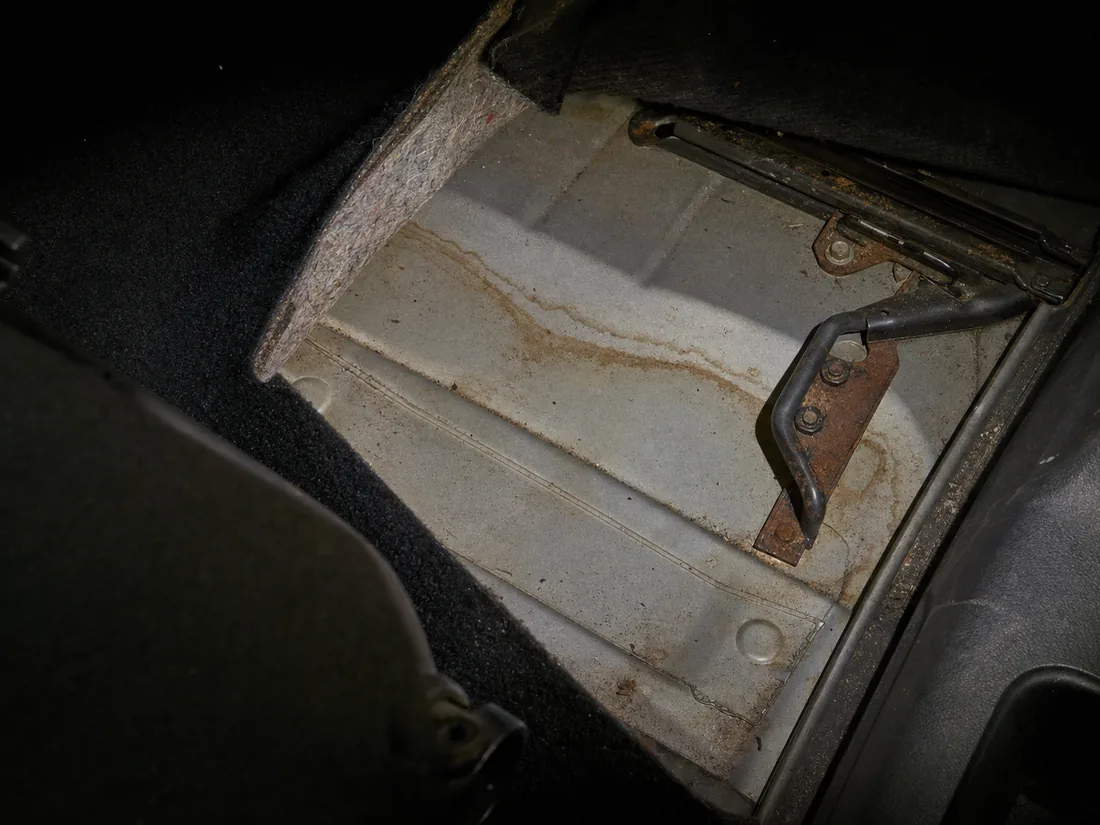
- 01Under the carpet — Peel back a corner of the carpet and the floor mats and look at the metal underneath for a silt line, water staining, or rust that has no business being there. Carpet that is newer than the car, or that does not match, is its own flag. (FTC and TxDMV)
- 02Seat bolts and console fixings — Rust on the seat-mounting screws, or marks showing the seats were unbolted and lifted — which is what somebody does to dry a carpet out. (TxDMV)
- 03The seat belts, fully extended — Pull each belt all the way out and read the webbing down its length. Fading and staining show near the spool end, which is the part nobody pulls out to look at. (TxDMV)
- 04The spare-tyre well — Lift the spare. Water pools in the well and it is routinely missed when a car is cleaned up for resale. (TxDMV)
- 05Glovebox, under-dash, boot — A waterline or dried mud in the places a cleaner does not reach. Under the dashboard is where the FTC and Florida’s agency both point first. (FTC and FLHSMV)
- 06Headlights and tail lights — Fogging inside the lens, or a horizontal water line across the reflector. Sealed units keep the evidence long after the interior has been shampooed. (FTC and TxDMV)
- 07The engine bay — Mud or dried residue in alternator crevices, behind wiring harnesses and relays, and in the recesses of the starter motor and power steering pump. (TxDMV)
- 08Wiring and connectors — Rusted components, water residue and corrosion on the electrical system — the damage that fails months later, not on the test drive. (TxDMV)
- 09The drain plugs — Rubber plugs under the floor and in the bottoms of the doors. Ones that look freshly removed or replaced were probably pulled to let floodwater out. (TxDMV)
- 10Underneath — Rust and flaking metal out of keeping with the car’s age and where it has lived. Both TxDMV and Florida’s agency put this in the same words. (TxDMV and FLHSMV)
- 11Your nose — Musty means water. Overwhelming air freshener or disinfectant means somebody would rather you did not notice the musty. (FTC and FLHSMV)
The two that catch the most people are the ones that take effort. Pulling a seat belt all the way out to its stop shows you webbing that has been sitting in a spool since the car was built — staining there is very hard to fake away. And lifting the spare wheel takes ten seconds and inspects a bowl that fills with water and gets forgotten.
What the checklist cannot do. The failure that matters most with a flooded car is electrical, and it is slow: corrosion working along a loom, in connectors, behind the dashboard, showing up as a fault months after the sale. TxDMV’s list ends on the wiring for that reason. An independent mechanic, which every one of the three agencies recommends, is the only version of this inspection that reaches those places — and it is worth more on a suspect car than any report you can buy.
What the free checks will and will not show
Before you pay anyone, use the free ones. The federal recall lookups and VIN decoder, the insurance-industry theft-and-salvage database, and a handful of state title checks all cost nothing, and we have written up exactly what each covers and where each one stops. Two limits matter especially here: the insurance database only knows about insured cars, and title-brand history — the part that would actually show a flood brand — comes from the federal NMVTIS database, which is paid.
One more thing worth knowing before you read too much into a brand. Florida states that vehicles are not inspected before being branded as a flood vehicle — the brand records a claim decision, not an engineer’s finding. It tells you what an insurer concluded, which is useful and is not the same as a condition report.
What the brand means where you are
“Flood title” is not one thing. The FTC’s consumer definition — “A “flood title” means the car has damage from sitting in water deep enough to fill the engine compartment.” — is a 2018 buying tip, and your state’s statutory test is what actually governs. North Carolina brands a vehicle partly submerged badly enough to damage the body, engine, transmission or differential, with no dollar threshold at all. California has no flood brand as such: water damage folds into “Salvaged.” Texas keeps flood under its salvage title with a flood notation on it.
We have all fifty checked against their own statutes and titling manuals, including whether each state carries an incoming brand forward or translates it into its own: flood title rules, state by state. That table is the answer to “but the title looks clean” in whichever state you are standing in.
If the flooded car is yours
Everything above is written from the buyer’s side of the bonnet, because that is who searches for it. If you are on the other side — the water came up, the car is yours, and you want to know what you may legally do with it — that is a different question with a harder answer, and it turns on whether an insurer was ever involved. We have written it separately: selling a flood- or storm-damaged car, including the paperwork, what has to be disclosed and who actually buys them.
Sources
- FTC — How to steer clear of a flood-damaged car — November 15, 2022; the FTC’s most recent flood-car guidance
- FTC — Don’t get swamped buying a flood-damaged car — October 30, 2018; water stains, masking smells, and the flood-title definition
- TxDMV Smart Buyer — Water Damage — September 2019; the most detailed of the three inspection checklists
- FLHSMV consumer advisory — flooded vehicles — the smell test, the overlooked places, and why an out-of-state flood car can carry a clean title
Related: what a flood brand means in all 50 states · the checks that cost nothing · the seller’s side of the same problem.