California title brands, in the state’s own words
California prints seven brands on a Certificate of Title. Rebuilt is not one of them, and neither is Revived Salvage — a repaired total-loss car keeps the brand it already has. Here is every brand the state issues, what puts it there, and the statute or agency page it was read from.
Last updated .
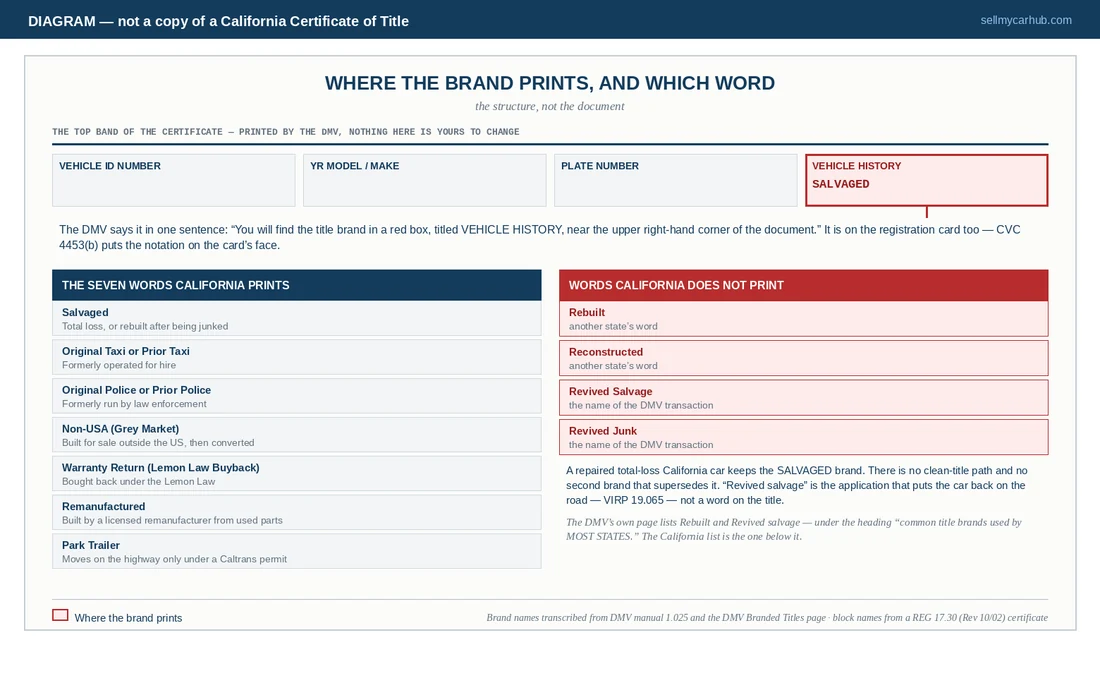
Where the brand is, and what it says
A brand is the line that records what happened to a car before you met it. California puts it in one place and the DMV states it in a sentence: “You will find the title brand in a red box, titled VEHICLE HISTORY, near the upper right-hand corner of the document.” It is not only on the title — CVC 4453(b) puts the notation on the face of the registration card too, so a car whose title you have not seen still shows its history on the paperwork in the glovebox.
The DMV adds that although California has indicated prior history on titling documents for many years, the information is now more prominently displayed on the latest revision of both the California Certificate of Title and the Salvage Certificate. Which means a car branded years ago may carry the notation somewhere less obvious than a current one does. If you are reading an older certificate and cannot find a red box, the history is still recorded — look for it in the printed detail near the vehicle description rather than concluding the car is clean.
The seven words California actually prints
Seven, and the list is shorter than most people expect. Salvaged: Vehicles marked with a “salvaged” brand were involved in an accident, or incurred considerable damage from another source, such as a flood or vandalism. This brand includes previously dismantled (junk) vehicles.
| Brand, as California prints it | What puts it there | Authority | Comes off? |
|---|---|---|---|
| Salvaged | A total loss salvage vehicle, and also a vehicle previously reported dismantled under CVC 11520 and later rebuilt. California collapses junk and salvage into this one printed brand. ↗ | CVC 4453(b)(1) and (b)(2); defined at CVC 544 | Permanent |
| Original Taxi or Prior Taxi | A motor vehicle formerly operated as a taxicab. ↗ | CVC 4453(b)(4) | Permanent |
| Original Police or Prior Police | A motor vehicle previously registered to a law enforcement agency and operated in law enforcement work. ↗ | CVC 4453(b)(3) | Permanent |
| Non-USA (Grey Market) | A motor vehicle manufactured outside of the United States and not intended by the manufacturer for sale in the United States. ↗ | CVC 4453(b)(5) | Permanent |
| Warranty Return (Lemon Law Buyback) | A vehicle reacquired by the manufacturer under California's Lemon Law, a vehicle with out-of-state titling documents reflecting a warranty return, or a vehicle another state has identified as requiring a warranty return title notation. ↗ | CVC 4453(b)(7); Civil Code 1793.23(c) | Permanent |
| Remanufactured | A vehicle constructed by a licensed remanufacturer from used or reconditioned parts. ↗ | CVC 4453(b) as implemented in VIRP 1.025 | Permanent |
| Park Trailer | A park trailer that, when moved upon the highway, must be moved under a Caltrans permit pursuant to CVC 35780. ↗ | CVC 4453(b)(6); Health & Safety Code 18009.3 | Describes current class |
Every row links the agency page or statute it was read from. Where the two disagree in emphasis they do not disagree in substance: the DMV’s procedures manual (section 1.025, written for its own staff) and its public Branded Titles page give the same seven, which is why they are recorded here as the state’s wording rather than one page’s phrasing.
California does not print “Rebuilt.” Nor “Revived Salvage.”
This is the part almost every page on the subject gets wrong, and the mistake is easy to make honestly, because it is sitting on the DMV’s own page. That page opens with a list headed common title brands used by most states — eighteen entries, including Rebuilt, Revived salvage and Revived junk. That list is about other states. The California list is the second one, headed the following brands are included on California Certificates of Title and DMV records, and it is the seven above. Read the first list as California’s and you will report brands the state has never issued.
So what happens to a California car that is totalled and then properly repaired? It keeps the Salvaged brand. There is no clean-title path, no “rebuilt” brand that supersedes it, and no point at which the notation ages off. What people mean when they say “revived salvage” is the application — the DMV transaction that puts the repaired car back on the road, set out at section 19.065 of the procedures manual, which defines it this way: “A revived salvage vehicle is a vehicle that was reported to DMV by the insurance company or owner as a total loss and has been restored to operational condition.” It is the name of a form-and-inspection process, not a word on the certificate.
The one thing that does remove the brand is not a repair at all. Where an insurer reported a total loss in error, the procedures manual allows the record to be corrected on a declaration signed under penalty of perjury by the claims manager responsible. That is a correction of a mistake, and it is the only route.
California sets no damage percentage
Buyers arrive at this question expecting a number, because plenty of states publish one — a percentage of the car’s value at which the brand becomes mandatory. California publishes none, and uses no total-loss formula either. CVC 544 makes it a judgment call by whoever is carrying the risk: a total loss salvage vehicle is one “wrecked, destroyed, or damaged, to the extent that the owner, leasing company, financial institution, or the insurance company… considers it uneconomical to repair the vehicle and because of this, the vehicle is not repaired.”
Two consequences worth holding on to. The same damage on the same car can be a total loss for one insurer and a repair for another, because the test is economic rather than structural — and a lightly damaged expensive car can escape a brand that a heavily damaged cheap one collects. And an unrecovered stolen vehicle is not a total loss salvage vehicle, whatever the insurer has paid out on it.
An out-of-state brand follows the car in
It does, and California is unusually clear about it where most states are silent. The procedures manual answers the question in the first line of the section, by naming nonresident cars alongside California ones: “DMV records and documents issued for a California or nonresident vehicle previously classified as a junk, salvage, police, grey market, taxi, warranty return, or currently classified as a park trailer must be marked with one of the following brands:”
The mechanism is worth understanding, because it is translation rather than transfer. California prints its own seven words, so a car arriving with another state’s “Rebuilt” or “Reconstructed” title is expected to land on the California list as Salvaged. The brand does not vanish at the state line and it does not arrive wearing its old name. A previously salvaged out-of-state car being registered for road use here must be referred to the California Highway Patrol for inspection; a car presented with a New York salvage certificate must be, specifically.
CVC 4453(b)(7) confirms the same thing from the statute side for one brand in particular, reaching out to “a vehicle with out-of-state titling documents reflecting a warranty return, or a vehicle that has been identified by an agency of another state as requiring a warranty return title notation, pursuant to the laws of that state.” It is also the only California brand whose printed wording the Legislature fixed: “The notation made on the face of the registration and pursuant to this subdivision shall state “Lemon Law Buyback.”” Every other word on the list is the department’s own, which is exactly why a search of the Vehicle Code for the word revived returns nothing at all.
Two things that are not brands, because the car gets no title
A seller or buyer runs into these words and reasonably assumes they are varieties of salvage. They are not, and the difference is final rather than technical: a Nonrepairable vehicle does not receive a branded title because it does not receive a title. A Nonrepairable Vehicle Certificate replaces the ownership document, and CVC 431 closes the door: a nonrepairable vehicle “has no resale value except as a source of parts or scrap metal,” and once declared, “cannot be titled or reregistered.” Three things put a car there — a surgical strip (completely stripped when recovered from theft), a complete burn, or an owner declared designation, which the manual describes as irreversible.
Nonrevivable junk is the same dead end by another route: a car worth $500 or less, abandoned, whose removal a peace officer or public-agency employee authorised. Once declared, it too cannot be titled or reregistered. If someone offers you either of these as a project car, the project cannot end in a registration.
Can you drive a salvaged car again?
Yes, and the requirements are more demanding than a repair. The car needs an identity inspection by the CHP or the DMV, a brake and light certificate or its electronic equivalent, smog where applicable, and — the one people are caught by — working airbags if it left the factory with them. CVC 5505 requires that a reconstructed vehicle “shall also be equipped with a supplemental restraint system in good working order that meets applicable federal motor vehicle safety standards and conforms to the manufacturer’s specifications.”
You must also be able to prove where the parts came from. The rebuilder or owner “shall have available, and shall present upon demand” bills of sale and invoices for the component parts — and the reason is blunt: if the CHP or DMV determines the vehicle or its parts were stolen, “the vehicle cannot be registered and the vehicle or parts will be seized.” Until the CHP certification and the paperwork are in, the department is barred from registering the car at all. Buying a half-finished rebuild means buying that evidentiary burden along with it.
What a dealer has to tell you — and what a private seller does not
These two duties are not the same, and the gap is where people get hurt. The dealer duty is in statute and specified down to the type size. CVC 11713.26 bars a dealer from displaying a used car at retail without first pulling a report from the National Motor Vehicle Title Information System. If that report shows the car is or has been junk or salvage, or the title carries a brand, the dealer must post this on the vehicle, in at least 14-point bold type with the word “Warning” in at least 18-point, on a red background of at least 4 by 5.5 inches, next to the FTC Buyer’s Guide:
WARNING According to a vehicle history report issued by the National Motor Vehicle Title Information System (NMVTIS), this vehicle has been reported as a total-loss vehicle by an insurance company, has been reported into NMVTIS by a junk or salvage reporting entity, or has a title brand which may materially affect the value, safety, and/or condition of the vehicle. Because of its history as a junk, salvage, or title-branded vehicle, the manufacturer’s warranty or service contract on this vehicle may be affected. Ask the dealer to see a copy of the NMVTIS vehicle history report. You may independently obtain the report by checking NMVTIS online at www.vehiclehistory.gov.
The dealer must also hand you the report itself on request before the sale. The exceptions are narrow: a car NMVTIS has no record of, where the dealer did try; and motorcycles, recreational vehicles and off-highway vehicles.
For private sales the DMV says only that “Sellers, including dealerships, are legally required to disclose a vehicle’s salvage title and history. However, this law is difficult to enforce, especially when a vehicle comes from another state.” That sentence is the department’s own characterisation and it cites no section — we looked and found none, so it is quoted here as the agency’s statement rather than presented as law. The practical reading is the one the DMV all but writes for you: check the car yourself. NMVTIS is public, it is the database the dealer would be required to search, and a private seller has no duty to search it for you.
What the brand costs, and what it does not
The fee is trivial and almost nobody knows it exists: CVC 9255.1 charges a two-dollar service fee on the initial issuance of a branded registration card, and exempts every subsequent transfer. The brand is not a recurring charge and it is not a penalty.
What it costs is resale, and that is not regulated at all. A branded car is worth less, insurers price it differently, and some lenders will not finance one — none of which appears in the Vehicle Code, because none of it is the DMV’s business. If you are holding one and deciding what to do with it, the arithmetic is the whole question, and it is a different question from this page: what a salvage or rebuilt title car is actually worth to a buyer.
Where the old DMV sheet went
If you followed a link to the DMV’s FFVR-33 fast-facts sheet, “Branded Titles — Look Before You Buy,” it is no longer published at that address. The department’s live replacement is its Branded Titles page, which carries the seven-brand California list quoted throughout this page. That is the official source and it is the one to link. This page exists because the official one answers what the brands are but not the questions that bring people to it — whether a brand comes off, whether an out-of-state brand follows the car, and what the damage threshold is.
Read at source on 2026-08-29 from the DMV’s Vehicle Industry Registration Procedures Manual, its public Branded Titles page, and the Vehicle Code text on the Legislature’s own site. Where the two agency sources could not settle a detail — whether the current certificate prints “Salvaged” or “SALVAGE” in capitals, for one — this page quotes the DMV’s spelling and does not assert the typography.