Selling a flood- or storm-damaged car
Whether you can sell it, and what you owe the buyer, turns on one thing — whether an insurer paid a claim. Both paths, from the statutes, including the case nobody writes about.
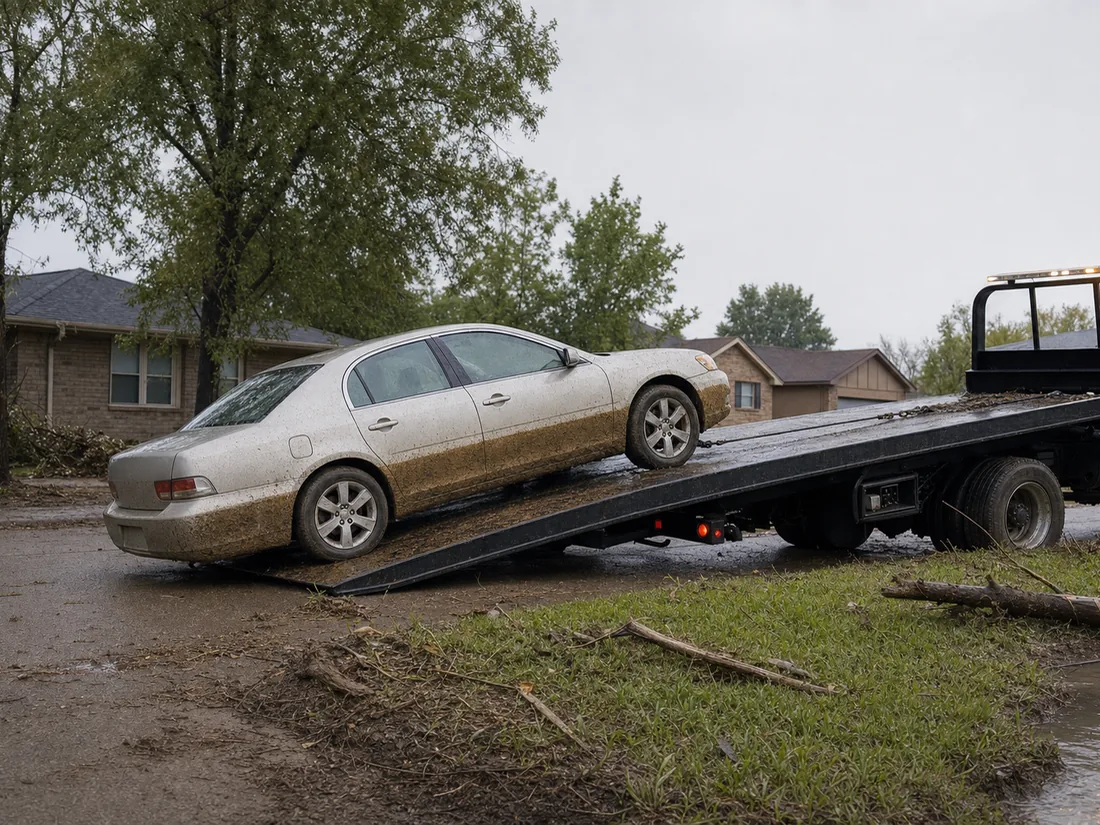
The fork is not the water. It is the claim.
- 2paths, and they barely overlap
- 5states checked for the no-claim case
- 11states checked on disclosure
- 20–40%the industry’s own guess at the hit
Everything about selling a flooded car turns on one question, and it is not how deep the water got. It is whether an insurance company paid out on it.
If an insurer totalled it and you kept the car, the branded title is issued to you, and until it arrives you generally cannot sell the car at all. Texas states the bar directly: the owner of a salvage or nonrepairable vehicle “may not transfer ownership of the motor vehicle by sale or otherwise” until the department has issued the salvage title. California requires the owner to obtain an endorsed salvage certificate before any sale or disposal. This is a hard legal bar, not paperwork you can catch up on afterwards.
If you never filed a claim — no comprehensive cover, or you decided not to claim — most published advice stops, and this is where the majority of our readers actually are. The honest answer is that several states still put a duty on you, because their salvage test is written around the vehicle’s damage rather than an insurer’s decision. North Carolina says so in as many words: a salvage motor vehicle is one whose repairs would exceed 75 percent of fair market retail value, “whether or not the motor vehicle has been declared a total loss by an insurer.”
No claim, no insurer: five states, read at source
These are the five whose statutes we read end to end for this exact fact pattern. They are not a survey of fifty, and we are not going to pretend otherwise — but they show how differently the duty is built, and between them they cover the shapes most other states use.
| State | What makes it salvage | What you must do | If you do not |
|---|---|---|---|
| California Veh. Code 544, 11515(c), (e), (g) | The owner considers the car uneconomical to repair. No percentage in the statute, and the owner's own judgment is listed first. | Forward the endorsed title and the plates to DMV within 10 days of the loss, then obtain a salvage certificate before any sale. | Failing to file is an infraction. Selling without the salvage certificate is a misdemeanor. |
| Florida Fla. Stat. 319.30(3)(a), 319.33(3) | Repair cost is 80% or more of what it would cost you to replace the car with one of like kind and quality. | Forward the title to the department within 72 hours of the car becoming salvage. | Knowingly taking money on a title the law required you to surrender is a third-degree felony. |
| Texas Transp. Code 501.091, 501.1002(b), 501.155 | “Damage” expressly includes flooding; the car is salvage when repairs would exceed 100% of its pre-damage value. | No deadline — but you may not transfer ownership at all until TxDMV issues the salvage title. Form VTR-441, $8. | Knowingly selling a salvage vehicle in breach is a Class C misdemeanor on a first offence. |
| Washington RCW 46.04.514, 46.12.600 | The owner's own determination that the vehicle is destroyed or uneconomical to repair, coequal with an insurer's. | Report the destruction and surrender the title marked DESTROYED within 15 days. | A gross misdemeanor from the 16th day, and again each day you still hold the title. |
| North Carolina G.S. 20-4.01(33), 20-71.4(a)(2) | Repairs would exceed 75% of fair market retail value — “whether or not the motor vehicle has been declared a total loss by an insurer.” | No title-surrender duty on an uninsured owner. The duty that bites is disclosure, in writing, before transfer. | Class 2 misdemeanor, plus civil liability under G.S. 20-348. |
Three things are worth pulling out of that table.
California’s clock is short and it starts at the water, not at your decision. The statute reads: “Whenever a total loss salvage vehicle is not the subject of an insurance settlement, the owner shall, within 10 days from the loss, forward the properly endorsed certificate of ownership or other evidence of ownership acceptable to the department, and the license plates” Ten days from the loss. And note what goes in with the title — the plates. California is ordinarily a state where plates stay with the car; a total-loss surrender is the exception.
Texas has no deadline, which is not the reprieve it sounds like. Nothing requires a Texas owner to file by any date. The restriction bites at the moment of sale instead, which is the moment you care about. Texas also writes flooding straight into the statutory definition of damage — “sudden damage to a motor vehicle caused by the motor vehicle being wrecked, burned, flooded, or stripped of major component parts” — while excluding gradual damage from any cause. A flood event counts; a slow seep does not.
Washington charges you for every day, and an old car does not escape it. Failing to report is “a gross misdemeanor… on the 16th day after the vehicle is destroyed and each day thereafter”. Washington does exclude older cars from the definition of “salvage vehicle” — but that carve-out decides whether a reissued title comes back branded, not whether you owe the department anything. The fifteen-day duty to report and surrender the title marked DESTROYED sits on the registered owner either way. The market-value threshold that matters is set by rule, not by the statute: $11,780 as of the current rule, where the statute still reads $6,790.
Two states we could not check, said plainly rather than left out. Oklahoma’s statute site served a bot challenge on every attempt and Indiana’s returned an empty JavaScript shell. Neither is a finding. If you are in either state, treat this page as silent about you and ring the agency.
What you have to tell the buyer
There is no federal duty. We looked at the three places one could live and it is in none of them: the federal odometer statement asks about mileage and the parties and nothing about damage; the FTC Used Car Rule reaches only dealers, at five or more vehicles in twelve months, and governs warranty disclosure anyway; and the federal NMVTIS rules impose reporting duties on states, insurers and salvage yards rather than on a seller.
So it is state law, and state law is genuinely all over the place. “You must disclose flood damage” is not a sentence anyone can publish honestly without naming the state. Here are eleven, read from their own codes:
| State | Who it binds | The rule | Penalty |
|---|---|---|---|
| New York Gen. Bus. Law 396-k(2) | Any seller | No person may knowingly sell a vehicle whose mechanical or electrical system was damaged by flood, fire or hurricane without first giving written notice of the damage, its nature and extent, and when and where it happened. | Class B misdemeanor |
| Massachusetts G.L. c.90 s.7N¼(8) | Private sellers, by name | A private seller must clearly disclose, before the sale, all known defects impairing the vehicle’s safety or substantially impairing its use. | Statutory remedies, alongside all other remedies |
| North Carolina G.S. 20-71.4(a)(2) | Any transferor | Unlawful to transfer a vehicle you know is or was a flood vehicle without disclosing it in writing beforehand. No age limit on this duty. | Class 2 misdemeanor plus civil liability |
| Illinois 625 ILCS 5/3-117.1 | Any person | Anyone who possesses or acquires a flood vehicle must apply for a title designating it a flood vehicle — a branding duty that reaches private individuals, not only dealers. | Per the vehicle code |
| Virginia Va. Code 46.2-1602 | Any person | Unlawful for any person, not merely a licensee, to sell a rebuilt vehicle without prior written disclosure on a form the Commissioner prescribes. | Per chapter 16 penalties |
| Florida Fla. Stat. 319.14(1)(c)8, (2) | Any person, but narrowly | No person may knowingly sell a flood vehicle without written disclosure. The catch: Florida defines a flood vehicle as one declared a total loss, so a flooded car no insurer ever totalled falls outside the definition. | Per s. 319.14 |
| Iowa Iowa Code 321.69, 321.69(9) | Any transferor, newer cars only | A damage disclosure statement is required from the transferor, private sellers included — but only for vehicles seven model years old or newer. | Per s. 321.69 |
| Kentucky KRS 186A.540 | Individuals, narrowly | The damage-disclosure duty expressly binds an individual as well as a dealer, but only for damage that happened while the car was in that seller’s own possession. | Per the statute |
| Minnesota Minn. Stat. 325F.6641 | Sellers generally, dealers on flood | The general damage-disclosure duty binds “the seller” but only at very severe damage. The flood-specific clause is dealer-only, and passes down to later sellers from there. | Per s. 325F.6641 |
| South Carolina S.C. Code tit. 56 ch. 19 | Nobody, on flood | Title 56, chapter 19 is insurer-reporting and title-branding only. We found no flood-disclosure duty on any seller, dealer or private. | — |
| Missouri Mo. Rev. Stat. 301.227 | Nobody, on flood | No flood-damage disclosure duty in the principal vehicle-title sections. The nearest comparable seller duty concerns junking certificates. | — |
New York is the broadest we found — “No person, firm or corporation shall knowingly sell” a vehicle whose mechanical or electrical system was damaged by flood or another natural disaster, without written notice first. Massachusetts is the clearest, because it is the only one that names you: “A private seller shall clearly disclose to any prospective buyer, before the sale, all known defects which impair the safety of the vehicle or which substantially impair its use.”
And Florida is the cautionary one. It bars any person from knowingly selling a flood vehicle without written disclosure — but it defines a flood vehicle as one declared a total loss. A flooded car that no insurer ever totalled sits outside the definition, which is precisely the case this page exists for.
“Sold as is” does not do what people think it does. Its legal effect is confined to implied warranties — the UCC provision every state has enacted excludes them where the buyer has examined the goods or refused to. That is all. It has nothing to say about concealing a known defect, and no state’s disclosure statute is switched off by writing “as is” on a bill of sale. If you know the car flooded, the honest sentence and the safe sentence are the same one.
What the damage does to the price
Nobody publishes a real number for this. There is no government figure, no academic figure, and the “up to 50, 60, 80 percent” claims that dominate search results trace back to articles with nothing underneath them. What does exist is an industry rule of thumb, and Kelley Blue Book states it plainly enough to be worth quoting as theirs: “A salvaged, reconstructed or otherwise “clouded” title has a permanent negative effect on the value of a vehicle. The industry rule of thumb is to deduct 20% to 40% of the Blue Book® Value, but salvage title vehicles really should be privately appraised on a case-by-case basis in order to determine their market value.”
Read that as what it is — a company’s rule of thumb, not a measurement, and one that comes with its own warning that these cars need individual appraisal. In practice the spread is enormous, because a car that took six inches on the carpet and a car that filled to the dashboard are the same brand on paper and completely different vehicles underneath.
Who actually buys a flooded car
Three routes, and which ones are open to you depends entirely on the fork at the top of this page.
A damage buyer. Companies that buy cars in any condition price on the car, not on the story, and a flood brand is an ordinary day’s work for them rather than a disqualification. If the car is unbranded and no claim was ever filed, this is usually the simplest route by a wide margin — and it is the one we handle.
A dismantler or scrap yard. Where the water reached the engine and the car is not worth reviving, its value is parts and metal. What paperwork that takes is state specific, and in the states that require a branded title before sale it is not a way around that requirement.
A retail buyer. Possible, generally the worst use of your time, and the one with real legal exposure attached. You are selling a car whose defining problem is invisible and shows up months later as electrical faults, to somebody who will find out. If you go this way, put the flood in writing and keep a copy.
Whichever you choose, the sequence is the same: work out which side of the insurance fork you are on, do the state filing if there is one, disclose in writing, and keep the paperwork. Every part of that is cheaper than the alternative.
Not sure whether the car crossed your state’s threshold, or whether an out-of-state brand follows it home? We have all fifty checked against their own statutes and titling manuals: flood title rules, state by state. And if you are on the other side of this — looking at a car and wondering — the eleven places to check are written up separately.
Sources
- N.C.G.S. 20-4.01 and 20-71.4 — the salvage definition that works without an insurer, the flood-vehicle condition test, and the transferor’s written-disclosure duty
- Cal. Veh. Code 544 and 11515 — the owner-judgment trigger, the ten-day no-settlement surrender, and the split between infraction and misdemeanor
- Fla. Stat. 319.30, 319.14 and 319.33 — the 80 percent uninsured total-loss test, the 72-hour duty, the flood-vehicle definition and the third-degree felony
- Tex. Transp. Code ch. 501 — flooding inside the statutory definition of damage, the bar on transfer before a salvage title issues, and the Class C first offence
- RCW 46.04.514, RCW 46.12.600 and WAC 308-56A-460 — the owner’s fifteen-day duty, the per-day gross misdemeanor, and the current $11,780 market-value threshold set by rule
- N.Y. Gen. Bus. Law 396-k — the broadest any-seller flood-disclosure duty found in any state
- Mass. G.L. c.90 s.7N¼ — the only statute found that names the private seller and states the duty in a single sentence
- Kelley Blue Book — values FAQ — the 20 to 40 percent industry rule of thumb, quoted as Kelley Blue Book’s own and not as a measurement
Related: what your state brands and what it does with an incoming brand · the buyer’s checklist · selling when the title is gone.