Most used-car checklists are a list of parts. This one runs in the order a careful buyer actually works: the paperwork that can end the deal in five minutes, then the outside of the car, the engine bay, the cabin, the drive, and last the mechanic. Every rule on it links to the regulation or agency that wrote it, and every price carries a date.
Last updated .
Ask for the title before you look at the car and put it next to the seller's ID; the names should match. A title signed by someone other than the seller and handed over blank is a skipped title, and it breaks the chain of ownership. Then look for a lienholder; Florida's motor vehicle agency explains that line: the lender's name is printed on the title next to the owner's and stays there until the debt is satisfied and a release is filed. If a lender is on it, the money has to go through them; how a sale with a loan actually closes is its own guide.
Match the VIN next. Texas's DMV tells buyers to confirm the VIN plate on the dash is present, secure and unaltered, and the same 17 characters should appear on the title, the door-jamb label and the insurance card. Our free VIN check decodes it; a decode that names a different engine or trim than the listing is a reason to stop.
Pull a title history before you drive anywhere; which tools are free is covered in free vehicle history report: what exists. A national title record is cheap: Texas's own Title Check starts at a couple of dollars as of September 2026. If it shows a salvage or rebuilt brand, read what those two words mean and do to value before you go further. The FTC's caveat: a history report can list accidents and flood damage but usually says nothing about mechanical condition.
Finally, the odometer. Federal law requires a written mileage disclosure at transfer. Under 49 CFR 580.5, the seller writes the reading on the title, signs it, and certifies one of three things: that the reading is the actual mileage, that it has passed the odometer's mechanical limit, or that it is not the actual mileage and should not be relied on. The statute behind it, 49 U.S.C. 32705, makes a false statement on that line a federal violation. Not every car gets one. 49 CFR 580.17 exempts vehicles over 16,000 pounds GVWR, model year 2010 and older cars once they are 10 years past their model year, and model year 2011 and newer cars only after 20 years. Check the number against age: the Federal Highway Administration's Table VM-1 puts 2023 average travel at 11,026 miles per year for short-wheelbase light-duty vehicles and 11,360 for long-wheelbase ones, so a seven-year-old car showing 30,000 miles needs a story, and the service records should tell it. Rollback statistics themselves are older and shakier than most articles admit.
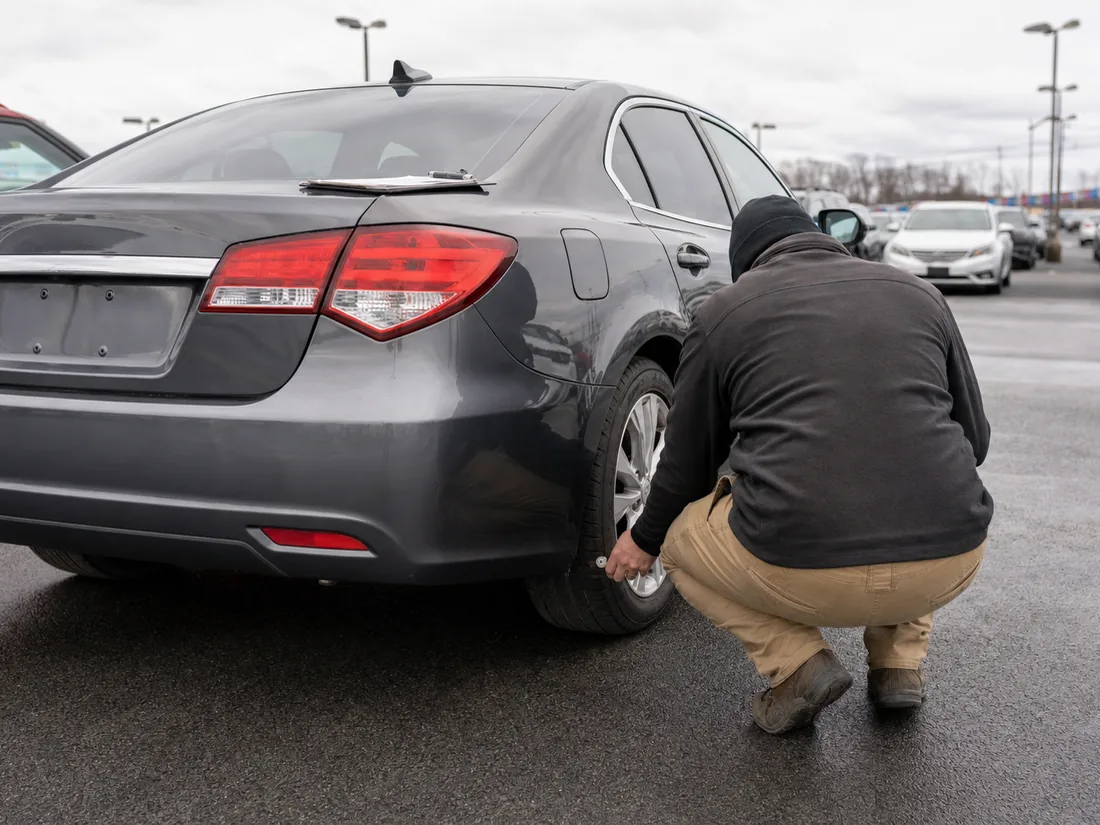
Do this on a dry car in daylight. Crouch and sight down each side: paint that changes shade between panels, a hood or trunk that sits higher on one side, door gaps that pinch at the top and open at the bottom, and overspray on rubber trim or under the hood latch all say a panel has been repainted or replaced. A repainted fender is normal on an older car; a repaired structure is not. Open every door and lift the trunk floor. Factory seam sealer is neat and slightly rough; body-shop sealer is smooth, lumpy or still smells.
Glass is quick. Pennsylvania's inspection code rejects a windshield with defects in the driver's acute vision area, or hazardous cracks anywhere that interfere with the driver's view, and a replacement is the seller's cost, not yours.
Tires are the most honest thing on the car, because nobody details them:
| Check | What you are looking for | What it tells you |
|---|---|---|
| Tread depth | Less than 2/32 inch in two adjacent treads is a rejection under Pennsylvania's inspection code | Four tires is a bill to subtract from the price |
| Wear pattern | Inside or outside edge bald, center bald, or scalloped blocks | Alignment, pressure neglect or worn suspension |
| Age | The DOT stamp's final four digits give the week and year of manufacture, so 0109 is the first full week of 2009 | Deep tread on a very old tire is still a very old tire |
| Matching | Same size and construction on each axle; the same code fails mismatched tires on one axle and exposed cord anywhere | One odd tire often means one repaired corner |
While you are down there, check each rotor through the spokes for a deep lip or scoring and the inside of each wheel for wet brake fluid. The tire guide covers pressure, rotation and age.
Open the hood with the engine cold, which means asking the seller not to warm it up for you; a cold start tells you about the battery, the starter and any rattle that fades after a few seconds. Pull the oil dipstick and the coolant cap. Oil that looks like coffee with milk, or coolant with an oily film, points to a head gasket or oil cooler letting the two mix, and that is a walk-away on most cars. Brown, gritty transmission fluid with a burnt smell is the same message from the gearbox. All seven fluids, and what each should look like, are in their own guide.
Then look for what does not match. A spotless engine bay on a car with 120,000 miles was cleaned for a reason, and a pressure washer hides a leak. One shiny part among dirty ones, a different style of hose clamp, fresh silicone at a gasket or tape on a harness are recent work the seller should explain and have a receipt for. Read the battery's date sticker, check the terminals for crust, and squeeze the radiator hoses, which should be firm, not crunchy or mushy.
Look at the strut towers and the frame rails ahead of the front wheels for kinks, fresh undercoating or welds, the marks of a front-end hit repaired well enough to sell. Silt in the seams, a musty smell or corrosion high on unpainted brackets are flood marks, and the eleven places to look for those get a page of their own.
Turn the key to on without starting the engine and watch the cluster. Every warning lamp should light for a bulb check, then go out once the engine is running. A lamp that never lights is the tell for a pulled bulb; airbag and ABS are the usual victims. A check engine lamp that is off proves less than people think. Texas's inspection program spells out why: a battery disconnect or a code clear puts the monitors back to Not Ready until the car has been driven through a full drive cycle, and for 2001 and newer vehicles the state fails the test when two or more non-continuous monitors read Not Ready. A cheap OBD-II scanner shows readiness in seconds; no codes and half the monitors not ready means a recent reset, so ask why.
Then press every switch: windows, locks, mirrors, seat motors, heat and then air conditioning for long enough to get cold, wipers, horn, every exterior light with a friend outside, and the backup camera. Lift the floor mats and press the carpet for damp. Compare wear with the odometer: a shiny wheel, a worn-through seat bolster and a smooth brake pedal on a car claiming 40,000 miles is the mismatch that sends an inspector back to the title.
The FTC's advice is to drive on hills, on highways and in stop-and-go traffic; a slow loop of the seller's street proves nothing. Take the car cold, radio off, windows down for the first mile so you can hear it.
Park with the engine idling and look underneath for drips. Then shut it off and restart it warm; a hot-start stumble is a different fault from a cold one.
Everything above happens without a lift; a pre-purchase inspection puts the car on one. AAA's guidance, updated February 2026, puts it at $100 to $250 for a professional inspection; Consumer Reports, in a piece updated March 2026, calls it worth the $100 to $150. For scale, the FTC's November 2016 brochure said about $100, so the figure has drifted up but not far.
Ask what is included. The FTC draws a line worth knowing: a safety inspection looks for conditions that make a car unsafe, not for its reliability, so a fresh state sticker is not a PPI. You want every seal and bushing looked at, every module scanned, and a written report. The FTC says that report should carry a cost estimate for every needed repair plus the make, model and VIN, and AAA's advice is the same: get the fixes and their costs in writing.
Dealers have to accommodate this; the FTC's guidance on one who refuses is blunt: consider going to another dealer. If insurance rules keep the car on the lot, a mobile inspection service can come to it. A private seller who refuses is telling you the same thing. Settle who owes any emissions test, too. California, for one, requires the seller to hand the buyer a valid smog certification at sale, and as of September 2026 the only age carve-out at sale is a car under four years old, where the buyer pays a smog transfer fee instead. The same page exempts 1975-and-older gasoline models and electrics from the inspection at registration. Who owes the inspection in each state is tabulated separately.
The rules change with the seller. The FTC's Used Car Rule covers any seller who moves six or more used cars in a year and requires a Buyers Guide on every used car offered. That form states whether the car is sold as is or with a warranty and what share of repairs the dealer pays, and it overrides anything in the sales contract, so a promise not written on it is not a promise. Maine and Wisconsin are exempt from the federal rule and use their own form.
None of that reaches a private party. In the FTC's words, private sellers are generally not covered by the Used Car Rule, private sales usually fall outside the implied warranties of state law, and the deal is as is unless your written agreement says otherwise. What you do have is the contract, so put the mileage, the price, the as-is term and any repair the seller agreed to make on the bill of sale.
| Item | Dealer | Private seller |
|---|---|---|
| Buyers Guide | Required on every used car | Not required |
| Warranty | As is, or as stated on the Guide | Usually as is; only your written contract binds |
| Odometer statement | Federal disclosure required | Federal disclosure required |
| Title transfer | The dealer files it | You file it; Texas gives buyers 30 days from the date of sale |
Use the inspection sheet, not the asking price, as your starting point. The FTC's suggestion is exactly that: take the estimated repair costs into the price negotiation. Rank the findings. Tires below the tread line, brakes near the end, a timing belt that is due and any active leak come off the price in full, because they are due now. Cosmetic marks and wear that matches the mileage are not discounts, and asking for them weakens the real ones. Two findings end the conversation rather than lowering the number: a title that does not match the seller or the VIN, and structural or flood repair the seller did not disclose.
Then keep the report. Everything you just did to this car is what the next buyer will do to you, and the seller who passes that inspection is the one with a folder of receipts, a mileage line that matches the service history, and nothing surprising under the hood. Cars that would fail this list still sell. They sell to buyers who price the problems in and take the car as it sits.
AAA's February 2026 guidance puts a professional pre-purchase inspection at $100 to $250, and Consumer Reports' March 2026 figure is $100 to $150. The FTC's older brochure said about $100, so the price has climbed but stayed modest. The shop, the region and the car move it within that band. Ask up front what the inspection includes and whether the report will list repair estimates with the VIN on it.
No. The FTC's own guidance says a history report may list accidents and flood damage but typically will not list mechanical problems, and that a report is not a substitute for an independent inspection. A clean report tells you nothing about a leaking rear main seal or a transmission that flares between gears. Use the report to rule cars out, and the mechanic to rule one in.
Generally no. The FTC's Used Car Rule reaches dealers, meaning anyone selling six or more used cars a year, and private sellers sit outside it, so there is no Buyers Guide. Private sales usually fall outside state implied warranties too, which makes them as-is by default. What binds a private seller is the written agreement, so put the mileage, price and any promised repairs on the bill of sale.
For most cars, yes. Federal regulation 49 CFR 580.5 requires the seller to disclose the odometer reading on the title at transfer, sign it, and certify whether the reading is actual, exceeds the mechanical limit, or is not the actual mileage. Under 49 CFR 580.17, model year 2010 and older cars are exempt once they are 10 years past their model year, and model year 2011 and newer cars only after 20 years.
Yes, because it usually means the codes were cleared recently. Texas's inspection program explains that disconnecting the battery or clearing codes resets the readiness monitors to Not Ready until the car completes a drive cycle, and for 2001 and newer vehicles two or more not-ready monitors fail the emissions test. A car with no codes and several monitors not ready deserves a direct question about what was erased and why.