Free VIN check: what the car is, and its open recalls
Every “free VIN check” site runs the same play: the lookup is free, the answer costs $15 to $85 at a checkout. This one is the other kind of free — your browser asks the federal database directly, and what NHTSA knows is what you see.
Last updated .
No car handy? Run the example VIN — a 2003 Accord with a recall history worth reading.
Nothing you type is sent to us or stored anywhere — the request goes from your browser to vpic.nhtsa.dot.gov and api.nhtsa.gov, the government’s own endpoints, and the answer comes straight back to this page.
What this checks, and what no free tool can
The decode tells you what the manufacturer registered the VIN as — year, make, model, trim, engine, where it was built — which is how you catch a listing whose title says one car and whose VIN says another. The recall list is the money part for a seller: an open campaign is free value you can add before listing, and a buyer who finds it first will use it against your price. What “free repair” actually covers has a limit, and it is not the one most pages state. What no free tool shows is accident and title history: that lives in NMVTIS, sold only through the approved providers the Department of Justice lists by name — anyone offering that data “free” is selling you something else.
How it works
Two public NHTSA endpoints, called straight from your browser: the vPIC decoder (vpic.nhtsa.dot.gov) turns the VIN into the vehicle’s build record, then the recalls API (api.nhtsa.gov) returns every campaign filed against that make, model and year. Both are public-domain federal services; we add nothing to the data and see none of it. The same queries typed into those sites by hand return the same answers — this page just saves the typing and reads the result back in order.
What each of the 17 characters is
A VIN is not a serial number with decoration around it. Every position is specified in federal regulation, so the same character means the same thing on a Kia and a Kenworth. Once you can read the positions you can sanity-check a listing in about ten seconds, without any tool at all.
| Position | Section | What it holds |
|---|---|---|
| 1–3 | World Manufacturer Identifier | Identifies the manufacturer and the type of vehicle. A 9 in position 3 is not a manufacturer code at all — it is the flag that says this builder is small enough to need a six-character identifier, so positions 12–14 finish the job of naming them. |
| 4–8 | Vehicle descriptor | The attributes: make, line, series, body type, engine type, and — for cars and light trucks — every restraint device and where it sits. The manufacturer chooses the coding, but it must be decipherable from what they file with NHTSA. |
| 9 | Check digit | A checksum over the other sixteen characters. Always 0–9 or the letter X. This is the one that catches a fake. |
| 10 | Model year | One character, on a 30-year cycle. The table below, and the trick for telling 1994 from 2024. |
| 11 | Plant | The assembly plant. Our example VIN comes back Marysville, Ohio — if a seller says the car is an import, this position disagrees. |
| 12–17 | Serial | The number the plant assigned in production order. For cars and light trucks the last five characters are always numeric, which is a quick tell on its own. |
A VIN never contains I, O or Q. The rule spells out the permitted set — ABCDEFGHJKLMNPRSTUVWXYZ and 0–9 — and those three letters are left out because they are too easy to read as 1 and 0. If what you are looking at has one, you are reading a handwritten transcription error, or something worse. Every one of the seventeen spaces must be filled; a VIN with a blank is not a VIN.
Position 10: reading the model year
The year character repeats every thirty years, so on its own a P means 1993 or 2023. The tiebreaker is position 7: on cars and light trucks, if it is a number the year is in the 1980–2009 half of the cycle, and if it is a letter the year is 2010 or later. Our example VIN has a 2 in position 7 and a 3 in position 10 — a number, so 2003, and the federal decoder agrees.
| Code | If position 7 is a number | If position 7 is a letter |
|---|---|---|
| A | 1980 | 2010 |
| B | 1981 | 2011 |
| C | 1982 | 2012 |
| D | 1983 | 2013 |
| E | 1984 | 2014 |
| F | 1985 | 2015 |
| G | 1986 | 2016 |
| H | 1987 | 2017 |
| J | 1988 | 2018 |
| K | 1989 | 2019 |
| L | 1990 | 2020 |
| M | 1991 | 2021 |
| N | 1992 | 2022 |
| P | 1993 | 2023 |
| R | 1994 | 2024 |
| S | 1995 | 2025 |
| T | 1996 | 2026 |
| V | 1997 | 2027 |
| W | 1998 | 2028 |
| X | 1999 | 2029 |
| Y | 2000 | 2030 |
| 1 | 2001 | 2031 |
| 2 | 2002 | 2032 |
| 3 | 2003 | 2033 |
| 4 | 2004 | 2034 |
| 5 | 2005 | 2035 |
| 6 | 2006 | 2036 |
| 7 | 2007 | 2037 |
| 8 | 2008 | 2038 |
| 9 | 2009 | 2039 |
Position 9 is a checksum, and it catches invented VINs
Position 9 is not information about the car. It is arithmetic over the other sixteen characters, and it only comes out right if every one of them is right. That makes it the fastest test there is for a VIN somebody typed wrong — or made up.
The method is in the regulation. Give each character a value: digits are worth themselves, and letters take the values A–H = 1–8, J K L M N = 1 2 3 4 5, P = 7, R = 9, S–Z = 2 3 4 5 6 7 8 9. Multiply each by its position weight — 8 7 6 5 4 3 2 10 0 9 8 7 6 5 4 3 2 — add the products, and divide by 11. The remainder is the check digit, and a remainder of 10 is written as X.
On the example VIN, 1HGCM82633A004352, the products add to 311. 311 divided by 11 is 28 with 3 left over, so the check digit must be 3 — and position 9 of that VIN is a 3. It passes. (The regulation shows its own worked example, on a different VIN, adding to 411 with a remainder of 4 and a check digit of 4.)
Worth knowing what this does and does not prove. A VIN that fails the check digit is definitely wrong. A VIN that passes is only well-formed — someone copying a real VIN off another car of the same model produces a number that passes every arithmetic test in the world. That is what the title and the door-jamb sticker are for.
Where the VIN is, and what a mismatch means
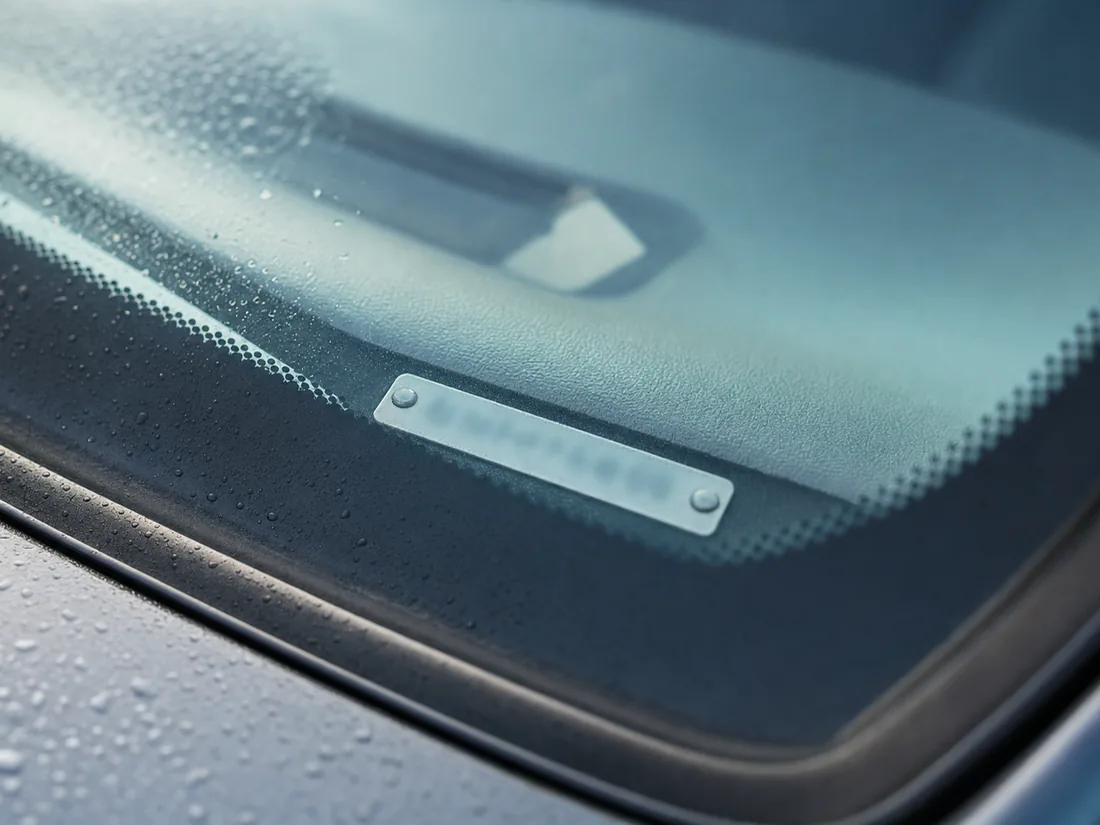
Federal rule requires the VIN on cars and light trucks to sit inside the passenger compartment and be readable from outside the car, through the glass, in daylight, by someone with ordinary eyesight standing at the left windshield pillar — characters at least 4 mm tall. That is why the dash plate exists and why it faces out. You will find the same number on the driver’s door-jamb sticker, the title, the registration and the insurance card.
All of them should match, character for character. If the dash plate and the door sticker disagree, stop — that is a salvage rebuild, a clerical error on a title, or a stolen car, and none of the three is yours to sort out at the kerb. If the title and the dash disagree by a single character, that is usually a typo at the counter, and it is fixable: most states have a correction affidavit for exactly this, and we keep every state’s form with a filled-in example.
The recall rule nobody states correctly
Almost every page on this subject says recall repairs are free forever. They are not, and the real rule is worth knowing before you drive to a dealer.
Federal law requires the manufacturer to fix a safety defect at no charge — but not if the first purchaser bought the vehicle more than 15 calendar years before the recall was announced. For tires the window is 5 years. Two details in that sentence do a lot of work:
- The clock stops when the recall is filed, not today. A 2003 car with a campaign announced in 2016 is inside the window and stays inside it — the repair is still free in 2026. Age alone never disqualifies a car.
- It follows the car, not the buyer. The 15 years run from the first purchaser. You do not need to be that person, you do not need a receipt, and buying the car used changes nothing.
So the useful question is never “is the car too old” — it is “when was this campaign announced.” The checker above lists the campaign numbers; the dealer can confirm from the number whether the repair is still covered, and can also tell you whether it was already done on this particular car, which the public list cannot.
Where this tool stops
| What you want | Where it lives | Cost |
|---|---|---|
| What the car is | NHTSA’s vPIC decoder — the manufacturer’s own filing | Free. The tool above calls it. |
| Open safety recalls | NHTSA’s recall database, by make, model and year | Free. The tool above calls it. |
| Title brands, odometer readings, total-loss and salvage records | NMVTIS, the federal title system, through the providers the Department of Justice approves and names | Paid. The Anti-Car Theft Act requires the system to fund itself from user fees, so there is no free door. |
| Accident history, service records, prior owners | Commercial reports — assembled from insurers, body shops and auctions, not from any government file | Paid, and no government source holds this at all. |
The two free rows are what this page does, and it does them without an email box. If what you are after is the bottom two rows — the thing people mean when they say “history report” — we have written up what a free vehicle history report can and cannot contain, including the checks worth running before you pay for anything.
Related: why there is no free version of this for license plates · the mileage check no decoder can do · what a flood brand means in your state.