The dealer's trade-in number and the price a private buyer would pay are both real, and the gap between them is not a trick. It is reconditioning, overhead, margin and risk, and in most states a sales-tax credit closes part of it. Here is how the offer is built from the auction floor up, which states give the tax credit and which do not, a worked example, and where instant online offers fit.
Last updated .
Every dealer who takes your car has two ways to get rid of it: recondition it and sell it off the lot, or run it through a wholesale auction. The auction is the floor under every trade-in offer. If the appraiser cannot see a way to retail your car for more than the auction would pay, the offer is the auction price less the cost of getting it there.
That auction price is not a mystery. Cox Automotive publishes the Manheim Used Vehicle Value Index, built by applying statistics to more than 5 million wholesale transactions a year, adjusted for mix, mileage and season, with January 1997 set to 100. As of August 2026 it stood at 208.2, up 0.4% on a year earlier and down 0.9% from July.
Now stack the dealer's costs on that floor. Reconditioning comes first; a 2016 Cox Automotive dealer briefing said an automatic-approval threshold of $600 to $800 per car is common. Then inspection, detailing, lot time, commission and margin. Kelley Blue Book, which publishes both figures, says its trade-in number will usually sit below its private-party number because the reselling dealer pays for reconditioning, safety inspections and other costs of doing business.
The trade-in is also the dealer's cheapest supply line. NADA's 2025 data shows franchised dealers sourced 45.4% of the used cars they retailed from trade-ins on new-car sales and another 23.6% from trade-ins on used-car sales, against 21.9% bought at auction. A trade skips the buyer's fee, transport and bidding, which is why a dealer will sometimes pay a little over auction: it is still cheaper than buying the same car at Manheim.
A private buyer pays more than the auction and less than the dealer's window sticker, and the reason is what they do not get. A dealer that sells more than five used vehicles in a 12-month period must post the FTC's Buyers Guide on every car, stating whether it comes with a warranty or as-is. Your buyer gets no guide, no financing desk, no return window and no reconditioning, and the lower price is what they are paid for taking that on.
How much lower depends on the car, not on a rule of thumb. Consumer Reports' April 2025 selling guide says a trade-in typically yields less than selling to an individual, and Kelley Blue Book says the same about its own values, but neither publishes a fixed spread. What the sources do fix is where the two ends sit. NADA puts the average retail price of a used car at a franchised dealer at $28,680 in 2025, and Cox Automotive's mid-2026 report has average used listing prices back near $27,000. Everything between the auction and those numbers is reconditioning, overhead and margin; a private sale lets you keep a slice of it.
Two things set the size of the slice. Reconditioning is close to a fixed cost, so it eats a bigger share of a $5,000 car than of a $25,000 one, and the percentage gap is widest on old, high-mileage cars. And depth of demand matters: a clean, common, late-model car has a deep private market, while an odd trim, a branded title or a known fault has a thin one, and thin markets push private prices back toward wholesale.
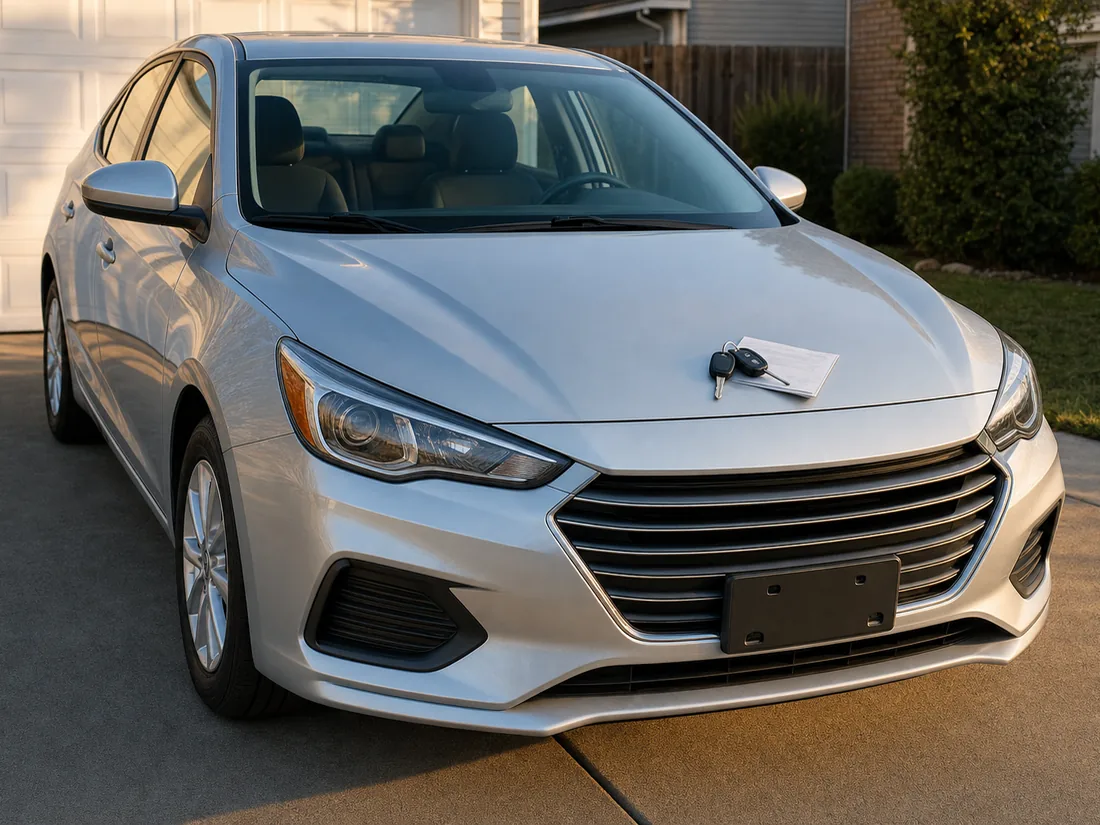
This is the piece the private-sale side leaves off the scale. Most states that tax vehicle sales tax only the difference between the new car's price and your trade-in allowance. Texas says it in one line: 6.25 percent of the sales price, minus any trade-in allowance. Illinois capped the credit at $10,000 during 2020 and 2021, then dropped the cap for sales from January 1, 2022. Michigan Treasury's 2026 reciprocity table for out-of-state buyers lists state after state as 100% trade-in allowed.
The exceptions as of September 2026:
| Where | What happens to the trade-in | Rate |
|---|---|---|
| California | No credit. The CDTFA's dealer guide says you cannot deduct the allowance for the trade-in: sell a $20,000 car against a $4,000 trade and tax is due on $20,000. | 7.25% state rate |
| Virginia | No credit. The DMV's gross sales price does not include credit for trade-ins; a $40,000 car with a $5,000 trade is taxed on $40,000. | 4.15% |
| District of Columbia | No credit possible. The excise tax is fair market value times an mpg-based percentage, not what you paid. | Varies by weight and mpg |
| Hawaii | No credit. The general excise tax is imposed on the gross income of the business and may be passed on to you; Michigan's table lists Hawaii as no trade-in allowed. | 4% state rate |
| Michigan | Capped. For 2026 the credit is $12,000 or the agreed-upon value, whichever is less. The statute raises the cap $1,000 each January and removes it in the year the figure passes $14,000, which works out to January 1, 2029. | 6% |
| Kentucky | New cars only. The usage-tax page grants the allowance when purchasing new vehicles, dated July 1, 2014. | 6% |
| Ohio | New cars only. Trade against a used car and the allowance does not reduce the taxable price. | 5.75% state rate |
| Rhode Island | Limited. The allowance covers cars, motorcycles and motor homes; trade in a pickup or anything else and it earns nothing. | 7% |
Each row is checked against the jurisdiction's own page, except that Hawaii's status rests on Michigan Treasury's 2026 reciprocity table and DC's follows from its value-based tax; the California, Hawaii and Ohio rates also come from Michigan's table. Maryland, which some lists put among the no-credit states, belongs on neither side. Its excise tax is 6.5% as of July 1, 2025, and the statute defines total purchase price as the agreed price less an allowance for trade-in. The five no-sales-tax states have nothing to credit; see the tax guide.
The numbers below are illustrative, realistic for a five-year-old mid-priced sedan; put your own figures in the same slots.
| Door | Cash for the car | Tax saved | Your costs | Net to you |
|---|---|---|---|---|
| Trade in at the selling dealer | $12,000 | $720 | $0 | $12,720 |
| Instant offer, redeemed as a trade where you buy | $12,600 | $756 | $0 | $13,356 |
| Instant offer, taken as cash | $12,600 | $0 | $0 | $12,600 |
| Private sale | $14,500 | $0 | $240 | $14,260 |
In a credit state the private sale clears the dealer's trade by $1,540 and the best instant offer by about $900. That is the wage for the hours of photos, messages, no-shows, test drives and the title counter, and for carrying the payment risk described below. Move the same car to California or Virginia and the tax column goes to zero for everyone: the private sale now beats the trade by $2,260, and the dealer's offer has nothing propping it up.
The general rule falls out of the table. A private sale wins when the price you can close, minus your selling costs, exceeds the trade-in offer multiplied by one plus your tax rate. At 6% and a $12,000 offer, a private buyer has to pay you more than $12,720 plus your costs before you have earned a dollar for your trouble.
Negative equity. If the payoff exceeds the car's value, a private buyer cannot simply hand you a check; the lien must clear first, and the shortfall is yours to fund in cash. A dealer will fold it into the new deal. The CFPB's June 2024 study, drawn from nine lenders' portfolios, found that between 2018 and 2022 11.6% of vehicle loans carried negative equity rolled in from the previous car, with a mean of $5,073 on new-car deals and $3,284 on used. The trade-in wins on mechanics, not on price; the CFPB's own guidance says rolling the balance forward makes the new loan more expensive. If you can cover the gap in cash, selling with a loan still lets you take the private price.
Cheap old cars. On a $3,500 car the percentage gap is large and the dollar gap is small, and the cheap-car buyer pool is where most of the no-shows and bad checks live. Seller obligations bite hardest here: in California the seller must give the new owner a valid smog certification, so a car that will not pass costs you a repair before it earns you a sale, while a dealer takes it as it sits and prices the repair into the offer.
Promotions. "Push, pull or drag it in for $3,000" is a discount wearing a trade-in costume. California's dealer guide even has a rule for the overallowance, a trade credit above the car's real value: the excess cannot be treated as a discount or otherwise deducted. The tell is the new car's price, which will not have moved. Compare the out-the-door total with the same car and no trade, then ask whether the inflated trade number beats the tax credit and a private sale together. Sometimes it does, especially when the manufacturer is funding the bonus.
Private wins on a car that is paid off or close to it, common enough to have many buyers, clean enough to need no reconditioning, and in a state where the tax credit is small or missing. It wins by more on a car dealers dislike: a manual transmission, an unusual color, a model with an enthusiast following that a franchised store would send straight to auction.
The risk is concentrated in one moment, the payment. The FTC's guidance is blunt: fake checks can take weeks to be discovered, and when one bounces the money you forwarded is yours to repay. A buyer who sends too much and asks for the difference back is running a scam every time. Take payment inside the buyer's bank, as a cashier's check drawn while you watch or a wire you confirm has landed before you sign the title. Meet in daylight at a police exchange zone; Montgomery County, Maryland has run one since 2017 at each of its six district stations, though officers there will not act as witnesses.
The paperwork is the other cost, and it is state-specific: a bill of sale, a release of liability filed the same day, a notary in some states and an inspection or emissions certificate in others. None of it is hard. All of it is time the dealer was charging you for.
Instant offers from Kelley Blue Book, CarMax, Carvana and the rest are dealer-side offers delivered to your phone. Kelley Blue Book says its tool weighs dealer sales data, auction prices and local private listings, and that most offers land inside its trade-in range, which sits below its private-party value. Their worth is not that they beat a private sale but that they are in writing. The Instant Cash Offer is valid for 7 days and redeemed at a participating dealer after an inspection; participating dealers are required to honor it if what you declared checks out. CarMax's online offer takes two minutes or less and is valid for seven days, and since November 2025 an associate will verify it in your driveway and collect the car.
Get two or three instant offers before you set foot in a showroom. Take the best one to the dealer's trade desk; the appraiser now has to beat a number instead of anchoring you to one. If you redeem the instant offer at a dealer you are buying from, it becomes a trade-in and picks up the tax credit in the states that give one. And if you sell privately, the best instant offer is your reserve price: the moment a buyer's best number, minus your costs, drops below it, stop negotiating and take the sure thing.
The trade-in number and the private price are the same car measured at two points between your driveway and its next owner. Most of the difference is labor and risk, and the only question is whose.
So run the arithmetic once with your own numbers: the best written offer, the tax credit your state actually gives, an honest private price and the hours you have. If the private sale clears the trade by a few hundred dollars, the dealer is paying you fairly to skip it. If it clears by a couple of thousand, that is a good wage for a weekend. Decide on the number, not the appraiser's story, and decide soon; the car is losing value every month you spend choosing.
Selling privately usually pays more, because a trade-in offer starts at wholesale and subtracts reconditioning, overhead and margin. Whether the extra is worth it depends on your state's sales-tax credit, your loan and your time. The break-even: the private price minus your selling costs must beat the trade offer multiplied by one plus your tax rate. Below that line the dealer is paying you to skip the work; above it, you are being paid for a weekend.
In most states, yes. Texas, for example, taxes 6.25 percent of the price minus the trade-in allowance. California, Virginia, the District of Columbia and Hawaii give no credit at all. Michigan caps it at $12,000 for 2026, with the cap ending in 2029. Kentucky and Ohio allow it only on new-car purchases, and Rhode Island excludes trucks. Those rules are as of September 2026 and are linked to each state's own page above.
The appraiser starts from the wholesale auction value, which the Manheim index tracks from more than 5 million transactions a year, then subtracts reconditioning, transport, lot time and margin. A 2016 Cox Automotive briefing put a common reconditioning baseline at $600 to $800 per car. Because trade-ins supplied about 69% of the used cars franchised dealers retailed in 2025, a dealer may pay slightly above auction rather than lose the car.
Yes. The dealer pays the lender from the deal and applies whatever is left to the new car. If the payoff exceeds the offer, the difference is negative equity, and the CFPB found 11.6% of vehicle loans written from 2018 to 2022 carried it forward, averaging $5,073 on new-car deals. The CFPB warns that rolling it in makes the new loan more expensive, so bring cash for the gap if you can.
They are real, written and time-limited. Kelley Blue Book's Instant Cash Offer is valid for seven days and redeemed at a participating dealer after an inspection; CarMax's online offer takes about two minutes and holds for seven days. Kelley Blue Book says most of its offers land inside its trade-in range, below its private-party value, so do not expect one to beat a private sale. Their job is to make the dealer's appraiser beat a written number and to set your reserve price if you sell on your own.