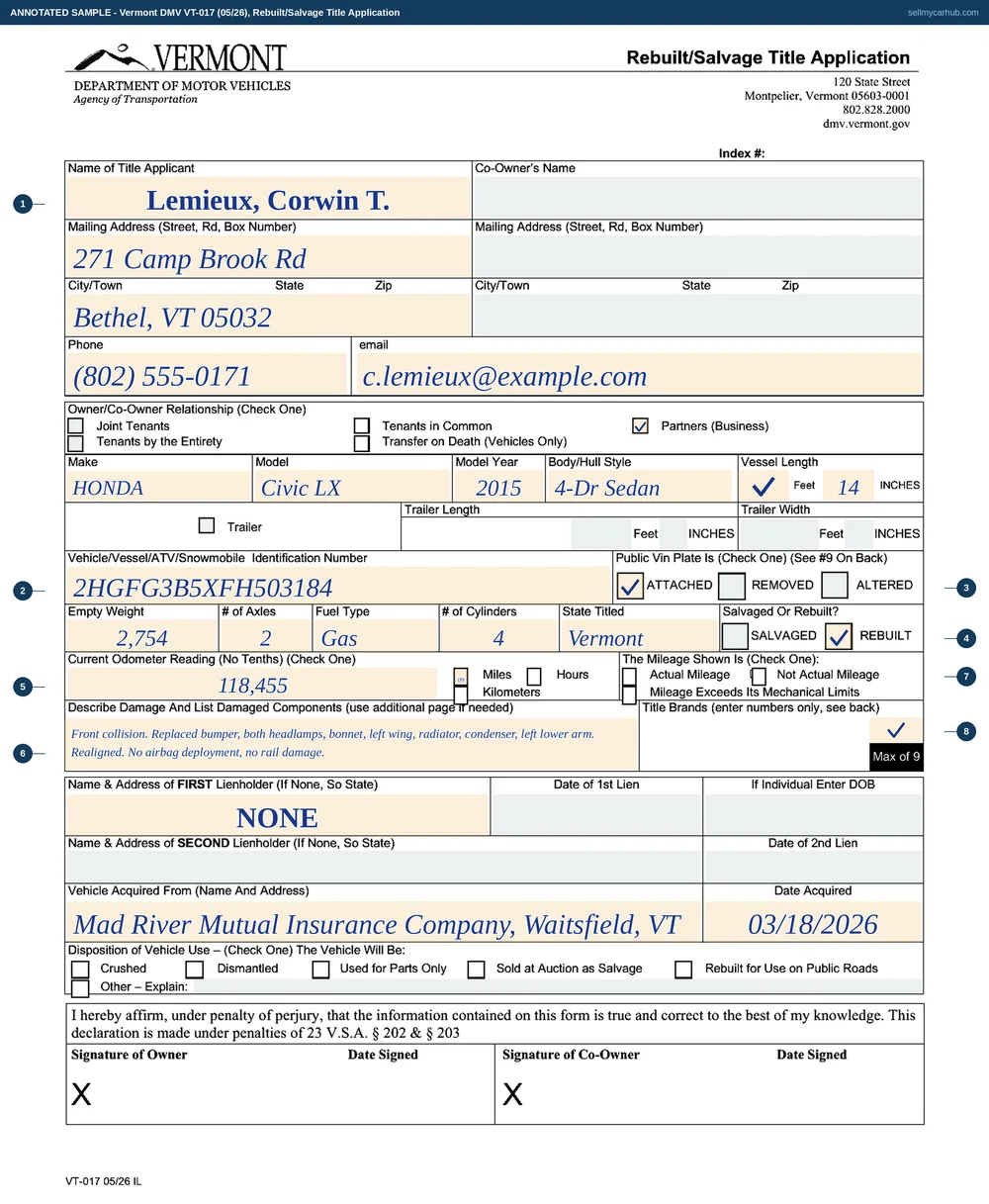
| Name of Title Applicant, Co-Owner's Name | Two name boxes at the top. Read the note at the foot of page one before filling in the second: a salvage title is issued in the applicant's name only, while a rebuilt title is issued to the owners listed on the front of this application. |
|---|
| Mailing Address, City/Town, State, Zip - twice | One address block for each name. They can differ. |
|---|
| Phone, email | Two contact boxes. The department uses them when the inspection has to be arranged. |
|---|
| Owner/Co-Owner Relationship (Check One): Joint Tenants, Tenants in Common, Partners (Business), Tenants by the Entirety, Transfer on Death (Vehicles Only) | The five ownership legends, on the same form that will print one of them onto the new certificate. Transfer on death here needs a separate VT-007 and only works where there is one owner. |
|---|
| Make, Model, Model Year, Body/Hull Style, Vessel Length, Trailer Length and Width | The description block, with vessel and trailer boxes a car leaves alone. |
|---|
| Vehicle/Vessel/ATV/Snowmobile Identification Number | One wide box. On a rebuilt car this is the number the department's representative will verify against the vehicle itself. |
|---|
| Public VIN Plate Is (Check One): ATTACHED, REMOVED, ALTERED | Three ticks with real consequences. The instructions send a removed plate to a separate form - a completed VT-003 must accompany this application, and a VIN must be assigned before the vehicle can be titled at all. |
|---|
| Empty Weight, # of Axles, Fuel Type, # of Cylinders, State Titled | Five technical boxes off the previous certificate or the door jamb. |
|---|
| Salvaged Or Rebuilt? | The tick that decides which of the two documents this application is. Everything else on the sheet reads differently depending on it. |
|---|
| Current Odometer Reading (No Tenths), with Miles, Kilometers or Hours, and The Mileage Shown Is: Actual Mileage / Not Actual Mileage / Mileage Exceeds Its Mechanical Limits | The reading and its certification. The instructions carry an exception a wrecked car often needs: a signed statement that the vehicle is not so equipped is accepted, provided it references the year, make and identification number. |
|---|
| Describe Damage And List Damaged Components | A deep free-text panel, and the substance of the form. The instruction is to describe the damage and list the damaged components, using additional pages where needed. |
|---|
| Title Brands (enter numbers only, see back), max of 9 | Up to nine codes from the NMVTIS table printed on the back - 01 flood damage, 02 fire damage, 09 rebuilt, 11 salvage, 14 collision, 51 disclosed damage and the rest. |
|---|
| Name & Address of FIRST Lienholder (If None, So State), Date of 1st Lien, If Individual Enter DOB | The lien block, with the department's usual instruction: if there is none, write that there is none rather than leaving it empty. |
|---|
| Name & Address of SECOND Lienholder, Date of 2nd Lien | A second lien block. Vermont prints no more than two lienholders on a certificate. |
|---|
| Vehicle Acquired From (Name And Address), Date Acquired | Where the wreck came from and when. On a car bought at a salvage auction or from an insurer, this is the paper trail. |
|---|
| Disposition of Vehicle Use - The Vehicle Will Be: Crushed, Dismantled, Used for Parts Only, Sold at Auction as Salvage, Rebuilt for Use on Public Roads, Other - Explain | Six outcomes and one tick. This is the department's record of what happens next, and picking Rebuilt for Use on Public Roads is what commits you to the inspection. |
|---|
| Signature of Owner, Date Signed, Signature of Co-Owner, Date Signed | Two signature rows, each marked with an X. The instructions allow an authorised agent to sign in the owner's place. |
|---|
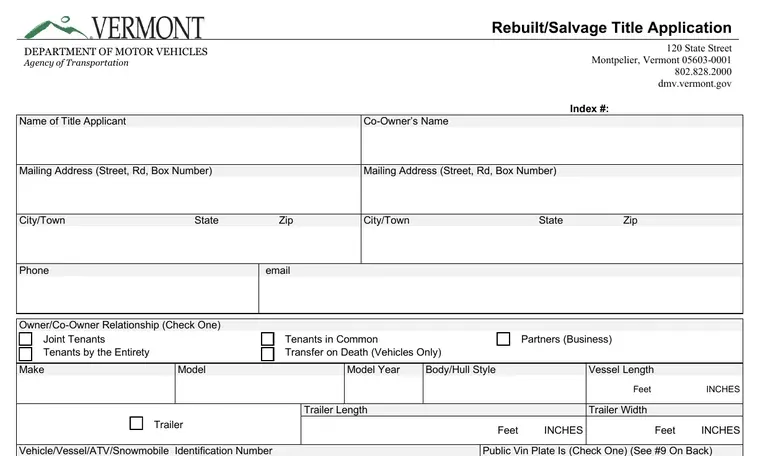 Step 1 · the form itself
Blank VT-017 — Rebuilt/Salvage Title Application
PDF at dmv.vermont.gov · new tab
View the blank VT-017
Step 1 · the form itself
Blank VT-017 — Rebuilt/Salvage Title Application
PDF at dmv.vermont.gov · new tab
View the blank VT-017
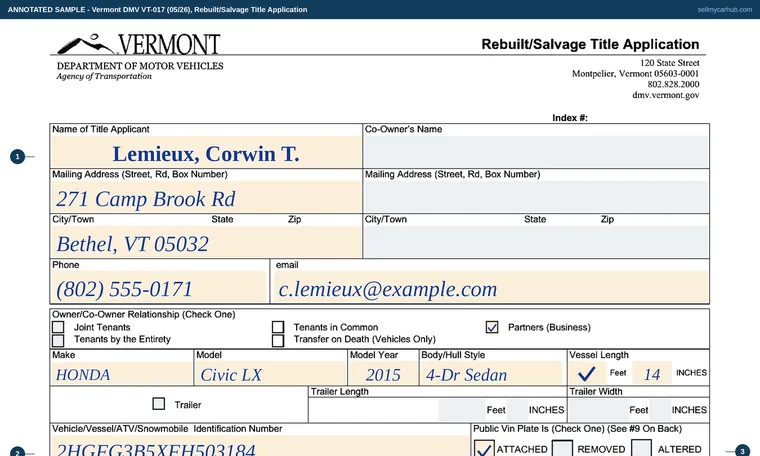 Step 2 · how to fill it in
Our filled-in VT-017 guide
PDF · 3 pages · 540 KB · new tab
See our filled-in example
Step 2 · how to fill it in
Our filled-in VT-017 guide
PDF · 3 pages · 540 KB · new tab
See our filled-in example