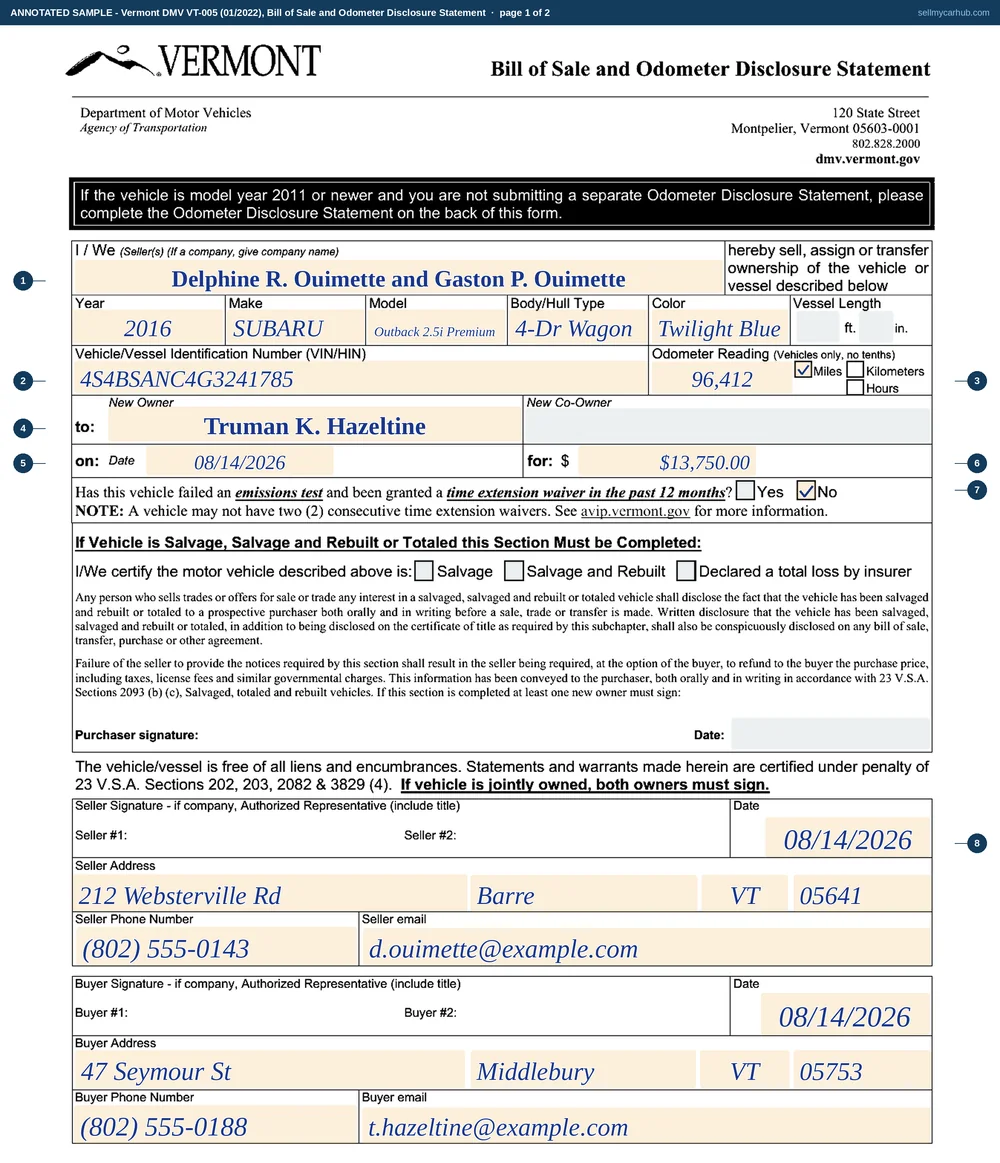
| I / We (Seller(s)) (If a company, give company name) | Every owner named on the front of the certificate, not just the one who is standing there. The instruction lower down the page is explicit: if the vehicle is jointly owned, both owners must sign. |
|---|
| Year, Make, Model, Body/Hull Type, Color | Copied off the certificate rather than off the dashboard. Body type is the department's own vocabulary - wagon, sedan, pickup - and colour is a required field on the buyer's application too. |
|---|
| Vessel Length, ft. and in. | Blank on a car. It is here because one form covers vehicles and vessels, and a boat under sixteen feet is not titled in Vermont at all. |
|---|
| Vehicle/Vessel Identification Number (VIN/HIN) | Seventeen characters on a modern car, copied from the certificate. VD-119i names it as one of the six things a Vermont bill of sale must contain. |
|---|
| Odometer Reading (Vehicles only, no tenths), with Miles, Kilometers or Hours | Whole numbers. The three unit boxes are one choice, and hours belongs to a tractor rather than a car. |
|---|
| New Owner, and New Co-Owner | The buyer, and a second buyer if there is one. Two names here means the buyer will have to pick one of the five ownership legends on their own application. |
|---|
| on: Date, and for: $ | The date of sale and the price you were actually paid. Both are on VD-119i's list of what the sheet has to carry. |
|---|
| Has this vehicle failed an emissions test and been granted a time extension waiver in the past 12 months? Yes / No | A question about Vermont's inspection programme, sitting on a bill of sale, answered by the seller. The note under it explains why it matters to the buyer: a vehicle may not have two consecutive time extension waivers. |
|---|
| If Vehicle is Salvage, Salvage and Rebuilt or Totaled this Section Must be Completed | Three boxes - salvage, salvage and rebuilt, or declared a total loss by insurer - above a reprint of s. 2093(b) and (c). If the section is completed at least one new owner must sign it. |
|---|
| Purchaser signature, and Date | The buyer's acknowledgement of the salvage disclosure, and the only signature on the front page that is not a party's ordinary signature. |
|---|
| Seller #1 and Seller #2, with Date | Under a certification that the vehicle is free of all liens and encumbrances. Signing that on a car with a live lien printed on its title is a false statement under s. 202. |
|---|
| Seller Address, City, State, Zip, Phone Number, email | Four boxes and two contact lines. The address is the one the department holds for you, not a forwarding one. |
|---|
| Buyer #1 and Buyer #2, Date, Address, Phone Number, email | The mirror image, filled in by the buyer at the same table. An unsigned buyer block is an unfinished bill of sale. |
|---|
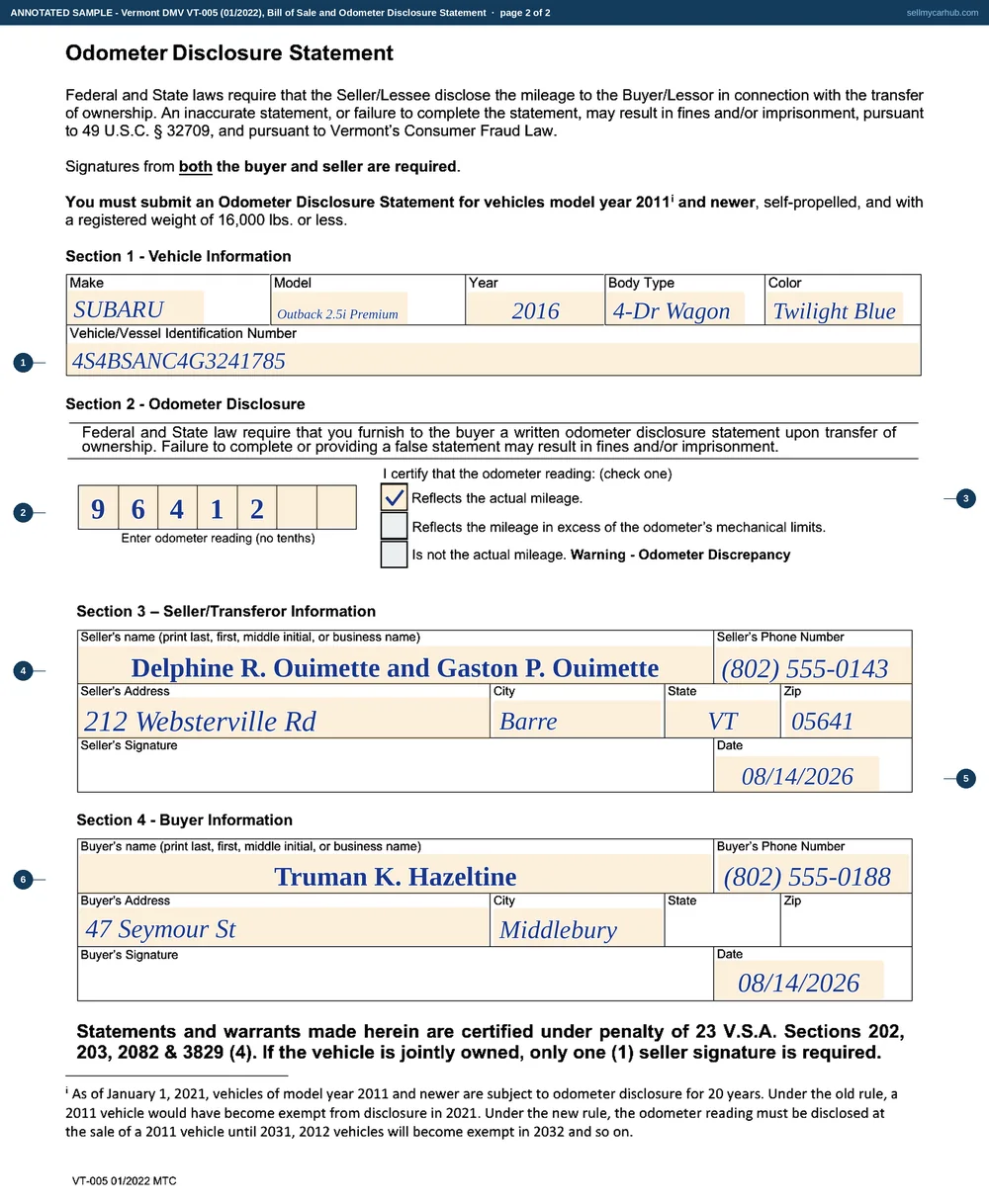
| Back page, Section 1 - Vehicle Information | Make, model, year, body type, colour and the identification number again, because the odometer statement is a free-standing federal document that has to identify its own vehicle. |
|---|
| Back page, Section 2 - Odometer Disclosure | A seven-cell comb for the reading and three certifications: reflects the actual mileage, reflects the mileage in excess of the odometer's mechanical limits, or is not the actual mileage - warning, odometer discrepancy. |
|---|
| Back page, Sections 3 and 4 - Seller/Transferor and Buyer Information | Printed names, addresses, phone numbers and both signatures. The heading above them is unambiguous: signatures from both the buyer and seller are required. |
|---|
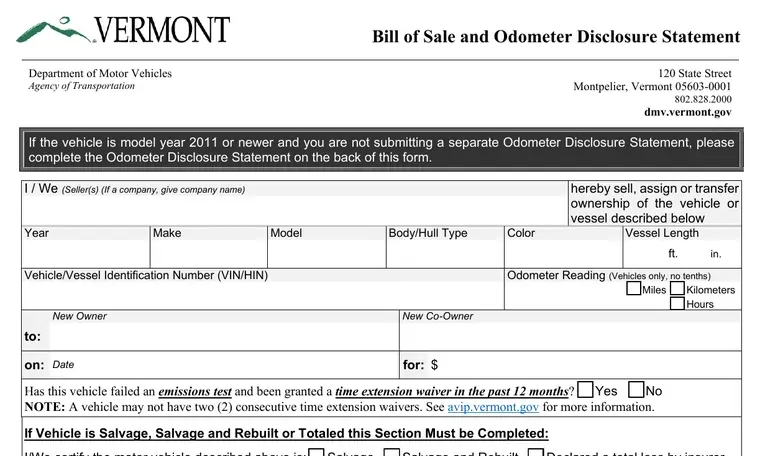 Step 1 · the form itself
Blank VT-005 — Bill of Sale and Odometer Disclosure Statement
PDF at dmv.vermont.gov · new tab
View the blank VT-005
Step 1 · the form itself
Blank VT-005 — Bill of Sale and Odometer Disclosure Statement
PDF at dmv.vermont.gov · new tab
View the blank VT-005
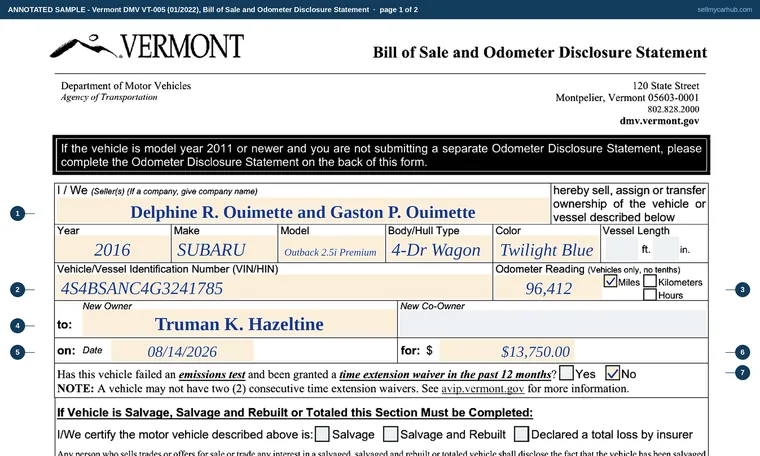 Step 2 · how to fill it in
Our filled-in VT-005 guide
PDF · 4 pages · 860 KB · new tab
See our filled-in example
Step 2 · how to fill it in
Our filled-in VT-005 guide
PDF · 4 pages · 860 KB · new tab
See our filled-in example