Sell My Car Hub

How to fill out Vermont VD-119

The single application that registers the car, applies for the title and works out the tax in one sheet, and the only document in a Vermont private sale that both parties appear on. It belongs to the buyer and the buyer pays for it. Section 6 is a block about you - your name, your address, the date you sold it - and there is a Seller Signature line in it that the instructions say is required only if no other bill of sale exists. A seller who has read Section 6 knows exactly what the buyer is about to write down about them, and knows why handing over a VT-005 saves them from being chased for a signature.

Written against VD-119 (10/2024), issued under 23 V.S.A. s. 202 and s. 4110, with the registration duty at s. 301, the title application at s. 2015 and the purchase and use tax at 32 V.S.A. chapter 219. The revision matters here. A VD-119 printed before October 2024 predates the Act 165 titling change and the electric-vehicle infrastructure fee, and its instruction sheet is the older VD-119i. Take a fresh copy of both from the department.

Two documents, and they are not the same thing. Take the blank VD-119 from the dmv.vermont.gov copy so you get the revision that is current today, then print our VD-119 guide and keep it beside you while you fill theirs in.

Filled in

What a completed one looks like

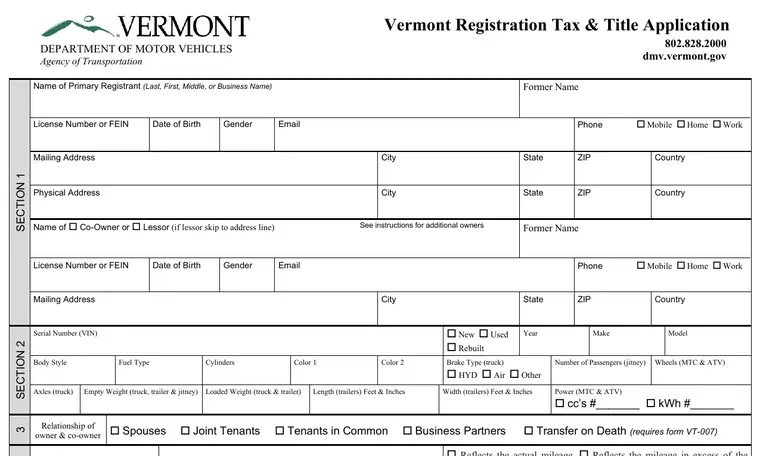
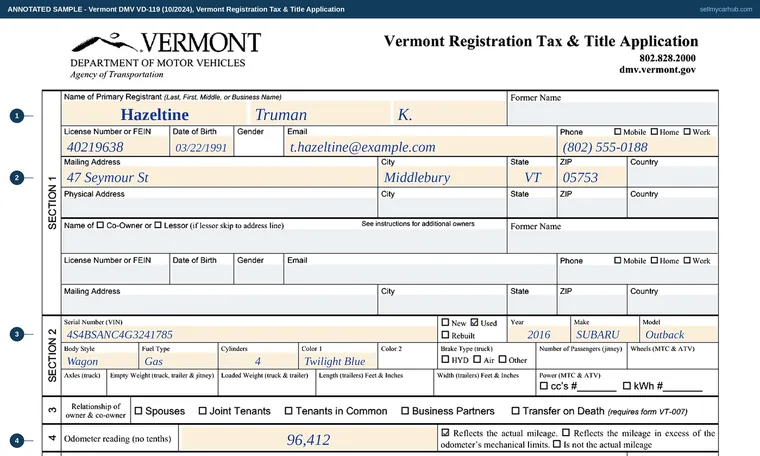
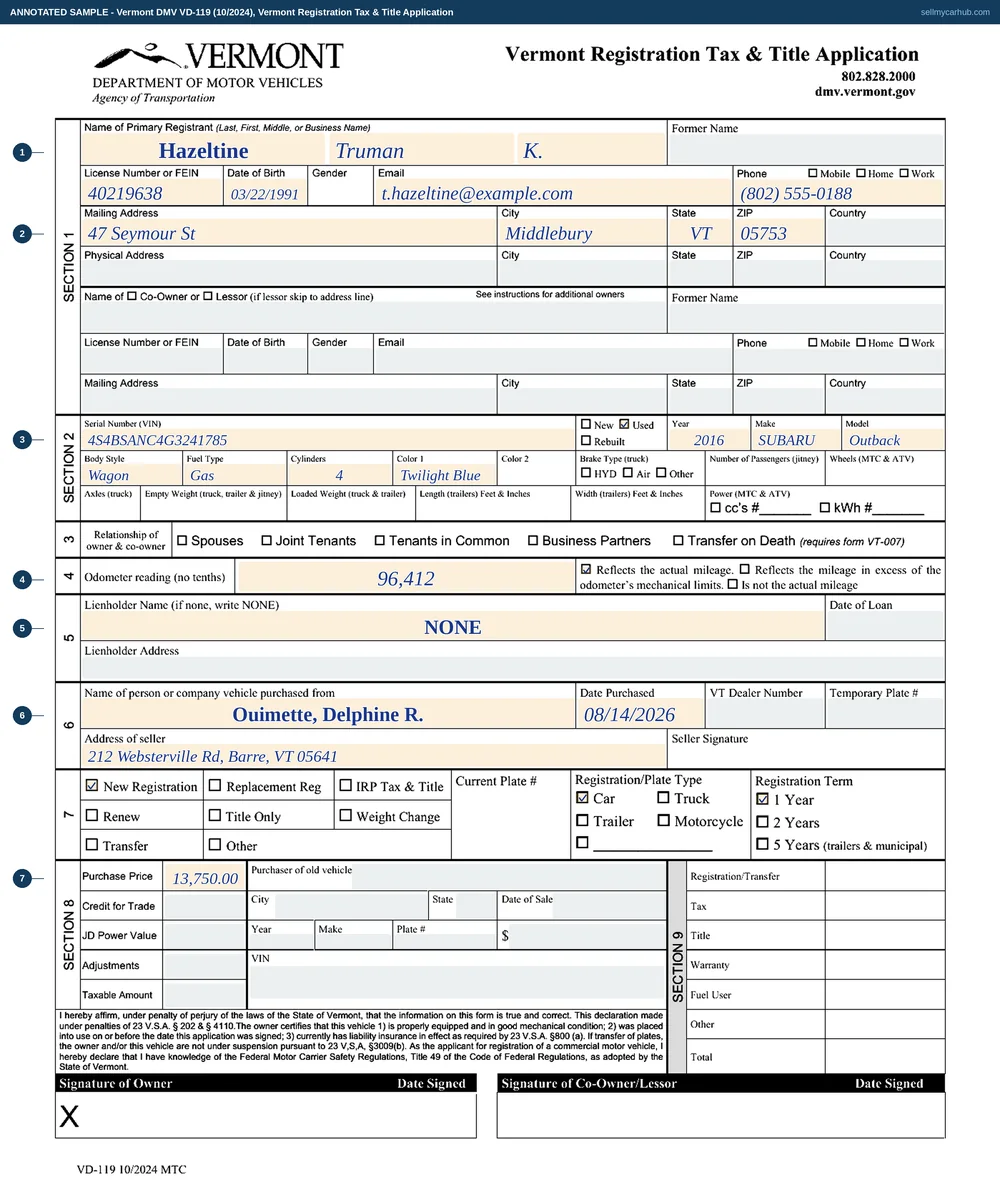
This is the actual VD-119, rendered from the PDF the Vermont Department of Motor Vehicles, Agency of Transportation publishes and completed end to end: letterhead, every field, and the blocks at the foot.

A completed Vermont Registration Tax & Title Application, form VD-119, filled in by the buyer of a 2016 Subaru Outback: Hazeltine, Truman K. in Section 1 with a Vermont licence number, date of birth and a Middlebury address; Section 2 carrying the vehicle identification number 4S4BSANC4G3241785, the Used tick, year 2016, make Subaru, model Outback, four cylinders and Twilight Blue; Section 4 an odometer reading of 96,412 with the actual-mileage box ticked; Section 5 reading NONE; and Section 6 naming Ouimette, Delphine R. of Barre with a purchase date of 08/14/2026 and no seller signature.
Rendered from the department's own PDF, completed as the buyer completes it at the counter. Note what is missing: the Seller Signature line in Section 6 is deliberately blank, because a VT-005 bill of sale exists and the instruction sheet says the seller's signature is only required if no other bill of sale does. Section 9's fee column has no fillable boxes behind it at all, so nothing is written there. Nobody in this sample exists.
Field by field

Every line, in the order you meet it

  1. 1
    The buyer fills this in

    Section 1, Name of Primary Registrant

    The buyer's legal name in three boxes, exactly as it appears on the licence they will show at the counter.

    Watch out: This is the name that gets printed on the new certificate. A nickname here is a corrected title later, at the department's full title fee and a fresh application.

  2. 2
    The buyer fills this in

    License Number or FEIN, and Date of Birth

    A Vermont credential number and a birth date. A business uses a federal identification number instead.

    Watch out: Vermont wants its own credential for a Vermont registration. A buyer who has just moved to the state and has not swapped their licence yet needs to read the Moving to Vermont page before they plan the trip.

  3. 3
    The buyer fills this in

    Mailing Address, and Physical Address

    The address the department will post to, and - if the first one is a PO box or a private mailbox - a physical one underneath.

    Watch out: The physical line will not accept a box number of any kind. It is the single most common reason a posted application comes back unprocessed.

  4. 4
    The buyer fills this in

    Section 2, Serial Number (VIN) and the New / Used tick

    Seventeen characters copied from the certificate you assigned, and Used ticked on any private sale.

    Watch out: Copy it from the title rather than the dash. The department checks NMVTIS on every title and registration transaction, and it checks the number it is given.

  5. 5
    The buyer fills this in

    Section 3, the relationship tick

    One of Spouses, Joint Tenants, Tenants in Common, Business Partners or Transfer on Death. Left blank where there is a single buyer.

    Watch out: Transfer on Death is one owner only and needs a VT-007 with it. Ticking it on a two-name application is a rejection, not a correction.

  6. 6
    The buyer fills this in

    Section 4, Odometer reading

    Whole miles, matching the figure on the bill of sale, with one of the three certifications ticked.

    Watch out: On a 2011-or-newer car this box does not replace the odometer disclosure statement. The instruction sheet asks for both.

  7. 7
    The buyer fills this in

    Section 5, Lienholder Name

    The buyer's new lender if they are financing, and the word NONE if they are not.

    Watch out: Whatever goes here decides where the certificate is posted. A lienholder named in Section 5 means the buyer will not see their own title until the loan is paid.

  8. 8
    The buyer fills this in

    Section 6, the block about you

    Your name, your address and the date purchased, written by the buyer onto their application.

    Watch out: Nowhere else in this transaction does the buyer write your details down. Give them the spelling from the face of the certificate rather than from a message thread.

  9. 9
    You fill this in

    Section 6, Seller Signature

    Left blank here, and legitimately so. The instruction sheet says the seller's signature is only required if no other bill of sale exists.

    Watch out: Hand over a completed VT-005 and this line never becomes your problem. Skip the bill of sale and you can expect a phone call asking you to drive somewhere and sign.

  10. 10
    The buyer fills this in

    Section 8, Purchase Price and the old-vehicle block

    The figure from the bill of sale, and - if there is one - the details of a vehicle traded or recently sold.

    Watch out: The tax is the greater of this figure and the J.D. Power clean trade-in value, so understating it moves nothing. If they are registering by post, a printed valuation dated within the last seven days has to be in the envelope.

  11. 11
    The buyer fills this in

    Signature of Owner

    The buyer's signature and date, and a co-owner's where there is one.

    Watch out: The paragraph above it certifies four things, one of which is that liability insurance is already in effect under s. 800(a). Signing it on the way to buy insurance is signing something untrue.

At a glance

What goes where

On the formWhat to put in it
Section 1, Name of Primary Registrant (Last, First, Middle, or Business Name)The buyer, in three boxes, with a Former Name box beside it. Whatever is written here is what the new certificate gets printed with.
License Number or FEIN, Date of Birth, Gender, Email, PhoneA Vermont credential for a Vermont registrant - the instruction sheet is explicit that registering here needs a Vermont driver's licence or non-driver identification card.
Mailing Address and Physical AddressTwo full lines. A physical address is required whenever the mailing address is a PO box or a private mailbox, and it will not take one itself.
Name of Co-Owner or LessorA second buyer, or a leasing company. If there are more than two owners the department sends you to VT-012 instead.
Section 2, Serial Number (VIN), New / Used / Rebuilt, Year, Make, ModelCopied off the certificate you signed. Rebuilt is a tick rather than a word, and ticking it changes what the department asks for next.
Body Style, Fuel Type, Cylinders, Color 1, Color 2, Brake Type, Passengers, WheelsEight descriptive boxes, most of them blank on a passenger car. Colour is one the department calls a must.
Axles, Empty Weight, Loaded Weight, Length, Width, Power in cc's or kWhThe truck, trailer, motorcycle and all-terrain block. All of it stays empty on a car, and all of it is compulsory on a pickup.
Section 3, Relationship of owner and co-ownerFive ticks and no others: Spouses, Joint Tenants, Tenants in Common, Business Partners, Transfer on Death. The last of them carries a note that it requires form VT-007.
Section 4, Odometer reading (no tenths), with three certificationsThe reading, and one of reflects the actual mileage, reflects the mileage in excess of the odometer's mechanical limits, or is not the actual mileage. On a 2011-or-newer car a separate odometer disclosure statement is required as well.
Section 5, Lienholder Name (if none, write NONE), Date of Loan, Lienholder AddressThe buyer's new lender, not the one you paid off. If a lienholder is named here the title is posted to them rather than to the buyer.
Section 6, Name of person or company vehicle purchased from, Date Purchased, VT Dealer Number, Temporary Plate #You, and the date. The dealer number and temporary plate boxes stay empty in a private sale.
Section 6, Address of seller, and Seller SignatureYour address, and a signature line whose rule is in the instruction sheet rather than on the form: the seller's signature is only required if no other bill of sale exists.
Section 7, transaction type and plate typeEight transaction ticks from New Registration to Transfer, a plate type, a current plate number, and a one, two or five year term.
Section 8, Purchase Price, Credit for Trade, JD Power Value, Adjustments, Taxable AmountThe tax worksheet. Beside it sits a block about the previous vehicle - purchaser of old vehicle, city, state, date of sale, year, make, plate and VIN - which is how a trade-in or a recent sale becomes a credit.
Section 9, the fee columnRegistration or transfer, tax, title, warranty, fuel user, other, total. Written in by whoever is preparing the application; there is no fillable box behind any of it.
Signature of Owner and Signature of Co-Owner, with datesUnder an affirmation covering four things at once: that the information is true, that the vehicle is properly equipped and in good mechanical condition, that it was placed into use on or before the date of signing, and that liability insurance is in effect as required by 23 V.S.A. s. 800(a).

What gets this one rejected

Rules that decide whether it is accepted

Every line here was read off VD-119 (10/2024) itself — the PDF is here — and off the Vermont Department of Motor Vehicles, Agency of Transportation pages. This is plain-language help with a form, not legal advice, and where our wording and the agency's differ, theirs governs.

Back to all Vermont seller paperwork, or what selling a car in Vermont involves.

Want the paperwork handled instead?

Get My Instant Offer → Online · about 2 minutes · free

Or send the details — we'll come to you

If the buyer has vanished with your signed title and the DMV still has the car in your name, tell us the year, the mileage and the plate and we will tell you what it is worth today.

or call/text (877) 405-1808