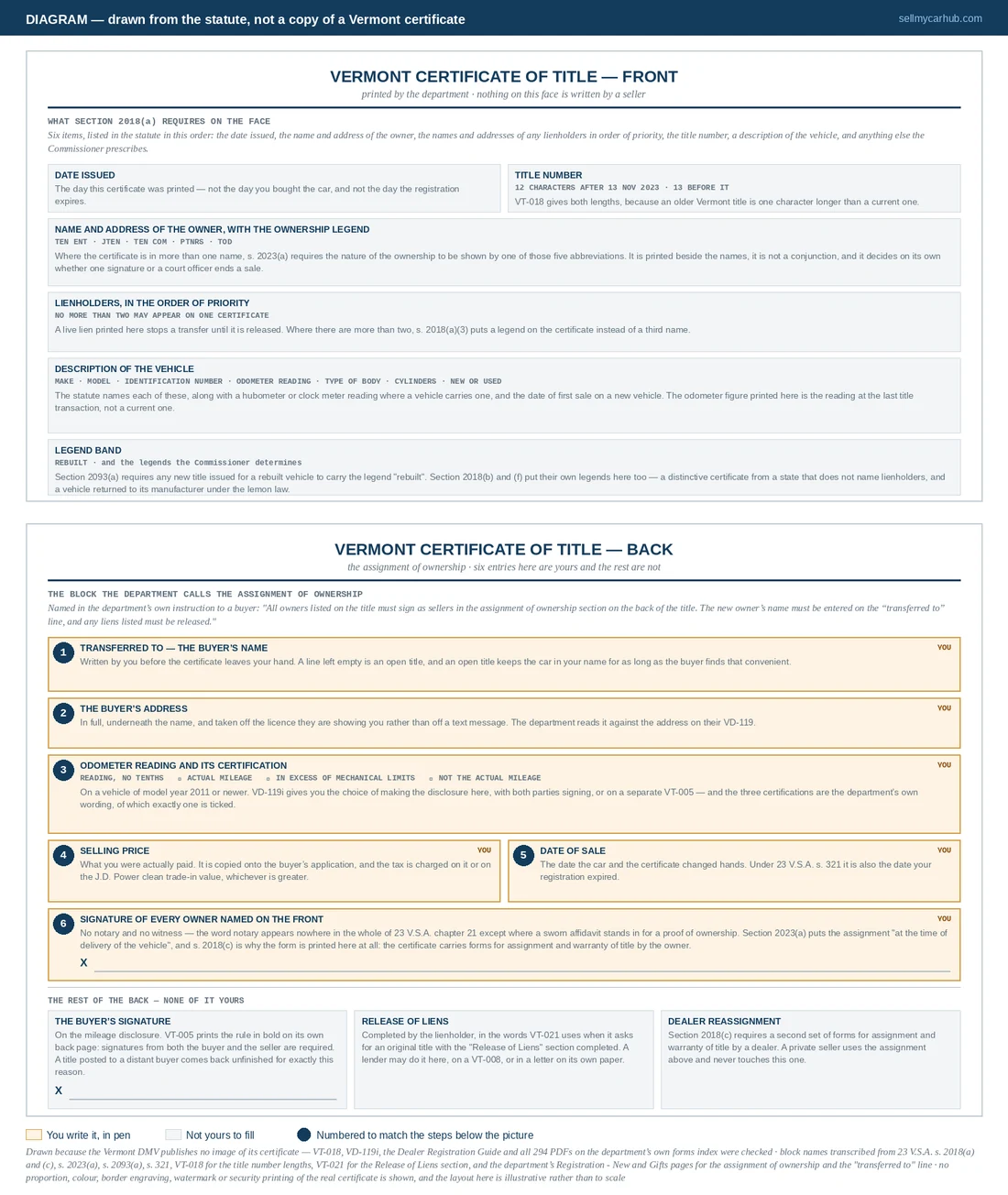
A Vermont certificate prints the department's record on the front and gives the whole of your job to the back, in the block the department calls the assignment of ownership. The Vermont DMV publishes no photograph of its own certificate anywhere - all 294 PDFs on its forms index were downloaded and scanned to be sure - so the picture below is a diagram, marked as one, and every block on it is named from a statute or a departmental page that is cited beside it.
Last updated .
Your 10 boxes
As a private seller you complete these and nothing else:
There is no blank Vermont certificate to download and there never has been - it is controlled stock printed by the department, and Vermont issues no electronic version of it. What we can give you is beside this paragraph: a one-page checklist of the six entries that are yours, in the order the back of the certificate asks for them.
Strikeovers and erasures are not corrected in place - the department's answer to a mistake is a separate signed statement, VN-020, completed by the person who made it.
The department's order does not vary: complete the assignment of ownership on the back, have every owner named on the front sign as a seller, write the buyer's name on the transferred to line, make sure any lien is released, disclose the mileage if the car is a 2011 or newer, hand it over with a bill of sale, photocopy both, take the plates off, and send the registration certificate back endorsed with the date of transfer and the new owner's name and residence.
Drawn, not photographed
A Vermont Certificate of Title, laid out from the statute that says what has to be printed on it
The Vermont DMV publishes no image of its own certificate. Four sources were checked before this was drawn: VT-018, the department's own Title Informational Bulletin, which is text and nothing else; VD-119i, whose single embedded picture is the Vermont coat of arms; the Dealer Registration Guide, which walks the VD-119 section by section with no illustration on the page at all; and every one of the 294 PDFs linked from dmv.vermont.gov/forms, downloaded and listed raster by raster. Not one of them contains a certificate. So this is a diagram, and every block name on it is transcribed from a source named in the caption.
Amber — you write it, in pen
Grey — not yours to fill
Numbered — the six things on the back that a Vermont seller writes
Click or tap the picture to open it full size.
A diagram, not a reproduction. Every block name on it is transcribed from a source: 23 V.S.A. s. 2018(a) for the six things each certificate the Commissioner issues shall contain and for the rule that no more than two lienholders may appear on one; s. 2018(c) for the forms for assignment and warranty of title by the owner and by a dealer that the certificate itself has to carry; s. 2023(a) for the five ownership legends TEN ENT, JTEN, TEN COM, PTNRS and TOD; s. 2093(a) for the REBUILT legend; VT-018 for the title number being twelve characters on certificates issued after 13 November 2023 and thirteen before it; the department's Registration - New page and Gifts page for the assignment of ownership section, the transferred to line and the release of liens; and VT-021 for the Release of Liens section being completed by the lienholder. No proportion, colour, border engraving, watermark or security printing of the real certificate is shown, because none of it has been seen.
A real one, filled in
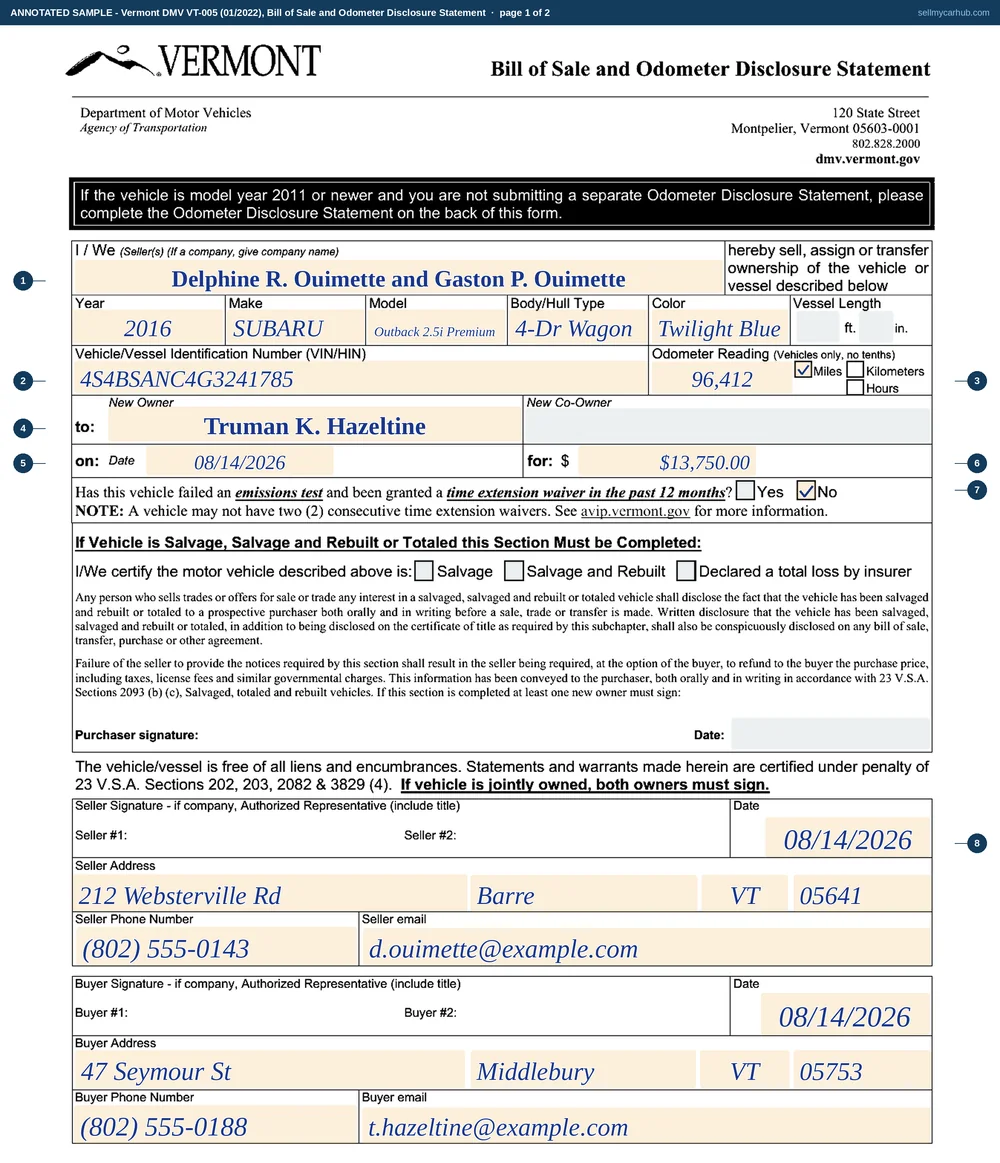
The VT-005, which carries the same odometer statement on a separate sheet
This is the department's own form, rendered from its own PDF and filled in the way a Vermont seller fills it in. It matters here because VD-119i gives you a choice about where the odometer disclosure goes - use form VT-005, or have buyer and seller both sign the back of the title - so this sheet is the assignment block's mileage statement, unpacked and made legible. Note the contradiction the department has printed on one document: the front says that if the vehicle is jointly owned both owners must sign, and the odometer statement on the back says that only one seller signature is required.
Click or tap the picture to open it full size.
Taken from the department's own PDF and completed as a private seller completes it. Nobody in this sample exists, the credit union and the buyer are invented, and the VIN carries a correct check digit but identifies no vehicle.
Before you watch. This is the department's only video that touches titling, and it is addressed to buyers rather than to sellers. It is here because NMVTIS is the database that decides what happens to a Vermont car with no title: if it shows an active title somewhere, the department will ask the buyer to obtain that title or go through the bond process on VT-020; if it shows nothing at all, a notarised VT-025 and a VIN verification will do instead. What your buyer is told to check is what your paperwork has to survive.
Published by the Vermont Department of Motor Vehicles on its own channel - checked through YouTube's oEmbed endpoint, which returns the department as the author. Runtime read from the duration badge and the accessibility label on the department's own videos tab, which agree. Nothing loads from YouTube until you press play.
Step by step
Every box, in the order you meet it
0
You fill this in
Before any box: work out whether you have a certificate at all
Three Vermont cars have no title in the owner's hands. One is financed and the lender has the paper. One is model year 2009 or older and Vermont never issued a certificate for it. One had a title once and it is lost.
Watch out: They need three different answers, and only one of them is quick. A lender's certificate needs a payoff and a release. A never-titled car needs the original or a certified copy of the last registration certificate. A lost certificate needs a VT-004 and $42.00 before you can sell at all.
1
You fill this in
The buyer's name, on the transferred to line
Written by you, in the assignment of ownership on the back, before the certificate leaves your hand.
Watch out: The department names this line specifically when it lists what a buyer must bring. An assignment handed over with that line empty is an open title, and an open title is how a car sold in August produces a parking ticket in your name in November.
2
You fill this in
The buyer's address
In full, underneath the name. It is the same address the buyer will write on their own VD-119, and the department reads the two against each other.
Watch out: Take it off the licence they are showing you rather than off a text message. An address that does not match the application is a returned envelope and a fortnight.
3
You fill this in
The odometer reading, and one of three certifications
The reading in whole miles, tenths left off, wherever the vehicle is a 2011 model year or later. The three boxes beside it are the department's own wording: reflects the actual mileage, reflects the mileage in excess of the odometer's mechanical limits, or is NOT the actual mileage - warning odometer discrepancy.
Watch out: The middle box is about an instrument that ran out of digits and went round to zero again - not about a car that has covered a great many miles. Ticking it because a number looks large invents a discrepancy that gets printed on every certificate this car is issued from now on.
4
You fill this in
The selling price
What you were actually paid. It is copied onto the buyer's VD-119 and it is one of the six things VD-119i requires a Vermont bill of sale to carry.
Watch out: Writing it low does not help the buyer. Purchase and use tax is charged on the price or the J.D. Power clean trade-in value, whichever is greater, so an understated figure changes nothing except your exposure.
5
You fill this in
The date of sale
The date the car and the certificate changed hands. Under s. 321 it is the date your registration expired, and it is the date every clock on this page starts from.
Watch out: Put the same date on the assignment, on the bill of sale and on the endorsement you write on the back of the registration certificate. Three dates for one sale is what turns a clean file into a query.
6
You fill this in
Your signature, and every other owner's
Every owner listed on the front signs as a seller. No notary, no witness, no appointment.
Watch out: Check the legend printed with the names before you set a completion date. TEN ENT and JTEN carry survivorship; TEN COM does not, and a certificate reading TEN COM after a co-owner has died needs a court officer's letter before anybody can sign.
7
The buyer fills this in
The buyer signs the odometer statement
Vermont requires signatures from both the buyer and the seller on the mileage disclosure - VT-005 prints that instruction in bold on its own back page.
Watch out: With the buyer absent the mileage statement stays incomplete no matter how much else has been signed. That is a reason not to post a signed title to a distant buyer and hope.
8
The lienholder fills this in
The release of liens, if a lienholder is printed on the front
Completed by the lienholder in the section provided on the certificate, or on a VT-008, or as a letter on the lender's own letterhead carrying the make, model, year, VIN, the owner's name and the lienholder's signature.
Watch out: The department accepts all three, and the letter is the one that arrives fastest. What it will not accept is your word for it - a certificate with a live lien printed on the front cannot be transferred, full stop.
9
You fill this in
The bill of sale, and a photocopy of everything
A VT-005 or your own sheet carrying the six things VD-119i names: make, year, VIN, purchase price, mileage, the seller's signature and the date of sale. Then copy the completed title and the bill of sale before they leave the table.
Watch out: The copy is not a formality. It is the "other satisfactory evidence of the date of transfer and new ownership" that s. 321 lets the Commissioner accept instead of the endorsed registration certificate, and it is what you will be asked for months later.
10
You fill this in
Take the plates off the car
Immediately, and before the buyer drives away. The department's instruction is in capitals on its own plates page: if you are selling your car, do NOT leave your plates on the car.
Watch out: Then decide what they are for. Transferring them to another vehicle is $30.00 and carries the unexpired time across; keeping them costs nothing; posting them back is optional as far as the department is concerned and mandatory as far as s. 321 is concerned, five days after the transfer.
11
You fill this in
Send the registration certificate back, endorsed
With the date of transfer and the name and residence of the new owner written on the back of it. That is Vermont's notice of sale, and it is set out in s. 321 rather than on any form.
Watch out: Or use the Mark Vehicle Sold option in myDMV, or send a VD-170 with the certificate. Whichever route you take, do it the same week - the record says the car is yours until something tells it otherwise.
Before the pen
Six rules for the pen, on a document that cannot be corrected in place
Six habits. The first is about a document that cannot be tidied up, and the last is about a document most Vermont sellers do not know they still owe.
A mistake is a separate form, not a crossing-out
Vermont's answer to an altered title is VN-020, a signed statement naming the section you got wrong and explaining the alteration in detail, completed by the individual who made it. The bond form goes further and says a completed VT-020 containing any erasures, alterations or strikeouts will be rejected outright.
Read the legend beside the owners' names before you set a date
TEN ENT, JTEN, TEN COM, PTNRS or TOD. It is printed on the certificate, it decides whether one signature or a court officer's letter ends this sale, and it is the single thing most likely to move a completion date by a fortnight.
Fill the buyer's block in yourself
Somebody who asks you to leave the transferred to line blank so they can "put it in a friend's name" is asking you to keep the car in yours. There is no version of that favour that ends well.
Leave the mileage boxes alone on a 2010 or older
Vermont's disclosure duty starts at model year 2011. Writing a reading into a box that does not need one manufactures a disclosure the buyer's next seller will have to explain.
Photocopy the finished title and the bill of sale before they leave the table
Not afterwards. Section 321 lets the Commissioner accept "any other satisfactory evidence of the date of transfer and new ownership", and a copy of the completed bill of sale is exactly that - but only if you have one.
Write the endorsement on the registration certificate while you are still sitting down
Date of transfer, and the new owner's name and residence, on the back. It takes fifteen seconds at the table and it is the one Vermont duty that survives the handshake.
The ink rule is the Vermont DMV's own: “All owners listed on the title must sign as sellers in the assignment of ownership section on the back of the title. The new owner's name must be entered on the “transferred to” line, and any liens listed must be released.”
— Vermont DMV, Title guide.
Check your source
Three things Vermont sellers tell each other that are not true
Three things Vermont sellers tell each other. The first one is the reason this state needs a page of its own, and the department's own title guide is where it is contradicted.
"Vermont doesn't title cars over fifteen years old, so my 2011 doesn't need one."
That was the rule and it stopped on 1 January 2024. Act 41 of 2023 amended 23 V.S.A. s. 2012, s. 2013 and s. 2017, and the department states the effect on the back of its own VT-025: titles are required for all vehicles as of 1 January 2024, where previously Vermont only titled vehicles fifteen years old or newer at registration. What survives is subdivision 2012(10), which exempts a vehicle more than fifteen years old on 1 January 2024 - a fixed date, so a fixed set of cars, model year 2009 and older. A 2011 has needed a title since it was new and always will. And even the exempt set is exempt only while nobody sells the car.
"You have to hand the plates back at the counter when the car goes."
There is no counter step in an ordinary Vermont sale and the department says so in its own FAQ: you are not required to return plates to DMV, and if you want to return them, post them. The tax page puts the principle plainly - the plates belong to you, not the vehicle. What the department does insist on is that they come off the car before it goes, and what 23 V.S.A. s. 321 insists on is different again: it gives you 24 hours to apply to move the plates to another vehicle you own, and says that if no such application reaches the Commissioner the plates are to be returned five days after the transfer. The practical reading is the department's; the statutory reading is stricter; nobody is served by being told only one of them.
"Vermont has no release-of-liability form, so there's nothing to file."
There is no form, and there is still something to file. Section 321 says the registration expires the instant ownership transfers and then names your duty: return the registration certificate to the Commissioner immediately, with the date of transfer and the name and residence of the new owner endorsed on the back. Alternatively the Commissioner may accept any other satisfactory evidence of the date of transfer and new ownership - which is what a copy of your bill of sale is - and myDMV carries a Mark Vehicle Sold option on the vehicle's own block. What protects you against what the buyer does next is a different provision, s. 2023(d): an owner who has delivered possession and complied with the assignment requirements is not liable as owner for damages afterwards. Doing both is fifteen minutes.
Eight signature rules, and the third and fourth are the ones that turn a fortnight's wait into an afternoon, because Vermont prints its co-ownership rule as a legend rather than a conjunction:
You, as an owner named on the face of the certificate
In the assignment of ownership on the back. No notary and no witness - the word notary appears nowhere in the whole of 23 V.S.A. chapter 21 except where a sworn affidavit stands in for a proof of ownership.
Every owner named, whatever the legend says
The department's instruction is flat and has no exception in it: all owners listed on the title must sign as sellers in the assignment of ownership section on the back of the title.
The surviving spouse alone, on a title reading TEN ENT
Tenants by the entirety carries a right of survivorship, and VT-021 asks only for a copy of the death certificate identifying the surviving spouse.
The surviving owner alone, on JTEN
Joint tenants carries survivorship too, and again a copy of the death certificate is what the department asks for.
An executor or administrator, on TEN COM or where no legend is printed
No survivorship. VT-021 sets out four routes - intestate with and without probate, will with and without probate - and each needs a letter from a court officer or from the Probate Court before the assignment can be signed.
The beneficiary, after a death, where the legend reads TOD
And nobody before it. Section 2023(f) gives the principal owner every right of ownership and transfer until death, and the designated transferee none until a valid death certificate exists.
An attorney-in-fact, on a VN-101
The only signature in the Vermont set that takes a witness and a notary, and neither of them may be the agent. The department will not accept your own power of attorney form.
Nobody at all, on a 2009-or-older car Vermont never titled
There is no certificate to sign. The registration certificate is the ownership document and the transfer runs on it and a bill of sale.
Once it is signed
Signing the back is the middle of a Vermont sale, not the end of it. What follows is the part with your name still on the record: the plates come off the car, the registration certificate goes back to Montpelier endorsed with the date and the buyer's name, and if you have bought a replacement within three months the tax on the car you just sold may be waiting for you.