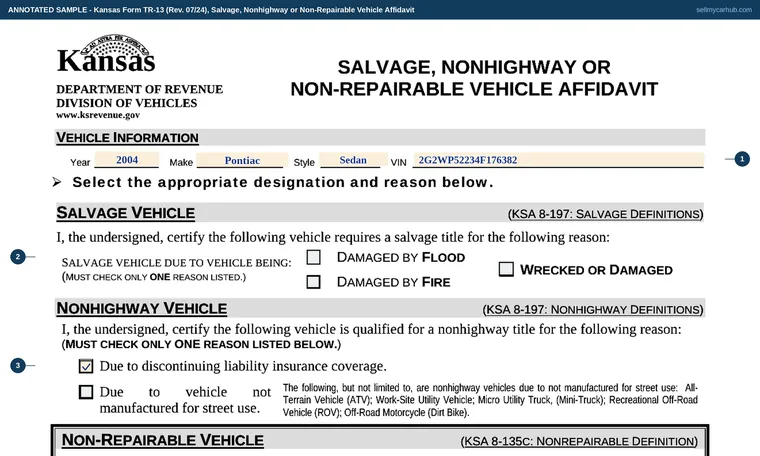
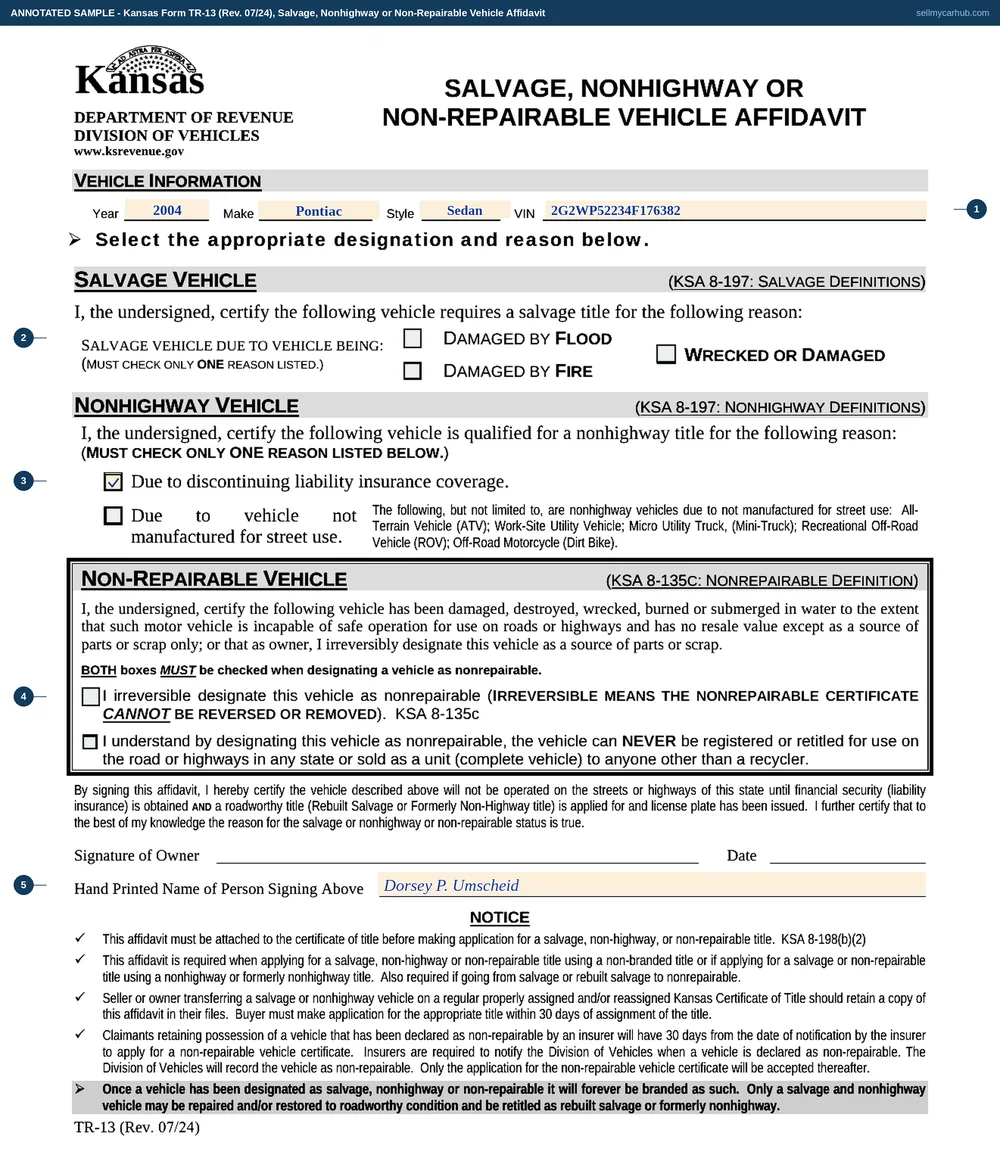
The one-page fork in a damaged or uninsured car's road, with three prongs. Salvage, for a vehicle damaged by flood, fire, or wrecked - one reason only, says the form. Nonhighway, for a vehicle that dropped its liability insurance or was never manufactured for street use, the box that covers ATVs, dirt bikes and the project car in the barn. And non-repairable, the prong with no way back: both of its boxes must be ticked, the first declaring the designation irreversible, the second acknowledging the vehicle can never be registered or retitled for road use in any state, or sold whole to anyone but a recycler.
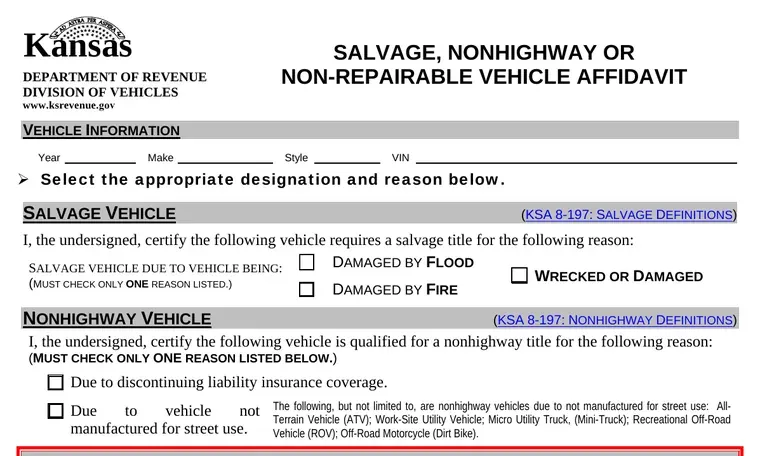
Written against TR-13 (Rev 07/24), issued under K.S.A. 8-197 and 8-135c. Between the nonhighway prongs, the insurance box is the one ordinary sellers actually meet - the project car whose coverage lapsed years ago cannot be re-registered without either restoring insurance or taking the nonhighway title this affidavit applies for. Choose it knowingly: the nonhighway brand stays in the vehicle's history even after a formerly-nonhighway title brings it back, and the buyer's MVE-1 examination is waiting at the far end of the restoration.
Two documents, and they are not the same thing. Take the blank TR-13 from the ksrevenue.gov copy so you get the revision that is current today, then print our TR-13 guide and keep it beside you while you fill theirs in.
This is the actual TR-13, rendered from the PDF the Kansas Department of Revenue, Division of Vehicles publishes and completed end to end: letterhead, every field, and the blocks at the foot.
The salvaged vehicle's year, make, body style and VIN.
Watch out: From the certificate, as always - this affidavit gets attached to that certificate, and the two must describe the same car.
Salvage for flood, fire or wreck damage; nonhighway for dropped insurance or never-street-legal machines; non-repairable for a vehicle that is parts and scrap.
Watch out: One section, and within it one reason. The salvage and nonhighway headers both print must check only one, and a hedged affidavit is a returned one.
If - and only if - the vehicle is truly done: both boxes, the irreversible acknowledgement and the never-registered-anywhere acknowledgement.
Watch out: The form defines irreversible in capitals: the certificate cannot be reversed or removed. No resale as a whole vehicle to anyone but a recycler, in any state, ever. Price that sentence before ticking it.
Signature, date, and hand printed name under the certification that the vehicle stays off the road until insured, retitled and plated.
Watch out: The promise covers the tow to the buyer too - a nonhighway car travels on a trailer, not on a last quiet drive across town.
The affidavit goes with the title to the county treasurer for the salvage, nonhighway or non-repairable title; a transferring seller keeps a copy on file.
Watch out: The buyer's clock is printed in the notice - application for the appropriate title within 30 days of assignment - and your retained copy is the proof of what was disclosed.
| On the form | What to put in it |
|---|---|
| Vehicle Information | The wrecked vehicle's year, make, body style and VIN, across the top row. |
| Salvage Vehicle | The certification that the vehicle requires a salvage title, with three reasons and the instruction to check only one: damaged by flood, damaged by fire, wrecked or damaged. |
| Nonhighway Vehicle | Two reasons, one box each: due to discontinuing liability insurance coverage, or due to vehicle not manufactured for street use - with the printed list of what that covers, from all-terrain vehicles and work-site utility vehicles to off-road motorcycles. |
| Non-Repairable Vehicle | The certification that the vehicle is incapable of safe operation with no resale value except as parts or scrap, or that the owner irreversibly designates it so - and the two boxes that both must be checked, one accepting that irreversible means the certificate cannot be reversed or removed, the other that the vehicle can never be registered or retitled anywhere or sold as a unit except to a recycler. |
| The operation certification | Above the signature: the vehicle will not be operated on the streets or highways of this state until financial security is obtained and a roadworthy title - rebuilt salvage or formerly non-highway - is applied for and a license plate issued. |
| Signature block | The owner's signature, the date, and the hand printed name of the person signing. |
Every line here was read off TR-13 (Rev 07/24) itself — the PDF is here — and off the Kansas Department of Revenue, Division of Vehicles pages. This is plain-language help with a form, not legal advice, and where our wording and the agency's differ, theirs governs.
Back to all Kansas seller paperwork, or what selling a car in Kansas involves.