Sell My Car Hub

How to fill out Kansas TR-212a

The buyer's application - the sheet the county treasurer keys your sale into - and worth a seller's five minutes because every entry the buyer makes is copied off the paperwork you hand over. It collects the owners' names and license numbers, the vehicle, the purchase date and the mileage with its four-box certification, the lienholder and mailing addresses, transfer-on-death beneficiaries, a plate transfer from the buyer's previous vehicle, and a fee column the county completes down the right-hand edge, from title fee through property tax to sales tax and the grand total.
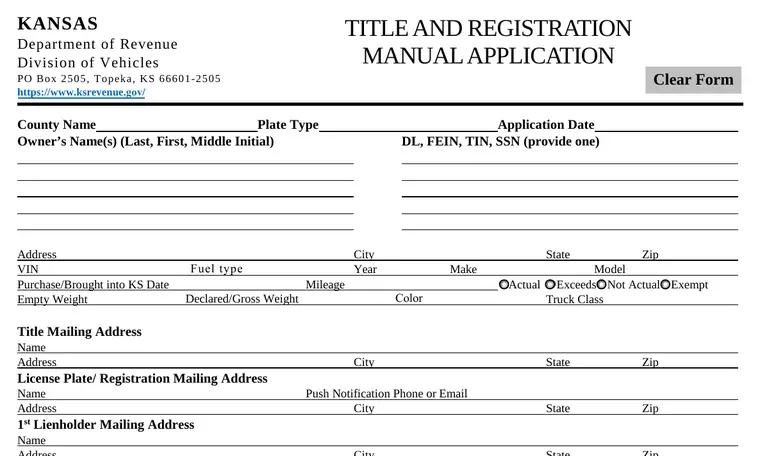
Written against TR-212a (07/24), issued under K.S.A. 8-135(b). This is the buyer's form - a seller signs nothing on it - but the fee column explains a negotiation that surprises people: the buyer's first visit to the treasurer includes sales tax on your agreed price, property tax, and the fee stack, all at once. A buyer who has not budgeted for the counter sometimes tries to renegotiate the price after the handshake. The cure is the one the Division's own pages suggest: agree the price, write it on the assignment and the bill of sale, and let the county do its arithmetic.

Two documents, and they are not the same thing. Take the blank TR-212a from the ksrevenue.gov copy so you get the revision that is current today, then print our TR-212a guide and keep it beside you while you fill theirs in.

Filled in

What a completed one looks like

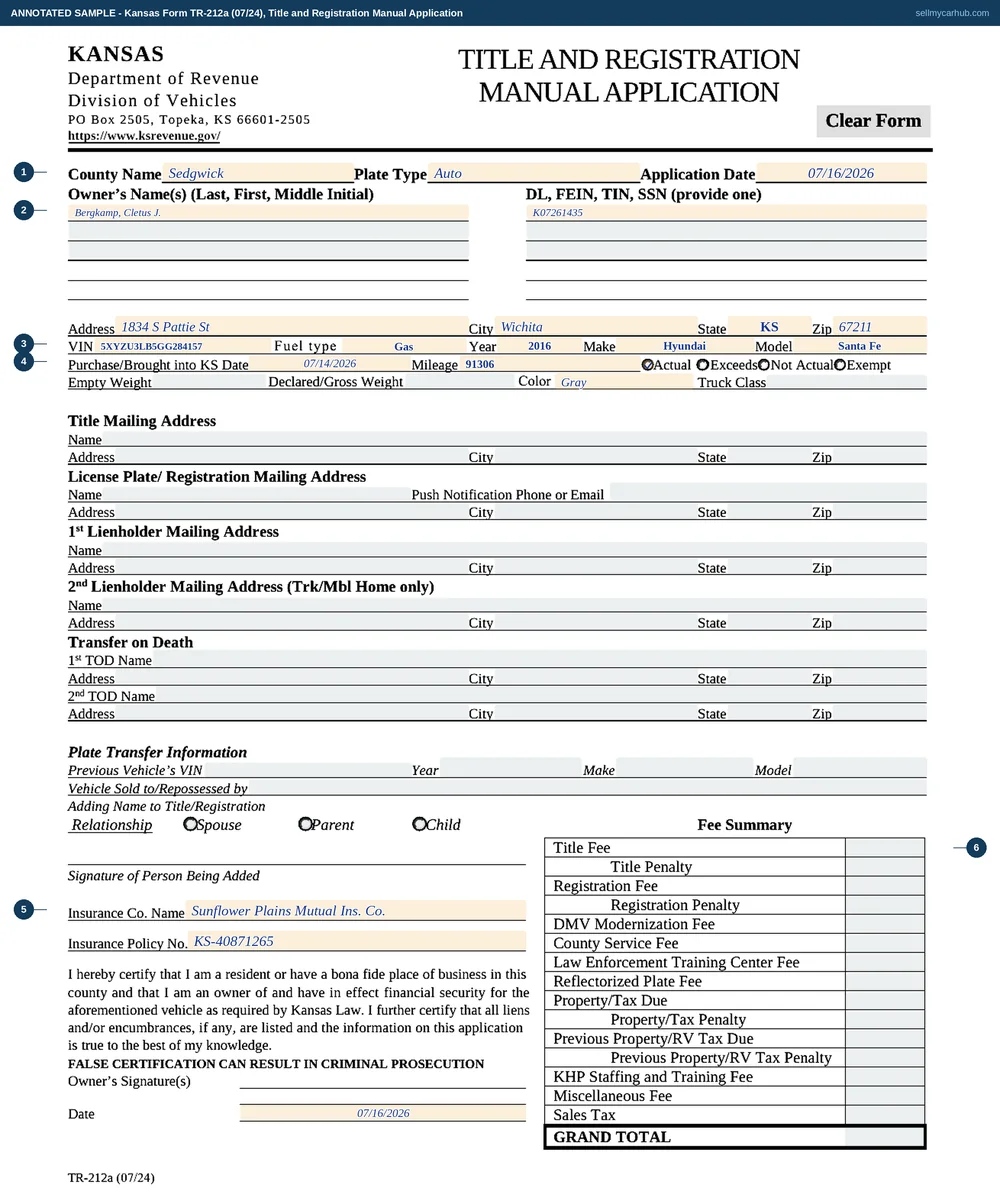
This is the actual TR-212a, rendered from the PDF the Kansas Department of Revenue, Division of Vehicles publishes and completed end to end: letterhead, every field, and the blocks at the foot.

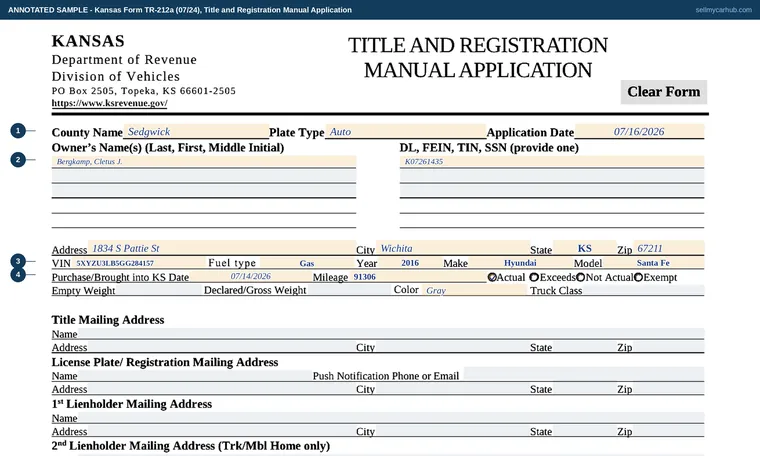
Kansas Form TR-212a Title and Registration Manual Application filled in from the buyer's side: Sedgwick county, application date 07/16/2026, owner Bergkamp, Cletus J. with a Kansas driver's license number, his Wichita address, a 2016 Hyundai Santa Fe with vehicle identification number 5XYZU3LB5GG284157, purchase date 07/14/2026, mileage 91306 with the Actual box ticked, gas fuel type, color gray, no lienholder, the insurance company and policy number completed, and the county's fee summary column left empty.
The application as the buyer files it two days after the sale. Amber is what they complete from your paperwork; the entire fee summary column stays grey because the county treasurer prices the transaction at the counter, and the truck weights, TOD blocks and plate transfer band are grey because this sale uses none of them.
Field by field

Every line, in the order you meet it

  1. 1
    The buyer fills this in

    County and date

    The county where the vehicle will be garaged, the plate type, and the application date.

    Watch out: The 60-day clock is checked here: the county measures the application date against the purchase date lower down, and the penalty line in the fee column is waiting if the gap is longer.

  2. 2
    The buyer fills this in

    Owners and identifiers

    Each owner's name, last name first, with a license number or tax identifier apiece.

    Watch out: The names entered here are the names the next title will print - and the and/or choice between them sets how many signatures that title will need to sell, a decision the buyer inherits from this form.

  3. 3
    The buyer fills this in

    The vehicle and the mileage

    VIN, year, make, model and fuel, then the purchase date, the mileage and one of the four boxes.

    Watch out: Both come straight off the assigned certificate. The Exempt box is for the vehicles the age rule releases - 2010 or older at ten years, 2011 or newer at twenty - not for a reading the buyer forgot to collect.

  4. 4
    The buyer fills this in

    Where things get mailed

    Title mailing address, plate and registration mailing address, and a phone or email for push notifications.

    Watch out: If a lender is financing the purchase, the lienholder block changes where the title goes - a liened Kansas title is held electronically and nothing is mailed until the lien clears.

  5. 5
    The buyer fills this in

    Insurance and the certification

    Company and policy number, then the signature under the residency and financial-security certification.

    Watch out: The warning is printed in capitals - false certification can result in criminal prosecution - and it covers the lien statement as much as the insurance.

  6. 6
    Somebody else fills this in

    The fee column

    Title fee, registration, the state's named fees, property tax, sales tax on the purchase price, and the grand total - all entered by the county treasurer.

    Watch out: The sales tax line is computed from the price on your assignment, in the buyer's home county, and a completed TR-312 pair from a qualifying 120-day sale-and-replacement shrinks it to the difference.

At a glance

What goes where

On the formWhat to put in it
County, plate type and application dateThe header row - which county's counter, what kind of plate, and the day the application is made.
Owner's Name(s)Five rows for owners, last name first, each with a driver's license, FEIN, TIN or SSN - the form wants one identifier per owner.
Address and vehicle bandThe owner's address, then VIN, fuel type, year, make and model on one row.
Purchase date and mileagePurchase/brought into KS date, the mileage, and four boxes to characterise it: Actual, Exceeds, Not Actual, Exempt.
Weights, color and truck classEmpty weight, declared or gross weight, color and class - the truck entries idle on an ordinary car.
Mailing addressesSeparate blocks for where the title goes, where the plate and registration go, and a push notification phone or email.
LienholdersFirst lienholder's name and mailing address, with the second block reserved for trailers and mobile homes.
Transfer on DeathTwo TOD blocks - Kansas titles can name a beneficiary at application, which is what later makes the TR-82 affidavit possible.
Plate transfer and added namesThe previous vehicle's VIN, year, make and model, who it was sold to or repossessed by, and the relationship boxes - spouse, parent, child - for a name being added, with that person's signature.
Insurance and certificationInsurance company and policy number, the certification that the applicant is a resident with financial security in effect, the warning that false certification can result in criminal prosecution, and the owner's signature and date.
Fee SummaryThe column the county completes: title fee, title penalty, registration fee and penalty, the modernization, county service, law enforcement training center and reflectorized plate fees, property tax and its penalty, previous property tax, the highway patrol staffing fee, sales tax, and the grand total.

What gets this one rejected

Rules that decide whether it is accepted

Every line here was read off TR-212a (07/24) itself — the PDF is here — and off the Kansas Department of Revenue, Division of Vehicles pages. This is plain-language help with a form, not legal advice, and where our wording and the agency's differ, theirs governs.

Back to all Kansas seller paperwork, or what selling a car in Kansas involves.

Want the paperwork handled instead?

Get My Instant Offer → Online · about 2 minutes · free

Or send the details — we'll come to you

Sell to us and no county counter, fee column or 60-day clock has your name anywhere near it.

or call/text (877) 405-1808