Sell My Car Hub

How to fill out Kansas TR-312

Kansas's bill of sale, and a form that is honest about its own limits: it opens by declaring itself an affidavit of the amount of money or value that was exchanged, and states that only antique vehicles - 35 years old or older - can have ownership transferred by bill of sale. For everything newer it transfers nothing. What it has become instead, since the 120-day trade-in law took effect, is the tax document that ties your sale to your next purchase: the county treasurer wants a completed TR-312 from both transactions before taxing only the difference.
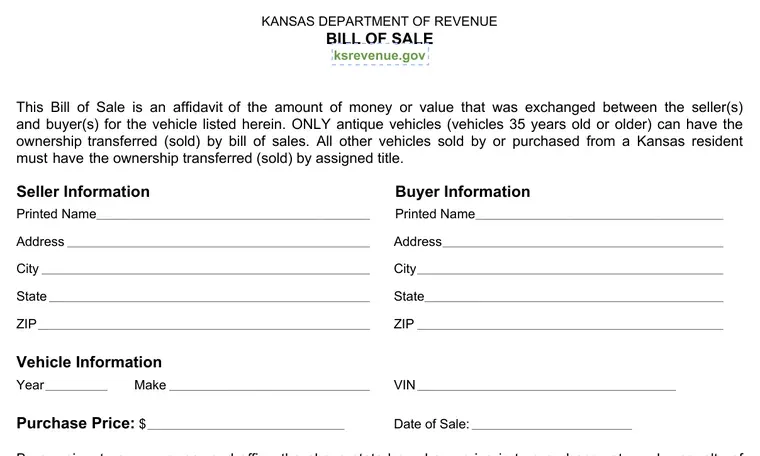
Written against TR-312 (Rev 8-22), issued under K.S.A. 79-3697 and K.A.R. 92-19-30. Do not let the word antique tempt a shortcut on a merely old car. The line is 35 model years, the form draws it twice, and below it the sheet is an affidavit only - a 1998 pickup sold on this form alone has not been sold at all in Kansas law, and the buyer will discover that at the treasurer's counter with your phone number in hand.

Two documents, and they are not the same thing. Take the blank TR-312 from the ksrevenue.gov copy so you get the revision that is current today, then print our TR-312 guide and keep it beside you while you fill theirs in.

Filled in

What a completed one looks like

This is the actual TR-312, rendered from the PDF the Kansas Department of Revenue, Division of Vehicles publishes and completed end to end: letterhead, every field, and the blocks at the foot.

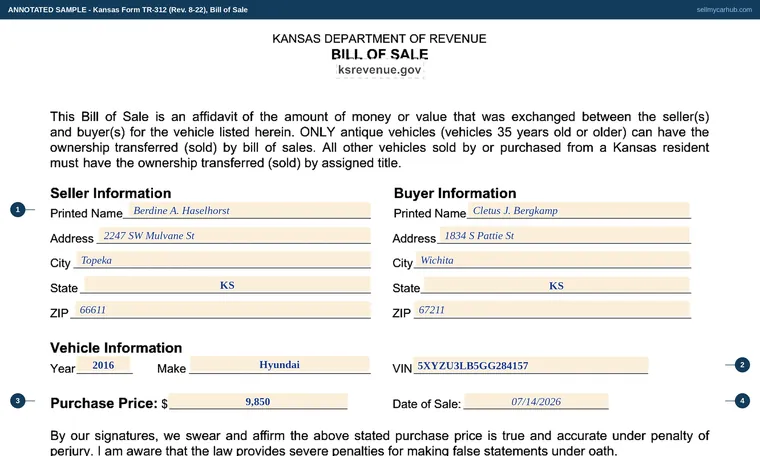
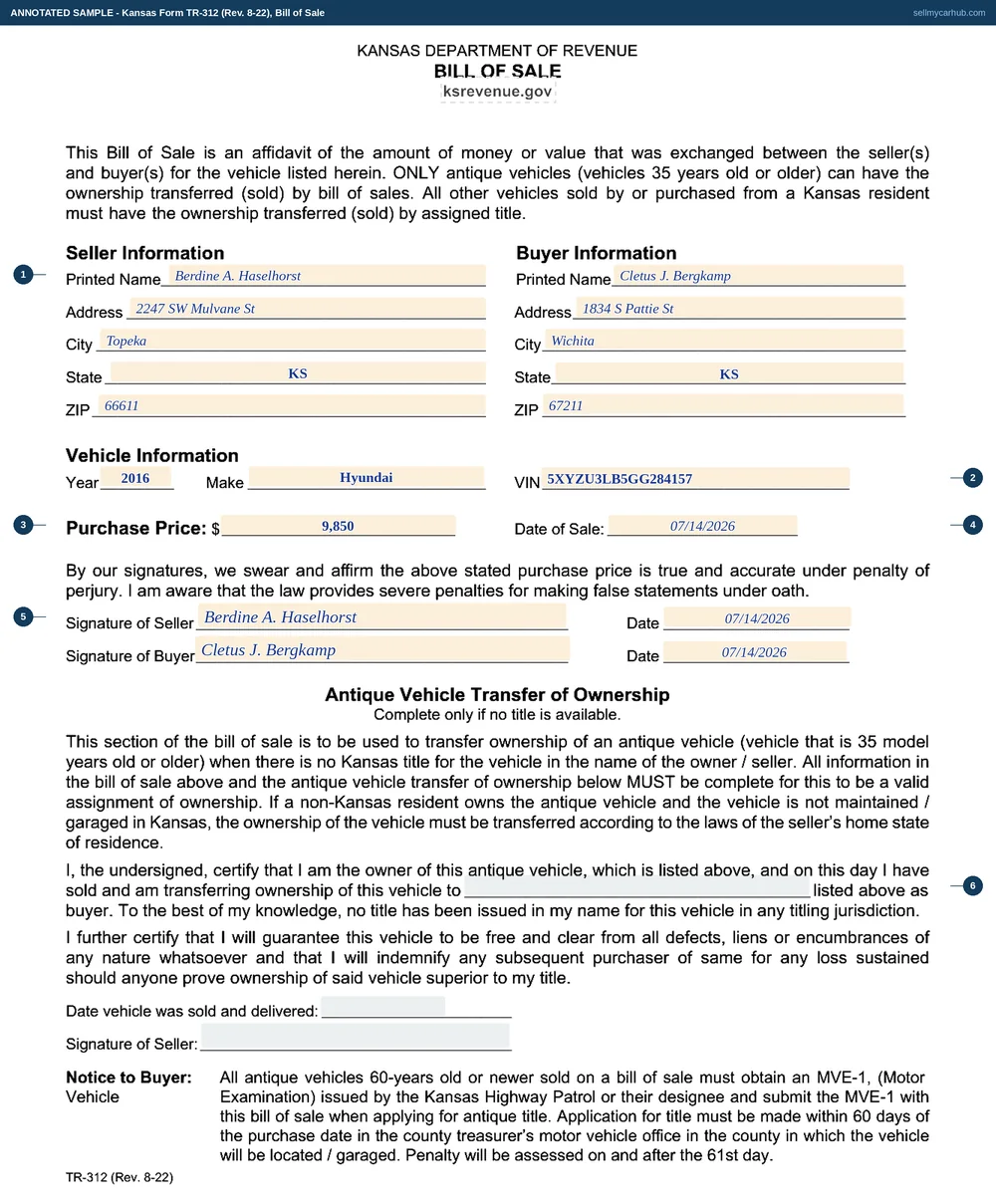
Kansas Form TR-312 Bill of Sale filled in: seller Berdine A. Haselhorst of 2247 SW Mulvane St, Topeka, KS 66611 in the left column, buyer Cletus J. Bergkamp of 1834 S Pattie St, Wichita, KS 67211 in the right, a 2016 Hyundai with vehicle identification number 5XYZU3LB5GG284157, purchase price 9,850 dollars and date of sale 07/14/2026, both signature lines signed and dated the same day, and the antique vehicle transfer of ownership section at the foot left empty.
The whole sheet as the Division publishes it. Amber is the ordinary sale - both parties' columns, the vehicle row, the price and the two signatures. The antique transfer section stays grey because this 2016 Hyundai has a title, and that section's own instruction is complete only if no title is available.
Field by field

Every line, in the order you meet it

  1. 1
    You fill this in

    Seller and buyer columns

    Printed names and full addresses, yours on the left, the buyer's on the right.

    Watch out: Print the buyer's name exactly as it will appear on the title assignment - the tax statute requires at least one buyer and seller here to match the assignment, and the treasurer checks.

  2. 2
    You fill this in

    Year, make and VIN

    The vehicle row, copied from the face of the certificate.

    Watch out: Copy the VIN from the title rather than the dash. If the two disagree, the sale has a bigger problem than this form, and the buyer's county will find it.

  3. 3
    You fill this in

    Purchase price

    The dollar amount actually changing hands, sworn to by both of you.

    Watch out: The county computes the buyer's sales tax from the actual selling price, and the regulation lets the Director substitute fair market value where a stated price bears no reasonable relationship to it. A courtesy lowball helps nobody and is perjury besides.

  4. 4
    You fill this in

    Date of sale

    The day of delivery, beside the price.

    Watch out: Three documents now carry this date - the assignment, this bill of sale and the TR-216 filing if you make one - and the 120-day window for the tax offset is measured from it.

  5. 5
    You fill this in

    Both signatures, both dates

    Signature of Seller and Signature of Buyer, each with its date, under the perjury sentence.

    Watch out: Get the buyer's signature before the car leaves. The offset paperwork needs signatures of the seller and the buyer and the date signed, and chasing a stranger's autograph a month later rarely goes well.

  6. 6
    You fill this in

    The antique half, usually empty

    The Antique Vehicle Transfer of Ownership section, used only for a vehicle 35 model years old or older with no title issued in your name anywhere.

    Watch out: Read its warranty sentence before signing it for a genuine antique: you are guaranteeing the vehicle free and clear of all defects, liens or encumbrances and promising to indemnify any subsequent purchaser if someone proves better ownership.

  7. 7
    You fill this in

    Copies, then the counter

    The buyer takes the original to the county treasurer; you keep a signed copy.

    Watch out: If you buy a replacement within 120 days, your copy plus the bill of sale from the purchase is what the treasurer or the Department needs to tax only the difference - and the claim stays open for three years.

At a glance

What goes where

On the formWhat to put in it
Seller InformationYour printed name, address, city, state and ZIP, down the left-hand column.
Buyer InformationThe buyer's printed name and address, mirrored down the right-hand column.
Vehicle InformationYear, make and VIN on one row - the three identifiers the treasurer matches against the certificate.
Purchase Price and Date of SaleThe dollar figure and the day, side by side. The purchase price here must match the price on the title assignment, because the tax statute behind the 120-day rule requires the sale price, date of sale and at least one buyer and seller on the bill of sale to match the assignment.
The sworn sentencePrinted above the signatures: by our signatures, we swear and affirm the above stated purchase price is true and accurate under penalty of perjury.
Signature of Seller, Signature of BuyerOne signature line and its date for each side. Both sign - a one-sided bill of sale fails the tax statute's own list, which requires signatures of the seller and the buyer and the date signed.
Antique Vehicle Transfer of OwnershipThe lower half of the sheet, used only when there is no title: a certification that you own the antique, that no title was issued in your name in any jurisdiction, and a warranty that you will indemnify any subsequent purchaser should anyone prove superior ownership.
Notice to BuyerThe printed band at the foot: an antique sold on a bill of sale that is 60 years old or newer needs an MVE-1 examination from the Kansas Highway Patrol, and application for title must be made within 60 days of the purchase date, with penalty assessed on and after the 61st day.

What gets this one rejected

Rules that decide whether it is accepted

Every line here was read off TR-312 (Rev 8-22) itself — the PDF is here — and off the Kansas Department of Revenue, Division of Vehicles pages. This is plain-language help with a form, not legal advice, and where our wording and the agency's differ, theirs governs.

Back to all Kansas seller paperwork, or what selling a car in Kansas involves.

Want the paperwork handled instead?

Get My Instant Offer → Online · about 2 minutes · free

Or send the details — we'll come to you

One form sworn under penalty of perjury, matched entries across two documents, and a tax refund that dies on a mismatch - or one offer from us and none of it.

or call/text (877) 405-1808