Kansas transfers a car on the back of the certificate, and the law itself dictates what is printed there: K.S.A. 8-135(c)(2)(A) requires a form for assignment of title to be executed by the owner, a statement of all liens, blank spaces for an abstract of mileage as to each owner, and two reassignment forms reserved to dealers. The Division's instruction for sellers names the entries: purchase price, date of sale, odometer reading, and the print and signatures of seller and buyer. You complete all of it except the buyer's two lines, and nothing on it is notarized.
Last updated .
Your 5 boxes
As a private seller you complete these and nothing else:
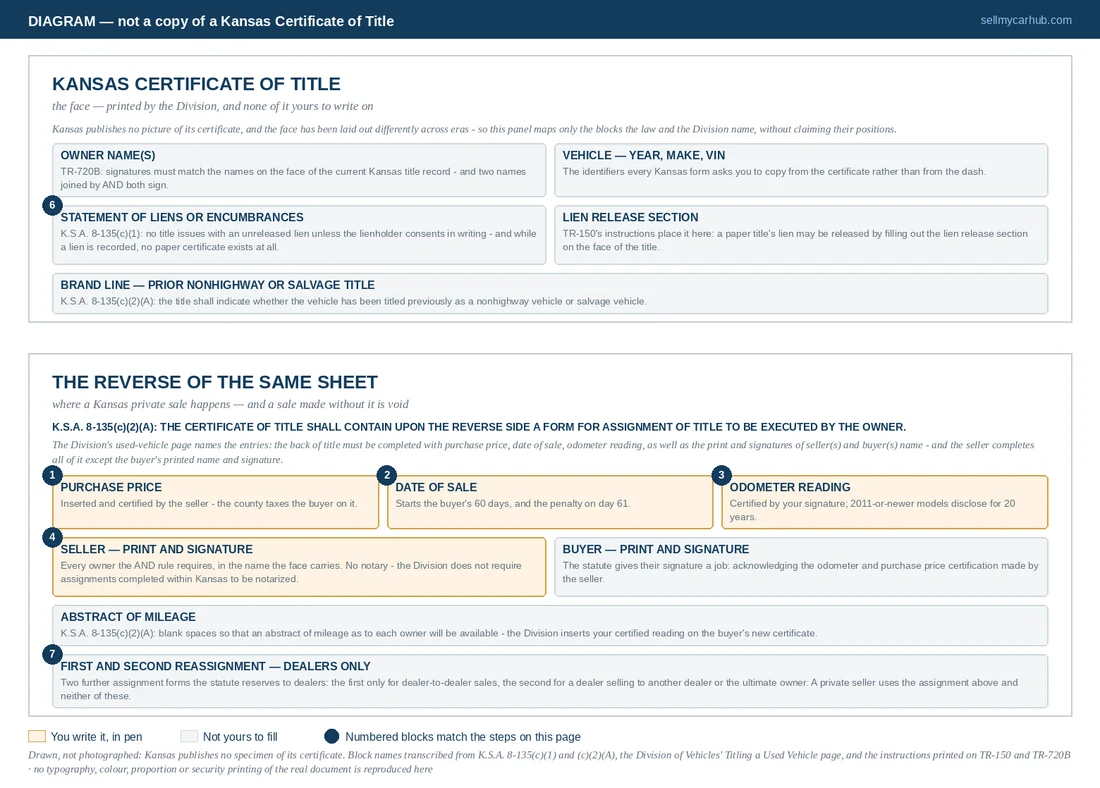
There is no blank Kansas certificate to look at anywhere: the state publishes no specimen, a real one is secure stock in your drawer, and a liened one is not printed at all - it sits in the Division's computer as an electronic title until the release comes in. The diagram below is drawn from the statute and the Division's instructions instead, and says so on its face.
A sale without assignment of the certificate of title is fraudulent and void - K.S.A. 8-135(c)(7).
The statute is the specification here: the certificate of title shall contain upon the reverse side a form for assignment of title to be executed by the owner, with the seller certifying the mileage and the purchase price and the buyer signing to acknowledge both.
A labelled diagram
The certificate, drawn from the statute and the Division's own words
Kansas publishes no specimen of its certificate of title - not in the Dealer and Salesperson Handbook, not on any Division page, not inside any of the seller-facing forms we read. So what follows is a diagram, marked as one: every block on it is named from K.S.A. 8-135, from the Division's titling instructions, or from the form that references it, and the drawing reproduces no typography, colour or security printing of the real document.
Amber — you write it, in pen
Grey — not yours to fill
Numbered — matches the steps below
Click or tap the picture to open it full size.
Drawn, not photographed, and labelled from cited sources only: the assignment side's contents from K.S.A. 8-135(c)(2)(A), the seller's entries from the Division's Titling a Used Vehicle page, and the face's lien release section from TR-150's own instructions.
The seller's half
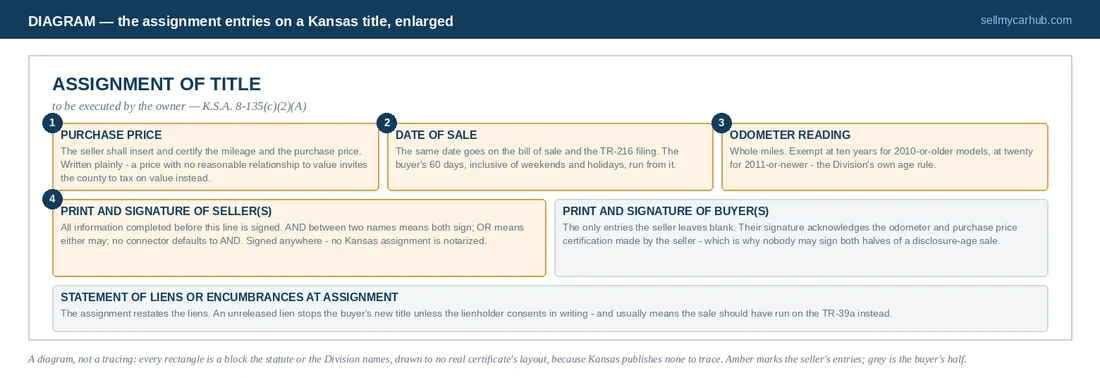
The assignment entries, with the seller's boxes marked
The same diagram's assignment panel, enlarged. Amber is what the Division says the seller completes - all information on the assignment of title except for the buyer's printed name and signature - and the two grey lines are the buyer's, which double as their sworn acknowledgement of your mileage and price entries.
Click or tap the picture to open it full size.
Every rectangle here is a diagram block, not a tracing - Kansas titles vary by era and no public specimen exists to trace. What does not vary is the statute's list of what the assignment carries, and that is what is drawn.
Click or tap the picture to open it full size.
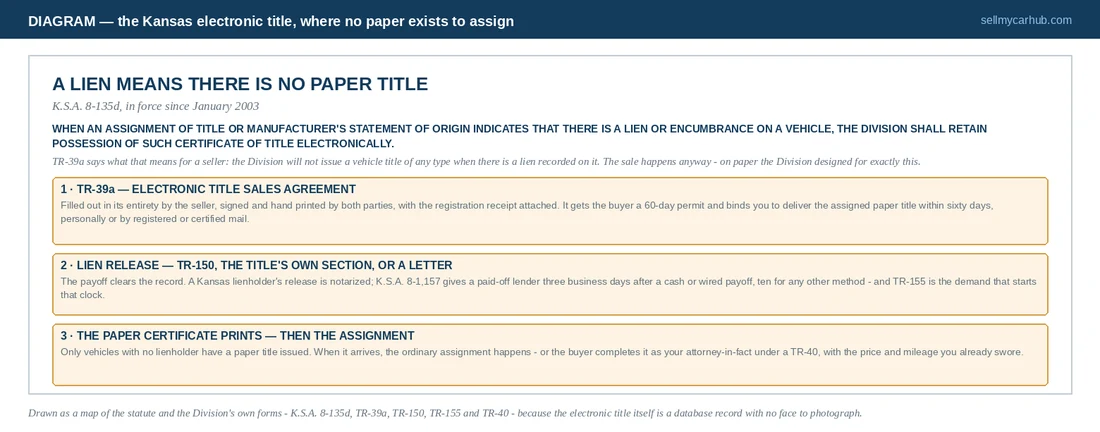
The half of the Kansas story with no certificate in it at all. A lien on the record means the Division is holding the title electronically under K.S.A. 8-135d, and the sale runs on the TR-39a until a clear paper certificate exists to assign.
Step by step
Every box, in the order you meet it
1
You fill this in
Purchase price
Your entry, and a certified one - the statute has the seller insert and certify the mileage and the purchase price, and the county treasurer computes the buyer's sales tax from the actual selling price written here.
Watch out: Kansas needs no separate bill of sale when the price is on the title - Pub. KS-1526's rule is that a bill of sale is not required if the sale price is entered on the vehicle title. Write it plainly; a price the treasurer finds bears no reasonable relationship to fair market value invites the tax to be computed on value instead.
2
You fill this in
Date of sale
The day possession changes. The Division's used-vehicle page counts the buyer's 60 days from the day the title was assigned to the new owner.
Watch out: This date also starts the penalty clock - the county assesses it on and after the 61st day - and it is the date you will certify on the TR-216 notification, so all three must agree.
3
You fill this in
Odometer reading
Whole miles at the moment of transfer, unless the vehicle is exempt: 2010 model year or older vehicles are exempt at ten years, 2011 or newer at twenty.
Watch out: Your signature below this line is the certification, and the buyer's is the acknowledgement - which is why Kansas will not let one person sign both halves of a disclosure-age sale even with a power of attorney, unless it is the dealer-stock secure form.
4
You fill this in
Your printed name and signature
Both, and for every owner the and/or rule requires: names joined by and all sign, names joined by or need only one, and no connector means and.
Watch out: Sign exactly the name the face of the certificate carries. The TR-720B's parallel rule for replacements - signatures of the owners must match the names on the face of the current Kansas title record - is how the county reads every signature you give it.
5
The buyer fills this in
The buyer's printed name and signature
The only two entries the Division leaves to the buyer, and the statute gives their signature a job: acknowledging the odometer and purchase price certification made by the seller.
Watch out: Never hand over a certificate with these blank and the rest complete - that is an assignment in blank, and the statute you are relying on voids sales that travel without a proper assignment.
6
The lienholder fills this in
The lien statement, and the release
The assignment carries a statement of all liens or encumbrances on the vehicle at the time of assignment, and a lien printed on the certificate must be released - in the lien release section on the face, on a notarized TR-150, or by the lienholder's letter.
Watch out: If the loan is still open there is usually no paper certificate at all: the Division holds liened titles electronically and will not print one until the lien clears. That sale runs on the TR-39a, not on this page.
7
Dealers only
The dealer reassignments
Two further assignment forms printed on the reverse, which the statute reserves to dealers - the first for dealer-to-dealer sales, the second for a dealer selling to another dealer or the ultimate owner.
Watch out: A private seller never writes here. If a previous sale filled your assignment block and you are not a dealer, stop and call your county treasurer before anyone signs anything.
8
You fill this in
Then the plate, then the filing
Not on the certificate at all. The plate comes off at delivery because the registration and the right to use it expired at the moment of transfer, and the optional TR-216 notification goes in online for $10.
Watch out: The plate is worth money twice over - $1.50 moves the number to your next vehicle, or the county treasurer refunds the unused registration and property tax from the day the plate reaches the counter.
Before the pen
Before you write on it
Six Kansas habits, and the first exists because the statute voids a sale made without the certificate.
Never sell without the certificate
This is the Kansas rule that outranks every other: a sale without assignment of the title is fraudulent and void under K.S.A. 8-135(c)(7). A missing certificate is replaced for ten dollars on the TR-720B before the sale, not papered over with a handshake and a bill of sale.
Fill in everything except two lines
Price, date, mileage, your printed name, your signature - all yours. The buyer's printed name and signature are the only entries the Division leaves for the other side of the table.
Check the connector between co-owners
And means both of you sign, or means either of you can, and no connector is read as and. Two minutes with the face of the certificate saves a sale-day scramble for an absent co-owner's power of attorney.
No white-out, no write-overs
The Division's forms carry the warning in capitals - any alterations or erasures will void this form - and its registration FAQ refuses lien releases with any erasures, whiteouts, alterations or mutilations. A spoiled certificate becomes a mutilated one: TR-720B, ten dollars, attach the ruined title.
Original ink for any power of attorney
A faxed or photocopied power of attorney will not be accepted - the Division wants all signatures in the original ink, and since January 2025 a replacement-title application signed under one needs a copy of the owner's driver's license attached.
Whole miles, and the right box
The odometer certification takes no tenths. Rolled past its limits gets the mechanical-limits statement; a reading you cannot vouch for gets not actual, and the printed warning beside it - odometer discrepancy - follows the vehicle onto every later title.
The ink rule is the Division of Vehicles' own: “The seller must complete all information on the assignment of title except for the buyer's printed name and signature.”
— Kansas Division of Vehicles, Titling a Used Vehicle.
Check your source
What Kansas sellers get told that is not true
Three confident claims Kansas sellers hear that the Division's own pages contradict. Each correction links its Kansas source.
“A bill of sale transfers the car.”
Not in Kansas, for anything newer than an antique. The TR-312 says it about itself: only antique vehicles, 35 years old or older, can have the ownership transferred by bill of sale - all other vehicles sold by or purchased from a Kansas resident must have the ownership transferred by assigned title. The bill of sale is an affidavit of the price, and since January 2025 its real job is the 120-day sales tax offset, which is why both your sale and your replacement purchase now want one.
“Get the title notarised or the county will bounce it.”
The Division's FAQ says the opposite: it does not require most title assignments, title applications and bills of sale completed within Kansas to be notarized. The notary Kansas does insist on belongs to the lienholder - a release of lien, a lienholder's consent, and the lienholder's portion of the TR-42 are required to be notarized, with out-of-state lienholders excused. If someone met a notary during a Kansas sale, it was the bank's officer, not the seller.
“You cannot sell it until the loan is paid and the paper title is in your hand.”
Kansas built a lane for exactly this sale. Because the Division holds every liened title electronically and will not issue any title while a lien is recorded, the TR-39a Electronic Title Sales Agreement exists to sell the car first: it gets the buyer a 60-day permit, binds you to deliver the properly assigned paper title within sixty days personally or by registered or certified mail, and pairs with a TR-40 power of attorney so the buyer can complete the assignment when the clear certificate finally prints.
Kansas signatures run on two rules - the and/or rule for owners, and no notary for any of them:
Every owner joined by AND
The Division's rule is mechanical: and means all persons listed must sign, or means either person can sign with only one signature required, and a missing connector defaults to and.
The buyer, on the assignment
Their signature is not decoration - the statute makes it the acknowledgement of the odometer and purchase price certification made by the seller.
Nobody in front of a notary
The Division does not require title assignments, title applications or bills of sale completed within Kansas to be notarized. It reserves the right in unusual circumstances, and that is all.
An attorney-in-fact, in original ink
On a TR-41 for a paper title or a TR-40 for an electronic one - the Division will not accept a faxed or photocopied power of attorney, and no one may sign both sides of a disclosure-age sale.
The lienholder, sworn
A lien printed on the certificate is released in the lien release section on its face, on a notarized TR-150, or by the lienholder's letter - the notary belongs to the Kansas lienholder's signature, never to yours.
Once it is signed
Two things follow a completed Kansas assignment. The plate comes off before the car leaves - the registration died at the moment of transfer - and ten dollars on the iKan portal files the notification that ends your liability for what the buyer does next.