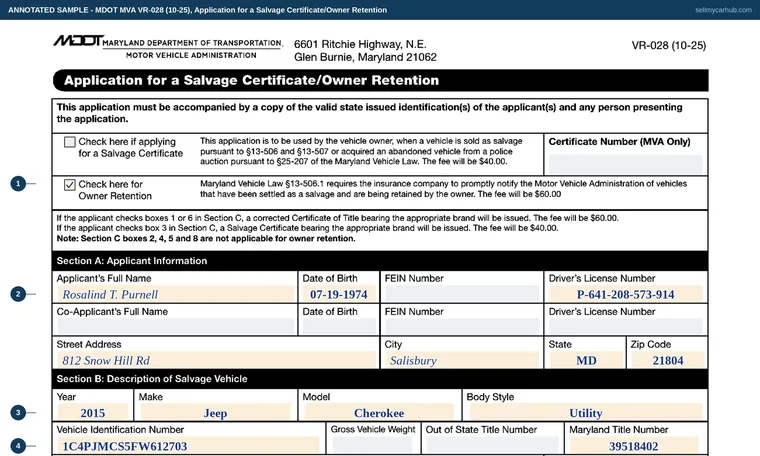
Two different applications printed on one sheet, and the tick at the top decides which one you are making. A Salvage Certificate at $40.00 is an ownership document for a vehicle being sold as salvage; Owner Retention at $60.00 is what happens when an insurer settles a total loss and you keep the car. Section C is where the whole thing is decided - eight numbered statements about the damage, and the one you tick determines what document comes back.
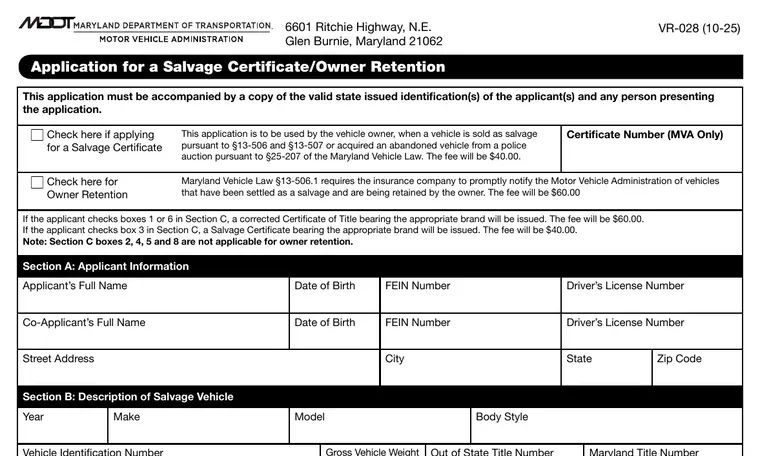
Written against VR-028 (10-25), issued under Maryland Transportation Article, Sections 13-506 and 13-507. There is a real difference between this and the insurer's own form. Where the insurance company has taken the car in settlement, it files a VR-449 and you are not the applicant at all. This one is for the owner who kept it, and for a private owner selling a wreck as salvage.
Two documents, and they are not the same thing. Take the blank VR-028 from the mva.maryland.gov copy so you get the revision that is current today, then print our VR-028 guide and keep it beside you while you fill theirs in.
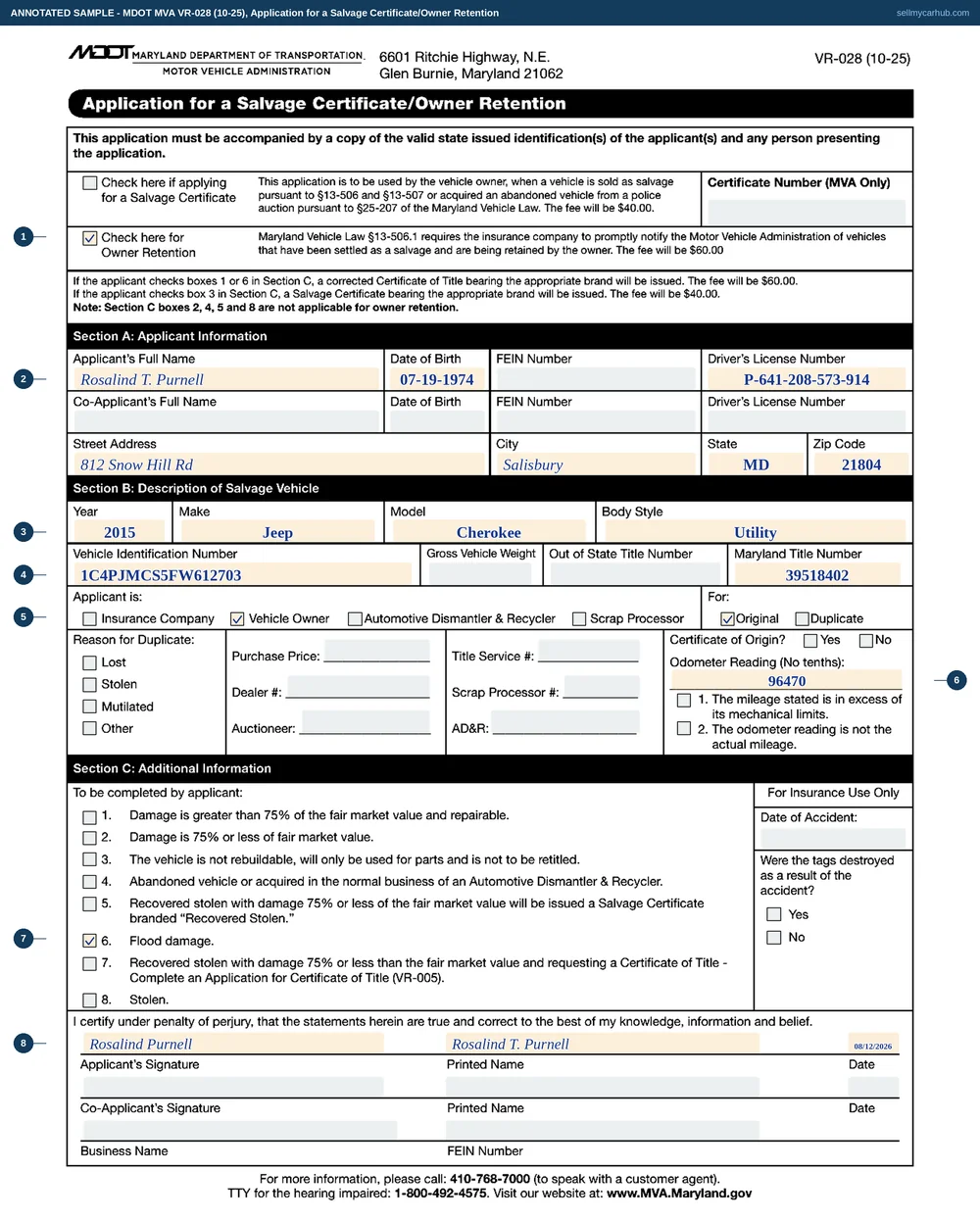
This is the actual VR-028, rendered from the PDF the Maryland Motor Vehicle Administration publishes and completed end to end: letterhead, every field, and the blocks at the foot.
Two ticks at the head of the sheet. Owner Retention for a car you kept after a settlement; Salvage Certificate for one being sold as salvage.
Watch out: This is the fee as well as the form. Owner retention is $60.00 and a salvage certificate is $40.00, and ticking both is how an application comes back unread.
Your details, with a co-applicant row beneath and an address row under that.
Watch out: A copy of the identification goes in the envelope. The instruction at the top of the sheet asks for it from the applicant and from whoever hands the form in, which can be two different people.
Four boxes describing the vehicle, from the certificate you are surrendering with the form.
Watch out: The certificate has to travel with this. There is no version of a salvage application that leaves the title in a drawer.
Two boxes on the second row of section B, with gross vehicle weight and an out-of-state title number between them.
Watch out: The VIN is what the police inspection will later be checked against, so a transposed character here creates a problem months downstream.
Four ticks - insurance company, vehicle owner, automotive dismantler and recycler, scrap processor.
Watch out: Vehicle Owner is the one a private person ticks. If an insurer is applying it is their form and their tick, and most of the boxes below change meaning.
A box on the right of the sheet with the two exception statements underneath it.
Watch out: Read it off the cluster if the cluster still reads. If it does not, tick the second statement rather than guessing a number.
Tick the one that describes the vehicle. Flood damage is 6; damage over 75% and repairable is 1; not rebuildable and for parts only is 3.
Watch out: The note above section A tells you what each choice produces. Statements 1 and 6 give a corrected title with a brand; statement 3 gives a salvage certificate; and statements 2, 4, 5 and 8 are not available on an owner retention at all.
The signature block at the foot, with a second row for a co-applicant and a business name and FEIN line under that.
Watch out: Print as well as sign. The certification above it is a penalty-of-perjury statement about the condition of a vehicle, which is a claim somebody may check.
| On the form | What to put in it |
|---|---|
| The two check boxes at the top | Check here if applying for a Salvage Certificate, used when a vehicle is sold as salvage under sections 13-506 and 13-507 or acquired from a police auction. Check here for Owner Retention, which the law requires the insurance company to notify the MVA about. |
| The fee logic | Printed as a note rather than a table: boxes 1 or 6 in Section C produce a corrected Certificate of Title bearing the appropriate brand at $60.00; box 3 produces a Salvage Certificate at $40.00; and boxes 2, 4, 5 and 8 are not applicable for owner retention. |
| Section A: Applicant Information | Full name, date of birth, FEIN and driver's licence number for applicant and co-applicant, then street address, city, state and ZIP. |
| Section B: Description of Salvage Vehicle | Year, make, model, body style, vehicle identification number, gross vehicle weight, out-of-state title number and Maryland title number. |
| Applicant is | Four ticks - insurance company, vehicle owner, automotive dismantler and recycler, scrap processor - and beside them Original or Duplicate, and a certificate of origin yes or no. |
| Reason for Duplicate | Lost, stolen, mutilated or other, with purchase price, title service number, dealer number, scrap processor number, auctioneer and AD&R boxes alongside. |
| Odometer Reading | A reading box on the right of the sheet marked no tenths, with the mechanical-limits and not-actual-mileage ticks stacked underneath it. |
| Section C, statements 1 to 8 | Damage greater than 75% of fair market value and repairable; damage 75% or less; not rebuildable and for parts only; abandoned or acquired in the normal business of a dismantler; recovered stolen with damage 75% or less, branded Recovered Stolen; flood damage; recovered stolen at 75% or less where a Certificate of Title is wanted instead; and stolen. |
| For Insurance Use Only | A date of accident box and a question about whether the tags were destroyed as a result of the accident. |
| The salvage definition on the reverse | Damaged by collision, fire, flood, accident, trespass or other occurrence to the extent the cost to repair the vehicle for legal operation safely on a highway exceeds 75% of the fair market value prior to sustaining the damage, with the categories each brand corresponds to. |
Every line here was read off VR-028 (10-25) itself — the PDF is here — and off the Maryland Motor Vehicle Administration pages. This is plain-language help with a form, not legal advice, and where our wording and the agency's differ, theirs governs.
Back to all Maryland seller paperwork, or what selling a car in Maryland involves.