Sell My Car Hub

How to fill out Maryland VR-449

Not your form, and it is on this page for exactly that reason. When an insurer settles a total loss and takes the car, it applies for a salvage certificate in its own name - and if your certificate of title is defective, lost or destroyed, this affidavit stands in for it. Your name is at the top of it and you sign nothing on it, which is a combination worth recognising before somebody asks you to.
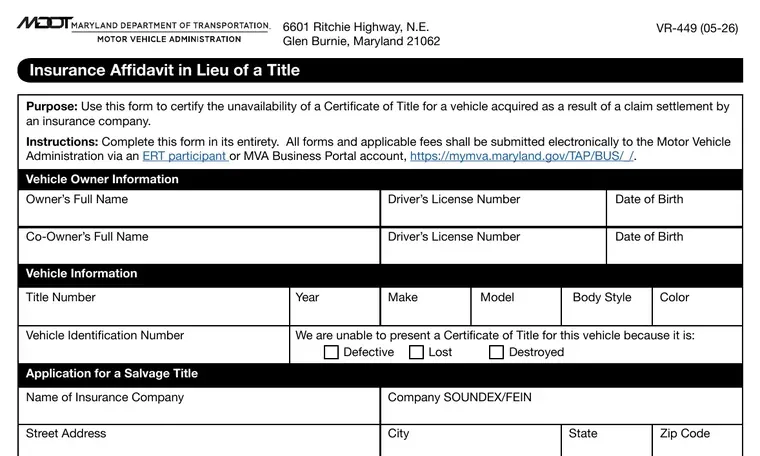
Written against VR-449 (05-26), issued under Maryland Transportation Article, Section 13-506.1. If you kept the car after the settlement rather than surrendering it, this is the wrong form entirely and the VR-028 is the right one. The difference is possession, and the salvage statute turns on it: a vehicle has not been acquired by an insurance company if the owner retains possession of it.

Two documents, and they are not the same thing. Take the blank VR-449 from the mva.maryland.gov copy so you get the revision that is current today, then print our VR-449 guide and keep it beside you while you fill theirs in.

Filled in

What a completed one looks like

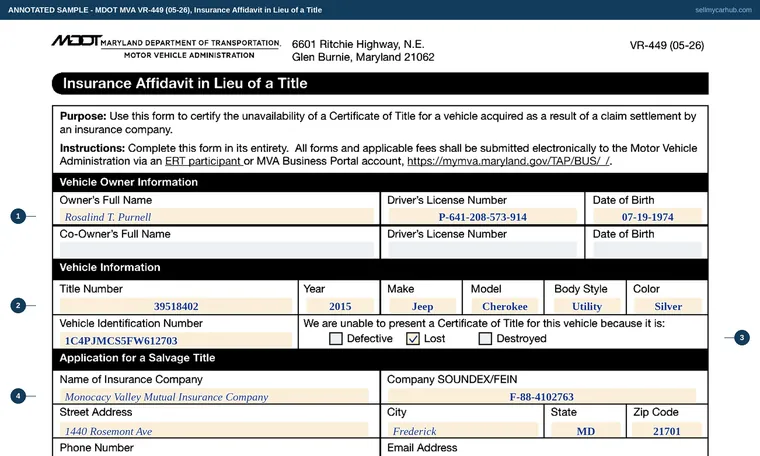
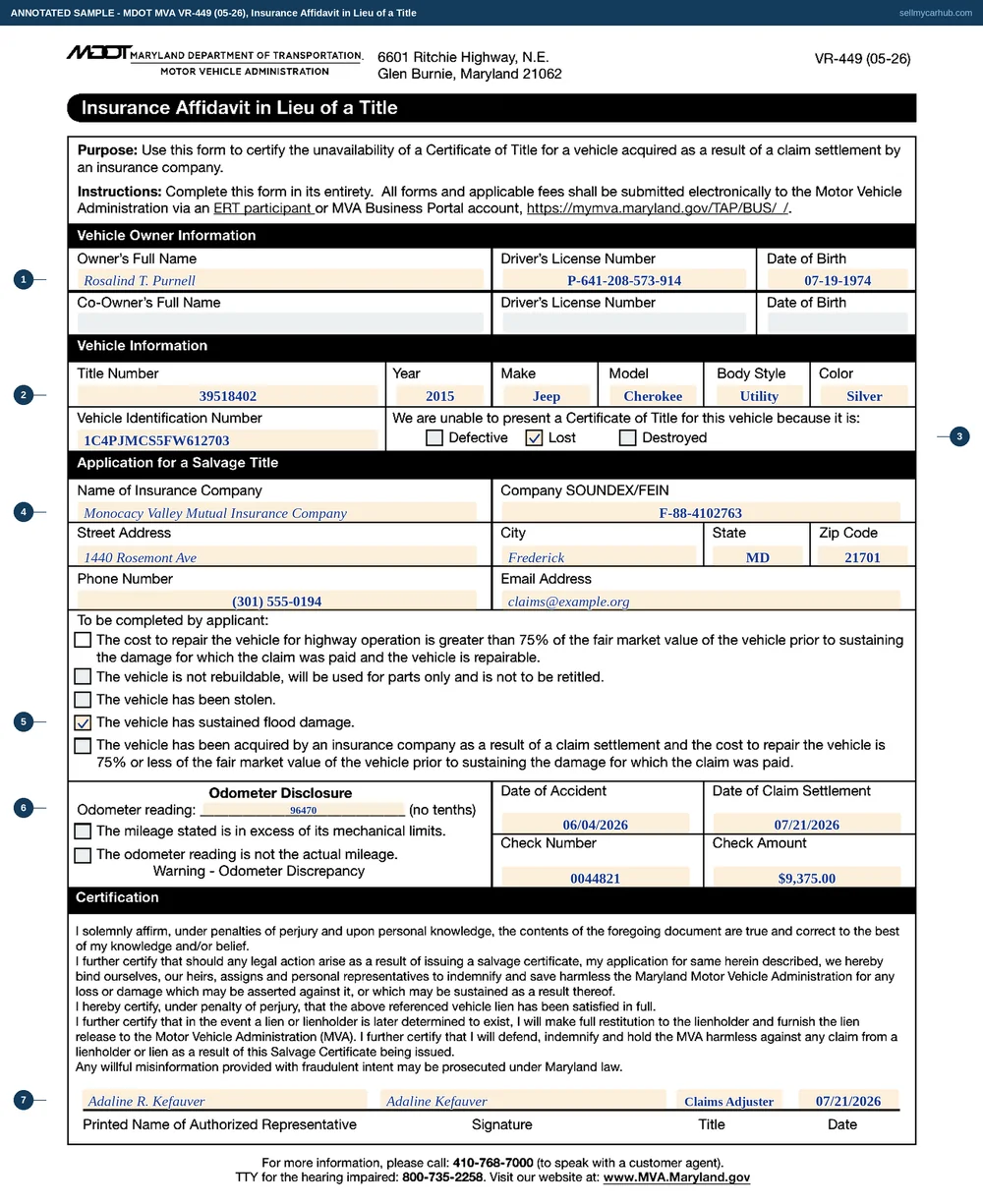
This is the actual VR-449, rendered from the PDF the Maryland Motor Vehicle Administration publishes and completed end to end: letterhead, every field, and the blocks at the foot.

A Maryland VR-449 insurance affidavit in lieu of a title filled in from the insurer's side: owner Rosalind T. Purnell with a driver's licence number and date of birth, a 2015 Jeep Cherokee in Billet Silver with VIN 1C4PJMCS5FW612703, the Lost box ticked, the applicant named as Monocacy Valley Mutual Insurance Company with an address and phone number, flood damage selected, an odometer reading of 96470, a date of accident and date of claim settlement, a check number and amount, and the authorised representative's signature at the foot.
The actual VR-449 at revision 05-26. The owner's block at the top is the only part of the sheet about the seller, and the single signature at the foot belongs to the insurance company - which is the clearest illustration of whose form this is.
Field by field

Every line, in the order you meet it

  1. 1
    You fill this in

    Owner's Full Name, DL Number, Date of Birth

    The top block, describing the person the vehicle was titled to.

    Watch out: This is where your details end. Check them if you are shown the form, because a mismatch here is what stalls a filing you have no other visibility of.

  2. 2
    The lienholder fills this in

    Title Number and Vehicle Information

    Title number, year, make, model, body style, colour and VIN, completed by the insurer from its claim record.

    Watch out: Give the insurer the title details early. An adjuster working from a photograph of a wing mirror does not have the title number, and this is the form that needs it.

  3. 3
    The lienholder fills this in

    Defective, Lost or Destroyed

    Three ticks explaining why the certificate cannot be presented.

    Watch out: If you still have the certificate, none of these apply and this form is unnecessary. Handing the title over at settlement is the cheaper, simpler path.

  4. 4
    The lienholder fills this in

    Name of Insurance Company and SOUNDEX/FEIN

    The applicant block: the company, its identifier, address, phone number and email.

    Watch out: The applicant is the insurer. If your own name appears in this block, somebody has misunderstood which of the two salvage forms is being filed.

  5. 5
    The lienholder fills this in

    The five damage statements

    One selection, from repair cost over 75% and repairable through to acquisition at 75% or less.

    Watch out: This is the statement that decides the brand on the record, and the record follows the VIN for the rest of the vehicle's life.

  6. 6
    The lienholder fills this in

    Odometer Reading, Date of Accident, Date of Settlement

    Three boxes across the middle of the sheet, with the two odometer exception ticks beneath the reading.

    Watch out: Photograph the odometer before the car is collected. Once the vehicle has gone, the reading on this form is the only one anybody has.

  7. 7
    The lienholder fills this in

    Printed Full Name of Authorized Representative and Signature

    One row at the foot: printed name, signature, title and date. There is no owner signature line anywhere on the form.

    Watch out: If you are handed this to sign, stop. The absence of a line for you is the form telling you it is somebody else's document.

At a glance

What goes where

On the formWhat to put in it
PurposeUse this form to certify the unavailability of a Certificate of Title for a vehicle acquired as a result of a claim settlement by an insurance company.
InstructionsAll forms and applicable fees shall be submitted electronically to the Motor Vehicle Administration via an ERT participant or MVA Business Portal account - so this never arrives on paper at a counter.
Vehicle Owner InformationOwner's full name, driver's licence number and date of birth, with a co-owner row underneath. This is you, and it is the only part of the sheet that is about you.
Vehicle InformationTitle number, year, make, model, body style, colour and vehicle identification number, then three ticks for why the certificate cannot be presented: Defective, Lost, Destroyed.
Application for a Salvage TitleName of the insurance company, its SOUNDEX or FEIN, street address, city, state, ZIP, phone number and email address.
To be completed by applicantFive statements, one to be chosen: repair cost greater than 75% of fair market value and repairable; not rebuildable and for parts only; the vehicle has been stolen; the vehicle has sustained flood damage; or acquired by an insurance company as a result of a claim settlement where the repair cost is 75% or less.
Odometer DisclosureA reading box marked no tenths with the two exception ticks, beside the date of accident and date of claim settlement.
Check Number and Check AmountTwo boxes recording the settlement payment itself.
CertificationA solemn affirmation, an indemnity holding the MVA harmless, and a separate certification that any lien on the vehicle has been satisfied in full with a promise of restitution and a lien release if one later appears.
SignatureOne line only, at the foot: printed full name of authorized representative, signature, title and date - all of them the insurance company's.

What gets this one rejected

Rules that decide whether it is accepted

Every line here was read off VR-449 (05-26) itself — the PDF is here — and off the Maryland Motor Vehicle Administration pages. This is plain-language help with a form, not legal advice, and where our wording and the agency's differ, theirs governs.

Back to all Maryland seller paperwork, or what selling a car in Maryland involves.

Want the paperwork handled instead?

Get My Instant Offer → Online · about 2 minutes · free

Or send the details — we'll come to you

Settled with the insurer, kept the car, and now cannot work out what it is worth to anyone? Tell us about it - a brand on the record does not stop us buying.

or call/text (877) 405-1808