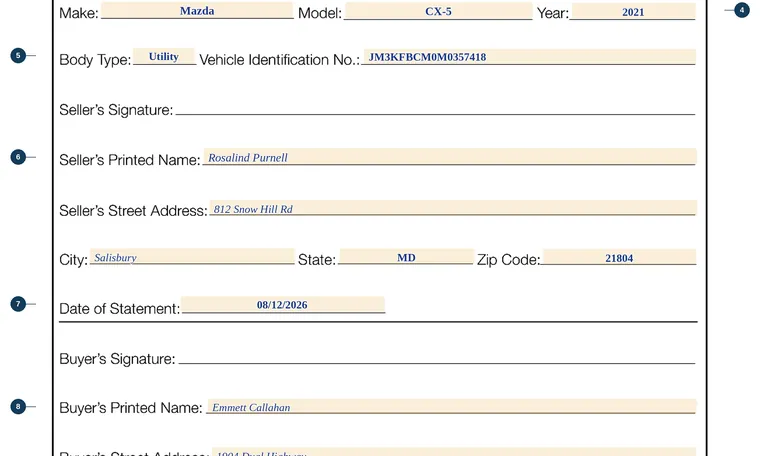
A separate mileage statement for the times the printed box on the certificate is not available or not enough - a title held by a lender, a duplicate on its way, a certificate whose odometer box has already been used. Maryland puts the disclosure on the title itself, so on an ordinary sale this form is a second copy rather than the main event, and it is printed in triplicate: white to the MVA, canary to the seller, pink to the buyer.
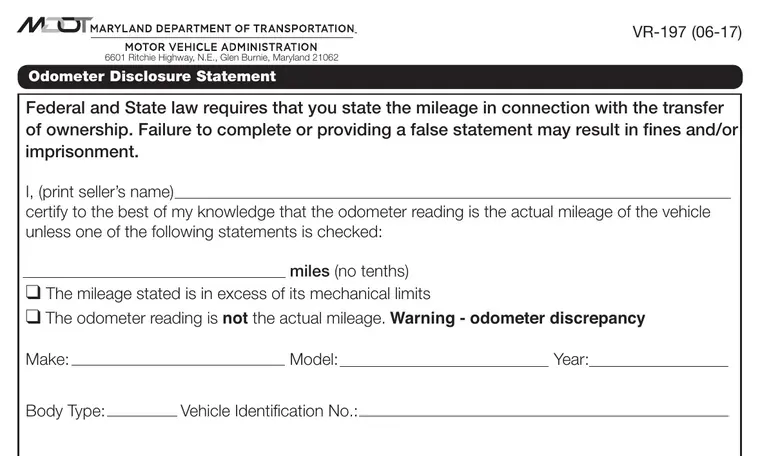
Written against VR-197 (06-17), issued under 49 CFR Part 580 and Maryland Transportation Article, Section 13-112. The revision printed on this one is from 2017 and it is the oldest form in the seller's set. It is still what the MVA publishes, which is why the page is written against it - but check the code in the corner before you rely on a copy you saved.
Two documents, and they are not the same thing. Take the blank VR-197 from the mva.maryland.gov copy so you get the revision that is current today, then print our VR-197 guide and keep it beside you while you fill theirs in.
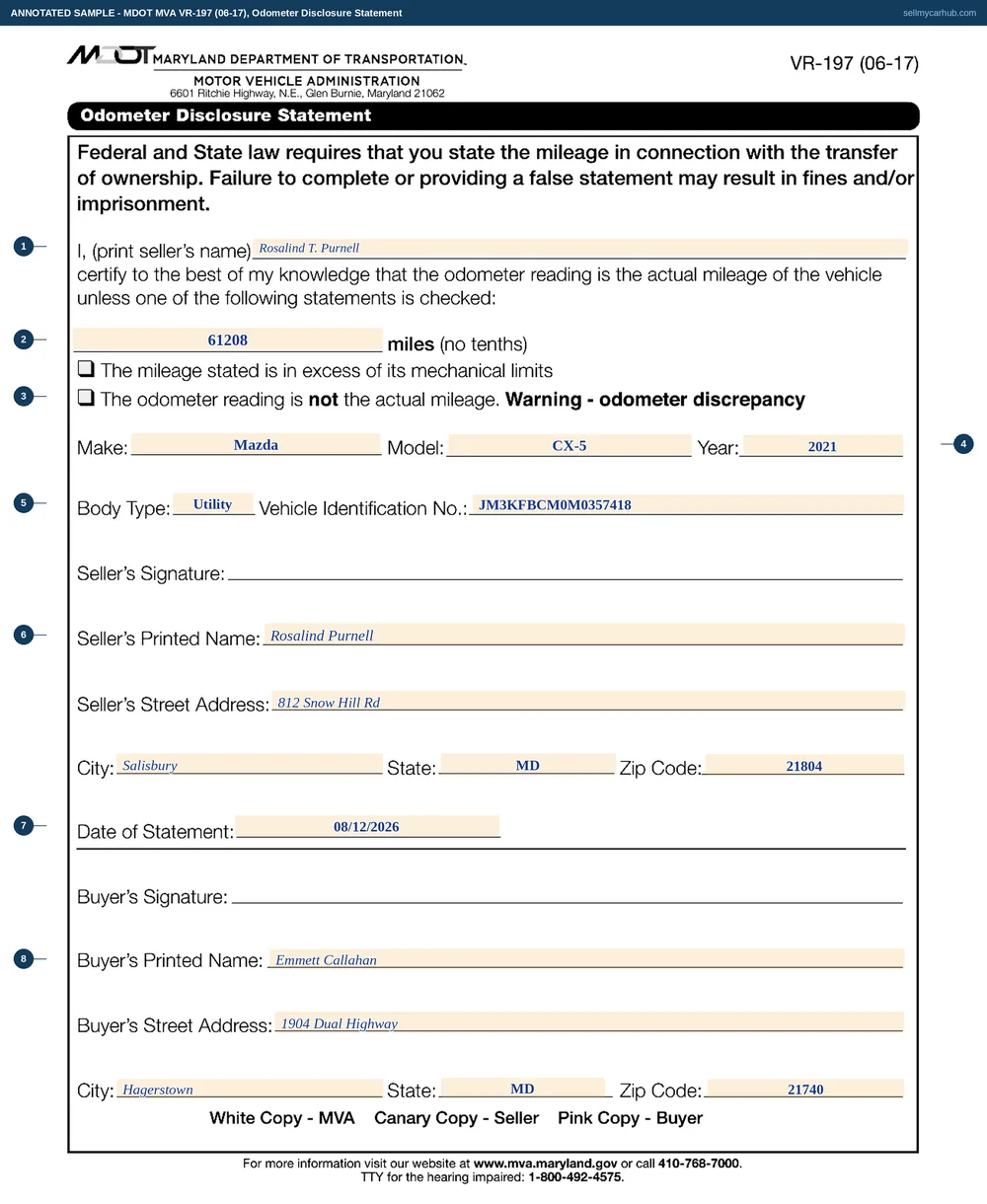
This is the actual VR-197, rendered from the PDF the Maryland Motor Vehicle Administration publishes and completed end to end: letterhead, every field, and the blocks at the foot.
The first rule on the sheet, inside the certification sentence.
Watch out: Print it as the face of the certificate has it, middle initial included. This is a certification in your name and it should be recognisable as yours.
Whole miles in the box marked no tenths, read on the day you sign rather than the day the buyer first looked at the car.
Watch out: A fortnight of test drives is a different number. If the reading has moved since you last wrote it down, write the new one and change the certificate to match before anyone signs.
Tick the first for a reading in excess of its mechanical limits, the second for a reading that is not the actual mileage.
Watch out: Ticking the second one puts a permanent warning on the vehicle's record. It is still the right answer where it is true, and the warning is printed on the form precisely so that nobody can claim not to have seen it.
Three boxes across the middle of the sheet, taken from the certificate rather than the dashboard.
Watch out: Trim names are a trap on this row. The title's make and model are what the MVA has on file and what this statement has to agree with.
The row underneath, with the VIN in the wider box.
Watch out: Check it back against the certificate character by character. The VIN is what ties this loose sheet of paper to the vehicle it is about.
Four rules down the middle of the sheet: signature, printed name, street address, then city, state and ZIP.
Watch out: There is no notary block on this form and there is not meant to be. Do not go looking for one, and do not let anybody tell you the mileage statement has to be sworn in Maryland.
One box under the seller's address. The day you signed.
Watch out: It should match the DATE OF SALE box on the reverse of the certificate. A gap between the two invites the question of which document describes the transaction.
The last four rules on the sheet, mirroring yours.
Watch out: Keep the canary copy with the buyer's signature on it. It is the only proof you will have that the disclosure was made before the vehicle changed hands, which is what the federal rule actually requires.
| On the form | What to put in it |
|---|---|
| The federal warning | Federal and State law requires that you state the mileage in connection with the transfer of ownership. Failure to complete or providing a false statement may result in fines and/or imprisonment. |
| I, print seller's name | A rule inside the certification sentence. Your name, printed, as it appears on the face of the certificate. |
| The reading | A box marked miles, no tenths, under the words certifying it to be the actual mileage of the vehicle unless one of the following statements is checked. |
| The two exception boxes | The mileage stated is in excess of its mechanical limits, and the odometer reading is not the actual mileage, the second of them followed by the words Warning - odometer discrepancy. |
| Vehicle block | Make, model and year on one row; body type and vehicle identification number on the next. |
| Seller block | Signature, printed name, street address, then city, state and ZIP, then the date of statement. |
| Buyer block | The mirror image at the foot: signature, printed name, street address, city, state and ZIP. |
| The distribution line | White Copy - MVA, Canary Copy - Seller, Pink Copy - Buyer. It is a three-part form and each party is meant to walk away with one. |
Every line here was read off VR-197 (06-17) itself — the PDF is here — and off the Maryland Motor Vehicle Administration pages. This is plain-language help with a form, not legal advice, and where our wording and the agency's differ, theirs governs.
Back to all Maryland seller paperwork, or what selling a car in Maryland involves.