Sell My Car Hub

How to fill out Maryland VR-181

The only document in a Maryland private sale that a notary ever touches, and it is not the title. One sheet that records the vehicle, the mileage, the buyer, the sum received and - the box everyone skips - the reason the vehicle may be purchased for a price less than fair market value. It exists to prove a price to the Administration, and it is worth nothing for that purpose unless it is sworn.
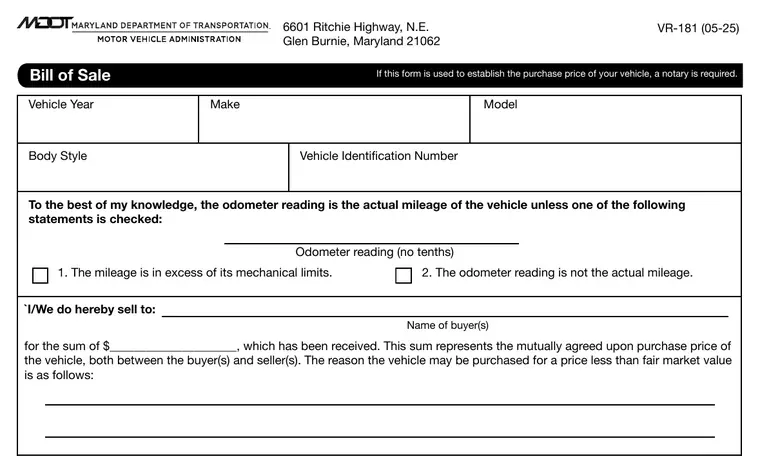
Written against VR-181 (05-25), issued under Maryland Transportation Article, Section 13-809. Do not sign this one at the kitchen table and carry it to a notary afterwards. Both of you signing in front of the same notary at the same sitting is the cheapest version of this errand and the only one that matches the words printed under the signature block.

Two documents, and they are not the same thing. Take the blank VR-181 from the mva.maryland.gov copy so you get the revision that is current today, then print our VR-181 guide and keep it beside you while you fill theirs in.

Filled in

What a completed one looks like

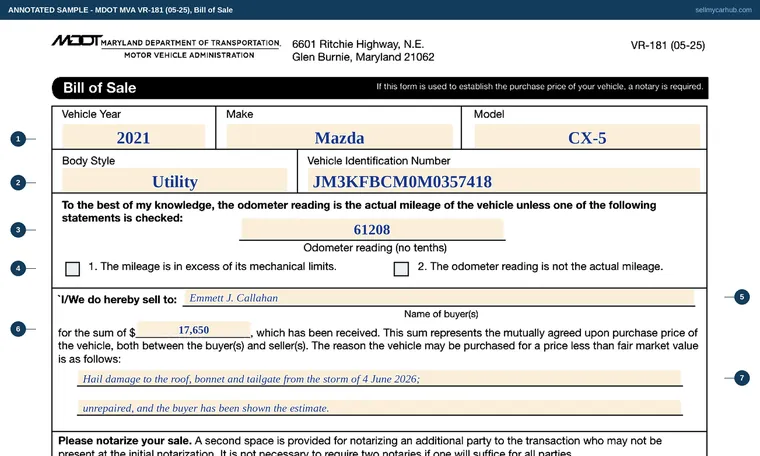
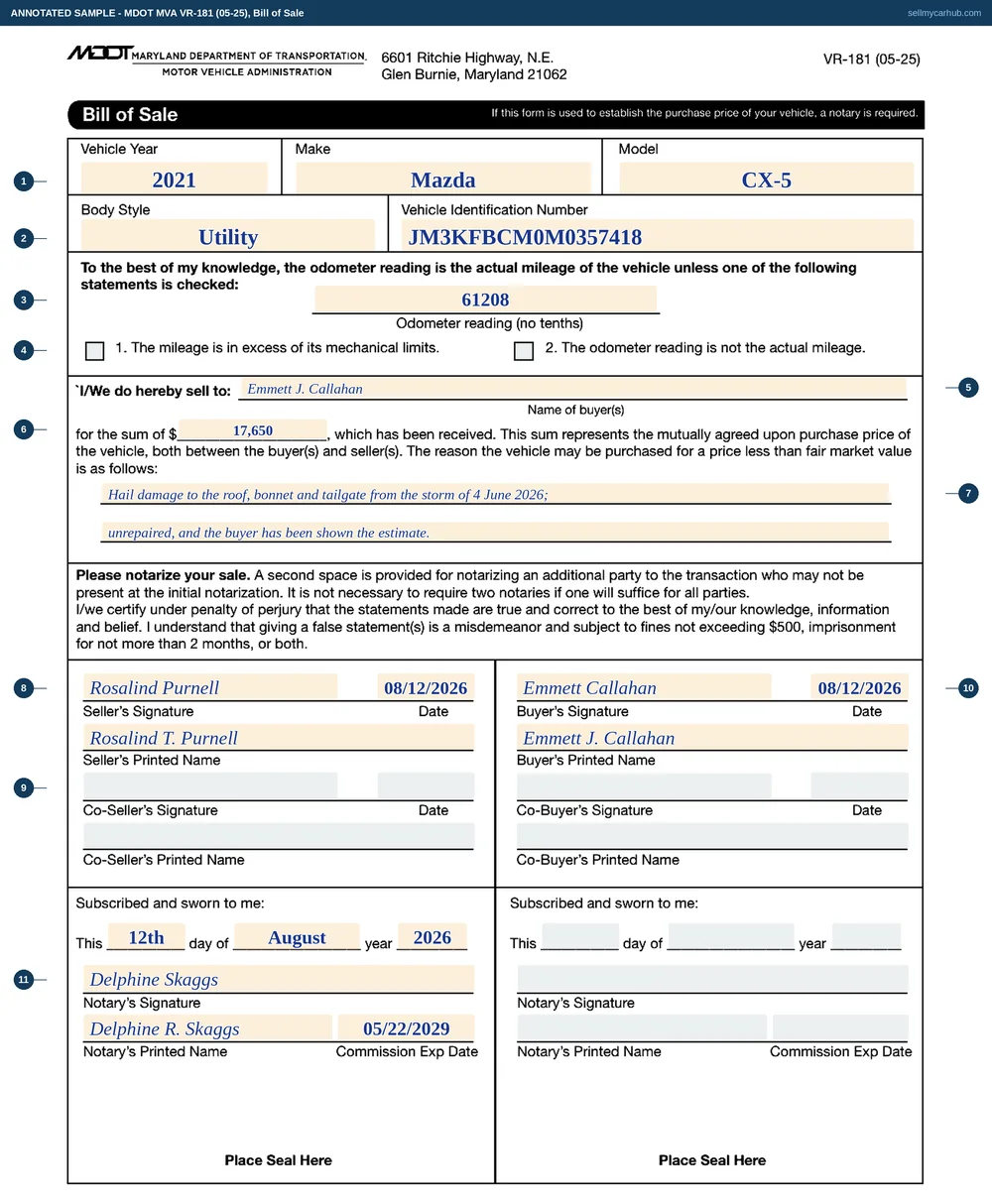
This is the actual VR-181, rendered from the PDF the Maryland Motor Vehicle Administration publishes and completed end to end: letterhead, every field, and the blocks at the foot.

A Maryland VR-181 bill of sale filled in and notarised: a 2021 Mazda CX-5, VIN JM3KFBCM0M0357418, odometer 61208 with neither exception box ticked, sold to Emmett J. Callahan for 17,650 dollars, the reason line explaining hail damage to the roof and bonnet, seller Rosalind T. Purnell and the buyer signing and dating on 12 August 2026, and a completed notary block naming Delphine R. Skaggs with a commission expiry date.
The actual VR-181 at revision 05-25. Note that the reason line is used rather than skipped: on a 2021 car sold below book value it is the sentence that decides whether the Administration taxes the buyer on the price or on the guide.
Field by field

Every line, in the order you meet it

  1. 1
    You fill this in

    Vehicle Year, Make, Model

    Three boxes across the top of the sheet, copied from the face of the certificate.

    Watch out: From the title, not from the registration card and not from memory. A model written as CX5 where the title says CX-5 is the kind of small mismatch that gets a document handed back.

  2. 2
    You fill this in

    Body Style and Vehicle Identification Number

    The second row. The VIN box is wide because it holds seventeen characters.

    Watch out: Read it back against the title one character at a time. Eight and B, zero and D, five and S are the pairs that go wrong.

  3. 3
    You fill this in

    Odometer reading

    A box in the middle of the certification sentence, marked no tenths.

    Watch out: This is the third place the same number has to appear - the certificate, this form, and the buyer's application. Write the certificate first and copy from it twice.

  4. 4
    You fill this in

    The two exception boxes

    Tick 1 where the mileage is in excess of its mechanical limits, or 2 where the odometer reading is not the actual mileage.

    Watch out: Both empty is a positive statement that the reading is true, not a neutral one. On a car with a replaced cluster, ticking 2 is the honest answer and leaving it is a false certification under the perjury line at the foot.

  5. 5
    You fill this in

    Name of buyer(s)

    The rule after the printed words I/We do hereby sell to.

    Watch out: Every buyer who is going on the title goes on this line. If a couple are buying jointly and only one name appears here, the bill of sale no longer matches the certificate.

  6. 6
    You fill this in

    for the sum of

    The amount actually received, inside the sentence that certifies it as the mutually agreed upon purchase price.

    Watch out: The same figure as the SELLING PRICE box on the back of the title. This document exists to corroborate that box, so a disagreement between the two destroys its only purpose.

  7. 7
    You fill this in

    The reason the vehicle may be purchased for a price less than fair market value

    Two long rules under the sum. Say plainly what is wrong with the car or what the circumstances were.

    Watch out: Write something specific. Hail damage across the roof and bonnet, or a failed transmission, or a sale to a family friend - the Administration is deciding whether to believe a number, and a blank line gives it nothing to believe.

  8. 8
    You fill this in

    Seller's Signature and Date

    Left-hand column, first row of the signature grid, with the printed name on the line underneath.

    Watch out: Sign in front of the notary. Everything below this row is a notary certifying that you appeared, and a pre-signed form makes that certificate untrue.

  9. 9
    You fill this in

    Co-Seller's Signature and Printed Name

    The row below yours, used where the certificate names a second owner.

    Watch out: If the second owner cannot be there, that is exactly what the form's second notary block is for - the sworn statement can be taken later without redoing the sheet.

  10. 10
    The buyer fills this in

    Buyer's Signature, Date and Printed Name

    The right-hand column, mirroring the seller's side.

    Watch out: The MVA wants a bill of sale signed by all buyers and sellers. A form the buyer has not signed does not establish anything about a price two people agreed.

  11. 11
    The buyer fills this in

    Subscribed and sworn to me

    The day, month and year, then the notary's signature, printed name, commission expiry date and seal.

    Watch out: Maryland banks and shipping shops both do this and often free for customers. Check that the commission expiry date is actually written - an empty expiry line is the commonest defect in an otherwise perfect notary block.

At a glance

What goes where

On the formWhat to put in it
The line under the titleIf this form is used to establish the purchase price of your vehicle, a notary is required. That sentence is the whole reason the form has a notary block.
Vehicle blockYear, make and model across the first row; body style and vehicle identification number across the second.
Odometer certificationA reading box marked no tenths, sitting under the certification that it is the actual mileage unless one of two statements is checked - in excess of its mechanical limits, or not the actual mileage.
I/We do hereby sell toName of buyer or buyers, on a rule that runs almost the full width of the sheet.
for the sum ofThe figure received, inside a printed sentence saying that it has been received and that it represents the mutually agreed upon purchase price of the vehicle, both between the buyer(s) and seller(s).
The reason boxTwo rules under the printed words: the reason the vehicle may be purchased for a price less than fair market value is as follows. This is the box the Administration reads when it decides whether to accept your figure.
The perjury certificationI/we certify under penalty of perjury that the statements made are true and correct, with the penalty spelled out: giving a false statement is a misdemeanor and subject to fines not exceeding $500, imprisonment for not more than 2 months, or both.
Signature gridFour pairs of boxes: seller's signature and date with printed name below, co-seller's the same, and the mirror image for buyer and co-buyer on the right-hand side.
Two notary blocksSubscribed and sworn to me, this day of month year, then the notary's signature, printed name and commission expiry date, and a Place Seal Here panel. There are two of them, and the form explains why: a second space is provided for notarizing an additional party to the transaction who may not be present at the initial notarization.

What gets this one rejected

Rules that decide whether it is accepted

Every line here was read off VR-181 (05-25) itself — the PDF is here — and off the Maryland Motor Vehicle Administration pages. This is plain-language help with a form, not legal advice, and where our wording and the agency's differ, theirs governs.

Back to all Maryland seller paperwork, or what selling a car in Maryland involves.

Want the paperwork handled instead?

Get My Instant Offer → Online · about 2 minutes · free

Or send the details — we'll come to you

Selling well under book value because of what is wrong with the car is a normal thing to have to explain. Tell us what it is and we will make an offer without asking you to write it on a form.

or call/text (877) 405-1808