The form that turns a transfer with no money in it into an excise-tax-free one, and it works only inside a printed list of relationships. Handing a car to a son, a daughter-in-law or a grandparent uses this; handing one to a cousin, a friend or a partner you are not married to does not, and the MVA charges the tax on book value instead. Its reverse carries something no other Maryland form does: a completed picture of the back of a certificate of title.
Written against VR-103 (04-26), issued under Maryland Transportation Article, Section 13-810(c). There is a separate form for one narrow case this one nearly covers. An aunt or uncle aged 65 or over giving a vehicle to a niece or nephew is excise-tax exempt, and where proof of the relationship is not available the MVA asks for a VR-299 instead of documents.
Two documents, and they are not the same thing. Take the blank VR-103 from the mva.maryland.gov copy so you get the revision that is current today, then print our VR-103 guide and keep it beside you while you fill theirs in.
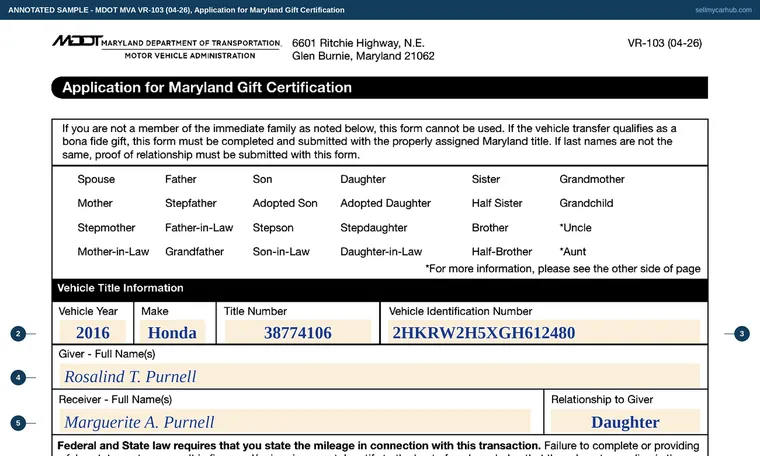
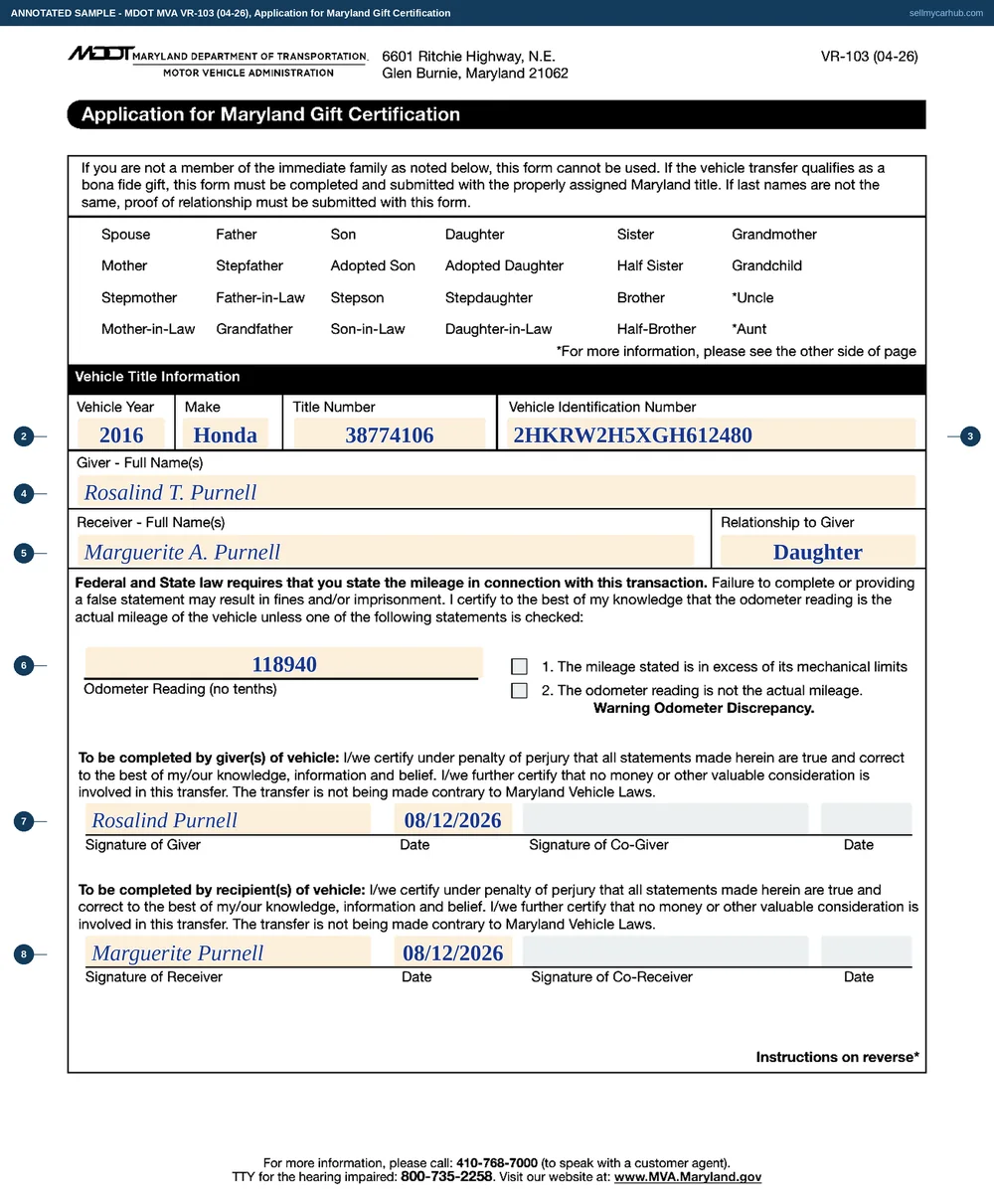
This is the actual VR-103, rendered from the PDF the Maryland Motor Vehicle Administration publishes and completed end to end: letterhead, every field, and the blocks at the foot.
Tick the one word in the grid that describes what the receiver is to you.
Watch out: Read the list before you promise anybody a tax-free car. Cousins, nephews under the aunt-or-uncle rule, unmarried partners and friends are all absent from it, and there is no discretion at the counter.
Three boxes on the vehicle row, copied from the face of the certificate.
Watch out: The title number is the eight-digit figure at the top right of the certificate, and the MVA's own guidance is not to use the red control number printed above it.
The wide box at the end of the vehicle row.
Watch out: Take it from the title. The plate riveted to the dashboard is the same number, but a title that has been mis-keyed once will keep being mis-keyed if you copy from the car instead.
One wide rule. Every owner printed on the front of the certificate goes on it.
Watch out: If the title names two people, both are givers here and both sign below. A gift signed by one of two joint owners is not a complete transfer.
The names of everyone taking the car, and the relationship word from the grid.
Watch out: Where surnames differ, put the proof in the envelope now - a marriage certificate or a birth certificate - because the form asks for it and an application without it stops.
Whole miles, no tenths, with the two exception boxes beside it.
Watch out: The federal disclosure applies to a gift exactly as it applies to a sale. Nothing about the absence of money makes the mileage optional.
Two signature and date pairs under the giver's certification.
Watch out: The sentence you are signing says no money or other valuable consideration is involved in this transfer. If there is a price, however small and however friendly, this is the wrong form and a bill of sale is the right one.
The matching pair under the receiver's certification, at the foot of the sheet.
Watch out: Both certifications have to be signed. It is genuinely common for one half of this form to come back empty because it looks like a repeat of the block above it.
| On the form | What to put in it |
|---|---|
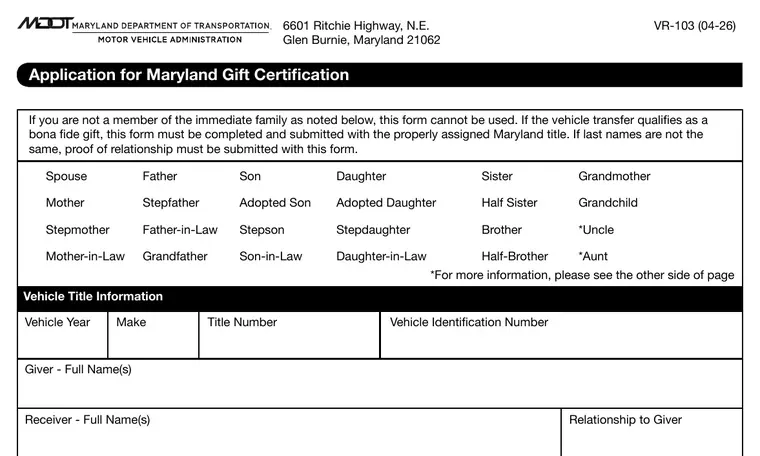
| The relationship grid | Twenty-four ticks across four rows: spouse, father, son, daughter, sister, grandmother, mother, stepfather, adopted son, adopted daughter, half sister, grandchild, stepmother, father-in-law, stepson, stepdaughter, brother, uncle, mother-in-law, grandfather, son-in-law, daughter-in-law, half-brother and aunt. Aunt and uncle carry an asterisk pointing at the instructions on the reverse. |
| Vehicle Title Information | Vehicle year, make, title number and vehicle identification number, on one row. |
| Giver - Full Name(s) | A single wide rule for everyone named on the face of the certificate. |
| Receiver - Full Name(s) and Relationship to Giver | The person taking the car, and the word from the grid above that describes how they are related. |
| Odometer Reading | A box marked no tenths with the federal warning above it and the two exception statements beside it. |
| To be completed by giver(s) of vehicle | A perjury certification, and inside it the sentence that defines a gift for Maryland's purposes: no money or other valuable consideration is involved in this transfer. |
| To be completed by recipient(s) of vehicle | The identical certification, signed by the receiver and any co-receiver. |
| The instructions on the reverse | Six blocks of guidance - financed vehicles, adding a name, deleting a name, an individual-to-individual transfer, which plates may move across, and the inspection exemptions - printed above the MVA's own picture of a completed certificate of title. |
Every line here was read off VR-103 (04-26) itself — the PDF is here — and off the Maryland Motor Vehicle Administration pages. This is plain-language help with a form, not legal advice, and where our wording and the agency's differ, theirs governs.
Back to all Maryland seller paperwork, or what selling a car in Maryland involves.