Sell My Car Hub

How to fill out Colorado DR 2410

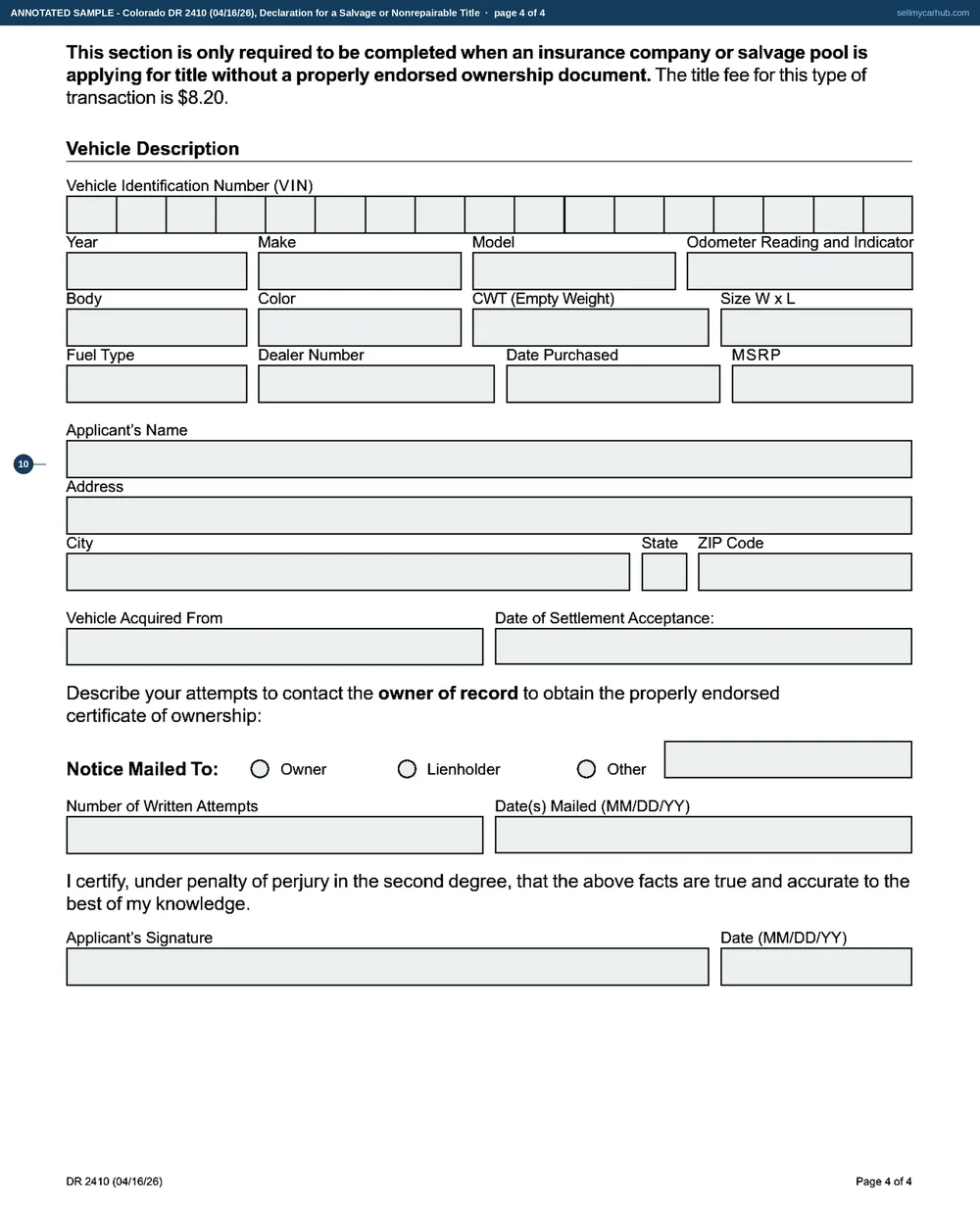
The form whose title says insurer and whose first three pages are an owner's. It is how a salvage or nonrepairable certificate is applied for in Colorado, and an owner who keeps a written-off vehicle after a settlement, or who wants to sell one as salvage, files pages one to three. Page four is the part the name refers to, and it is only required to be completed when an insurance company or salvage pool is applying for title without a properly endorsed ownership document.
Written against DR 2410 (04/16/26), issued under C.R.S. 42-6-110(1.5) and 42-6-102(15), (17). Selling a written-off car privately without applying for a salvage certificate first leaves the buyer holding a vehicle they cannot register. The department's own instruction to an owner who plans to sell a salvage vehicle is to apply for the salvage certificate before the sale or transfer.

Two documents, and they are not the same thing. Take the blank DR 2410 from the dmv.colorado.gov copy so you get the revision that is current today.

Filled in

What a completed one looks like

This is all 4 pages of the actual DR 2410, rendered from the PDF the Colorado Department of Revenue, Division of Motor Vehicles publishes and completed end to end: letterhead, every field, and the blocks at the foot.

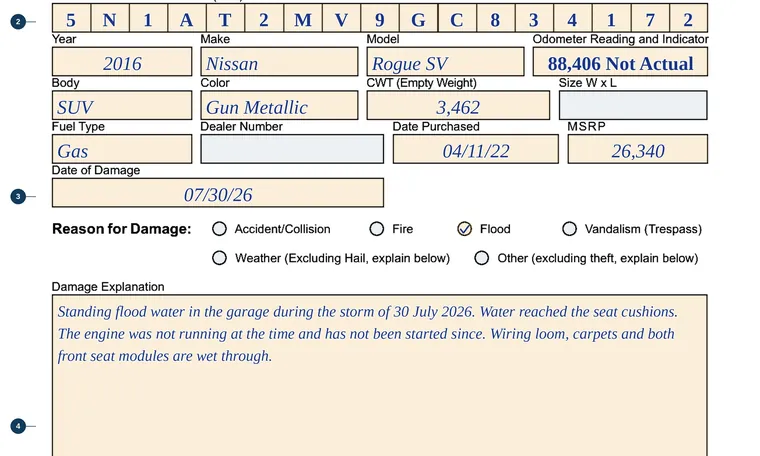
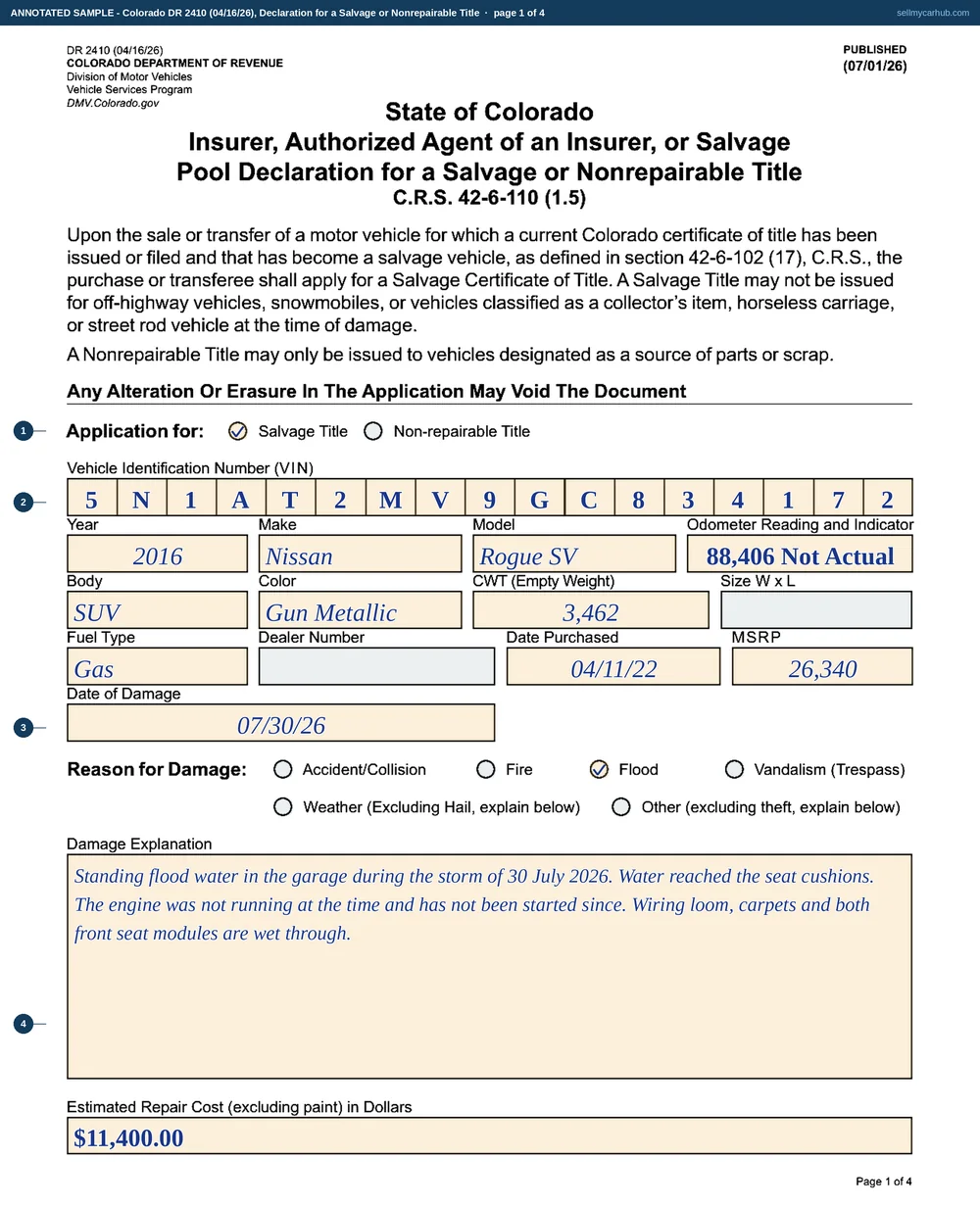
All four pages of Colorado form DR 2410, the first two filled in by an owner: the Salvage Title box ticked for a 2016 Nissan Rogue, vehicle identification number 5N1AT2MV9GC834172, damaged by flood on 30 July 2026 with an estimated repair cost of 11,400 dollars, applicant Thaddeus L. Okonkwo of Grand Junction signing the certification with a Colorado driver licence recorded and the block witnessed.
Page 1 of 4. Salvage rather than nonrepairable, the vehicle in full detail, the date and reason for the damage, and the estimated cost of repair excluding paint.
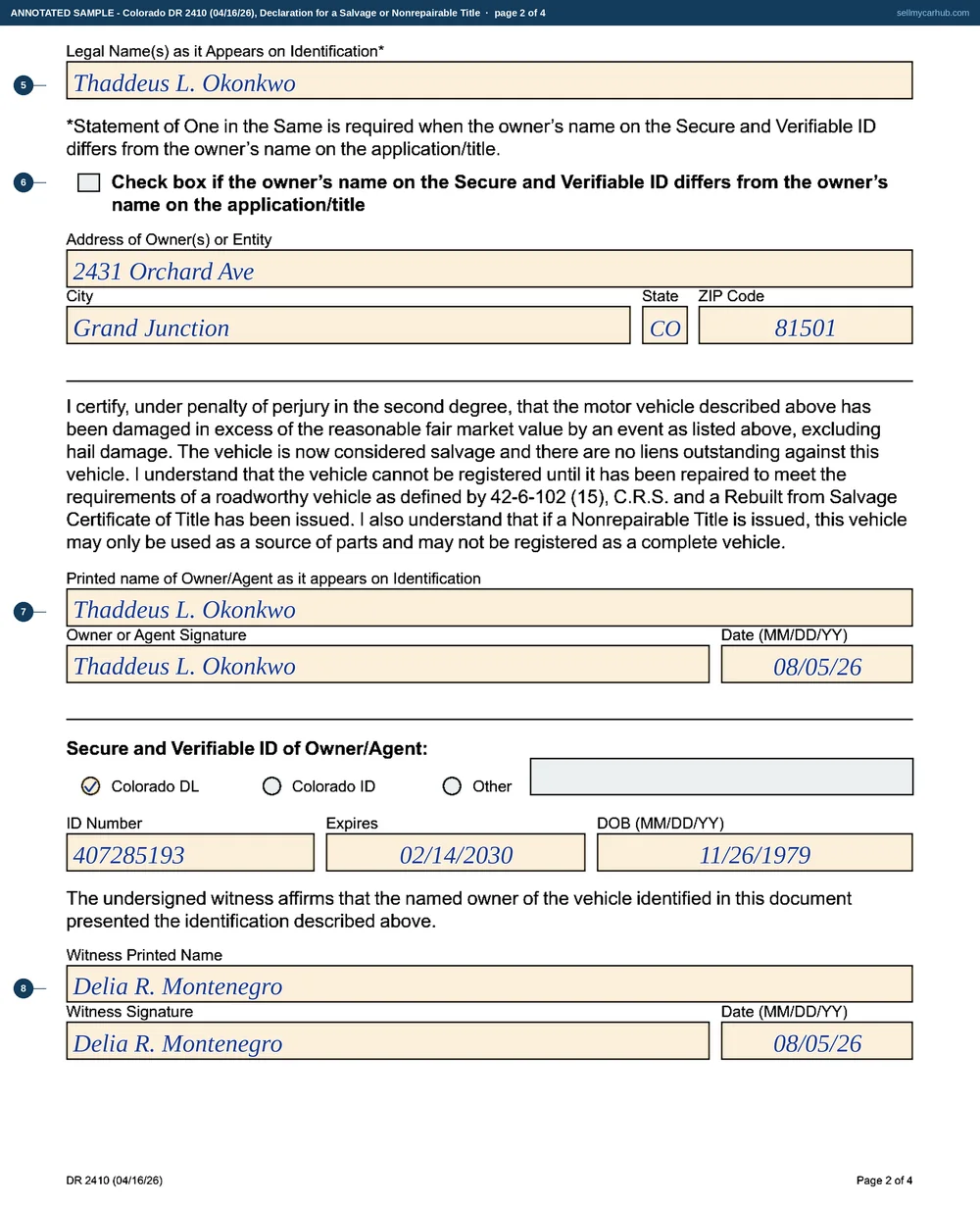
All four pages of Colorado form DR 2410, the first two filled in by an owner: the Salvage Title box ticked for a 2016 Nissan Rogue, vehicle identification number 5N1AT2MV9GC834172, damaged by flood on 30 July 2026 with an estimated repair cost of 11,400 dollars, applicant Thaddeus L. Okonkwo of Grand Junction signing the certification with a Colorado driver licence recorded and the block witnessed.
Page 2 of 4. The owner's certification - damaged in excess of fair market value, no liens outstanding, and no registration until a Rebuilt from Salvage certificate is issued - with identification and a witness.
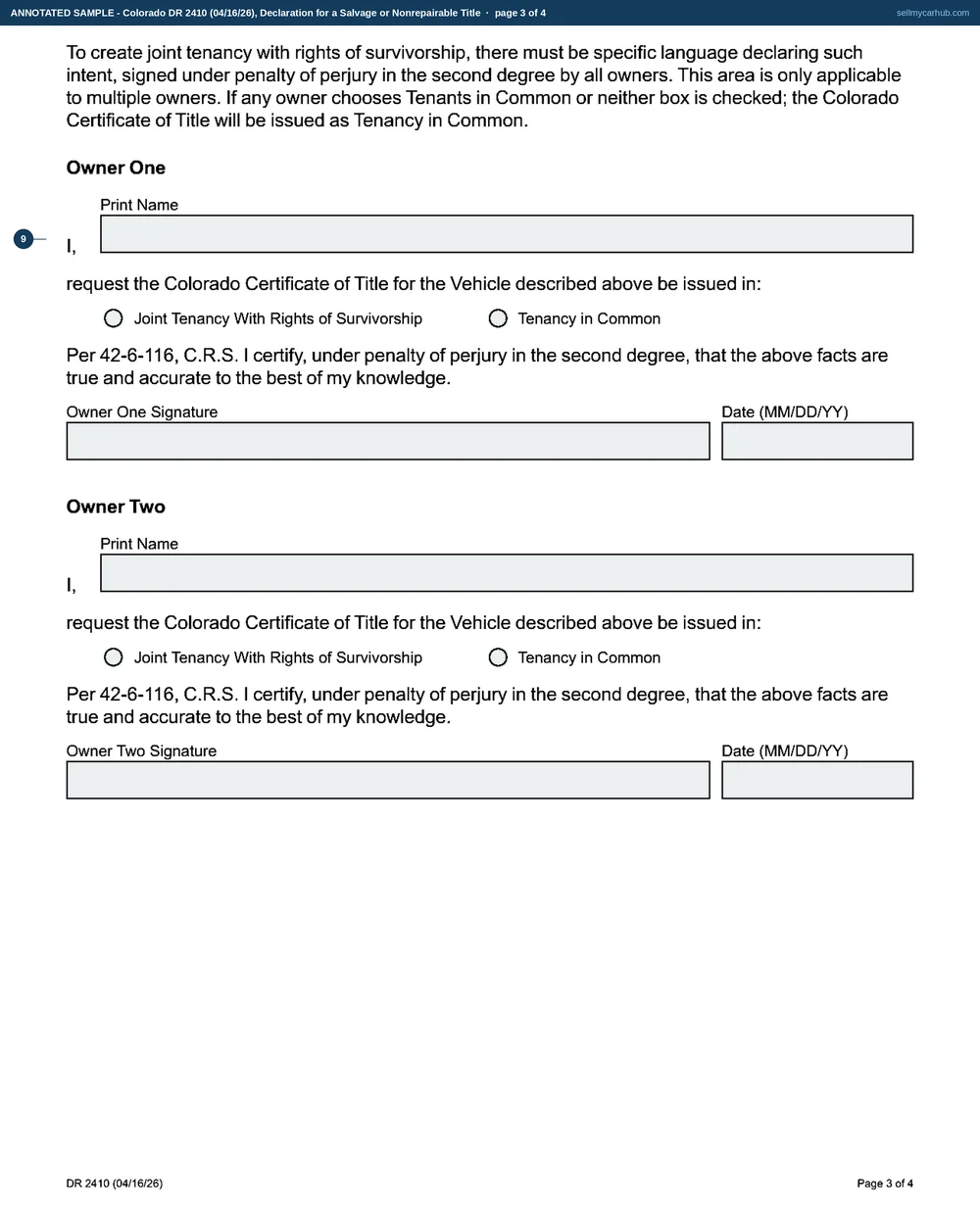
All four pages of Colorado form DR 2410, the first two filled in by an owner: the Salvage Title box ticked for a 2016 Nissan Rogue, vehicle identification number 5N1AT2MV9GC834172, damaged by flood on 30 July 2026 with an estimated repair cost of 11,400 dollars, applicant Thaddeus L. Okonkwo of Grand Junction signing the certification with a Colorado driver licence recorded and the block witnessed.
Page 3 of 4. The joint tenancy block, left entirely alone because one person owns this vehicle. Neither box ticked is itself an answer: the certificate issues as tenancy in common.
All four pages of Colorado form DR 2410, the first two filled in by an owner: the Salvage Title box ticked for a 2016 Nissan Rogue, vehicle identification number 5N1AT2MV9GC834172, damaged by flood on 30 July 2026 with an estimated repair cost of 11,400 dollars, applicant Thaddeus L. Okonkwo of Grand Junction signing the certification with a Colorado driver licence recorded and the block witnessed.
Page 4 of 4. The section the form is named after. An insurer, an authorized agent of an insurer or a salvage pool fills this in when the owner never sent the endorsed certificate back; an owner leaves every line of it empty.
Field by field

Every line, in the order you meet it

  1. 1
    You fill this in

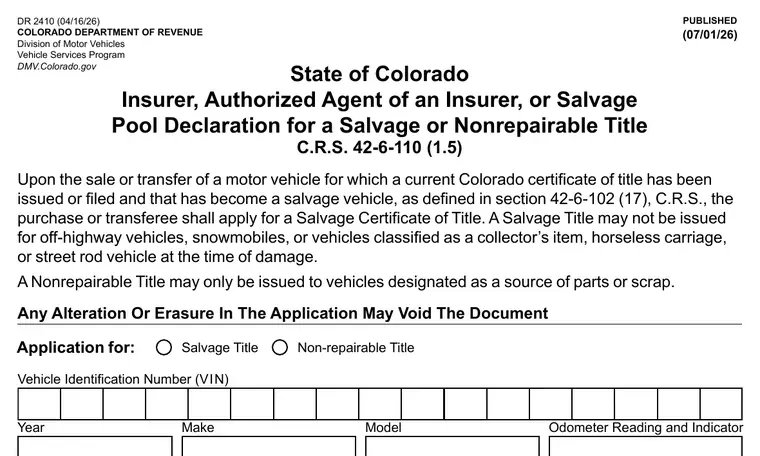
    Salvage Title or Non-repairable Title

    One of two boxes at the head of page one.

    Watch out: Nonrepairable is a one-way door. It marks the vehicle as a source of parts or scrap and no amount of later work turns it back into something registrable.

  2. 2
    You fill this in

    The vehicle description

    Identification number, year, make, model, odometer reading and indicator, body, colour, empty weight, size, fuel type, date purchased and MSRP.

    Watch out: The odometer indicator is the same three-way choice as everywhere else, and a flooded or burnt vehicle whose dash no longer reads is exactly what Not Actual is for.

  3. 3
    You fill this in

    Date of Damage and Reason for Damage

    The date, then one of Accident/Collision, Fire, Flood, Vandalism, Weather excluding hail, or Other excluding theft.

    Watch out: Weather and Other both carry an explanation requirement, and both exclude something - hail from the first, theft from the second.

  4. 4
    You fill this in

    Damage Explanation and Estimated Repair Cost

    A written description, then the cost of repair excluding paint.

    Watch out: Excluding paint is not a rounding instruction. The comparison the certification makes is between the repair cost and the vehicle's reasonable fair market value before the damage.

  5. 5
    You fill this in

    Legal name and the identification mismatch box

    Your name as identification prints it, and a tick box declaring that it differs from the name on the application or title.

    Watch out: Tick it honestly and put the statement of one and the same in the packet. This form flags the mismatch for you rather than waiting for a clerk to find it.

  6. 6
    You fill this in

    The certification, identification and witness

    A signature under a certification made under penalty of perjury in the second degree, then identification details and a witness's printed name, signature and date.

    Watch out: You are certifying that there are no liens outstanding. If a lender is still recorded, the release has to be dealt with before this can honestly be signed.

  7. 7
    Somebody else fills this in

    Page four is not yours

    The insurer's section - vehicle acquired from, date of settlement acceptance, attempts to contact the owner of record, notices mailed and how many.

    Watch out: Leave it entirely blank. It exists for the case where an insurer cannot get a properly endorsed certificate out of an owner, which is the opposite of what an owner filing this is doing.

At a glance

What goes where

On the formWhat to put in it
Application forTwo boxes at the top - Salvage Title or Non-repairable Title. A nonrepairable may only be issued to vehicles designated as a source of parts or scrap.
Vehicle Identification Number, Year, Make, Model, Odometer Reading and IndicatorThe description block, identical in shape to the ordinary title application.
Body, Color, CWT, Size, Fuel Type, Dealer Number, Date Purchased, MSRPTwo more rules of vehicle detail.
Date of DamageIts own box, and it is the date the whole application hangs on.
Reason for DamageSix choices: Accident/Collision, Fire, Flood, Vandalism (Trespass), Weather excluding hail with an explanation, and Other excluding theft with an explanation.
Damage Explanation and Estimated Repair CostA free-text box, then the estimated cost of repair excluding paint, in dollars.
Legal Name(s) as it Appears on IdentificationWith a starred note that a statement of one in the same is required where the name on the identification differs, and a tick box to declare that it does.
The owner's certificationThat the vehicle has been damaged in excess of the reasonable fair market value by an event as listed above, excluding hail damage; that it is now considered salvage; that there are no liens outstanding; and that it cannot be registered until repaired to the standard of a roadworthy vehicle and a Rebuilt from Salvage certificate has been issued.
Secure and Verifiable ID and the witnessColorado DL, Colorado ID or Other with a number, expiry and date of birth, then a witness printed name, signature and date.
Page three - the joint tenancy blockOwner One and Owner Two, each with a print name, the two tenancy boxes and a signature, under the same default rule as elsewhere.
Page four - the insurer's sectionVehicle description again, applicant's name and address, Vehicle Acquired From, Date of Settlement Acceptance, a box describing attempts to contact the owner of record to obtain the properly endorsed certificate of ownership, Notice Mailed To with Owner, Lienholder and Other boxes, the number of written attempts and the dates mailed.

What gets this one rejected

Rules that decide whether it is accepted

Every line here was read off DR 2410 (04/16/26) itself — the PDF is here — and off the Colorado Department of Revenue, Division of Motor Vehicles pages. This is plain-language help with a form, not legal advice, and where our wording and the agency's differ, theirs governs.

Back to all Colorado seller paperwork, or what selling a car in Colorado involves.

Want the paperwork handled instead?

Get My Instant Offer → Online · about 2 minutes · free

Or send the details — we'll come to you

Written off, not running, or too far gone to fix - that is most of what we buy. Tell us where it is.

or call/text (877) 405-1808