Sell My Car Hub

How to fill out Florida HSMV 82363

The form that decides whether a wrecked car can ever be road legal again. It is used by an insurance company that has paid a total loss, and by an owner or self-insured owner who kept the vehicle - which is the version that matters here, because an owner who retained a settled total loss is a private seller with a very particular piece of paper to sort out first.
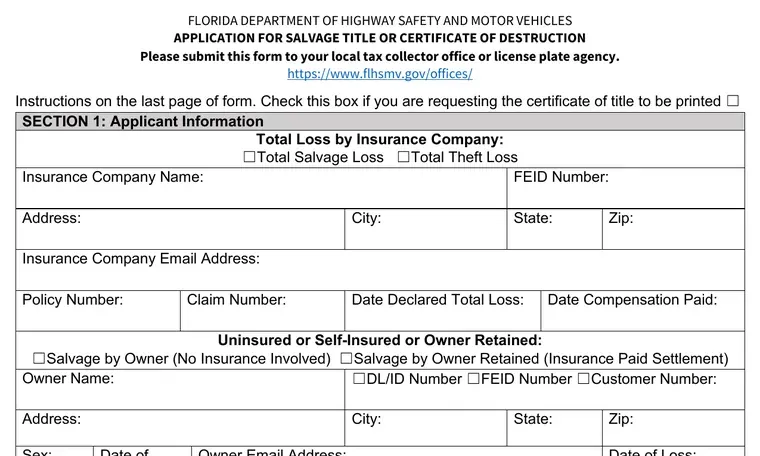
Written against HSMV 82363 (Rev 07/24), issued under section 319.30, Florida Statutes. Getting the classification wrong in your favour is not a clerical error - the whole form is signed under penalties of perjury and the resulting brand follows the vehicle for the rest of its life. If the numbers are near the line, take the estimate and the valuation to the counter and let them decide.

Two documents, and they are not the same thing. Take the blank HSMV 82363 from the flhsmv.gov copy so you get the revision that is current today.

Filled in

What a completed one looks like

This is all 3 pages of the actual HSMV 82363, rendered from the PDF the Florida Department of Highway Safety and Motor Vehicles publishes and completed end to end: letterhead, every field, and the blocks at the foot.

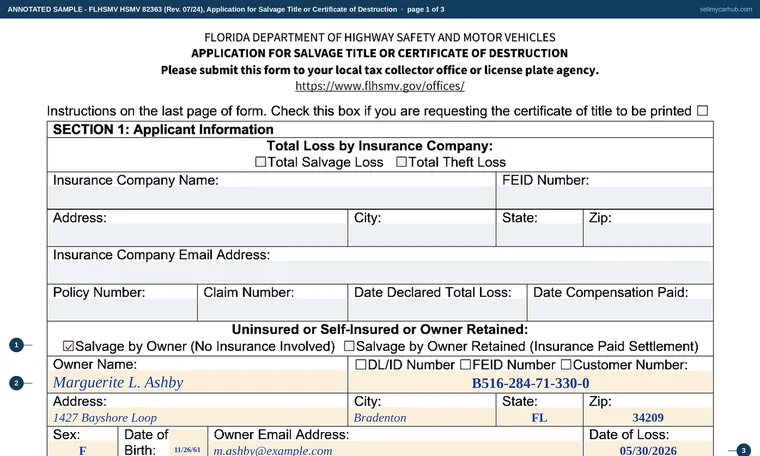
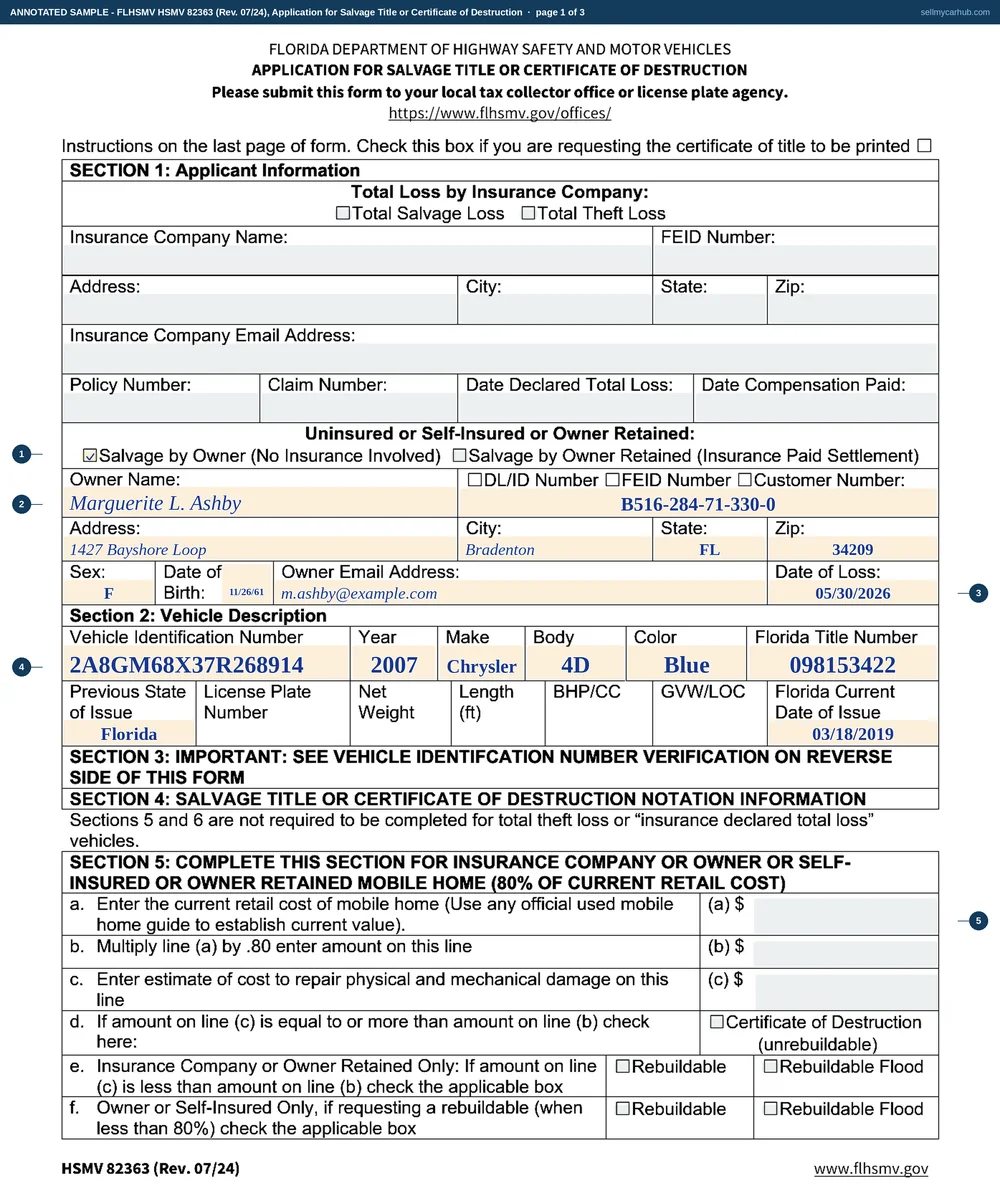
All three pages of the Florida HSMV 82363 filled in by an uninsured owner: Salvage by Owner with no insurance involved ticked in section 1 with the owner's name, address and date of loss, a 2007 Chrysler Pacifica described by VIN and Florida title number in section 2, the certificate of destruction box ticked in section 7 on page two, and on page three an odometer reading of 164,905 with the applicant's signature and printed name.
Page 1 of 3.
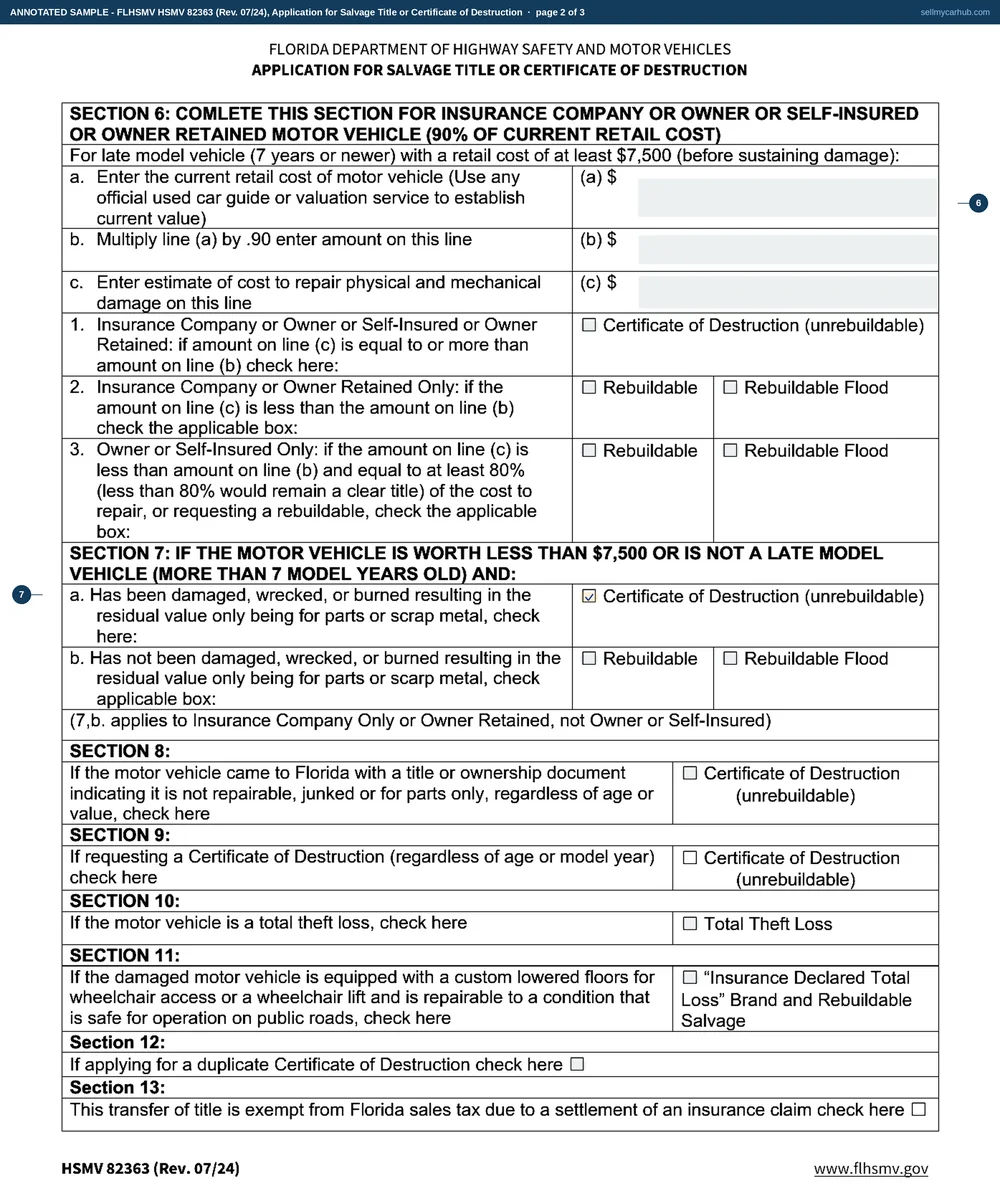
All three pages of the Florida HSMV 82363 filled in by an uninsured owner: Salvage by Owner with no insurance involved ticked in section 1 with the owner's name, address and date of loss, a 2007 Chrysler Pacifica described by VIN and Florida title number in section 2, the certificate of destruction box ticked in section 7 on page two, and on page three an odometer reading of 164,905 with the applicant's signature and printed name.
Page 2 of 3.
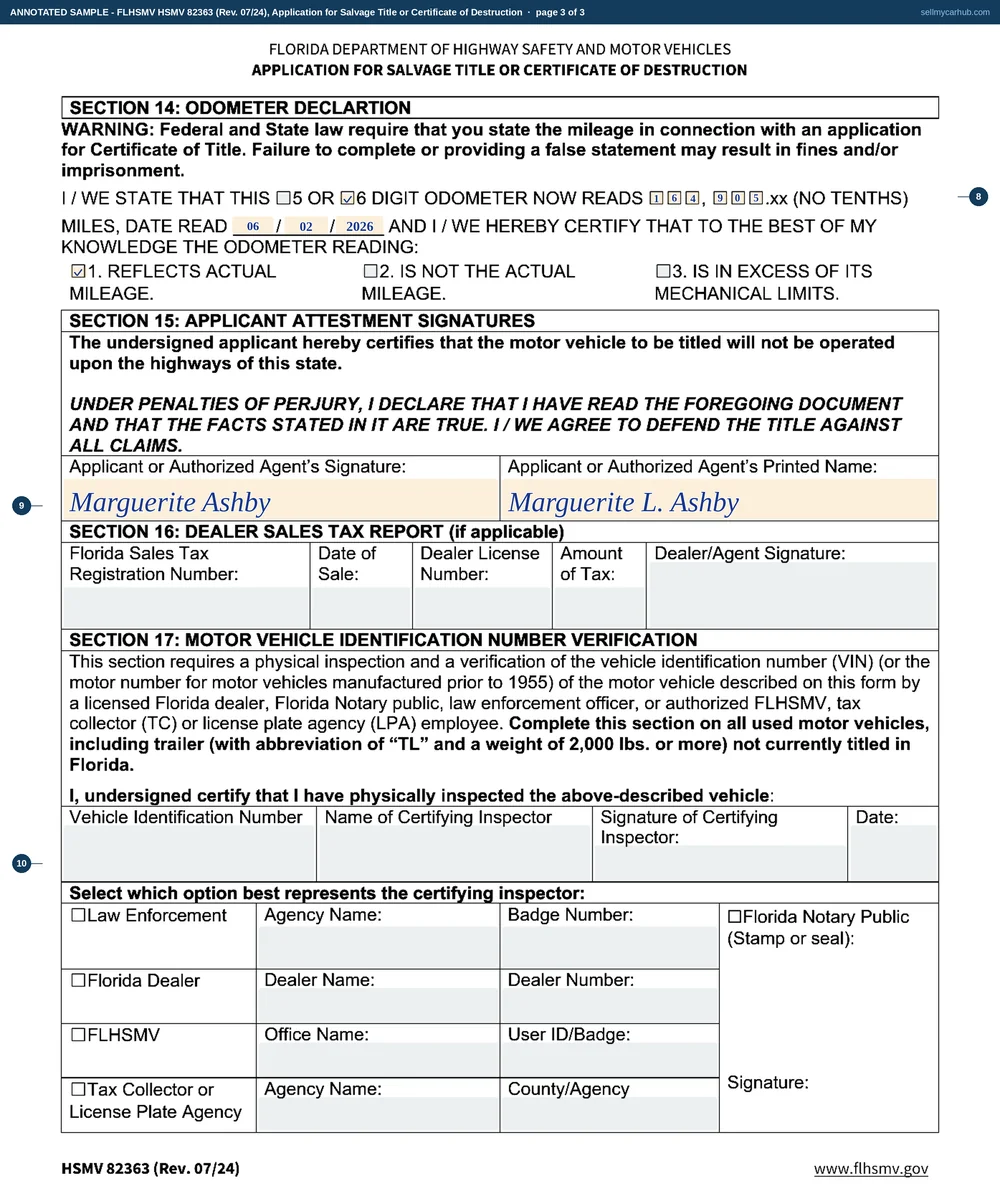
All three pages of the Florida HSMV 82363 filled in by an uninsured owner: Salvage by Owner with no insurance involved ticked in section 1 with the owner's name, address and date of loss, a 2007 Chrysler Pacifica described by VIN and Florida title number in section 2, the certificate of destruction box ticked in section 7 on page two, and on page three an odometer reading of 164,905 with the applicant's signature and printed name.
Page 3 of 3.
Field by field

Every line, in the order you meet it

  1. 1
    You fill this in

    Which kind of applicant you are

    Total salvage loss or total theft loss where an insurance company is applying; salvage by owner with no insurance involved, or salvage by owner retained after a paid settlement, where it is you.

    Watch out: This choice changes which later sections you are allowed to use. Sections 5 and 6 are not required for a total theft loss or an insurance declared total loss, and section 7b is expressly not available to an owner or self-insured applicant.

  2. 2
    You fill this in

    Owner name, licence number and address

    Your name, your driver licence, FEID or customer number, address, sex, date of birth and email.

    Watch out: The insurance block above yours has its own name, address, policy and claim boxes. Filling those in because they came first on the page is the commonest way this form arrives describing an insurer that has nothing to do with the vehicle.

  3. 3
    You fill this in

    Date of loss

    The day the damage happened, at the right-hand end of your block.

    Watch out: It anchors everything else on the form. On a car damaged in a named storm it is also the date every other agency will ask you for, so take it from the same source you gave them.

  4. 4
    You fill this in

    The vehicle description

    VIN, year, make, body, colour, Florida title number, previous state of issue, plate number, weights and the current date of issue.

    Watch out: Section 3 is a heading rather than a block: it tells you to see the vehicle identification number verification on the reverse. That verification is on page three and has to be done by somebody else.

  5. 5
    Dealers only

    Section 5, the mobile home arithmetic

    Retail cost, multiplied by 0.80, and the cost of repair - the mobile home test.

    Watch out: It is grey here because a car is not a mobile home. The two tests are genuinely different: 80 per cent of retail for a mobile home, 90 per cent for a late model motor vehicle, and using the wrong one gets the wrong document issued.

  6. 6
    You fill this in

    Section 6, the late model motor vehicle test

    Current retail cost, that figure multiplied by 0.90, and the estimated cost of repair.

    Watch out: Read the qualifying line above it first: it applies to a late model vehicle, seven years or newer, with a retail cost of at least $7,500 before it was damaged. Anything older or cheaper skips this section entirely and goes to section 7.

  7. 7
    You fill this in

    Section 7, for an older or cheaper vehicle

    One of two boxes. Damaged, wrecked or burned so that the residual value is only parts or scrap metal gets a certificate of destruction; not damaged to that extent gets a rebuildable.

    Watch out: The parenthesis underneath is the trap for a private owner: 7b applies to an insurance company only or owner retained, not to an owner or self-insured. An uninsured owner of an old wreck has one box available, and it is the one that ends the vehicle.

  8. 8
    You fill this in

    Section 14, the odometer declaration

    On page three. Tick 5 or 6 digit, one figure per box, the date read, and one of the three statements.

    Watch out: Note the order of the three statements here - actual, then not actual, then in excess of mechanical limits. It is not the order the certificate of title prints them in, and it is not the order page one of the buyer's title application prints them in either.

  9. 9
    You fill this in

    Section 15, the applicant's signature

    Signature on the left, printed name on the right.

    Watch out: The certification above it is doing two jobs. One is the perjury declaration; the other is a promise that the vehicle will not be operated upon the highways of this state, which is a statement about what you do next rather than about what has already happened.

  10. 10
    Dealers only

    Section 17, the identification number verification

    VIN, the certifying inspector's name and signature, a date, and one of four ticked rows saying who they are.

    Watch out: A licensed Florida dealer, a notary, a law enforcement officer, or an authorised department, tax collector or licence plate agency employee. Complete on all used motor vehicles not currently titled in Florida - which is the same test as on HSMV 82042, printed again on a different form.

At a glance

What goes where

On the formWhat to put in it
Section 1, which applicant you areTwo blocks. The insurance company block, for a total salvage loss or a total theft loss, with policy number, claim number, the date declared a total loss and the date compensation was paid. The owner block underneath is ticked as salvage by owner where no insurance was involved, or salvage by owner retained where an insurer paid a settlement.
Section 2, the vehicleIdentification number, year, make, body, colour, Florida title number, previous state and plate, net weight, length, horsepower, gross weight and the current date of issue.
Section 6, the arithmetic for a motor vehicleFor a late model vehicle - 7 years or newer - with a retail cost of at least $7,500 before the damage: enter the current retail cost from an official used car guide or valuation service, multiply it by .90, and enter the estimate of the cost to repair the physical and mechanical damage.
Section 6, what the answer decidesIf the repair estimate equals or exceeds ninety per cent of the retail value, the box is a certificate of destruction and the vehicle is unrebuildable. If it is less, the applicable box is rebuildable, or rebuildable flood.
Section 7, older or cheaper vehiclesWhere the vehicle is worth less than $7,500 or is more than 7 model years old: damaged, wrecked or burned so that the residual value is only for parts or scrap metal is a certificate of destruction; anything else can be rebuildable or rebuildable flood.
Sections 8 to 13The remaining routes - a vehicle that arrived in Florida already marked not repairable, junked or for parts only; a straightforward request for a certificate of destruction; a total theft loss; a wheelchair-accessible vehicle with lowered floors or a lift, which gets its own insurance declared total loss brand; a duplicate certificate of destruction; and a box for a transfer exempt from sales tax because of an insurance settlement.
Section 14, odometer declarationThe usual five or six digit reading in whole miles with the three certifications - and the last page says when not to complete it, which is when the vehicle is exempt under the twenty and ten year rules.
Section 15, the applicant's attestmentThat the vehicle to be titled will not be operated upon the highways of this state, under penalties of perjury, with an agreement to defend the title against all claims.
Section 17, VIN verificationThe same physical inspection the department requires elsewhere, certified by a licensed Florida dealer, a Florida notary public, a law enforcement officer, or an authorised FLHSMV, tax collector or licence plate agency employee.

What gets this one rejected

Rules that decide whether it is accepted

Every line here was read off HSMV 82363 (Rev 07/24) itself — the PDF is here — and off the Florida Department of Highway Safety and Motor Vehicles pages. This is plain-language help with a form, not legal advice, and where our wording and the agency's differ, theirs governs.

Back to all Florida seller paperwork, or what selling a car in Florida involves.

Want the paperwork handled instead?

Get My Instant Offer → Online · about 2 minutes · free

Or send the details — we'll come to you

Insurance wrote it off and you kept it? That is a car we buy every week. Tell us what happened to it.

or call/text (877) 405-1808