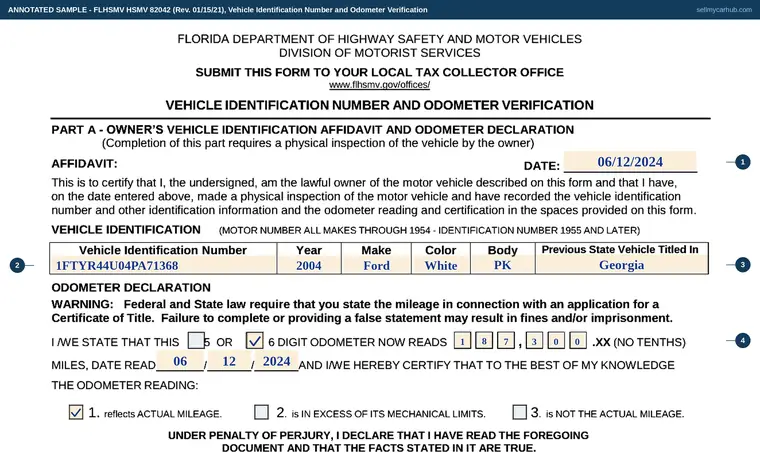
Florida's proof that the car in the driveway is the car on the paperwork. It is required on every used motor vehicle not currently titled in Florida, including trailers of 2,000 pounds or more, and it is two affidavits stapled together: yours about the vehicle and the mileage, and a second one from somebody authorised to say they physically looked at the number.
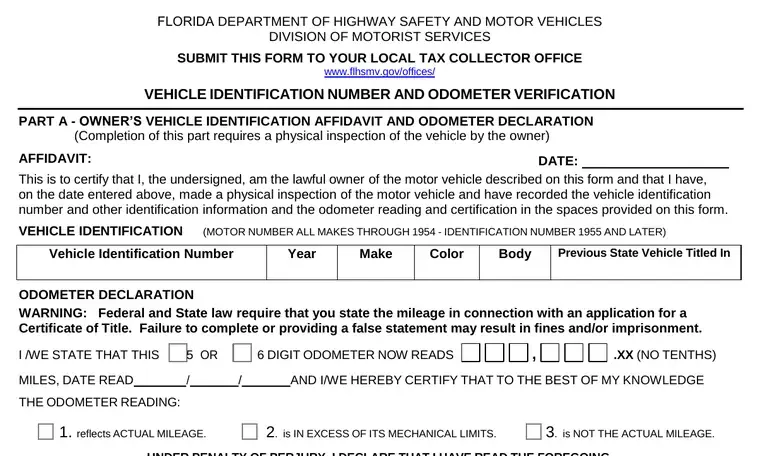
Written against HSMV 82042 (Rev 01/15/21), issued under section 319.23(3)(a), Florida Statutes. If your car came into Florida from another state and has never been titled here, budget for this before you advertise it. Finding an authorised inspector takes a day; finding one while a buyer waits in your driveway takes longer.
Two documents, and they are not the same thing. Take the blank HSMV 82042 from the flhsmv.gov copy so you get the revision that is current today.
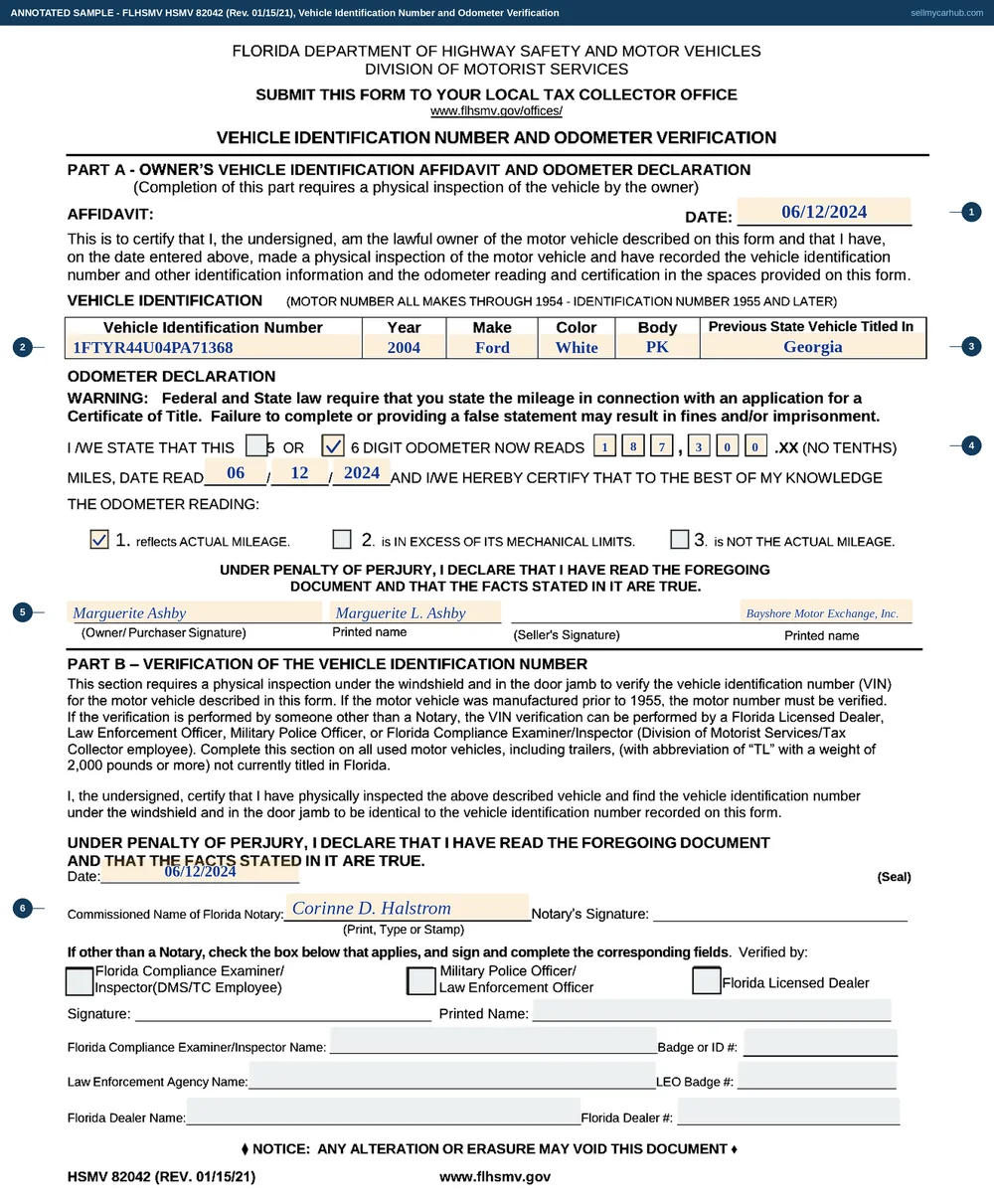
This is the actual HSMV 82042, rendered from the PDF the Florida Department of Highway Safety and Motor Vehicles publishes and completed end to end: letterhead, every field, and the blocks at the foot.
Top right of Part A, before anything else.
Watch out: The paragraph beneath it certifies that on the date entered above you made a physical inspection of the vehicle. Dating it for a day you were not standing next to the car is the part of this form that is an affidavit rather than a checklist.
VIN, year, make, colour and body type across the strip.
Watch out: The heading beside it carries a footnote most people never read: motor number for all makes through 1954, identification number 1955 and later. If you are titling something genuinely old, that is the difference between two numbers in two different places.
The state the certificate you are surrendering came from.
Watch out: It is also the answer to why you are filling this in at all. Part B has to be completed on all used motor vehicles not currently titled in Florida, so a car that has always been Florida-titled does not need this form.
Tick 5 or 6 digit, one figure per box, the date read, then one of the three statements.
Watch out: Reading the dash is part of the physical inspection you are swearing to. It is the same reading that will go on the title application, and a discrepancy between the two is a discrepancy in one document, because both of them are yours.
Owner or purchaser signature and printed name on the left, seller's signature and printed name on the right.
Watch out: The seller here is whoever you got the vehicle from, and their half is frequently blank because they are in another state. Get it if you can: an unsigned seller line is one more thing for a clerk to ask about.
A date, the commissioned name of a Florida notary and their signature - or, instead of a notary, one of the four ticked rows underneath with a name, badge or dealer number.
Watch out: This is the one place a notary genuinely appears in Florida vehicle paperwork, and it is not the sale. They are certifying they physically inspected the number under the windscreen and in the door jamb, which is why the vehicle has to be with them.
| On the form | What to put in it |
|---|---|
| Part A, your affidavit | That you are the lawful owner, that you made a physical inspection on the date entered, and that you have recorded the identification number and the odometer reading on the form yourself. |
| Part A, the vehicle | The identification number - the form notes it is the motor number on all makes through 1954 and the identification number from 1955 - with year, make, colour, body and the previous state the vehicle was titled in. |
| Part A, the odometer declaration | Five or six digit odometer, the reading in whole miles with no tenths, the date read, and the three certifications: reflects actual mileage, is in excess of its mechanical limits, is not the actual mileage. |
| Part A, who signs | Under penalty of perjury, with signature and printed name lines for the owner or purchaser and for the seller. |
| Part B, the verification itself | A physical inspection under the windshield and in the door jamb, certifying that the number in both places is identical to the number recorded on the form. |
| Part B, who may do it | A Florida notary public with a seal, or - if it is performed by someone other than a notary - a Florida compliance examiner or inspector employed by the Division of Motorist Services or a tax collector, a military police officer or law enforcement officer, or a licensed Florida dealer. |
| Part B, what they write down | Their signature, printed name, date, and the identifying detail for whichever box they ticked: examiner name and badge or identification number, agency name and law enforcement badge number, or Florida dealer name and dealer number. |
| When it is not needed | The second page lists the exceptions - a new motor vehicle whether bought in Florida or out of state, a mobile home, a trailer or semitrailer under 2,000 pounds, a trailer-type recreational vehicle, or an off-highway vehicle. |
Every line here was read off HSMV 82042 (Rev 01/15/21) itself — the PDF is here — and off the Florida Department of Highway Safety and Motor Vehicles pages. This is plain-language help with a form, not legal advice, and where our wording and the agency's differ, theirs governs.
Back to all Florida seller paperwork, or what selling a car in Florida involves.