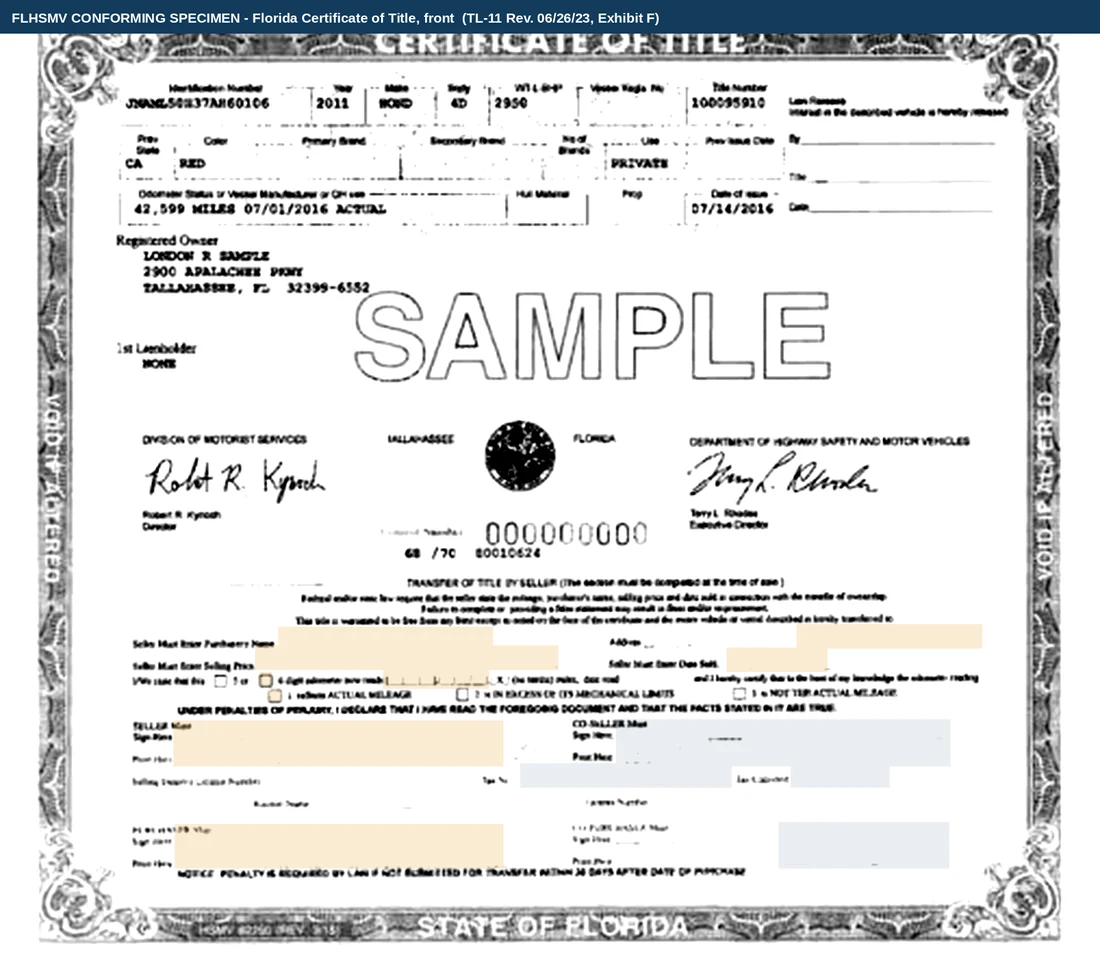
Florida runs a private sale through one block on the face of the certificate, headed Transfer of Title by Seller. There is no numbered field guide for it - FLHSMV does not publish one - so every line below is taken from the department's own transfer procedure, TL-11, which is the document the clerk at the counter is working from.
Last updated .
Your 11 boxes
As a private seller you complete these and nothing else:
You cannot download a blank Florida title and you should be suspicious of anywhere offering you one - the certificate is a controlled document that arrives from Tallahassee or lives in the department's database. What you can download is the procedure the counter staff follow, and our one-page checklist of the block you have to complete.
Two blanks turn a signed title into an open title, and Florida will not process one: the buyer's name and the selling price.
TL-11 asks for the block to be completed in full, with printed name and signature for each seller and each buyer. It also says not to reject an application where the printed name is typed or stamped rather than handwritten - but to reject it where the printed name is blank.
The real thing
FLHSMV prints its own certificate, and this is it
Not a drawing, and not a photograph of somebody's title. This is the conforming Florida Certificate of Title the department reproduces as Exhibit F of TL-11 (Rev. 06/26/23) - the procedure its own counter staff work from. It is watermarked SAMPLE, it reads VOID IF ALTERED down both margins, its control number is ten zeroes, and it is made out to the department's placeholder owner, LONDON R SAMPLE of Tallahassee, on a 2011 Honda that has never existed. Everything printed on it is FLHSMV's own. The amber block near the foot is the only part of this side a private seller ever writes on.
Amber — you write it, in pen
Grey — not yours to fill
Numbered — matches the steps below
Click or tap the picture to open it full size.
The whole front, at the size it comes off the press. Nothing is written on it here on purpose: the vehicle and owner printed at the top are the department's placeholders rather than the sale this page follows, and putting a different seller's handwriting over them would read as a contradiction. Everything above the amber block is printed in Tallahassee before the certificate reaches you.
Closer in
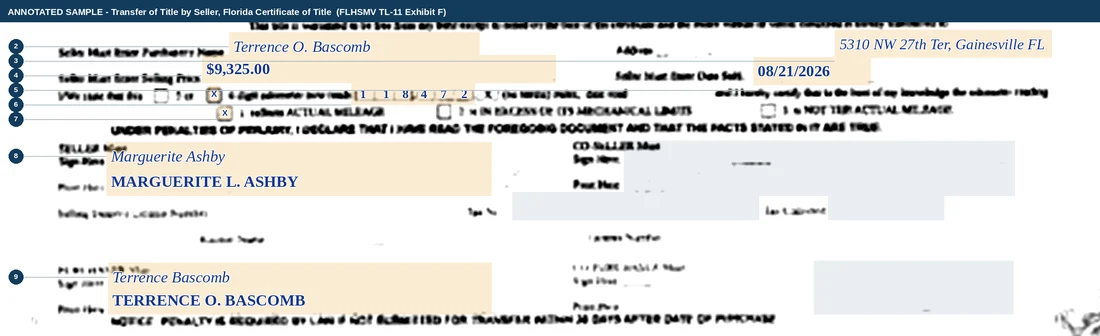
The Transfer of Title by Seller block, filled in
The block runs the full width of the certificate, which makes it small on any screen, so here it is on its own with a sale written into it. The handwriting and the numbers are ours; every printed word, rule and check box underneath is FLHSMV's. Tap a number to jump to what that line means.
Click or tap the picture to open it full size.
One private sale, written into FLHSMV's own specimen. The two lines that decide whether a clerk accepts it are the purchaser's name and the selling price - leave either blank and Florida calls it an open title. Note what is greyed: the co-seller column, the selling dealer's licence number, the tag number and the tax-collected box are somebody else's to fill, and the line under the whole block warns that a penalty is required by law if it is not submitted for transfer within 30 days after the date of purchase.
Click or tap the picture to open it full size.
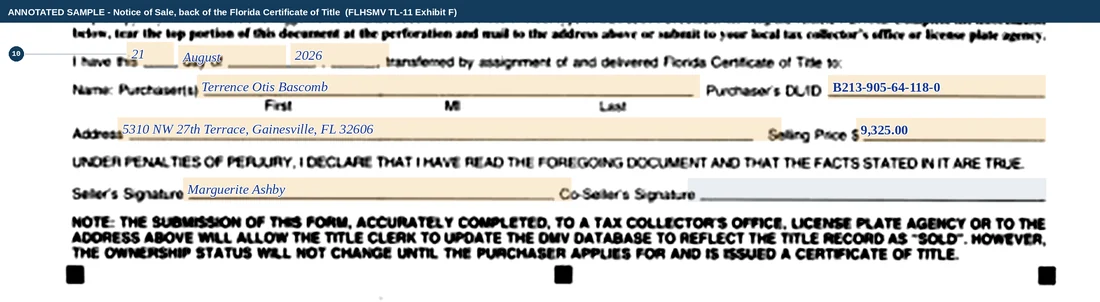
Turn it over and the top of the back is the Notice of Sale - one of the two ways to give the department the thirty-day notice under section 319.22(2)(b). The three black squares along the bottom edge are the perforation: the instruction above tells you to tear the top portion off at it and mail it in, or hand it to a tax collector's office or licence plate agency. The note is careful about what filing it does and does not do - the clerk updates the record to SOLD, but ownership does not change until the purchaser applies for a title of their own.
Step by step
Every box, in the order you meet it
1
You fill this in
First, find out whether you have a title at all
Check whether the department holds your title electronically. If it does, there is no paper certificate and nothing on this page gets signed - the transfer happens on HSMV 82994 at the counter.
Watch out: This is the step that decides the shape of the whole sale. An electronic title means the buyer has to come with you, in person, with photo identification. Finding that out on the day of the sale rather than a week before is how private sales fall apart.
2
You fill this in
The buyer's printed name
The full legal name of the person buying the car, legible, inside the Transfer of Title by Seller block.
Watch out: Leave it blank and you have created an open title. TL-11 defines one as a certificate submitted for transfer without the purchaser's name being legibly shown anywhere in this section, and the clerk circles the gap and stamps the title so every future agency knows.
3
You fill this in
The buyer's address
Where the buyer lives, copied off the identification you have just been shown rather than off the message they sent you.
Watch out: Check it against their licence while they are standing there. FLHSMV tells buyers to verify the seller's identification against the name on the title, and the check runs just as well in the other direction.
4
You fill this in
The selling price
The actual figure. Section 319.22(4) says no title shall be accepted for transfer unless the sales price is entered in the appropriately labelled place by the seller.
Watch out: Do not write over it if the number changes. An altered purchase price forces the buyer to produce an original or certified bill of sale signed by both of you, with the buyer's name, the price and a full description of the vehicle on it.
5
You fill this in
The date of sale
The day possession changes hands. Both thirty-day clocks start here.
Watch out: Yours is the notice of sale. Theirs is the title application, and the penalty for missing it lands on them - a $20 fee under section 319.23(6)(a), charged in addition to everything else.
6
You fill this in
The odometer reading, in whole miles
Current mileage with no tenths, the date you read it, and one of three boxes: reflects actual mileage, in excess of its mechanical limits, or not the actual mileage.
Watch out: In excess of mechanical limits is for a five-digit odometer that has rolled past 99,999. It is not a way of saying the number looks high, and ticking the wrong one of the three is a federal odometer statement made falsely.
7
You fill this in
Whether the car is exempt from that reading
A 2010-or-older car is exempt after ten years; a 2011-or-newer car after twenty. Exempt means the mileage line may be left blank.
Watch out: It does not mean the block may be left blank. The department's procedure is explicit that the seller must always sign and print their name here, along with the selling price and the printed name of the purchaser, whether an odometer reading is shown or not.
8
You fill this in
Your signature and your printed name
Both, for every owner the certificate names. The printed name may be typed or stamped; it may not be missing.
Watch out: No notary. TL-11 says notarisation is not required in this section even if there is a place for it printed on your certificate, and a notary block on an older title is not an instruction.
9
The buyer fills this in
The buyer's signature and printed name
The buyer signs the same block to acknowledge the mileage you disclosed.
Watch out: Section 319.225(5) forbids the same person signing as transferor and transferee in one transaction. If the buyer cannot be there, that is what the power of attorney is for - and it can cover one side of the disclosure, never both.
10
You fill this in
Turn it over and look for the Notice of Sale section
Florida prints a Notice of Sale of Motor Vehicle, Mobile Home, or Vessel section on the reverse of the certificate. Completing it is one of the two accepted ways of giving the department your thirty-day notice.
Watch out: The other is HSMV 82050 at a motor vehicle service center. Whichever route you take, do it - this is the step that ends your civil liability for what the buyer does with the car.
11
You fill this in
Take the plate off before the car goes
The registration plate is issued to you, not to the vehicle, and section 320.0609(2)(a) says the owner shall remove it and either return it or transfer it to a replacement vehicle.
Watch out: If you are moving out of Florida, or cancelling the insurance tied to that plate, FLHSMV says the tag must be surrendered to a motor vehicle service center rather than kept in a drawer.
12
You fill this in
Hand over what the buyer needs, and keep a copy
The completed certificate, and a bill of sale if there was any correction to the price or the name.
Watch out: HSMV 82050 doubles as the bill of sale when the seller and the purchaser both complete it, which is why it is worth filling in fully rather than only the seller's half.
Before the pen
First, know which block is yours
Six habits worth having before you write on a document that cannot be tidied up afterwards - and one of them is the thing Floridians most often get told wrongly.
No notary
The most persistent piece of wrong advice in Florida. The department says it twice in one procedure - once about the title and once about a manufacturer's statement of origin - and both times it adds that a printed space for it changes nothing.
Nothing crossed out
The reassignment forms say any alteration or erasure voids the assignment. A correction on a certificate costs an affidavit at best and a duplicate title at worst.
Print as well as sign
Every signature line in this set has a printed-name line beside it. A blank printed name is a rejection; a typed or stamped one is not.
Whole miles, no tenths
Every Florida odometer block says it in the label. The .xx is printed on the form for a reason.
The price goes on the title, not just in the bank transfer
It is a statutory condition of the transfer being accepted, and it is the seller's job rather than the buyer's.
Read the line above your signature
Under penalties of perjury, I declare that I have read the foregoing document and that the facts stated in it are true. It is on all thirteen forms here.
The Florida advice that keeps going round, and why it is wrong
Three claims that circulate about selling a car in Florida. Two of them cost a seller a wasted trip; the third can cost them a car. Each correction links the Florida source it came from.
"Florida titles have to be signed in front of a notary."
They do not. The department's transfer procedure states that notarisation is not required in the Transfer of Title by Seller section on the Florida title even if there is a place for notarisation, and repeats it for a certificate of origin. Where a notary does appear in Florida vehicle paperwork is the VIN inspection on HSMV 82042 - a notary certifying that they physically looked at the number under the windscreen, which is a different job entirely.
"Any car over ten years old is exempt from the odometer disclosure."
Only if it was built in 2010 or earlier. Section 319.225(4) reads: a vehicle with a model year of 2011 or newer is exempt from odometer disclosure after 20 years, and a vehicle with a model year of 2010 or older is exempt from odometer disclosure after 10 years. The ten-year version survives in odd corners of Florida's own material - the legal authority summary at the front of procedure TL-09 still describes the exemption as motor vehicles which are 10 years old or older, while the body of that same forty-four page document uses the twenty-year rule throughout.
"Leave the buyer's name off the title so they can flip it."
That is a criminal offence for both of you and the clerk will spot it. Section 319.22(5) makes it illegal to transfer title to a motor vehicle when the purchaser's name does not appear on the title, and any buyer or seller who knowingly and wilfully does it with intent to commit fraud commits a misdemeanour of the first degree. The department's own procedure calls the result an open title, and the counter circles the empty area and stamps the certificate with the county stamp so that every agency handling it afterwards can see what happened.
Who has to be holding the pen depends on one word printed between the names on your certificate:
Every owner, where the names are joined by “and”
All of them sign, or one of them holds a power of attorney for the others.
Either owner, where the names are joined by “or”
One signature is a proper endorsement. Section 319.22(2)(a)1.a. calls it joint tenancy and gives each co-owner the absolute right to dispose of the vehicle.
The buyer
Signs and prints their name in the same block, acknowledging the mileage you disclosed. That acknowledgment is theirs to give, not yours to write in.
A notary
Nobody. TL-11: notarisation is not required in the Transfer of Title by Seller section on the Florida title even if there is a place for notarisation.
An attorney-in-fact
Can sign for you on HSMV 82053, and can complete the odometer disclosure as buyer or as seller - but never as both.
A surviving spouse
Uses HSMV 82152 to take a deceased co-owner's name off, and Florida charges no title fee for it.
Once it is signed
Signing is the middle of the job, not the end of it. Two things still have to happen on your side: the plate comes off the car, and the notice of sale goes in within thirty days.