Sell My Car Hub

How to fill out Florida HSMV 82101

Three applications printed as one, and choosing the wrong one of the three costs either money or a wasted trip. A duplicate replaces a paper certificate that is lost, stolen or damaged. A lost in transit request covers one the department issued that never arrived. A duplicate with transfer orders the replacement and hands it straight to a buyer in the same transaction.
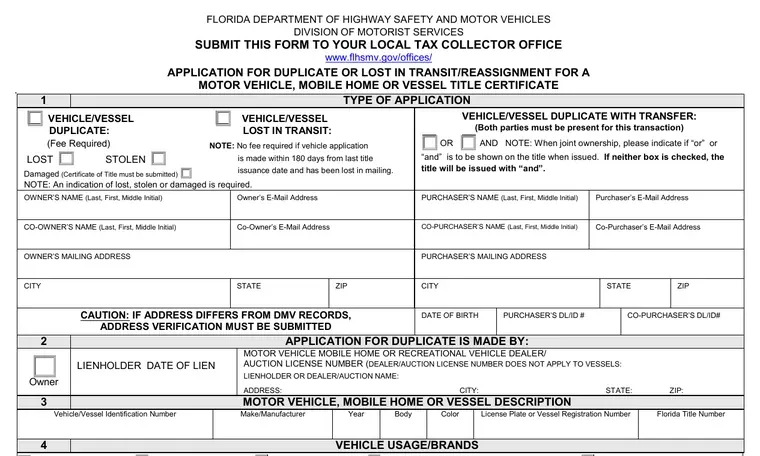
Written against HSMV 82101 (Rev 01/13/21), issued under section 319.29, Florida Statutes. If the paper title merely went missing and the record still shows you as the owner, this is the cheap route. If you cannot show the department that the car is yours at all, a duplicate is not the form you need and no amount of filling it in will make it one.

Two documents, and they are not the same thing. Take the blank HSMV 82101 from the flhsmv.gov copy so you get the revision that is current today.

Filled in

What a completed one looks like

This is the actual HSMV 82101, rendered from the PDF the Florida Department of Highway Safety and Motor Vehicles publishes and completed end to end: letterhead, every field, and the blocks at the foot.

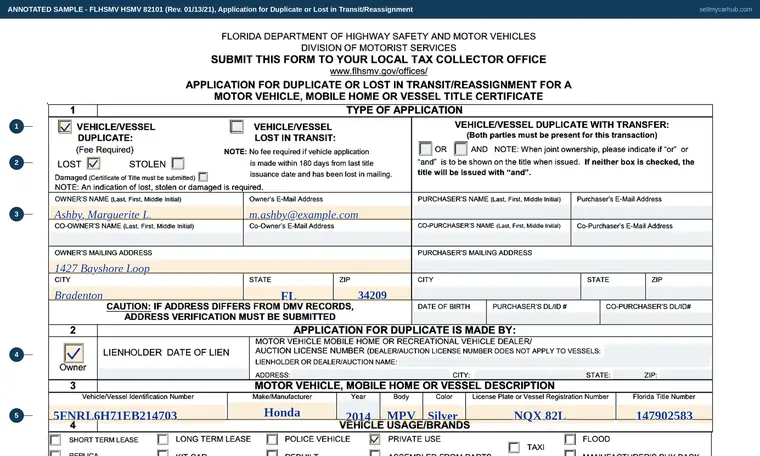
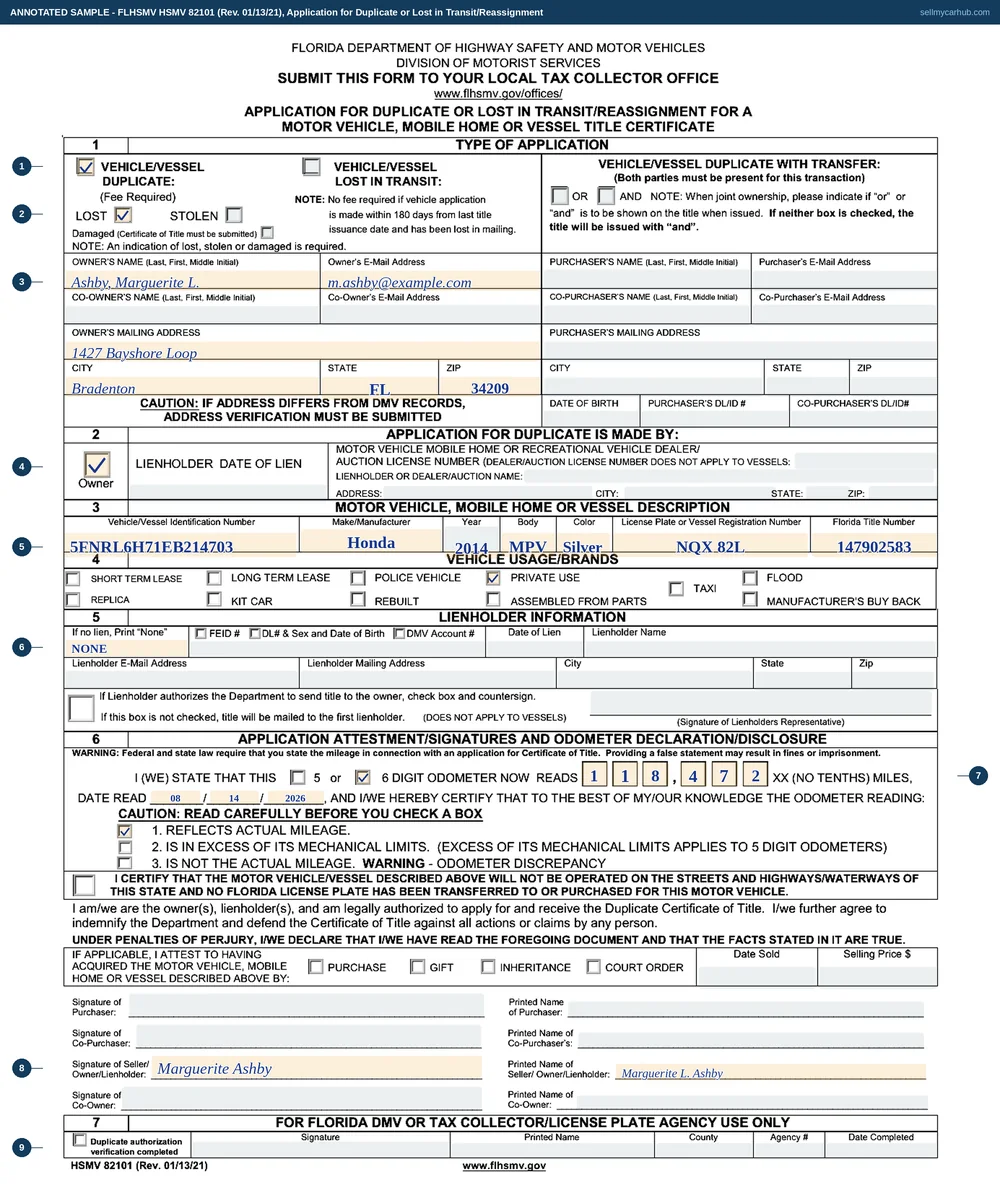
The Florida HSMV 82101 filled in as a straightforward duplicate: Vehicle/Vessel Duplicate ticked with Lost marked underneath, owner Ashby, Marguerite L. of Bradenton, the Owner box ticked in section 2, a 2014 Honda Odyssey described by VIN with its plate number and Florida title number, NONE written on the no-lien line, an odometer reading of 118,472 with the actual-mileage box ticked, and the owner's signature and printed name at the foot.
The actual HSMV 82101, filled in for the ordinary case: the paper certificate has gone missing and the owner wants another one, with no sale attached. Every purchaser box down the right-hand side is grey, and so is section 7 - that block belongs to the tax collector or licence plate agency, not to you.
Field by field

Every line, in the order you meet it

  1. 1
    You fill this in

    Which of the three applications this is

    Vehicle/Vessel Duplicate, Vehicle/Vessel Lost in Transit, or Duplicate with Transfer. Tick one.

    Watch out: Lost in transit has no fee if the application is made within 180 days of the last title issuance and the certificate went astray in the post. Duplicate with transfer is a duplicate and a sale in one visit, and the form warns that both parties must be present for it.

  2. 2
    You fill this in

    Lost, stolen or damaged

    One of the three, immediately underneath. The form says an indication of lost, stolen or damaged is required.

    Watch out: Damaged has a condition attached that the other two do not: the certificate itself has to be submitted with the application. If you tick damaged and keep the certificate, you have applied for something the counter cannot issue.

  3. 3
    You fill this in

    Owner's name, email and address

    Name last-name-first, then the mailing address, city, state and zip.

    Watch out: There is a caution printed across the middle of that block: if the address differs from the department's records, address verification must be submitted. A duplicate posted to an address the record does not know is a duplicate nobody receives.

  4. 4
    You fill this in

    Who the application is made by

    Tick Owner. The rest of section 2 is for a lienholder, a dealer or an auction applying instead.

    Watch out: Where a lienholder is on the record, the title goes to them by default. That is what the countersign box further down the form is for, and it is a lender's box rather than yours.

  5. 5
    You fill this in

    The vehicle description row

    VIN, make, year, body, colour, licence plate number and the Florida title number.

    Watch out: The plate number belongs on this one, unlike the buyer's title application - you still hold the registration, because a lost certificate does not change who the plate is issued to.

  6. 6
    You fill this in

    The lienholder line

    If there is no lien, print NONE. If there is, the lienholder's details go in the boxes beside it.

    Watch out: Print the word rather than leaving the line blank. A blank line is an unanswered question and comes back; NONE is an answer, and the department asks for it in those terms.

  7. 7
    You fill this in

    The odometer declaration

    Tick 5 or 6 digit, one figure per box, then the date read and one of the three statements.

    Watch out: People are surprised to find a mileage declaration on a replacement-title application, and skip it. It is a title application like any other, and federal law attaches the disclosure to the application rather than to the sale.

  8. 8
    You fill this in

    The seller, owner or lienholder signature

    Signature on the left, printed name on the right, on the third of the four signature rows.

    Watch out: Four rows and they are easy to confuse. The two above are the purchaser's and co-purchaser's, and on a duplicate with no transfer they stay empty. Signing the wrong row is fixable, but only with another form.

  9. 9
    Dealers only

    Section 7, for the office

    Duplicate authorisation verification, a signature, a printed name, county, agency number and the date completed.

    Watch out: It is headed for Florida DMV or tax collector or licence plate agency use only. Writing in it does not speed anything up; it makes the form look tampered with.

At a glance

What goes where

On the formWhat to put in it
Section 1, type of applicationWhich of the three, and for a duplicate, an indication of lost, stolen or damaged - the form says that indication is required. A damaged certificate has to be surrendered with the application.
Section 1, lost in transitNo fee is required if the application is made within 180 days from the last title issuance and the certificate was lost in the mail. After 180 days the ordinary charges apply. The instructions add a second condition: at least 20 days must have passed since you ordered it.
Section 1, duplicate with transferBoth parties must be present for this transaction, with photo identification, and a power of attorney may not be used except where an insurance company is paying a total loss.
Section 1, the peopleOwner and co-owner names with e-mail addresses on the left, purchaser and co-purchaser on the right where there is a transfer, with dates of birth and licence numbers. A caution runs underneath: if the address differs from the department's records, address verification must be submitted.
Address verification, if it is neededThe instructions list what counts - a driver licence, a paid utility or telephone receipt, proof of homestead exemption, a paid contract or turn-on order for utility service, a rental or lease contract agreement, a current registration certificate, or a copy of an insurance policy.
Section 2, who is applyingOwner, lienholder, or a dealer or auction with its licence number. A private seller ticks owner.
Section 3, the vehicleIdentification number, make, year, body, colour, plate or vessel registration number and Florida title number.
Section 4, usage and brandsThe same brand boxes the title carries - short and long term lease, police vehicle, private use, taxi, flood, replica, kit car, rebuilt, assembled from parts, manufacturer's buy back.
Section 5, lienholder informationIf there is no lien, print none. The instructions say so in terms, and a blank is not the same answer.
Section 6, attestment and odometerThe five or six digit choice, the reading in whole miles, the date read, and the three certifications. Then an indemnity: the applicant agrees to indemnify the department and defend the certificate of title against all actions or claims by any person.
Section 6, the non-use certificationA separate box certifying that the vehicle will not be operated on the streets and highways or waterways of this state and that no Florida licence plate has been transferred to it or purchased for it.
Section 6, signaturesUnder penalties of perjury. Separate lines for purchaser, co-purchaser, seller or owner or lienholder, and co-owner - which is how one form covers a duplicate and a transfer at once.

What gets this one rejected

Rules that decide whether it is accepted

Every line here was read off HSMV 82101 (Rev 01/13/21) itself — the PDF is here — and off the Florida Department of Highway Safety and Motor Vehicles pages. This is plain-language help with a form, not legal advice, and where our wording and the agency's differ, theirs governs.

Back to all Florida seller paperwork, or what selling a car in Florida involves.

Want the paperwork handled instead?

Get My Instant Offer → Online · about 2 minutes · free

Or send the details — we'll come to you

Lost Florida title? It stops a private sale and it does not stop us. Tell us about the car.

or call/text (877) 405-1808