Sell My Car Hub

How to fill out Florida HSMV 82993

The mileage disclosure on its own, for the narrow case where there is nowhere else to make it. Its own instructions say who may use it: any person buying or selling a motor vehicle who must make or acknowledge an odometer disclosure to comply with state or federal odometer law, and who has not made one on another state or federal form.
Written against HSMV 82993 (Rev 11/11), issued under section 319.225(4), Florida Statutes. Ninety-nine private sales in a hundred do not need this form, because the disclosure belongs on the title. Reach for it only when somebody at the counter tells you to.

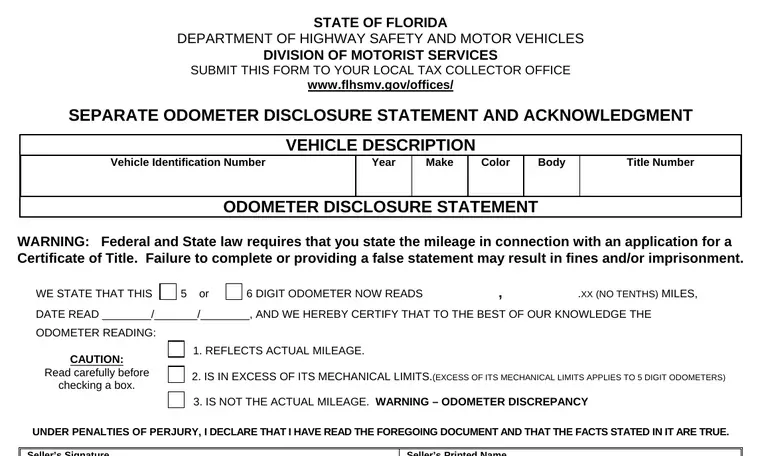
Two documents, and they are not the same thing. Take the blank HSMV 82993 from the flhsmv.gov copy so you get the revision that is current today.

Filled in

What a completed one looks like

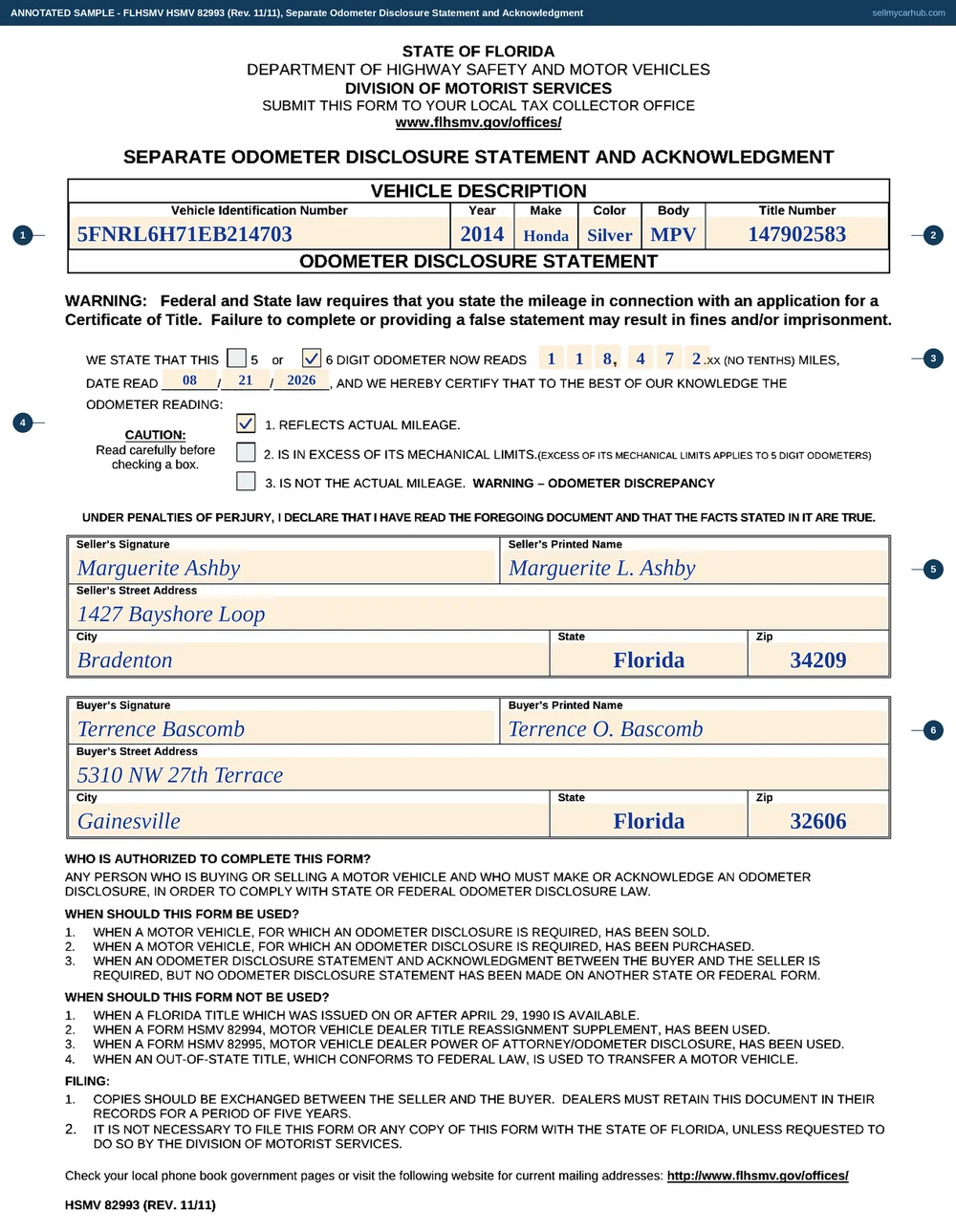
This is the actual HSMV 82993, rendered from the PDF the Florida Department of Highway Safety and Motor Vehicles publishes and completed end to end: letterhead, every field, and the blocks at the foot.

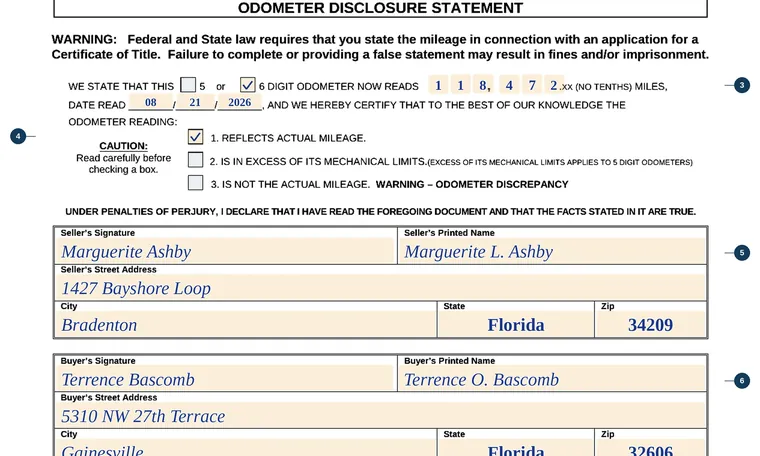
The Florida HSMV 82993 separate odometer disclosure filled in: the VIN, year, make, colour, body and title number of a 2014 Honda Odyssey across the top, a six-digit reading of 118,472 with the date read of 21 August 2026, the reflects-actual-mileage box ticked, and the seller's and buyer's printed names, signatures and full addresses in the two blocks below.
The actual HSMV 82993. Almost nobody needs it: the back of the form lists four situations in which it must not be used, and the first is a Florida title issued on or after 29 April 1990 being available. Where it earns its place is a disclosure that has to be made away from the certificate - and it is not filed with the state at all unless the department asks for it.
Field by field

Every line, in the order you meet it

  1. 1
    You fill this in

    The vehicle description strip

    VIN, year, make, colour, body and title number, along the top of the sheet.

    Watch out: Six boxes and no room for approximation. If you are reaching for this form it is usually because the certificate is not in front of you, which is exactly when a VIN gets copied from the wrong place.

  2. 2
    You fill this in

    The title number

    The Florida title number in the last box of that strip.

    Watch out: A disclosure that cannot be tied to a title record is a piece of paper with a number on it. If the title number is genuinely unavailable, that is a conversation to have at the counter before you sign anything.

  3. 3
    You fill this in

    The reading, one digit to a box

    Tick 5 or 6 digit, put the mileage in the printed boxes, and write the date you read it underneath.

    Watch out: The parenthesis beside the second statement on this form is a useful piece of plain English: in excess of its mechanical limits applies to 5 digit odometers. That is what it is for, and nothing else.

  4. 4
    You fill this in

    One of the three statements

    Reflects the actual mileage, is in excess of its mechanical limits, or is not the actual mileage - the last carrying its own warning of an odometer discrepancy.

    Watch out: The caution printed to the left says to read carefully before checking a box, and it is not decoration. This is the disclosure in its purest form: no vehicle description to hide behind, no sale details, just a number and a statement about it.

  5. 5
    You fill this in

    Seller's printed name, signature and address

    Name, signature and the full street address, city, state and zip in the upper block.

    Watch out: Both blocks want a complete address, which the certificate's own transfer section does not. That is because this sheet may end up separated from everything else, and an address is what makes it traceable.

  6. 6
    The buyer fills this in

    Buyer's printed name, signature and address

    The same four lines in the lower block. The form's title calls it an acknowledgment, and this is it.

    Watch out: Copies should be exchanged between the seller and the buyer, and a dealer has to keep theirs for five years. A private seller with no filing cabinet should still keep one somewhere findable for as long as the car is on the road.

At a glance

What goes where

On the formWhat to put in it
Vehicle descriptionIdentification number, year, make, colour, body and title number.
The warningThe federal one, printed above the disclosure: state and federal law require that you state the mileage in connection with an application for a certificate of title, and failure to complete or providing a false statement may result in fines and/or imprisonment.
The readingFive or six digit odometer, the mileage in whole miles with no tenths, and the date read.
The three certificationsReflects actual mileage. Is in excess of its mechanical limits, with a parenthesis noting that this applies to five digit odometers. Is not the actual mileage, with the words warning, odometer discrepancy printed beside it. A caution beside all three says to read carefully before checking a box.
Both sides signUnder penalties of perjury. Seller's signature, printed name and full address; buyer's signature, printed name and full address.
FilingCopies should be exchanged between the seller and the buyer. The form says it is not necessary to file this form or any copy of it with the State of Florida unless the Division of Motorist Services asks for it.

What gets this one rejected

Rules that decide whether it is accepted

Every line here was read off HSMV 82993 (Rev 11/11) itself — the PDF is here — and off the Florida Department of Highway Safety and Motor Vehicles pages. This is plain-language help with a form, not legal advice, and where our wording and the agency's differ, theirs governs.

Back to all Florida seller paperwork, or what selling a car in Florida involves.

Want the paperwork handled instead?

Get My Instant Offer → Online · about 2 minutes · free

Or send the details — we'll come to you

Not sure which mileage box applies to your car? Tell us the year and the reading and we will tell you.

or call/text (877) 405-1808