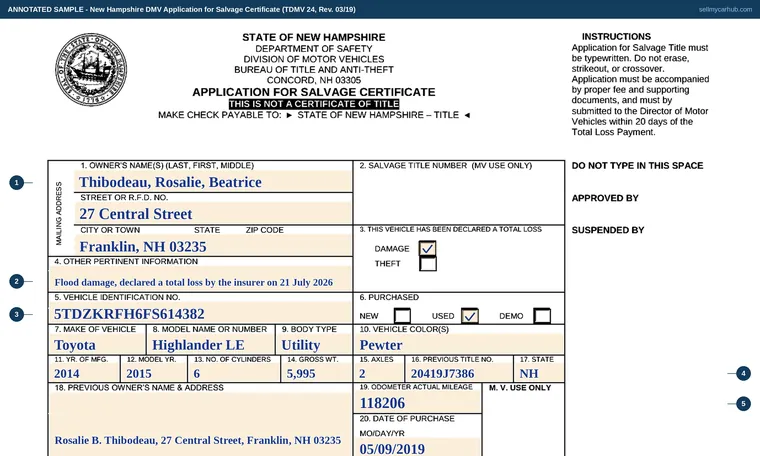
What replaces a certificate of title when a vehicle has been declared a total loss. The heading is blunt about what you end up holding - THIS IS NOT A CERTIFICATE OF TITLE - and the deadline is short: the application must be submitted to the Director of Motor Vehicles within 20 days of the total loss payment. In most cases the insurer files it, but the form is written for the owner and an owner who keeps the vehicle files it themselves.
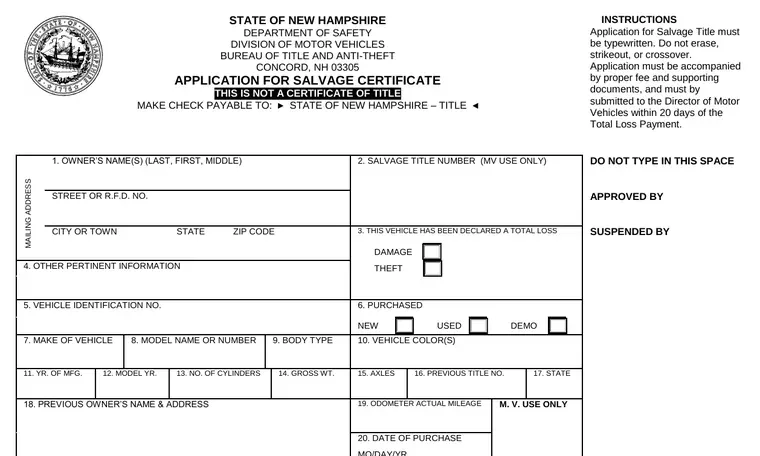
Written against TDMV 24 (Rev 03/19), issued under RSA 261:22. Selling a total-loss vehicle privately without the salvage certificate in hand is how these transactions go wrong. The buyer cannot register it - a salvage inspection has to happen first - and what you are handing over is a certificate that says on its face that it is not a certificate of title. Say what it is in the advert and be ready to show the paperwork.
Two documents, and they are not the same thing. Take the blank TDMV 24 from the dmv.nh.gov copy so you get the revision that is current today, then print our TDMV 24 guide and keep it beside you while you fill theirs in.
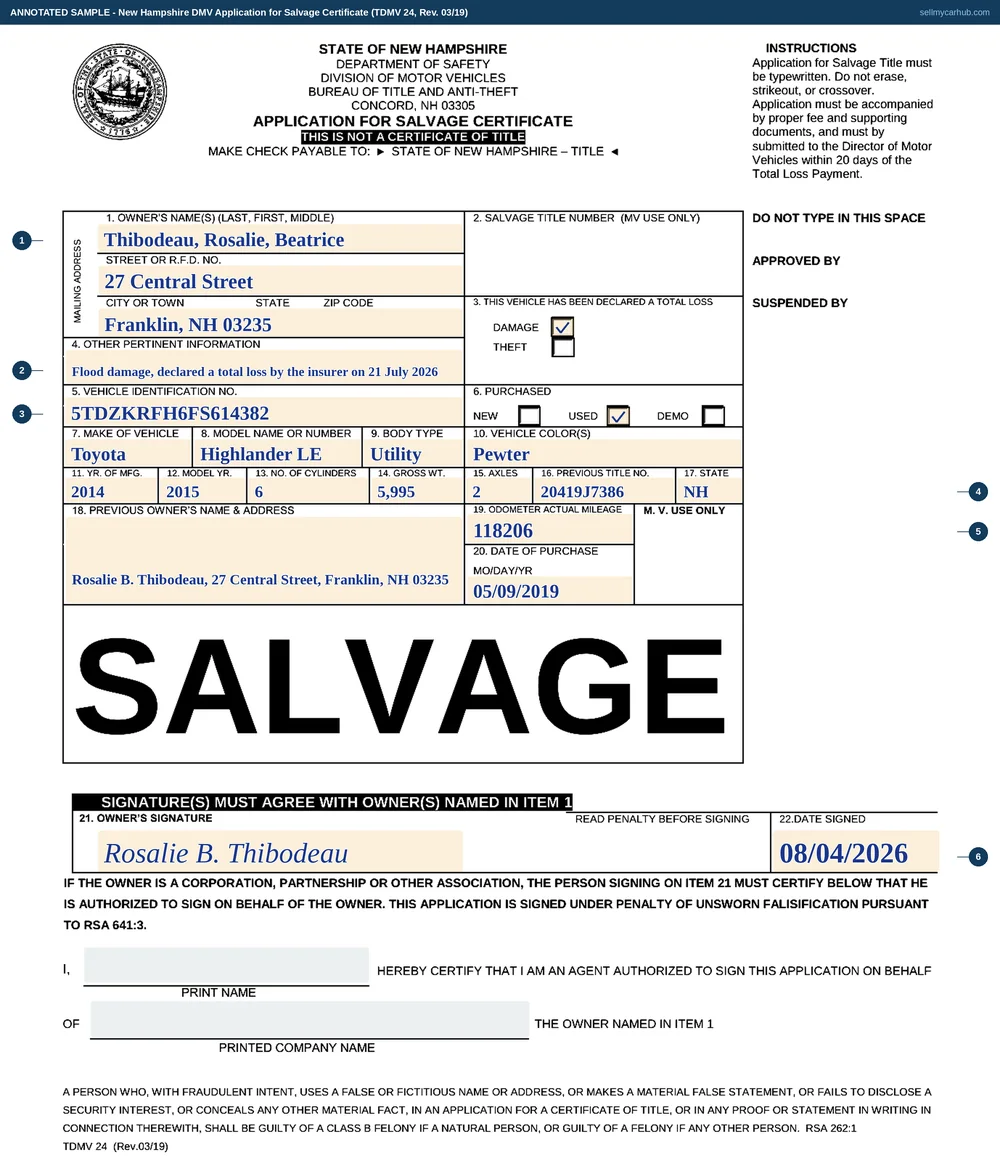
This is the actual TDMV 24, rendered from the PDF the New Hampshire Division of Motor Vehicles publishes and completed end to end: letterhead, every field, and the blocks at the foot.
The instruction block at the head of the form.
Watch out: And do not correct it in place either. Erasing, striking out and crossing over are all named as things that will get it returned.
Names last, first, middle, and the mailing address.
Watch out: Whoever signs item 21 has to be one of these names. The form says so directly above the signature line.
One of the two boxes.
Watch out: Theft here means a vehicle declared a total loss because it was stolen, not one that has been recovered undamaged - there is a separate route for that on the salvage affidavit.
The full number.
Watch out: Copy it from the previous certificate of title, then check it against the car. This record will outlive the vehicle.
The previous title number and the state that issued it.
Watch out: This is the link between the salvage record and the clean title that came before it. On a New Hampshire car it is on the certificate you are surrendering.
Actual mileage.
Watch out: Read it, even on a car that will never drive again. It is the last odometer figure the record will ever carry.
Owner's signature and the date.
Watch out: Read the penalty first - a class B felony for a material false statement in an application for a certificate of title - and note the 20-day clock started with the total loss payment, not with the accident.
| On the form | What to put in it |
|---|---|
| 1, owner's name and mailing address | Names last, first, middle, then street or R.F.D. number, city or town, state and ZIP. |
| 3, why | Two boxes: damage, or theft. |
| 4, other pertinent information | A free line. |
| 5 to 17, the vehicle | Vehicle identification number, whether purchased new, used or demo, make, model name or number, body type, colours, year of manufacture, model year, cylinders, gross weight, axles, previous title number and the state it was issued in. |
| 18 and 19 | Previous owner's name and address, and the odometer actual mileage. |
| 20, date of purchase | Month, day, year. |
| 21 and 22 | Owner's signature - and the form warns that signatures must agree with the owners named in item 1 - and the date signed. |
| The agent certification | For a corporation, partnership or other association, the person signing item 21 certifies they are authorised to sign on behalf of the owner, under penalty of unsworn falsification pursuant to RSA 641:3. |
Every line here was read off TDMV 24 (Rev 03/19) itself — the PDF is here — and off the New Hampshire Division of Motor Vehicles pages. This is plain-language help with a form, not legal advice, and where our wording and the agency's differ, theirs governs.
Back to all New Hampshire seller paperwork, or what selling a car in New Hampshire involves.