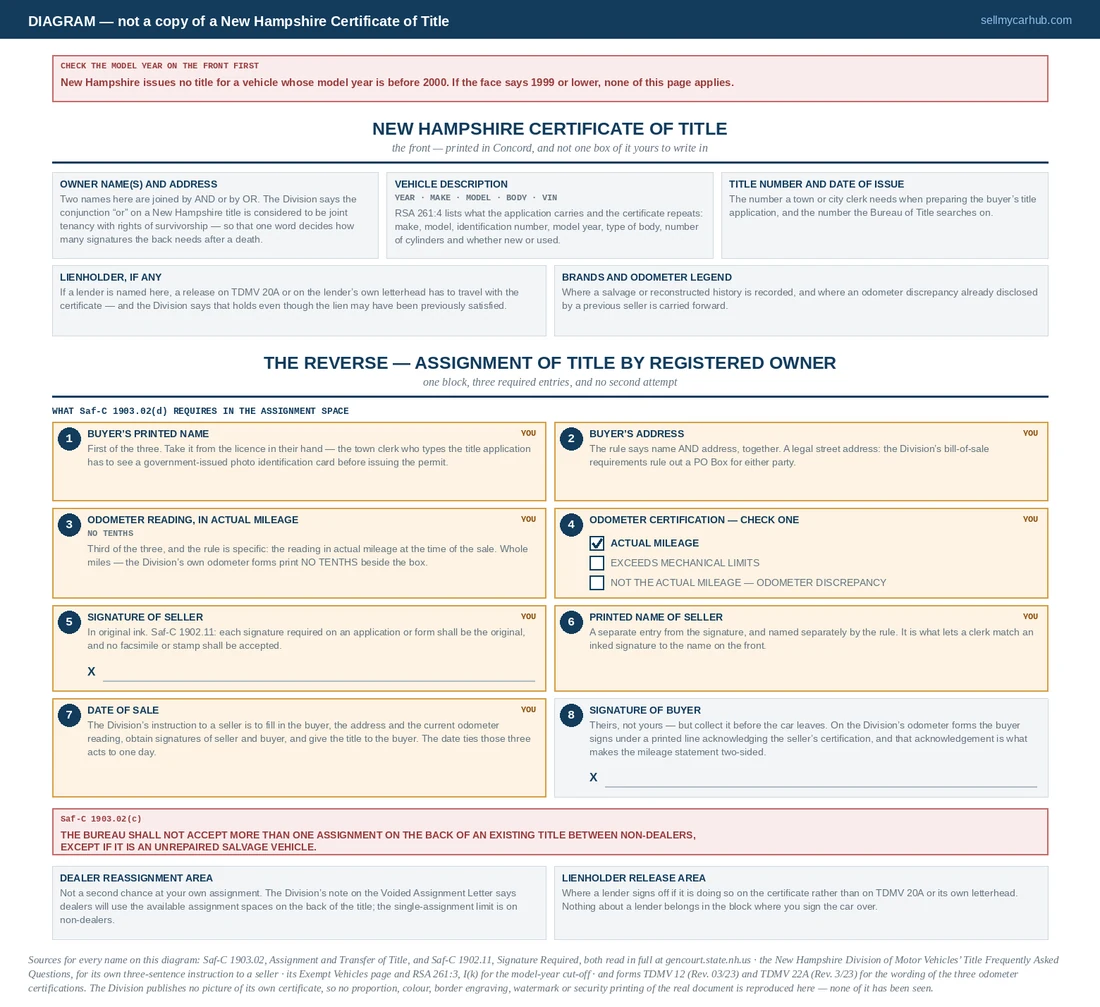
New Hampshire puts the whole private transfer in one block on the reverse of the certificate, and its administrative rule names the three things that block has to end up carrying. There is no picture of it here from the Division, because the Division does not publish one - so what follows is a diagram, labelled as a diagram, with every block name taken from the rule and from the Division's own instructions to sellers. Before you look at any of it, check the model year on the front: if the car is a 1999 or older there is normally no certificate to sign - New Hampshire titles those only when an owner asks - and unless you are holding one, this whole page is the wrong page for you.
Last updated .
Your 10 boxes
As a private seller you complete these and nothing else:
There is no blank New Hampshire title to download and no application form either. The assignment lives on the certificate that arrived in the post from the Bureau of Title, and the application that completes the transfer is typed for the buyer by a town or city clerk - the Division states at the foot of its own forms index that it may only be obtained at a clerk's office.
THE BUREAU SHALL NOT ACCEPT MORE THAN ONE ASSIGNMENT ON THE BACK OF AN EXISTING TITLE BETWEEN NON-DEALERS
The Bureau's requirement is a three-item list rather than a paragraph, and it is worth checking against the sheet before the buyer drives off: the buyer's name and address; the odometer reading in actual mileage at the time of the sale; and the seller's signature and printed name.
A diagram, not a photograph
What the Bureau of Title requires on the back of a New Hampshire certificate
The Division of Motor Vehicles publishes no specimen of its own certificate - not in a procedure manual, not in dealer training, not as an exhibit on any of the hundred-odd forms it does publish. Rather than show you somebody's real title with black bars over the parts that matter, this is drawn: the blocks are laid out in the order the Bureau's own rule lists them, every label is transcribed from that rule or from the Division's instructions to sellers, and the word DIAGRAM sits across the top so it can never be mistaken for the document itself.
Amber — you write it, in pen
Grey — not yours to fill
Numbered 1 to 8 — the blocks of the assignment, in the order the rule lists them
Click or tap the picture to open it full size.
Two things on this diagram are worth more than the rest of it. The odometer strip is a positive certification - one of the three boxes has to be ticked, and ACTUAL MILEAGE is a box rather than a default. And there is only one owner's assignment. The Bureau's rule allows exactly one between non-dealers, so a crossed-out entry is not a false start, it is a form that now needs a Voided Assignment Letter behind it.
A real one, filled in
The nearest thing New Hampshire publishes to a picture of the transfer
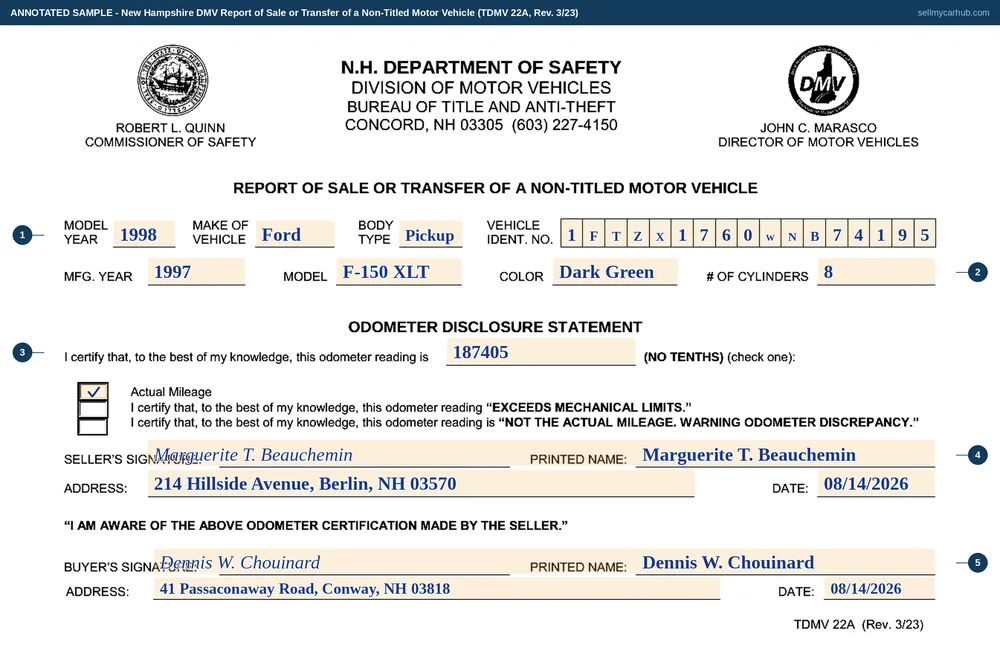
The Division does publish one document that carries the whole of a private transfer on a single sheet, and it is fillable: TDMV 22A, the report of sale the seller completes for a vehicle the state does not title. Every element of the certificate's assignment is on it - the buyer, the address, the odometer strip with its three boxes, both signatures and both dates - so this is what the block on the back of a certificate is asking you for, shown on paper the agency actually prints.
Click or tap the picture to open it full size.
Read the two halves of the bottom of this form against each other. The seller certifies the odometer reading. The buyer signs under a printed sentence saying they are aware of that certification - which is what makes the buyer's signature worth collecting before the car leaves, rather than something to chase afterwards.
Step by step
Every box, in the order you meet it
1
You fill this in
Check the model year before you touch the pen
The front of the certificate carries the model year. If it reads 1999 or lower, stop - New Hampshire does not title those and there should not be a certificate in your hand at all.
Watch out: It happens more than you would think, because a 1999-or-older car may be titled at the owner's request and a few were. If you do hold one, it is still the proof of ownership and it still gets assigned; if you do not, the buyer needs a bill of sale and your old registration instead.
2
You fill this in
The buyer's printed name
First item on the Bureau's list of what the assignment space shall contain, and it goes in your handwriting rather than theirs.
Watch out: Take it from the licence in their hand rather than from the text messages you have been swapping. The clerk who types the title application is matching this name to a photo identification card, because the statute requires them to see one before they issue the permit.
3
You fill this in
The buyer's address
Second item on the same list: name and address, together. Street, town, state and ZIP.
Watch out: It has to be a real street address. The Division's bill-of-sale requirements spell out the same rule for the parallel document - name, signature and legal address, no PO Box - and there is no reason to think the certificate is treated more loosely.
4
You fill this in
The odometer reading, in whole miles
Third item on the list, and the rule is specific about which number: the odometer reading in actual mileage at the time of the sale.
Watch out: Miles, and no tenths - the Division's own odometer forms print NO TENTHS beside the box. Read it off the dashboard on the day, not off the advert you wrote a fortnight ago.
5
You fill this in
Tick one of the three odometer boxes
ACTUAL MILEAGE, EXCEEDS MECHANICAL LIMITS, or NOT THE ACTUAL MILEAGE - WARNING, ODOMETER DISCREPANCY.
Watch out: This is where New Hampshire differs from most states. ACTUAL MILEAGE is a box you tick, not a default you fall into by leaving the others alone, and a strip with a number in it and no box ticked is an incomplete certification.
6
You fill this in
Sign, and print your name beside it
The last item on the Bureau's list, and it is two entries rather than one: the seller's signature and printed name.
Watch out: In ink, in your own hand. Each signature required on an application or form shall be the original, and no facsimile or stamp of a signature shall be accepted - which catches out anybody selling a car that is registered to a business.
7
You fill this in
Everyone named on the front signs
Two names on the face of the certificate means two signatures in the assignment.
Watch out: The exception is a death, and it is generous: where the vehicle was used for family purposes, the surviving spouse's signature and a copy of the death record are enough on their own. Two owners joined by the word 'or' are treated the same way whether or not they were married.
8
You fill this in
Hand the certificate over
The assigned certificate goes with the car. There is nothing to post to Concord and no copy kept for you.
Watch out: Photograph both faces first. That photograph is your only record of the mileage you disclosed and the date you disclosed it on, and section 14 of the chapter protects the owner who has delivered possession and complied - so it is worth being able to show that you did.
9
You fill this in
Take the plates off before they drive away
The registration expired the instant ownership transferred, so the plates are covering nothing and no expired number plates shall be displayed.
Watch out: The buyer is not stranded. A New Hampshire resident buys a 20-day temporary plate for $20.00 with a photocopy of the signed title, and a non-resident buys a 20-day in-transit registration on the same terms.
10
You fill this in
Keep the expired registration certificate
The statute tells you to: retain the expired certificate of registration in order to obtain transfer credit.
Watch out: Take it to your town or city clerk with proof of ownership of the next car and the credit comes off that registration. If the new fee is the same or less you pay nothing more; if it is greater you pay only the difference.
Before the pen
Six habits worth having before the pen touches the back of the certificate
Six habits, and the first one exists because this block has no second attempt.
One attempt, in ink
There is one owner's assignment on a New Hampshire certificate and the Bureau will not take a second. A mistake means a Voided Assignment Letter signed under penalty of unsworn falsification, plus an assignment form the Division does not publish.
Never leave the buyer's name out
Their name and address are the first thing the rule asks the assignment space to contain. A certificate handed over blank leaves a car registered in your name that somebody else is driving.
Tick a mileage box, do not just write a number
Three boxes, one of which is ACTUAL MILEAGE. New Hampshire asks you to certify positively rather than to decline to make an exception.
Print your name as well as signing it
The rule names both, separately, and a clerk matching an inked signature against the face of the certificate needs the printed version to do it.
No stamps, no photocopies, no scans
Each signature required on an application or form shall be the original. This is the rule that catches a car registered to a business whose owner signs everything with a stamp.
Do not promise a title for a car that never had one
Anything of model year 1999 or earlier is outside the title law here. What that buyer needs from you is a bill of sale and the registration certificate out of your glovebox.
The ink rule is the Division's own: “THE BUREAU SHALL NOT ACCEPT MORE THAN ONE ASSIGNMENT ON THE BACK OF AN EXISTING TITLE BETWEEN NON-DEALERS, EXCEPT IF IT IS AN UNREPAIRED SALVAGE VEHICLE”
— Saf-C 1903.02, Assignment and Transfer of Title.
Check your source
Three New Hampshire myths that cost real money
Three things said with total confidence about selling a car in New Hampshire. Each is wrong, each has the state's own source under it, and each of them costs somebody either a $35.00 duplicate-title fee, a wasted trip to Concord or a buyer who cannot register the car.
"It's a 1997 truck, so I'll just get a duplicate title for it."
There is almost certainly nothing to duplicate. New Hampshire titles a vehicle whose manufacturer's model year is before 2000 only when its owner asks for one, and the duplicate application says on its own face: if the vehicle model year is 1999 or older, the vehicle is Exempt and a Title may not be issued. What that buyer actually needs is a bill of sale carrying everything RSA 261:148 lists, and proof of the vehicle identification number - which is normally your old registration certificate, current or expired. Throw that certificate away and you have left them needing a VIN verification from an inspection station, a dealer or a police officer instead.
"Leave the plates on - the buyer needs them to drive it home."
They cannot use them and you should not offer them. RSA 261:66 expires the registration on transfer of ownership and RSA 261:77 forbids displaying expired plates, so the metal on that car is covering nobody from the moment the money changes hands. The buyer's answer is a $20.00 twenty-day temporary plate from a DMV drop box or appointment, and yours is to keep both the plates and the expired registration certificate - because the statute makes that certificate the thing you produce to get transfer credit against your next registration.
"Print the title application off the DMV site and we'll fill it in together."
It is not there, and it is not an oversight. Title applications are prepared by a New Hampshire Town/City Clerk, a New Hampshire licensed dealer or a lending institution, and the Division puts a note at the foot of its own forms index saying applications for a certificate of title may only be obtained at your town or city clerk's office. The administrative rules go further and name the versions the Bureau accepts, TDMV 23 and TDMV 23B, neither of which is published either. Your buyer is going to a clerk whatever the two of you do at the kerb; what you can give them is a properly completed assignment and, if the car is old enough, your registration certificate.
Six rules about who signs the back of a New Hampshire certificate, and only one of the signatures is yours:
Every owner printed on the front of the certificate
If the face names two people, both of them belong in the seller's row. The Division applies the same rule to the duplicate title application in as many words - if the vehicle is jointly owned, all owners' signatures are required.
Your signature and your printed name, as two separate things
The rule asks for the seller's signature and printed name, and the printed name is not decoration. It is what lets a clerk match an inked signature to the name on the face of the certificate.
Nobody by stamp, and no photocopied signature
Each signature required on an application or form shall be the original. No facsimile or stamp of a signature shall be accepted. Businesses that sign everything with a stamp have to find a pen for this one.
Somebody holding a power of attorney, where an owner truly cannot be there
New Hampshire publishes no power-of-attorney form of its own for this, but it does say what it will accept: any power of attorney which is accepted by the bureau in accordance with applicable law shall be notarised. That is the only notary in an ordinary transfer.
The surviving spouse alone, where the other owner has died
Where a certificate has been issued and the vehicle was used for family purposes, the signature of the surviving spouse on the certificate and a copy of the death record shall be deemed valid and sufficient for the proper transfer. Two owners joined by 'or' work the same way without needing to be married.
Nobody from the bank, in this block
A lienholder releases its interest on its own form or on its own letterhead, and that release travels with the certificate rather than being written into your assignment.
Once it is signed
Signing the back of the certificate is most of it. The rest is that the plates on the car are now attached to an expired registration, and the certificate in your glovebox that proves it is worth money against your next car.