Sell My Car Hub

How to fill out New Hampshire TDMV 12

The separate mileage certificate, for the two occasions the rule names: when an application for title or an assignment of title does not contain the current odometer mileage reading, and when a discrepancy is discovered. It is a seller's form from the first line - the sentence starts 'I, [seller's printed name], certify' - and the buyer signs at the foot to acknowledge what the seller has said.
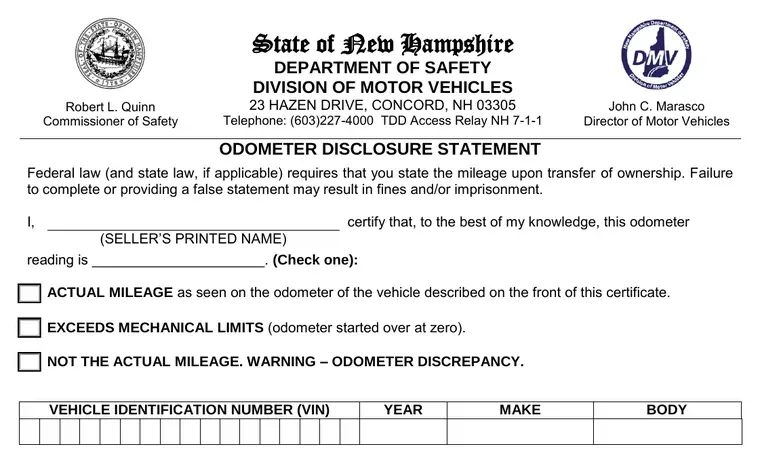
Written against TDMV 12 (Rev 03/23), issued under Saf-C 1903.05. Read the third box before you tick the second. 'Exceeds mechanical limits' means the odometer has run past its maximum and started again from zero. 'Not the actual mileage' is for everything else - a replaced instrument cluster, a broken odometer, a figure you cannot vouch for - and it carries the words WARNING, ODOMETER DISCREPANCY into the record for the rest of the vehicle's life. Ticking the wrong one of those two is not a small error.

Two documents, and they are not the same thing. Take the blank TDMV 12 from the dmv.nh.gov copy so you get the revision that is current today, then print our TDMV 12 guide and keep it beside you while you fill theirs in.

Filled in

What a completed one looks like

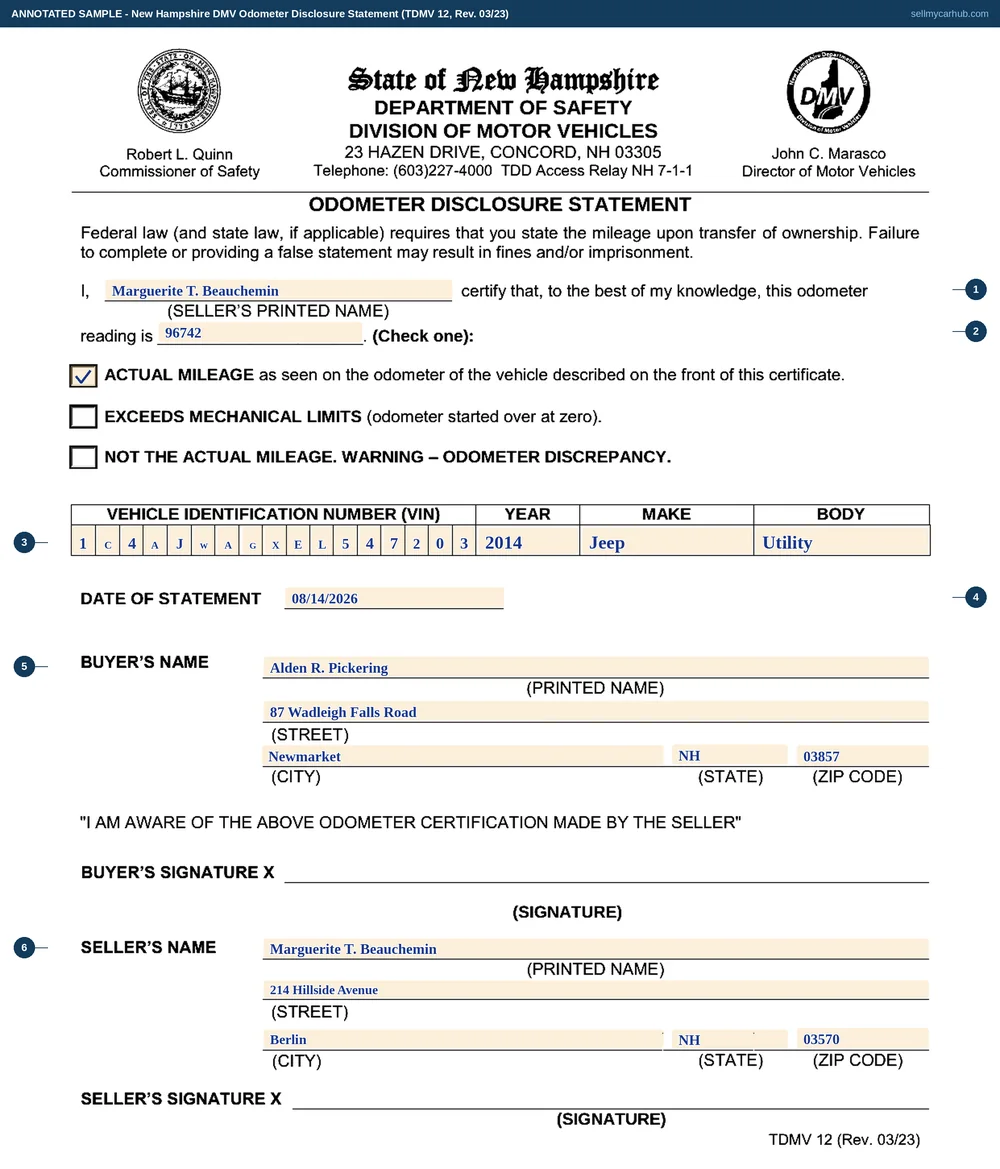
This is the actual TDMV 12, rendered from the PDF the New Hampshire Division of Motor Vehicles publishes and completed end to end: letterhead, every field, and the blocks at the foot.

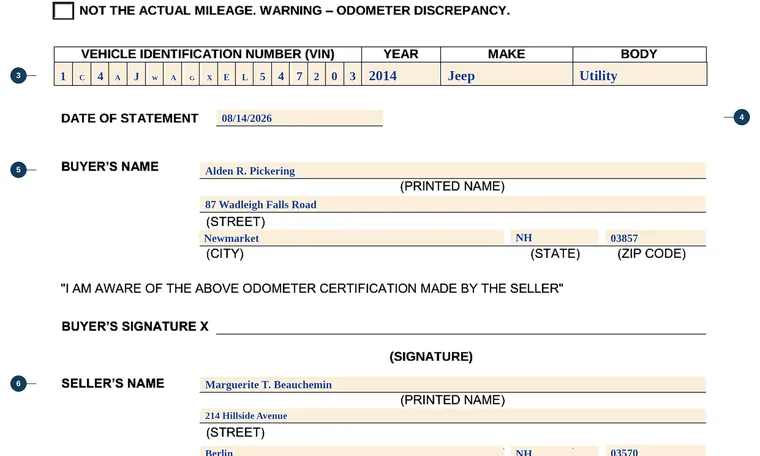
The New Hampshire Odometer Disclosure Statement, form TDMV 12, filled in as an annotated sample. The certifying sentence names Marguerite T. Beauchemin as the seller and gives the reading as 96742, with the ACTUAL MILEAGE box ticked below it. The vehicle identification number of a 2014 Jeep Wrangler is written one character per cell across a seventeen-cell comb with the year, make and body alongside. The buyer's block names Alden R. Pickering of Newmarket and the seller's block names Marguerite T. Beauchemin of Berlin, each with a street, city, state and ZIP and a signature line.
The seller's name appears twice on this form and the two appearances do different jobs. At the top it is inside the sentence being certified; at the foot it is the address block. Leave the top one blank and there is nobody certifying anything, however neatly the rest is filled in.
Field by field

Every line, in the order you meet it

  1. 1
    You fill this in

    Your printed name, in the sentence

    The first box on the form sits inside the words 'I, ______, certify that, to the best of my knowledge, this odometer reading is'.

    Watch out: Print it as it appears on the certificate of title. A shortened first name here and a full one on the title is the kind of mismatch that sends paperwork back from Concord.

  2. 2
    You fill this in

    The reading

    Whole miles, read off the dashboard on the day of the sale.

    Watch out: Take a photograph of the dashboard at the same time. It costs nothing and it is the only evidence you will ever have of what the odometer said when you wrote this.

  3. 3
    You fill this in

    Tick one of the three

    Actual mileage, exceeds mechanical limits, or not the actual mileage.

    Watch out: Only one. Two ticked boxes is a contradiction on a document that carries a federal warning about false statements.

  4. 4
    You fill this in

    The vehicle identification number

    One character per cell across the comb, with the year, make and body alongside.

    Watch out: Seventeen cells for a seventeen-character number. A pre-1981 vehicle has a shorter one, and it goes in from the left with the spare cells left empty rather than padded.

  5. 5
    You fill this in

    Date of statement

    The date you are certifying, not the date you printed the form.

    Watch out: It should match the date on the assignment or the bill of sale. Two different dates for one sale is a question somebody at the counter will ask.

  6. 6
    You fill this in

    Your address block

    Printed name, street, city, state and ZIP, and your signature.

    Watch out: A legal street address rather than a PO Box - the Division applies that rule to the bill of sale and there is no reason to expect it to be looser here.

  7. 7
    The buyer fills this in

    The buyer's block

    Their printed name, address and signature, under the acknowledgement line.

    Watch out: The line above their signature is the whole point of their block: they are recording that they were told the mileage, which is what protects you if the reading is ever questioned.

At a glance

What goes where

On the formWhat to put in it
Seller's printed nameWritten into the middle of the certifying sentence rather than at the foot of the form, which is why the box sits where it does.
The reading, and one of three boxesA reading box, then actual mileage as seen on the odometer of the vehicle described on the front of this certificate; exceeds mechanical limits, odometer started over at zero; or not the actual mileage, warning odometer discrepancy.
Vehicle identification numberA seventeen-cell comb, one character per cell, with year, make and body alongside it.
Date of statementThe date the certification is made, which is the date of the sale rather than the date the form was printed.
Buyer's blockPrinted name, street, city, state, ZIP and signature, under the printed line 'I AM AWARE OF THE ABOVE ODOMETER CERTIFICATION MADE BY THE SELLER'.
Seller's blockPrinted name, street, city, state, ZIP and signature, in the matching block underneath.

What gets this one rejected

Rules that decide whether it is accepted

Every line here was read off TDMV 12 (Rev 03/23) itself — the PDF is here — and off the New Hampshire Division of Motor Vehicles pages. This is plain-language help with a form, not legal advice, and where our wording and the agency's differ, theirs governs.

Back to all New Hampshire seller paperwork, or what selling a car in New Hampshire involves.

Want the paperwork handled instead?

Get My Instant Offer → Online · about 2 minutes · free

Or send the details — we'll come to you

If the odometer stopped years ago and you are not sure what you can honestly certify, that is a conversation worth having before the car is advertised, not after.

or call/text (877) 405-1808