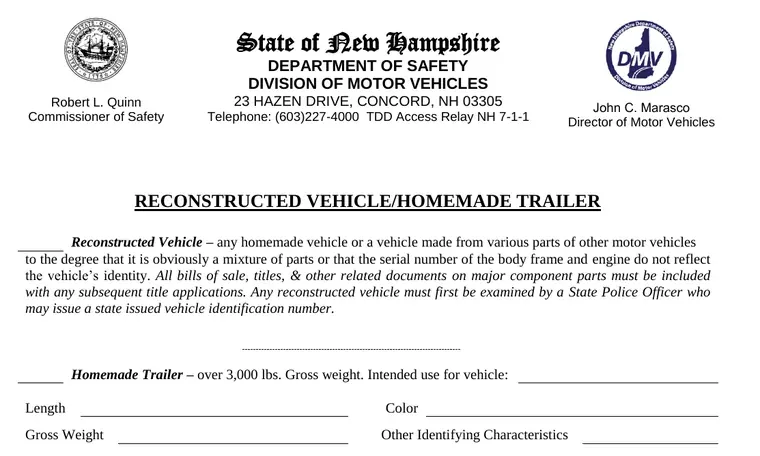
For a vehicle that is not really any one vehicle any more, and for a trailer somebody built in a shed. The Division's own definition on the form is worth reading before deciding whether it applies: a reconstructed vehicle is any homemade vehicle, or a vehicle made from various parts of other motor vehicles to the degree that it is obviously a mixture of parts or that the serial number of the body frame and engine do not reflect the vehicle's identity.
Written against TDMV 112 (Rev 03/22), issued under RSA 262:1 and Saf-C 1900. Selling a reconstructed vehicle means selling its paperwork trail as well. The requirement that every major component part's bill of sale or title accompany any subsequent title application does not expire when you sell - it lands on the buyer, and a buyer who cannot produce the receipts for the parts is a buyer who cannot title the vehicle. Hand the folder over with the keys.
Two documents, and they are not the same thing. Take the blank TDMV 112 from the dmv.nh.gov copy so you get the revision that is current today, then print our TDMV 112 guide and keep it beside you while you fill theirs in.
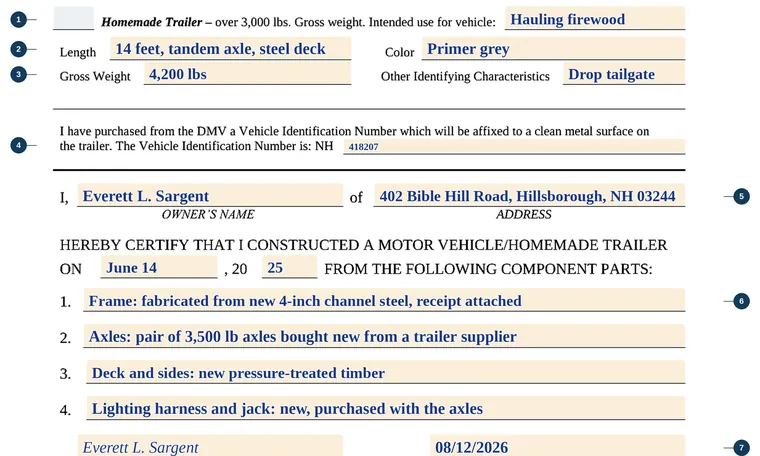
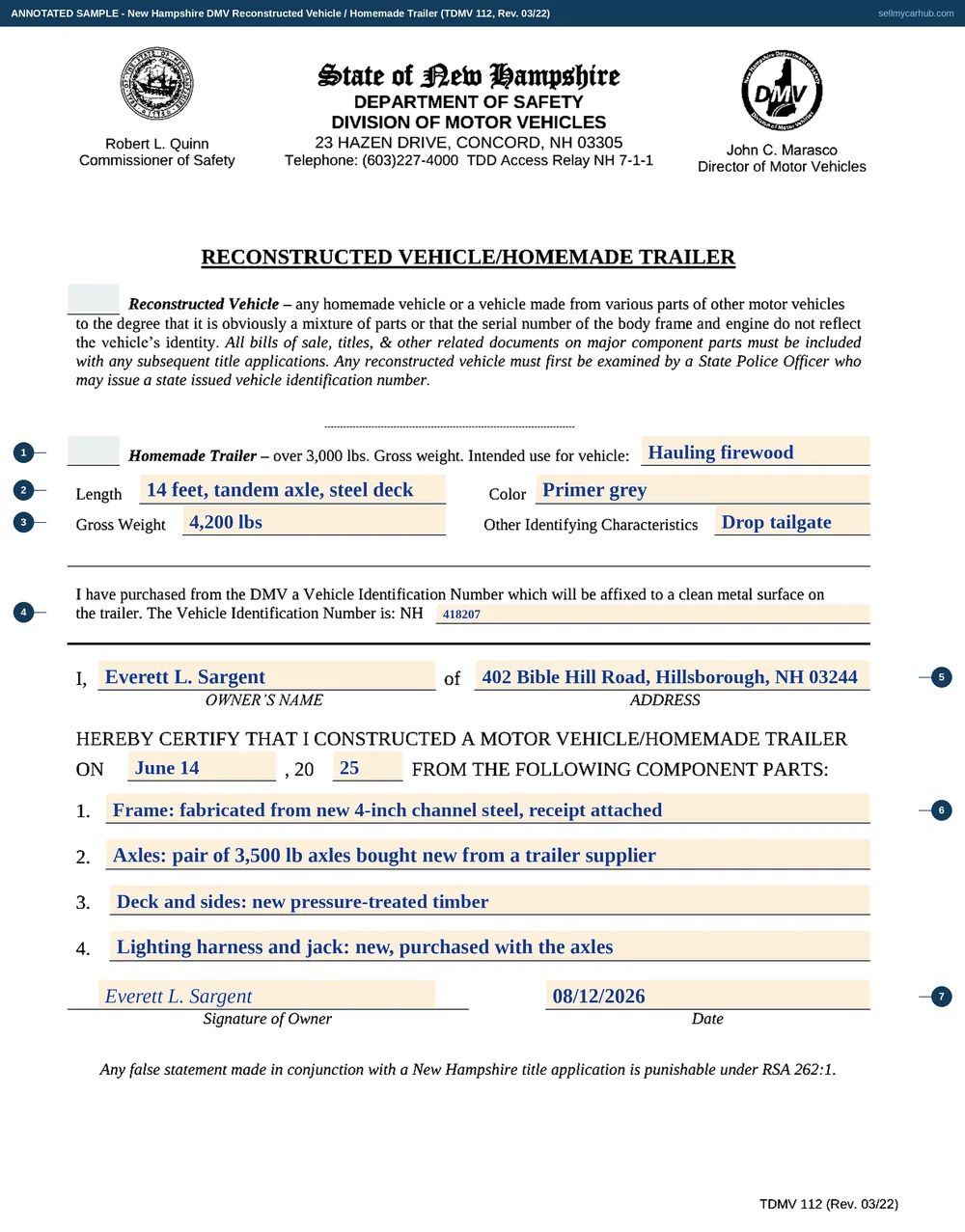
This is the actual TDMV 112, rendered from the PDF the New Hampshire Division of Motor Vehicles publishes and completed end to end: letterhead, every field, and the blocks at the foot.
A reconstructed vehicle, or a homemade trailer over 3,000 pounds.
Watch out: Read the printed definition. 'Obviously a mixture of parts' is a lower bar than most rebuilders assume, and so is a frame number that no longer reflects the vehicle's identity.
Length, colour, gross weight and other identifying characteristics.
Watch out: Gross weight decides whether the trailer is titled at all - under 3,001 pounds and it is exempt.
The number purchased from the DMV, written after the printed NH, and affixed to a clean metal surface.
Watch out: Buy it first. The certification is in the past tense - it says you have purchased the number - so this line is filled in after the visit, not before.
The single line running across the middle of the form.
Watch out: Match it to your licence. The whole document is a personal certification about work you did.
The date you built it.
Watch out: An honest approximation stated as one is better than a precise invention on a form whose false statements are punishable under RSA 262:1.
Four numbered lines.
Watch out: Name them specifically - the donor vehicle, the axle, the frame, whatever they are - and keep the receipts with the form.
A State Police officer examines a reconstructed vehicle and may issue a state identification number.
Watch out: This is a step, not a formality, and it comes before any title application. Book it early.
| On the form | What to put in it |
|---|---|
| Which it is | The reconstructed-vehicle definition, then a homemade trailer block for trailers over 3,000 pounds gross weight, with intended use. |
| Trailer description | Length, colour, gross weight and other identifying characteristics. |
| The assigned number | A certification that the owner has purchased a vehicle identification number from the DMV which will be affixed to a clean metal surface on the trailer, and a box for that number after the printed letters NH. |
| Owner's name and address | 'I ______ of ______' across one line. |
| The build | A certification that the owner constructed the motor vehicle or homemade trailer on a stated date, from four numbered component parts. |
| Signature and date | The owner's, at the foot. |
Every line here was read off TDMV 112 (Rev 03/22) itself — the PDF is here — and off the New Hampshire Division of Motor Vehicles pages. This is plain-language help with a form, not legal advice, and where our wording and the agency's differ, theirs governs.
Back to all New Hampshire seller paperwork, or what selling a car in New Hampshire involves.