Sell My Car Hub

How to fill out Hawaii CS-L(MVR)202

Some cars are not worth selling, and on Oahu the county will take one off your hands: its junk vehicle programme is free to residents and waives all back registration and fees, which on a car that has sat for years is the largest number in the conversation. This is the statement that does it, and it is a door that only opens one way. You certify that the vehicle has been junked, that it is incapable of safe operation for use on the public highway or has no resale value except as a source of parts or scrap, and - in the form's own capitals - that by junking this vehicle, the vehicle shall never again be titled or registered. The endorsed certificate of title goes in with it, for cancellation.
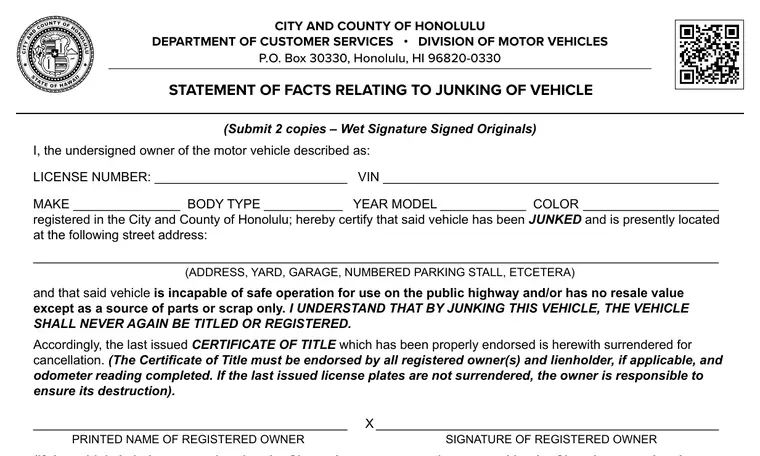
Written against CS-L(MVR)202 (06/2026), issued under City and County of Honolulu Department of Customer Services, Division of Motor Vehicles, surrendering the certificate of title for cancellation. Weigh this against a sale before you sign it, not after. The county's back-registration answer for an ordinary sale is that arrears are a matter for the buyer and seller to resolve, and a buyer taking on a delinquent car is assessed for the prior years it went unregistered. Junking wipes those years for you - and wipes the vehicle from the register permanently in the same stroke.

Two documents, and they are not the same thing. Take the blank CS-L(MVR)202 from the www4.honolulu.gov copy so you get the revision that is current today, then print our CS-L(MVR)202 guide and keep it beside you while you fill theirs in.

Filled in

What a completed one looks like

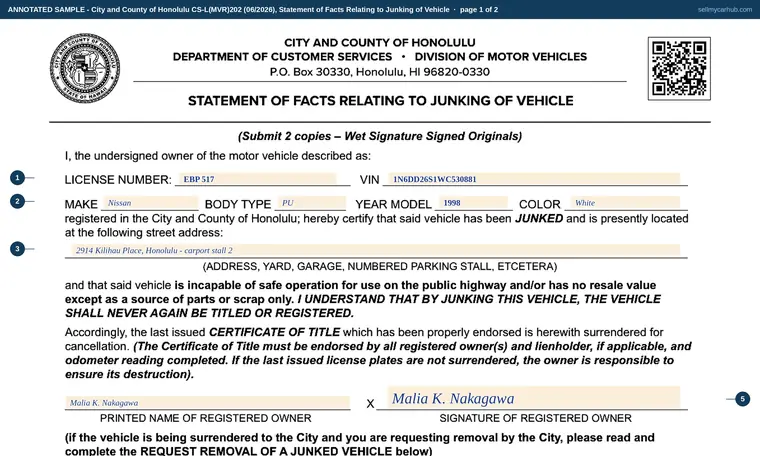
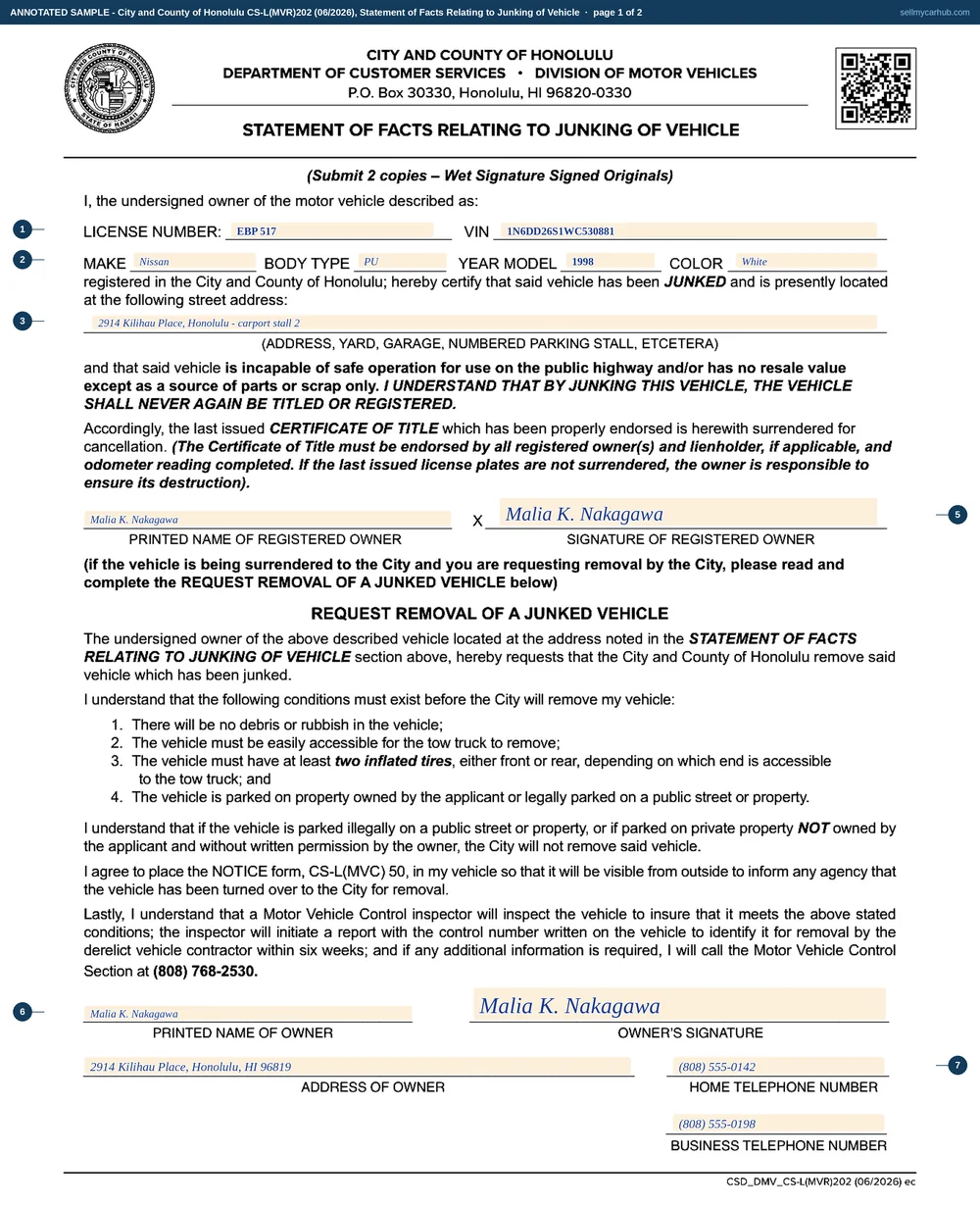
This is all 2 pages of the actual CS-L(MVR)202, rendered from the PDF the City and County of Honolulu Division of Motor Vehicle, Licensing and Permits publishes and completed end to end: letterhead, every field, and the blocks at the foot.

A completed Honolulu Statement of Facts Relating to Junking of Vehicle, form CS-L(MVR)202. The license number is EBP 517 with vehicle identification number 1N6DD26S1WC530881, make Nissan, body type PU, year model 1998, colour White. The vehicle is junked at 2914 Kilihau Place, Honolulu, carport stall 2, and the registered owner Malia K. Nakagawa has signed. The request for removal beneath repeats her name, signature, address and two telephone numbers.
Page 1 of 2. The statement of facts completed for a pickup that has stopped running, with the request for the City to remove it filled in underneath.
A completed Honolulu Statement of Facts Relating to Junking of Vehicle, form CS-L(MVR)202. The license number is EBP 517 with vehicle identification number 1N6DD26S1WC530881, make Nissan, body type PU, year model 1998, colour White. The vehicle is junked at 2914 Kilihau Place, Honolulu, carport stall 2, and the registered owner Malia K. Nakagawa has signed. The request for removal beneath repeats her name, signature, address and two telephone numbers.
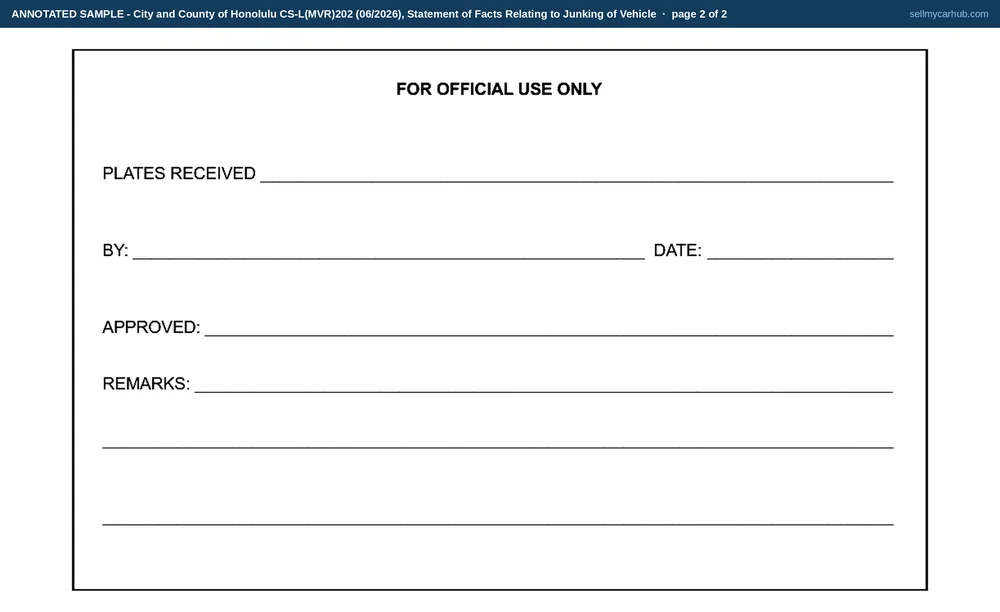
Page 2 of 2. Page two, shown unmarked: the official-use block where the county records the plates it received and approves the removal.
Field by field

Every line, in the order you meet it

  1. 1
    You fill this in

    License number and VIN

    The identifying pair. The VIN is what the county cancels the record against, so it matters more here than the plate does.

    Watch out: If the plate has already gone missing, the VIN alone will find the record. Say so in the removal request rather than leaving the plate box blank without explanation.

  2. 2
    You fill this in

    Make, body type, year model and colour

    Four boxes on one line. Colour is asked for here because an inspector has to find the vehicle at the address you give.

    Watch out: Describe the car as it looks now, not as the registration describes it. A resprayed vehicle that does not match its own paperwork wastes the inspector's visit.

  3. 3
    You fill this in

    Where the vehicle is

    A street address, and the county's own examples tell you how precise to be: address, yard, garage, numbered parking stall.

    Watch out: A numbered stall or a named carport is what turns an address into a location. An inspector who cannot identify the vehicle cannot write the control number on it.

  4. 4
    You fill this in

    The certification itself

    Not a field - the printed statement you are signing. That the vehicle is incapable of safe operation or has no resale value except as parts or scrap, and that it shall never again be titled or registered.

    Watch out: Read the capitals before you sign. There is no undo, and a car with a buyer waiting is not a car to put through this form.

  5. 5
    You fill this in

    Printed name and signature of registered owner

    The first signature block, closing the statement of facts. Two copies with wet original signatures are required.

    Watch out: Sign both copies by hand. Printing one signed sheet twice is exactly what the instruction under the heading exists to prevent.

  6. 6
    You fill this in

    The request for removal, if you want it

    The lower half. Four conditions are printed above it, from no rubbish in the vehicle to at least two inflated tires on the accessible end.

    Watch out: Skip this half entirely if you are having the vehicle collected privately. Signing it commits you to conditions you may not be planning to meet.

  7. 7
    You fill this in

    Name, signature, address and telephone numbers

    The removal request's own block, with home and business telephone numbers in separate boxes.

    Watch out: Give a number that will be answered. The inspector's visit and the contractor's six-week window both depend on someone being reachable.

  8. 8
    Somebody else fills this in

    Page two, official use only

    Plates received, by whom and on what date, approved by, and a remarks panel. The county completes all of it.

    Watch out: The plates-received line is the county's record that you handed the plates in. If you did not, the responsibility for destroying them is yours.

At a glance

What goes where

On the formWhat to put in it
License Number and VINThe identifying pair at the head of the sheet.
Make, Body Type, Year Model and ColorFour boxes across one line. Colour appears here and on no other form in the seller's set.
Street address where the vehicle is junkedOne long rule, with the county's own list of what counts printed beneath it: address, yard, garage, numbered parking stall, etcetera.
Printed name and signature of the registered ownerThe first signature block, ending the statement of facts half of the sheet.
Request removal of a junked vehicleThe second half, used only if you want the City to tow it. Four printed conditions sit above the signature.
Printed name, signature, address and two telephone numbers of the ownerThe removal request's own block - home and business numbers in separate boxes.
For official use onlyThe whole of page two: plates received, by whom and when, approval and remarks.

What gets this one rejected

Rules that decide whether it is accepted

Every line here was read off CS-L(MVR)202 (06/2026) itself — the PDF is here — and off the City and County of Honolulu Division of Motor Vehicle, Licensing and Permits pages. This is plain-language help with a form, not legal advice, and where our wording and the agency's differ, theirs governs.

Back to all Hawaii seller paperwork, or what selling a car in Hawaii involves.

Want the paperwork handled instead?

Get My Instant Offer → Online · about 2 minutes · free

Or send the details — we'll come to you

Before you sign a car out of existence, find out what it is actually worth: tell us what it is and where it sits, and we will make an offer on it as scrap or otherwise.

or call/text (877) 405-1808